
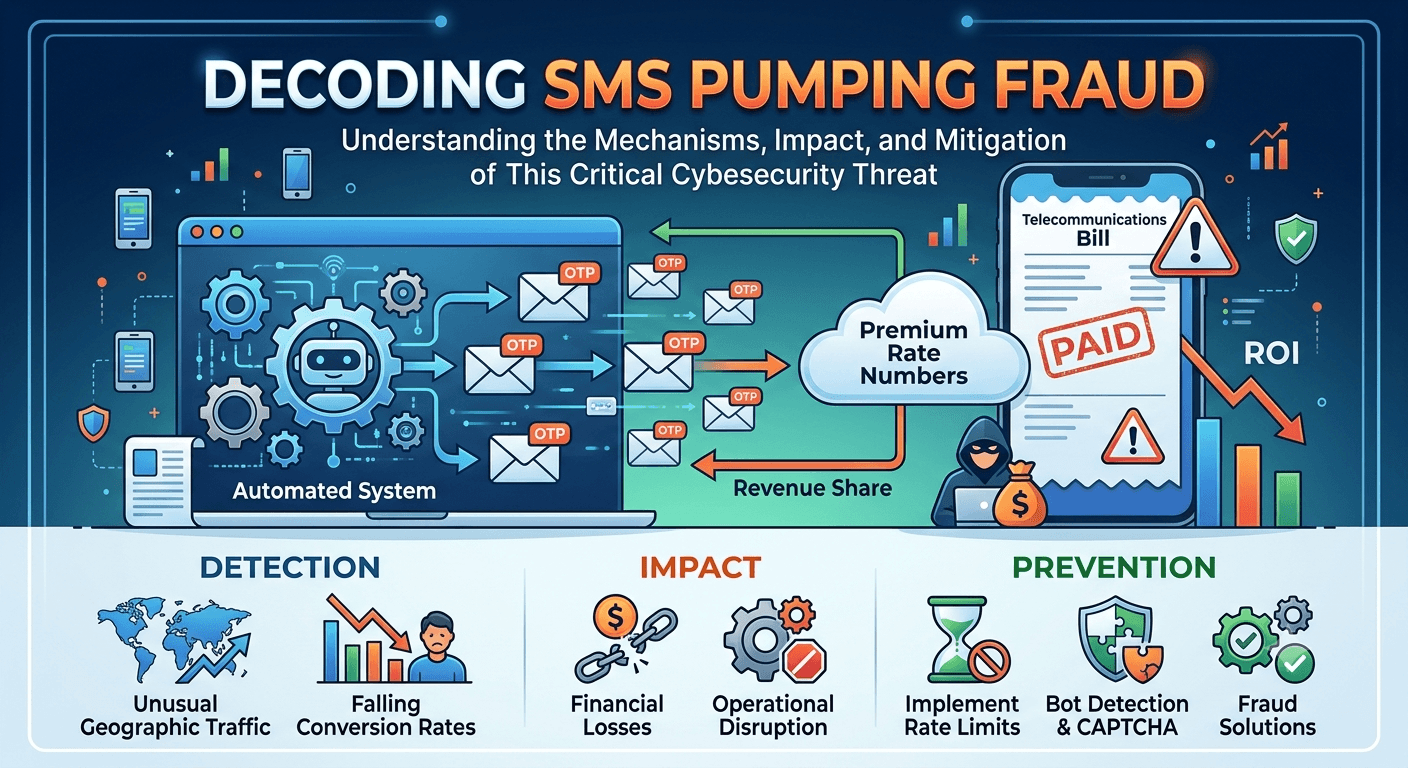
SMS pumping is a sophisticated form of fraud where cybercriminals exploit web forms to trigger large volumes of SMS messages, primarily one-time passwords (OTPs). By using automated bots, attackers enter mobile numbers into login or sign-up fields, forcing businesses to send thousands of messages to premium-rate numbers or numbers controlled by the fraudsters. This activity generates significant revenue for the attackers through revenue-sharing agreements with complicit mobile network operators. For businesses, the result is often a massive, unexpected telecommunications bill and disrupted services, making proactive detection and mitigation essential for maintaining operational integrity and financial security.
What is SMS pumping?
SMS pumping occurs when fraudsters exploit the automated messaging systemsf used by businesses to verify users or provide notifications. Most companies use Application-to-Person (A2P) messaging to facilitate secure transactions, and a staggering 89% of all international A2P SMS traffic is comprised of OTP messages. Attackers take advantage of this volume by identifying websites or mobile applications that send an SMS triggered by a user action, such as creating a new account or requesting a password reset.
The fraud is rooted in the telecommunications ecosystem where certain operators pay for inbound traffic. Fraudsters collaborate with these rogue or negligent mobile network operators to inflate the number of messages being sent to specific ranges of phone numbers. Because the business pays for the delivery of these messages regardless of whether they reach a real person, the attackers and their partners profit from every single message sent. This type of attack is also frequently referred to as artificial inflation of traffic or AIT fraud.
How does SMS pumping work?
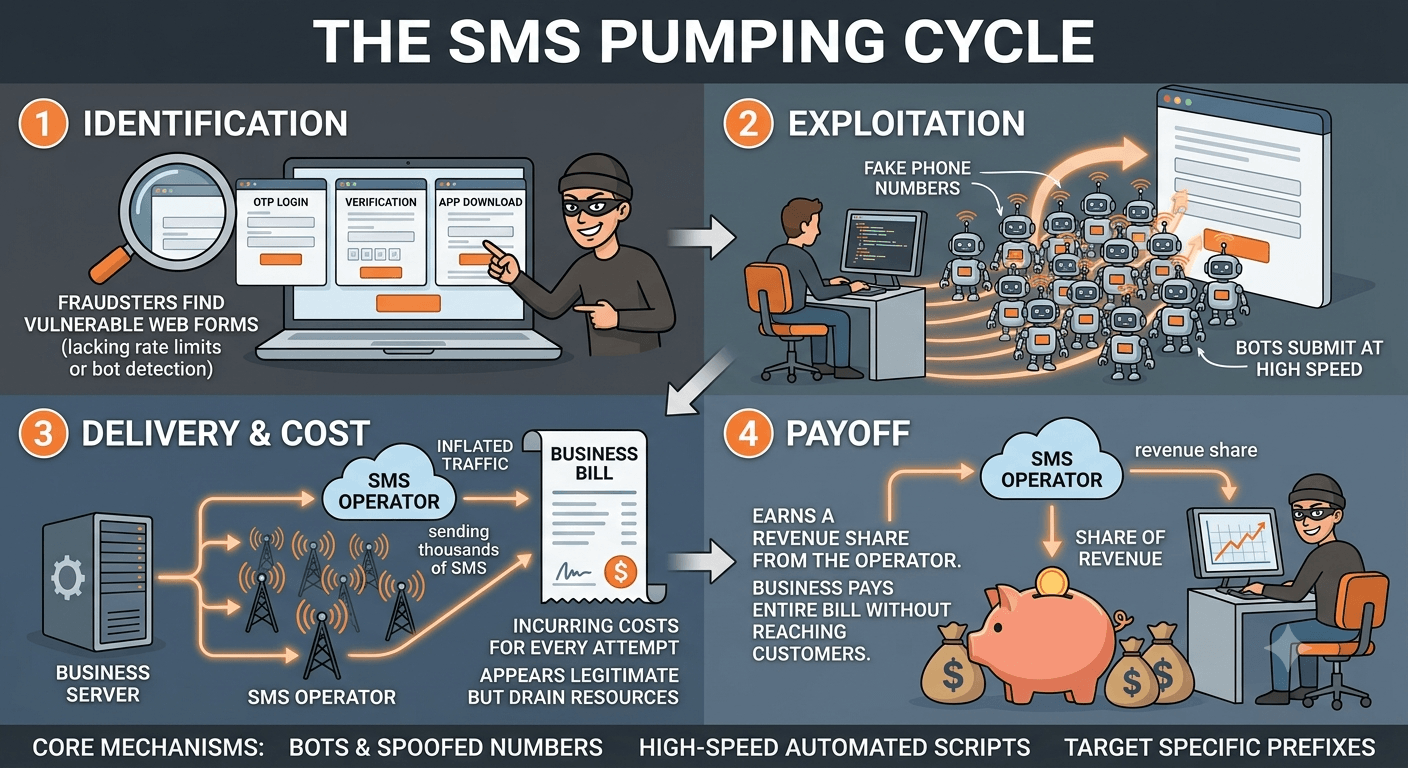
The core mechanism of SMS pumping involves the exploitation of SMS triggers built into standard web forms and mobile applications. Fraudsters program bots to submit fake or spoofed phone numbers into input fields that trigger an SMS, such as OTP login forms, account verification pages, or app download links. From the perspective of the business, these requests appear to be legitimate user interactions, but in reality, they are automated scripts running at high speed to drain resources.
The cycle begins when fraudsters identify a vulnerable web form that lacks sufficient protection like rate limiting or bot detection. Once the target is acquired, the bots flood the form with phone numbers belonging to specific prefixes that the fraudster has an interest in. The business then automatically sends thousands of SMS messages to those numbers, incurring costs for every attempt. The fraudster earns a revenue share from the SMS operator for this inflated traffic, while the business pays the entire bill without reaching a single legitimate customer.
How does SMS pumping impact businesses?
The scale of financial damage caused by these attacks is immense, with estimates suggesting that $1.15 billion was lost to SMS pumping in 2023 alone. This figure highlights how quickly costs can spiral out of control when automated systems are left unprotected. Beyond the direct financial hit, businesses often face an 85% rise in international SMS costs, a trend observed between 2020 and 2024 that is largely driven by these fraudulent activities. Companies find themselves paying for thousands of messages that provide zero return on investment.
Operational disruption is another severe consequence of an SMS pumping attack. When a business realizes it is being targeted, it may be forced to pause its entire messaging service to stop the financial bleeding, which inadvertently cuts off communication with real customers. This leads to a loss of trust and potentially a loss of revenue from users who cannot log in or verify their accounts. Furthermore, internal teams must shift their focus from growth-oriented tasks to emergency fraud response, slowing down the development of new features and products.
A prominent example of this issue surfaced in late 2022 when Elon Musk disclosed that Twitter was losing approximately $60 million per year to SMS pumping via two-factor authentication flows. This massive loss was driven by collusion with around 390 telecoms operators globally. Similarly, in 2024, security researchers at Okta tracked a sustained campaign targeting sign-up flows across multiple enterprise tenants. These incidents demonstrate that even the largest technology companies are vulnerable to the sophisticated tactics used in traffic pumping.
Where does SMS pumping happen?
Any digital interface that triggers an automated SMS is a potential entry point for fraudsters looking to exploit a business. The most common triggers include sign-up forms requiring an OTP, two-factor authentication (2FA) login screens, and account recovery modules. Even seemingly harmless features, such as a field to “send a download link to your phone,” can be weaponized if they are not properly secured against bot activity and rapid-fire submissions.
The geographic distribution of these attacks is not uniform, with certain regions showing a much higher density of high-risk markets. Africa currently has the highest concentration of these risks, followed closely by parts of Asia and the Caribbean. Specifically, the APAC, MENA, Africa, and CIS regions remain the most affected areas globally. Fraudsters often target businesses that have a global reach but lack region-specific security controls, allowing them to route messages to high-cost international destinations where they can maximize their profit share.
How to detect SMS pumping
1. Unusual geographic traffic
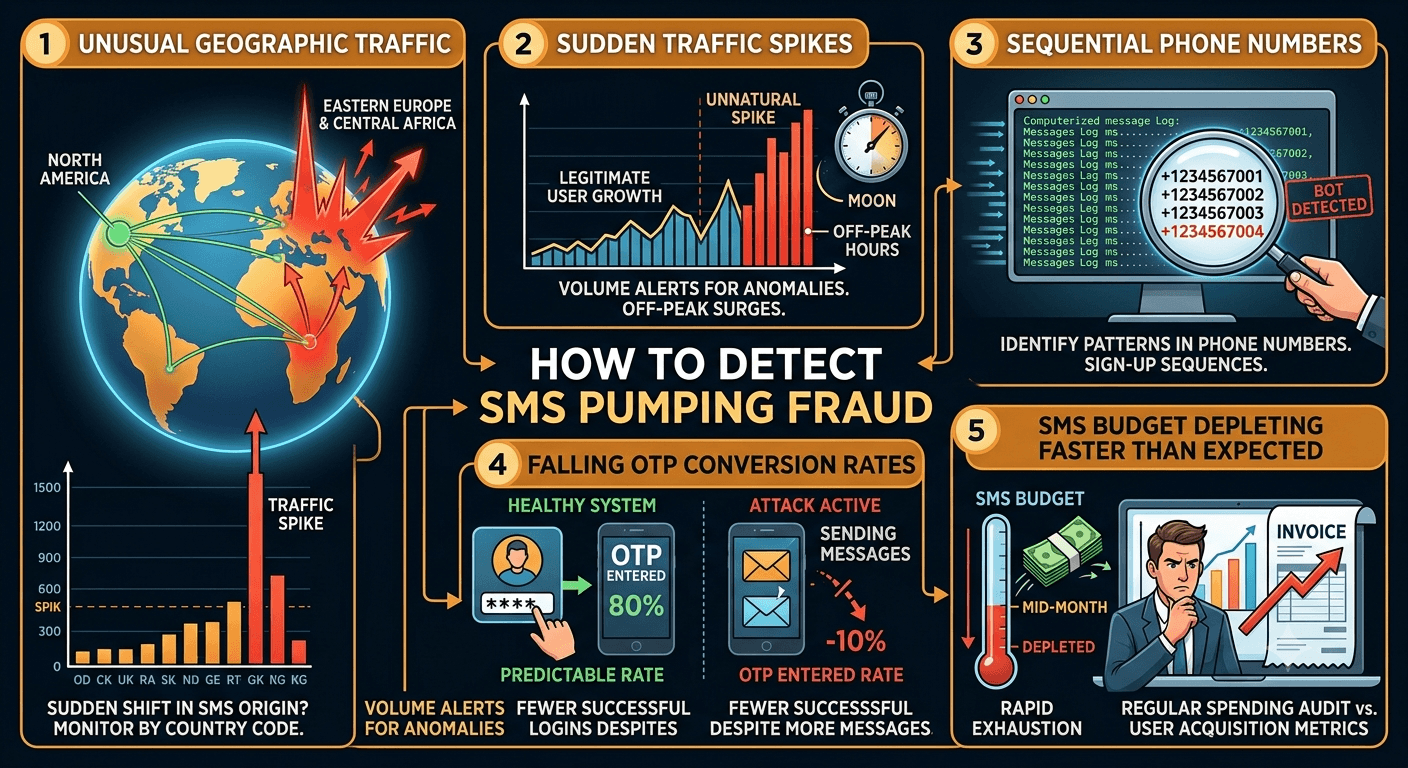
One of the first signs of an attack is a sudden shift in the geographic origin of your SMS traffic. If your business primarily serves customers in North America but you see a massive surge in OTP requests for numbers in Eastern Europe or Central Africa, it is likely that you are experiencing sms traffic pumping fraud. Monitoring your traffic by country code allows you to identify these anomalies before the costs become catastrophic.
2. Sudden traffic spikes
Legitimate user growth is typically steady or tied to specific marketing campaigns, whereas sms pumping fraud results in sharp, unnatural spikes in volume. These spikes often occur during off-peak hours or in a manner that does not correlate with actual user activity on your platform. Keeping a close eye on your messaging logs and setting up alerts for volume thresholds can help you catch these bursts of activity in real time.
3. Sequential phone numbers
Fraudsters often use batches of phone numbers that are numerically close to each other or follow a specific sequence. If your logs show hundreds of messages being sent to numbers like +1234567001, +1234567002, and +1234567003 within a few seconds, you are likely dealing with a bot-driven sms pumping attack. Legitimate users rarely sign up in such a perfectly sequential order from the same IP range.
4. Falling OTP conversion rates
A healthy messaging ecosystem has a predictable conversion rate where a significant percentage of sent OTPs are actually entered by the user. During an attack involving artificially inflated traffic, your conversion rate will plummet because the “users” receiving the messages are actually bots or non-existent accounts. If you notice that you are sending more messages but seeing fewer successful logins, your system is likely being exploited for traffic pumping.
5. SMS budget depleting faster than expected
Financial departments are often the first to notice that something is wrong when the telecommunications budget is exhausted mid-month. This rapid depletion is a classic hallmark of sms traffic pumping where the cost of international delivery for thousands of fake messages drains the company’s account. Regular auditing of your SMS spending against your actual user acquisition metrics is a vital part of a comprehensive sms pumping protection strategy.
How to prevent SMS pumping
Prevention is most effective when a business implements multiple layers of defense to make the attack too difficult or expensive for the fraudster. The first step is to implement strict rate limits that restrict how many OTP requests a single IP address or phone number can trigger within a specific timeframe. For example, allowing only three verification attempts per hour per user can significantly slow down an automated script and reduce the overall financial impact of an attack.
Another powerful deterrent is the introduction of friction at the form level through CAPTCHA or advanced bot detection tools. By requiring a user to solve a puzzle before an SMS is triggered, you can block the vast majority of automated submissions. Additionally, requiring delays between retries ensures that even if a bot bypasses initial checks, it cannot flood the system with requests. These measures, combined with real-time traffic monitoring, create a robust barrier against those attempting to generate inflated traffic.
-
Analyze the IP addresses of users requesting SMS codes to identify clusters from data centers or known proxy services.
-
Implement a blocklist for high-risk mobile prefixes that are frequently associated with premium-rate revenue sharing fraud.
-
Use a dedicated fraud prevention solution that leverages global databases to identify fraudulent phone numbers before the message is ever sent.
-
Monitor the duration of user sessions; bots often trigger an SMS immediately upon landing on a page, while real users take time to fill out other form fields.
-
Require email verification before allowing a user to request an SMS OTP to add an additional layer of identity validation.
How to stop SMS pumping
If you discover that your business is currently under an active attack, the immediate priority is to throttle the traffic to prevent further financial loss. You should start by blocking the IP addresses that are generating the most requests and temporarily disabling SMS triggers for the specific regions or countries where the suspicious activity is originating. This targeted approach allows you to stop the fraud without completely shutting down your service for legitimate users in other areas.
Once the immediate threat is neutralized, it is essential to conduct a thorough audit of your messaging logs to identify the exact vulnerability that was exploited. This might involve updating your API endpoints to require stronger authentication or revising your internal logic for how messages are dispatched. Implementing a solution like Infobip Signals can automate much of this process by detecting and blocking fraudulent traffic patterns before they can escalate into a full-scale crisis, ensuring your ait fraud risks are minimized.
-
Review your contract with your SMS provider to ensure you are not held liable for messages sent to known fraudulent routes.
-
Identify and disable any legacy web forms or hidden API endpoints that might be bypassing your current security measures.
-
Communicate with your telecommunications provider to see if they can block specific high-cost destinations at the network level.
-
Adjust your user onboarding flow to prioritize lower-cost verification methods, such as email or push notifications, for high-risk regions.
-
Set up automated kill-switches that trigger if your SMS volume exceeds a certain percentage above your daily average.
Read More: Contact Center vs Call Center: Which is the Best Choice?
Final Thought
SMS pumping is a growing threat that requires constant vigilance and a proactive approach to security. As fraudsters become more sophisticated in their use of bots and collusion with telecom networks, businesses must move beyond simple form triggers and adopt multi-layered defense strategies. By combining rate limiting, bot detection, and real-time monitoring, you can protect your financial resources and ensure that your messaging services remain available for your actual customers. Staying informed about the latest trends in artificially inflated traffic is the best way to safeguard your brand’s reputation and bottom line in an increasingly complex digital landscape.
FAQs
-
What is SMS pumping?
SMS pumping is a type of fraud where attackers use automated bots to trigger large volumes of SMS messages from a business’s website or app. These messages are sent to premium-rate numbers or ranges controlled by the fraudsters, allowing them to earn a share of the delivery fees paid by the targeted company.
-
What is AIT (artificially inflated traffic)?
Artificially inflated traffic, or AIT, refers to any scenario where SMS traffic is generated through fraudulent means rather than legitimate user interaction. This includes SMS pumping, where bots are used to inflate the volume of messages sent, leading to higher costs for businesses and illicit profits for fraudsters.
-
How do fraudsters profit from SMS pumping?
Fraudsters profit by collaborating with complicit mobile network operators or by using premium-rate phone numbers. When a business is tricked into sending a message to these numbers, the network operator receives a fee, and a portion of that fee is kicked back to the fraudster as a revenue share.
-
Which industries and regions are most affected by SMS pumping?
Any industry that relies on SMS for 2FA or account verification is at risk, particularly fintech, e-commerce, and social media platforms. Geographically, high-risk markets are most concentrated in Africa, Asia, and the Middle East, though the attacks can target businesses anywhere in the world.
-
How can I tell if my business is being targeted by SMS pumping?
You can identify an attack by looking for sudden spikes in SMS volume, a high number of messages sent to specific international regions you don’t usually serve, and a significant drop in your OTP conversion rates. Unexpectedly high telecommunications bills are also a primary indicator of this fraud.
-
What is the most effective way to prevent SMS pumping?
The most effective strategy is a multi-layered defense that includes implementing rate limits on SMS requests, using CAPTCHAs to block bots, and employing a dedicated fraud detection service. Monitoring traffic in real time allows you to catch and block suspicious patterns before they cause significant damage.
-
How does Infobip Signals detect and block SMS pumping?
Infobip Signals uses advanced machine learning and a global database of known fraudulent patterns to identify suspicious traffic in real time. It can automatically block messages to high-risk numbers or suspicious IP addresses, preventing the fraud from occurring without affecting the experience of legitimate users.
-
What is SMS flooding?
SMS flooding is a related but slightly different attack where a large volume of messages is sent to a single phone number to harass the recipient or overwhelm their device. While SMS pumping is focused on financial gain for the attacker, flooding is often used for disruption or as a smokescreen for other malicious activities.
-
How to send 1000 messages at once in SMS?
Businesses typically use A2P (Application-to-Person) platforms and APIs to send high volumes of messages simultaneously for legitimate purposes like marketing or notifications. However, this same capability is what fraudsters exploit through automated scripts to trigger thousands of unauthorized messages during a pumping attack.