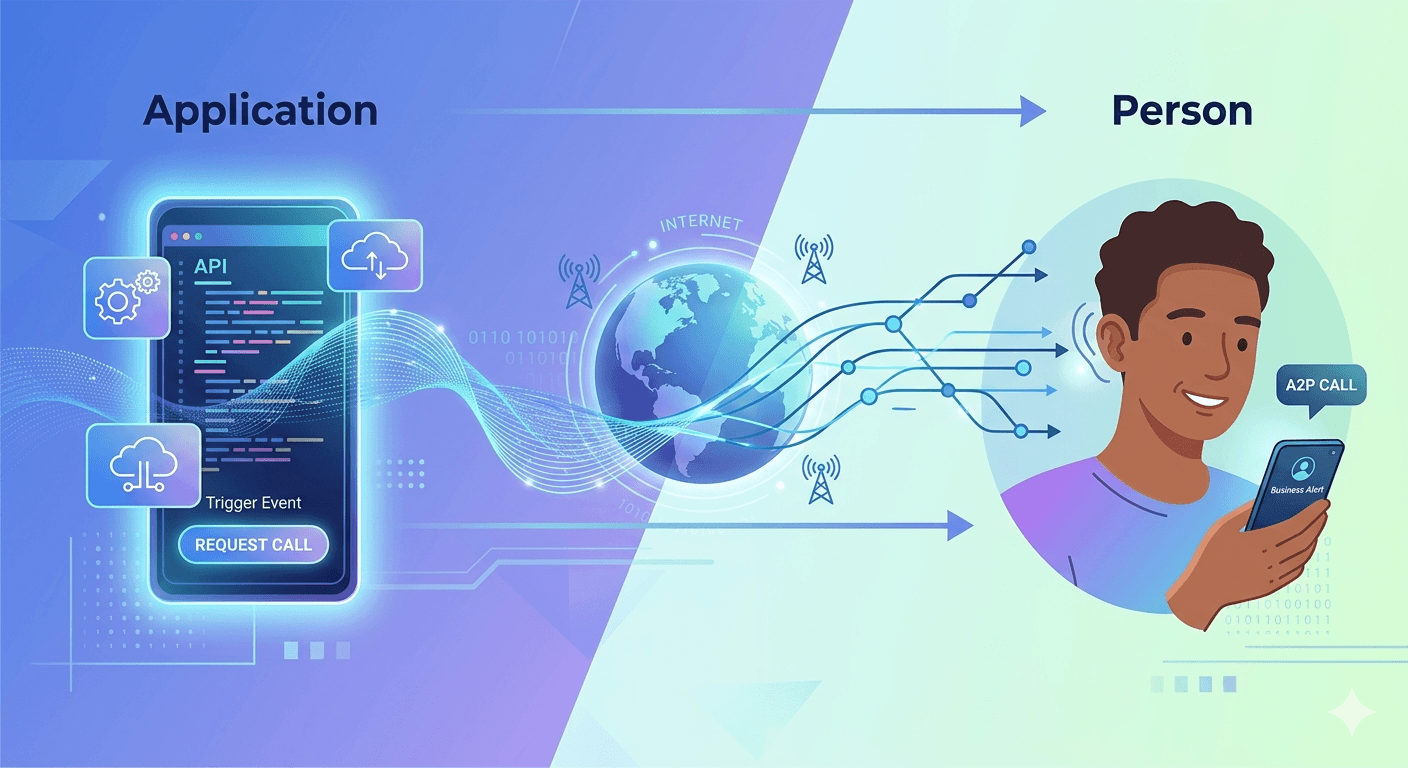
Application-to-Person (A2P) calling allows software to make automated voice calls to people. Instead of a person manually making each call, a system can automatically call customers when needed. For example, businesses can use A2P calling for appointment reminders, security alerts, delivery updates, payment notifications, and other important messages.
This automated calling method uses internet-based technology to send voice messages to many people quickly. It saves businesses time because staff do not need to make every call themselves. A2P calling can also help businesses improve customer communication, send important updates on time, and handle a large number of calls more easily.
What is A2P calling?
A2P (Application-to-Person) calling is a type of automated voice communication in which a software application places a call to a person. Businesses use A2P calls for appointment reminders, one-time passwords (OTPs), delivery updates, alerts, surveys and other automated notifications. The call may use a prerecorded message, text-to-speech or an interactive voice system.
Understanding what is a2p calling requires a deep dive into the evolution of modern telecommunications and the shift toward automated customer interactions. At its core, application-to-person calling is a process where a voice call is initiated by a software application rather than a human caller. This technology is widely used for delivering critical information, verifying identities through voice-based codes, and providing real-time updates regarding services or deliveries. When people ask what is a2p calling meaning, they are generally referring to the ability of a business to scale its voice outreach using cloud-based telephony infrastructures that bypass the traditional limitations of physical hardware and manual dialing processes.
A2P calling can be used for high-volume campaigns as well as individual transactional calls triggered by a specific event. In the context of a2p calling iphone users, many individuals see this specific label on their caller ID when a company uses an automated system that has not been fully registered with local carrier name databases. This often leads to questions about a2p calling caller id and whether the call is legitimate. For businesses, implementing this technology means they can reach thousands of customers in seconds, ensuring that time-sensitive information like credit card fraud alerts or school closure notifications are received and acknowledged instantly.
Research conducted by industry analysts at Juniper Research indicates that the global market for application-to-person communication is projected to exceed sixty billion dollars by the end of 2025. This growth is driven by the increasing demand for secure two-factor authentication and the integration of voice technology into common consumer apps. Furthermore, the meaning of a2p calling extends to the technical stack involved, which typically includes Voice over Internet Protocol and Session Initiation Protocol to route calls through the internet before they land on a standard mobile or landline network. By utilizing these digital pathways, companies avoid the high costs associated with traditional long-distance calling while maintaining crystal-clear audio quality for their end-users.
How A2P calling works
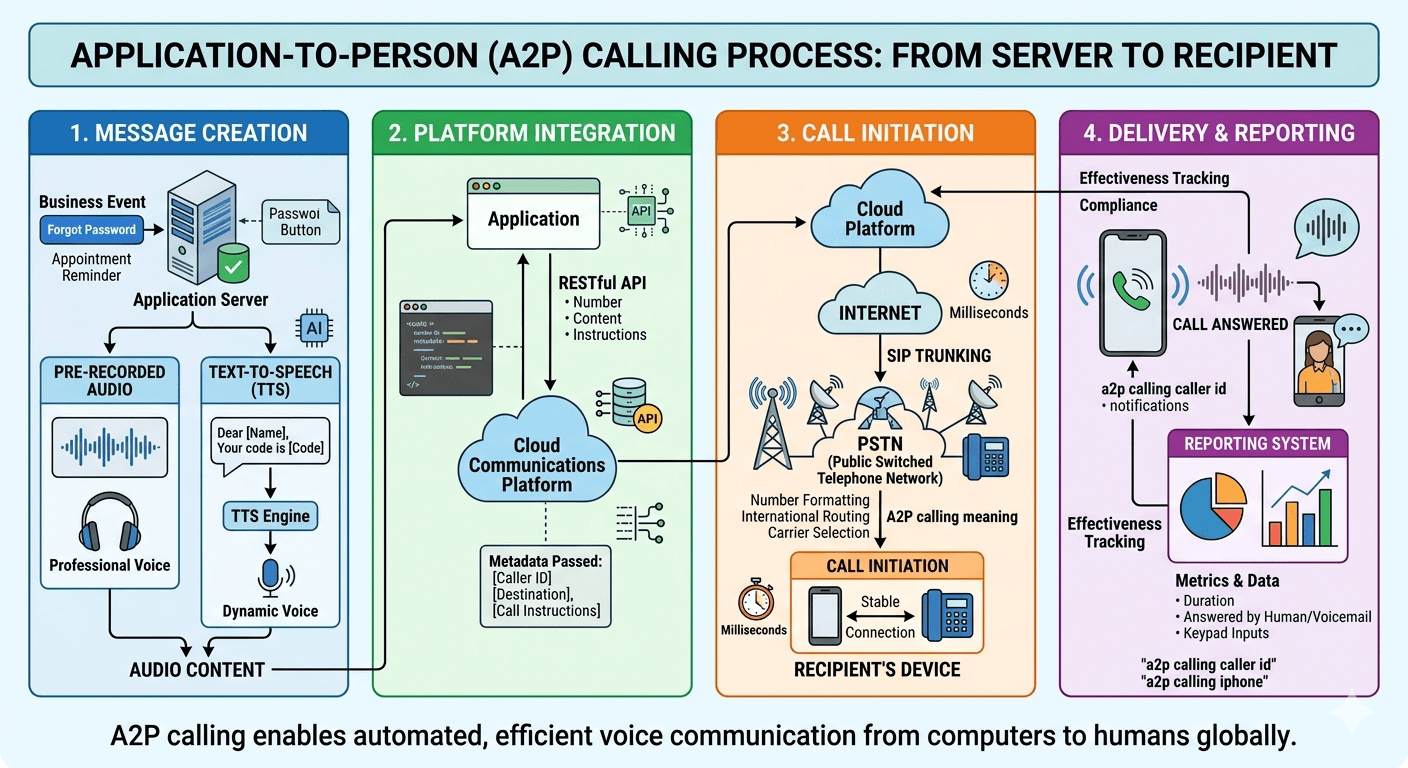
The technical architecture behind application-to-person communication is designed to move data from a computer server to a human ear in milliseconds. An A2P call usually begins when an event in an application triggers a request to a voice platform. This could be a user clicking a forgot password button or a scheduling system identifying an upcoming appointment. Once the trigger is activated, the application sends a request to a specialized voice provider through an API. This request contains the destination phone number, the content of the message, and any specific instructions regarding the voice profile or language to be used during the automated interaction.
1. Message creation
The first step in the lifecycle of an automated call involves the development of the audio content that the recipient will hear. This can be achieved through two primary methods: pre-recorded audio files or text-to-speech technology. Pre-recorded files are often used for static messages where a professional voice actor provides a warm and human-like experience for the brand. However, text-to-speech is becoming the industry standard for dynamic content because it allows the system to insert specific details like names, dates, or unique codes into a natural-sounding voice stream. Modern text-to-speech engines use artificial intelligence to mimic human intonation and cadence, making the a2p calling =more accessible and professional for global audiences who require diverse language support.
2. Platform integration
For a2p calling to function seamlessly, the business application must be tightly integrated with a cloud communications platform. The business application connects to a voice provider through an API. When a call is needed, the application sends the destination number, message instructions and other required information to the provider. Developers write code that allows their servers to communicate with the voice provider, passing along the necessary metadata for each call. This stage is crucial for ensuring that the a2p calling caller id displays correctly on the recipient’s device and that the call is routed through the most efficient digital pathways. Proper integration also allows for the collection of real-time data regarding call status and recipient interaction.
3. Call initiation
Once the communication platform receives the instruction from the application, it initiates the call through a process known as SIP trunking. This technology connects the internet-based voice data to the Public Switched Telephone Network which is the global system of interconnected phone lines. During this phase, the system handles complex tasks such as number formatting, international routing, and carrier selection. The goal is to establish a stable connection with the recipient’s mobile device or landline as quickly as possible. This is particularly important for time-sensitive a2p calling iphone notifications where a delay of even a few seconds could result in a failed authentication attempt or a missed emergency warning.
4. Delivery and reporting
The final stage occurs when the recipient answers the phone and the audio message is played. However, the work of the automated system does not end there. Advanced platforms provide detailed reporting on the outcome of every call, including metrics such as duration, whether the call was answered by a human or a voicemail system, and any keypad inputs provided by the user. This reporting is essential for businesses to track the effectiveness of their communication strategies and to comply with regulatory requirements. For instance, if a user receives a verification code via a2p calling, the system can confirm that the call was successfully completed before allowing the user to proceed with their login.
Use cases for A2P calling
The versatility of automated voice technology allows it to be applied across virtually every industry, from healthcare and finance to retail and logistics. One of the most common reasons businesses explore what is a2p calling is to improve the efficiency of their routine communications. Instead of having a staff member call dozens of people to confirm appointments, an automated system can handle the task in a fraction of the time and at a significantly lower cost. This allows human employees to focus on more complex tasks that require emotional intelligence and nuanced problem-solving.
1. Customer notifications and reminders
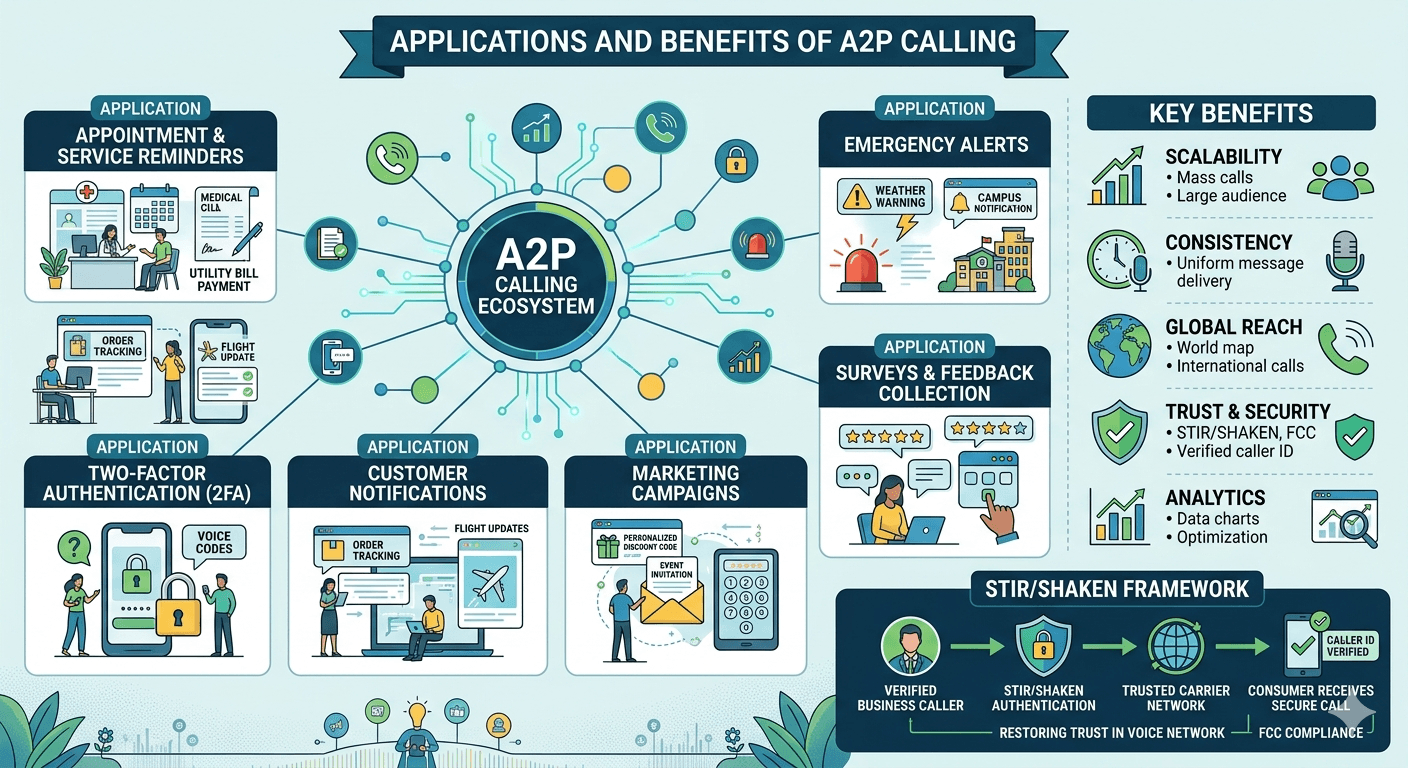
In the healthcare sector, automated calling systems are used to remind patients of upcoming consultations or to notify them that their laboratory results are ready for review. Automated reminders can help reduce missed appointments and save staff from making each reminder call manually. Similarly, in the utility sector, companies use automated calls to notify customers of planned maintenance work or to alert them if a bill is past due. These proactive communications help build trust and prevent service interruptions for the consumer while maintaining steady cash flow for the provider.
2. Two-factor authentication (2FA)
Security is perhaps the most critical application for a2p calling meaning in the digital age. While SMS is a popular channel for sending one-time passwords, voice-based codes offer an additional layer of accessibility and security. For users who may have difficulty reading small text on a screen or for those using landline phones, receiving a verification code via an automated voice call is an essential alternative. Voice-based OTPs can provide an alternative when SMS isn’t available or when the user needs to receive the code on a landline. Financial institutions frequently use these calls to verify large transactions or changes to account settings, ensuring that the person attempting the action is in possession of the registered phone device.
3. Emergency alerts
When a crisis occurs, speed and reach are the most important factors in any communication strategy. Government agencies and educational institutions utilize automated calling systems to broadcast emergency alerts to thousands of people simultaneously. Whether it is a notification about severe weather, a campus lockdown, or a public health announcement, these systems ensure that the message is delivered even if data networks are congested. The ability to bypass the delays inherent in manual calling makes this technology a literal lifesaver in high-pressure situations where every second counts toward ensuring public safety.
4. Marketing campaigns
While marketing often relies on visual media, voice-based outreach can be a powerful tool for personalized engagement. Businesses use automated calling to announce exclusive sales events, invite loyal customers to special events, or provide personalized discount codes based on previous purchase history. To ensure these calls are well-received, companies must adhere to strict regulatory guidelines regarding consent and calling hours. When done correctly, a well-timed voice message can feel more personal than a standard email, leading to higher conversion rates and increased brand loyalty among a diverse customer base.
5. Surveys and feedback collection
Gathering customer feedback is essential for continuous improvement, and automated calling provides a convenient way to conduct short surveys. After a customer service interaction or a product delivery, a system can trigger a call asking the user to rate their experience using their phone’s keypad. These Interactive Voice Response surveys allow businesses to collect structured data quickly and analyze it in real-time. Because the calls are automated, they are seen as less intrusive than a live interview, often resulting in more honest feedback from the consumer regarding the quality of the service they received.
Benefits of A2P calling
The primary advantage of implementing an automated voice system is the unprecedented scalability it offers to modern organizations. A single software application can manage millions of calls per day, a feat that would require a massive and prohibitively expensive call center if handled manually. This scalability ensures that as a business grows, its communication infrastructure can expand alongside it without a corresponding spike in overhead costs. Furthermore, automated calls provide a level of consistency that is impossible to achieve with human staff; the message is always delivered with the same tone, accuracy, and adherence to company scripts, regardless of the time of day.
Another significant benefit is the global reach provided by modern cloud communication platforms. Businesses can initiate calls to virtually any country in the world, often with local caller ID numbers that increase the likelihood of the call being answered. This global accessibility is vital for international e-commerce platforms and travel companies that need to communicate with customers across different time zones and languages. Additionally, the integration of advanced analytics allows companies to fine-tune their strategies based on data. By analyzing answer rates and call durations, businesses can determine the best times to reach their audience and identify which types of messages resonate most effectively with their users.
In the United States, STIR/SHAKEN helps carriers verify whether caller-ID information has been authenticated as a call moves across supported IP networks. It is designed to reduce caller-ID spoofing, but authentication does not by itself guarantee that a call is trustworthy.
According to reports from the Federal Communications Commission, the widespread adoption of these authentication standards has been a cornerstone in the ongoing effort to restore consumer trust in the telephone network. You can learn more about these regulations on the official FCC website.
1. Network reliability and call quality
The most important factor in choosing a provider is the stability of their network. Look for a provider with reliable network coverage, clear service-level information and redundancy to minimize outages. High-quality audio is also non-negotiable; if your customers cannot clearly understand the automated message, the entire purpose of the call is defeated. Requesting a trial or a demo to test the latency and clarity of the calls in different geographic regions is a wise step before committing to a long-term contract.
2. Customization and API capabilities
A good provider should offer a flexible API that allows your developers to easily integrate voice functionality into your existing workflows. This includes support for various programming languages, detailed documentation, and the ability to customize every aspect of the call experience. You should be able to control things like the caller ID, the use of text-to-speech or recorded audio, and the logic for handling calls that go to voicemail. The more control you have over the technical parameters, the better you can tailor the experience to meet the specific needs of your diverse user base.
3. Security and compliance
Because automated calls often carry sensitive information like 2FA codes or personal health reminders, security is a top priority. Depending on your location and industry, consider relevant privacy and telecommunications requirements, such as GDPR in applicable European contexts, HIPAA requirements for covered healthcare use cases in the United States, and rules governing automated calls and consent. Furthermore, they must have tools in place to help you remain compliant with telecommunications regulations like the Telephone Consumer Protection Act. This includes managing opt-out lists and ensuring that your calling patterns do not trigger spam filters. A provider that takes a proactive approach to compliance will save you from potential legal headaches and financial penalties in the future.
4. Cost efficiency
While quality is paramount, the cost of the service must align with your business budget. Look for a transparent pricing model that offers volume discounts as your calling needs grow. Some providers charge based on the number of seconds used, while others have flat rates per call. It is also important to account for hidden costs such as setup fees, monthly minimums, or charges for additional features like call recording and transcription. A thorough cost-benefit analysis will help you determine which provider offers the best value for your specific use cases and expected call volume.
5. 24/7 expert support
Even with the best technology, issues can occasionally arise. When they do, you need access to a support team that understands the technical nuances of application-to-person communication. A provider that offers 24/7 support with guaranteed response times is essential for businesses that operate around the clock. Check for reviews or case studies that highlight the provider’s responsiveness and their ability to resolve complex routing issues or technical bugs quickly. Having an expert team on your side provides peace of mind and ensures that your critical communication lines remain open at all times.
How to choose an A2P calling provider
Selecting the right partner for your automated voice needs is a critical decision that impacts the reliability and success of your communication strategy. A provider acts as the gateway between your software and your customers, so their infrastructure must be robust enough to handle high volumes of traffic without failing. When evaluating potential partners, it is important to look beyond just the price per minute and consider the underlying technology and support systems they offer. A cheap provider that suffers from frequent downtime or poor audio quality will ultimately cost your business more in lost customers and damaged reputation.
Read More: What is Call barring? Comprehensive Guide
Final Thought
A2P calling allows software applications to place automated voice calls to people for purposes such as reminders, alerts, verification codes, delivery updates and surveys. The application typically connects to a cloud voice provider through an API, which then places the call and reports the result back to the system. For businesses considering A2P calling, the most important factors are reliable delivery, clear pricing, appropriate caller identification, API capabilities and compliance with the calling and privacy rules that apply to their audience.
FAQs
-
What Is A2P Calling?
A2P calling stands for Application-to-Person calling, a process where a software application initiates a voice call to a human recipient. It is commonly used for automated reminders, security alerts, and customer notifications, allowing businesses to communicate with large groups of people efficiently without manual effort.
-
What is an example of A2P?
A classic example is receiving an automated phone call from your bank to verify a suspicious transaction. Another common example is a dental office’s system calling you 24 hours before your appointment to confirm your attendance and providing options to reschedule using your phone’s keypad.
-
Will this replace my team?
No, A2P calling is mainly useful for repetitive tasks such as reminders, alerts and verification calls. Human staff are still needed for conversations that require judgement, problem-solving or personalized support.
-
Is setup hard?
Setting up an automated calling system is relatively straightforward for businesses with access to a developer. Most modern providers offer robust APIs and detailed documentation that allow for quick integration into your existing CRM or scheduling software within a few days.
-
What if it says something wrong?
Test scripts before launch and make sure dynamic information such as names, dates and codes is pulled from reliable data. Monitoring failed or incorrect calls can help you identify problems quickly.
-
Can I test it on real calls?
Most reputable providers offer a sandbox environment or a trial period where you can send test calls to your own device. This allows you to evaluate the audio quality, the latency, and the accuracy of the caller ID before you roll the system out to your entire customer base.
-
What if I need help?
Top-tier communication providers offer extensive support resources, including live chat, technical documentation, and dedicated account managers. Choosing a partner with 24/7 support ensures that you have access to experts whenever you encounter technical challenges or routing issues.
-
What does A2P calling mean?
A2P calling means Application-to-Person calling. It describes a voice call initiated automatically by a software application and delivered to a person, rather than a call manually placed by another individual.
-
Why Does My iPhone Show “A2P Calling”?
When an iPhone displays this label, it typically means the incoming call is from an automated system that the carrier has identified as an application-based source. This is a common way for modern smartphones to help users distinguish between personal calls and automated business notifications.