
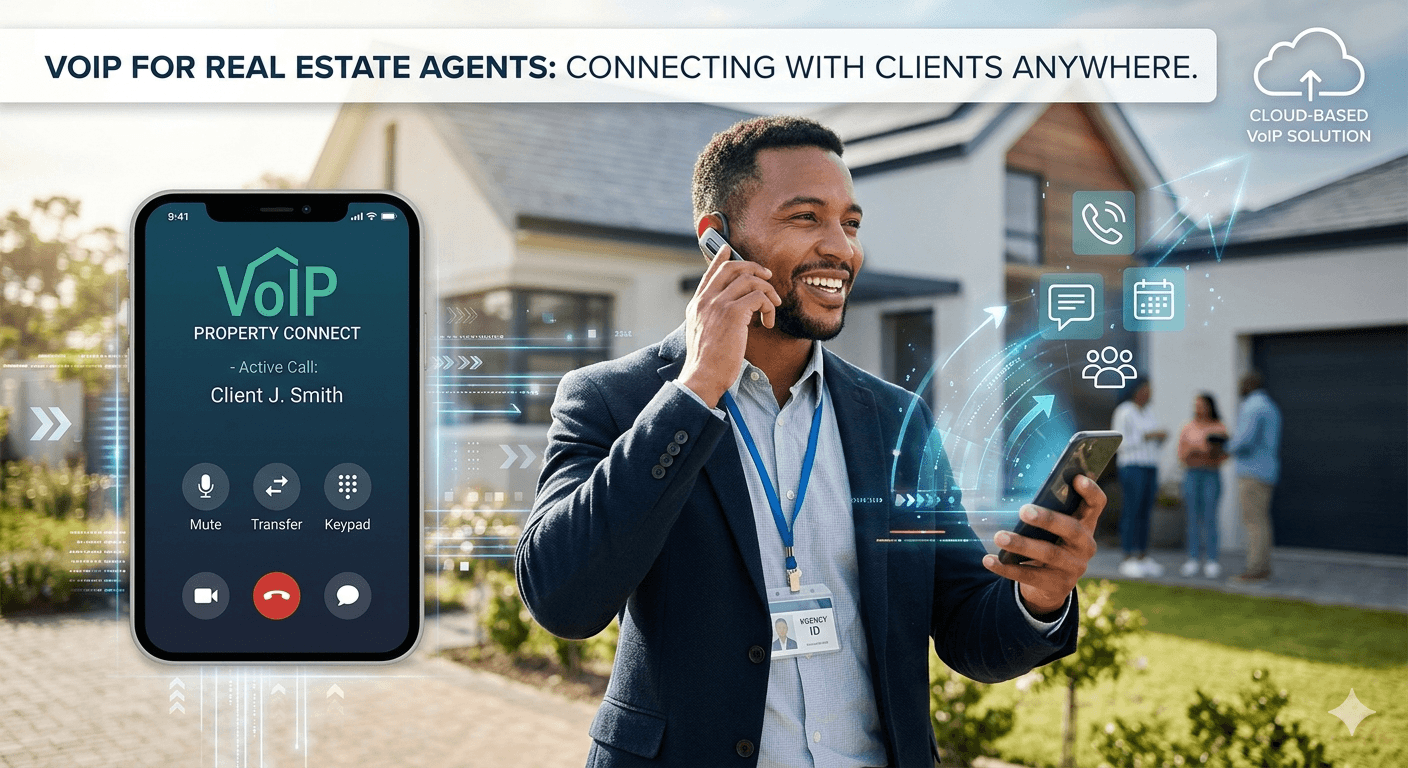
VoIP for Real Estate Agents is a cloud-based communication solution that enables realtors to manage property inquiries and client relationships through the internet rather than traditional landlines. This technology offers essential mobility, allowing agents to take their office extension anywhere, ensuring no valuation or lead is ever missed. By integrating voice, video, and messaging into one platform, real estate professionals can streamline their operations and provide a seamless customer experience. Implementing VoIP for Real Estate Agents reduces overhead costs while providing advanced tools like CRM integration and automated call routing, which are vital for competing in today’s fast-paced property market.
Common Communication Problems in Estate Agencies
Estate agencies deal with high-intent, time-sensitive enquiries where every second counts for a potential sale. When communication breaks down, it usually results in lost instructions rather than minor delays, as clients often move on to the next available agent immediately. Traditional real estate phone system setups often fail to meet these demands, leading to missed opportunities and frustrated potential buyers.
Many agencies struggle with managing a high volume of calls during peak property seasons or after a new listing goes live. If the staff is already on the phone or out for a viewing, a legacy system simply rings until the caller hangs up or goes to a generic voicemail. This lack of responsiveness can damage the agency’s reputation and lead to a significant loss in revenue over time.
High enquiry volumes lead to missed valuation calls when lines are busy.
Calls are manually transferred between branches, which significantly slows down response times and creates a disjointed experience.
Missed enquiries often lack visibility, meaning there is no clear record for follow-up by the sales team.
Offices often operate as separate islands without shared communication, making it difficult to coordinate multi-branch listings.
Mobile agents frequently miss calls while they are on viewings or traveling off-site, leading to delayed communication.
How VoIP Improves Customer Experience in Real Estate Agencies ?
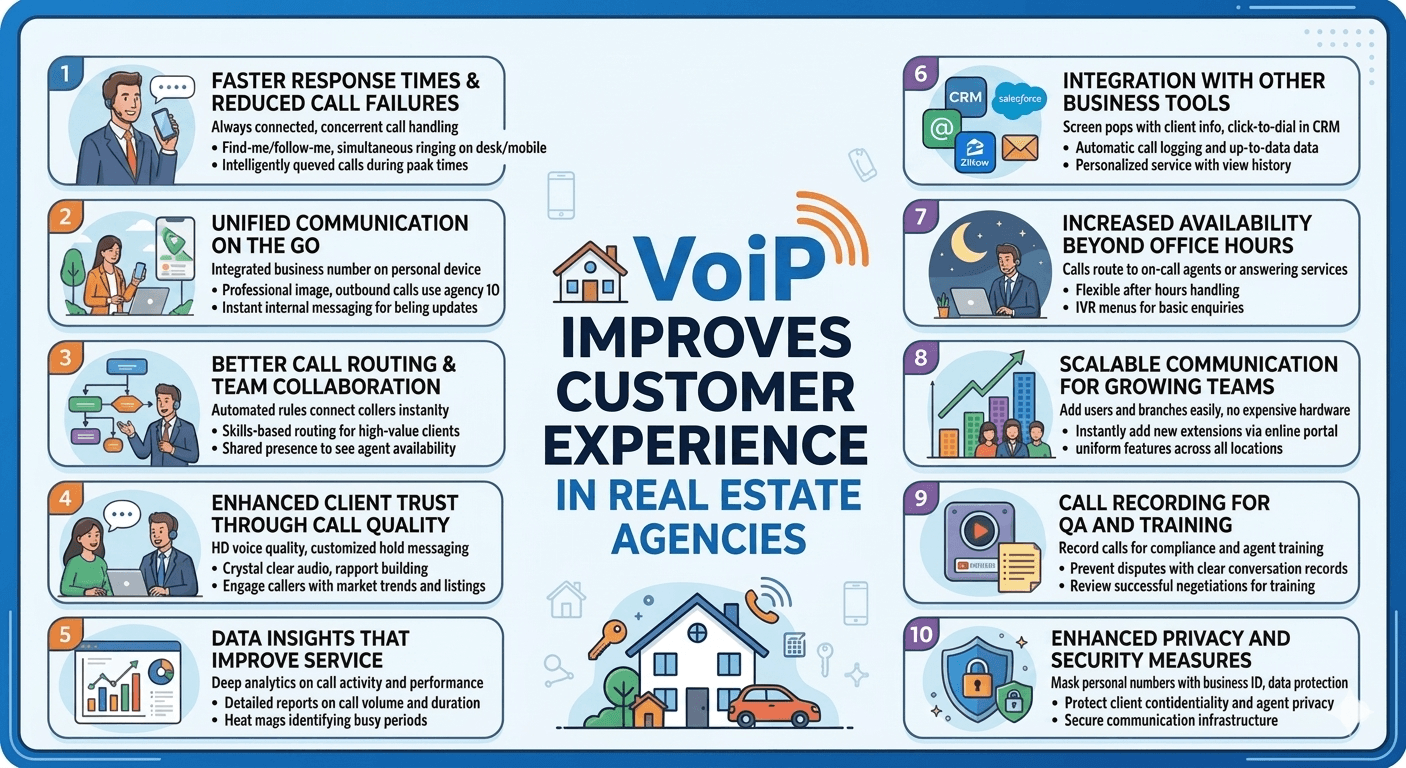
1. Faster Response Times and Reduced Call Failures
In the real estate industry, the speed of response is often the determining factor between closing a deal and losing it to a competitor. VoIP for Real Estate Agents addresses this by ensuring that calls are never left unanswered, regardless of where the agent is located. With features like find-me/follow-me, an incoming call can ring an office desk phone, a laptop, and a mobile device simultaneously.
This technology eliminates the bottleneck of traditional hardware that only allows a certain number of concurrent calls. By moving to the cloud, agencies can handle an unlimited number of simultaneous enquiries, placing callers into organized queues during busy periods. This ensures that every lead is acknowledged and eventually connected to a professional, rather than hearing a busy signal.
Immediate lead notification through mobile app alerts.
Intelligent call queuing that keeps buyers engaged with music or property updates while they wait.
Auto-attendants that direct callers to the right department without human intervention.
Seamless transition between office and mobile devices without dropping the call.
2. Unified Communication on the Go
The modern realtor is rarely tied to a desk, spending a significant portion of their day at property viewings, inspections, or meetings. A traditional realtor phone system often leaves these agents disconnected from the main office hub. VoIP solves this by providing a unified communication experience across all devices, ensuring that the agent has access to their full suite of tools on their smartphone.
This mobility allows agents to maintain a professional appearance by using their business number for all outbound calls, even when using a personal cell phone. It also allows for instant internal messaging among team members, which is critical for checking the status of a listing or confirming a viewing time on the fly.
According to the National Association of Realtors, over 90% of realtors use their smartphones for business frequently, making integrated voip for real estate a necessity.
3. Better Call Routing and Team Collaboration
Effective call routing is the backbone of a successful real estate office phone systems setup. Instead of relying on a receptionist to manually transfer every call, VoIP systems use automated rules to send callers to the most appropriate person. For example, a call regarding a specific luxury listing can be routed directly to the listing agent, while a general enquiry goes to the front desk.
Collaboration is further improved through shared presence indicators, which show team members who is currently available, on a call, or out at a viewing. This prevents the frustration of transferring a client to an agent who isn’t there to answer. When everyone is on the same system, coordinating between the sales, lettings, and administrative teams becomes an effortless process.
Skills-based routing directs high-value clients to senior agents automatically.
Shared call parking allows one agent to take a call and another to pick it up once they have the file ready.
Conference calling capabilities enable agents to quickly bring mortgage brokers or legal advisors into a conversation.
Internal chat groups foster quick communication regarding new listings or price changes.
4. Enhanced Client Trust Through Call Quality
The professional image of an agency is often built on the quality of its communication. Dropped calls, static, or background noise during a high-stakes negotiation can erode client trust. High-definition (HD) voice quality is a standard feature when you evaluate the telecommunications company get voip on real estate, ensuring that every word is heard clearly, which is essential for building rapport.
Professionalism is also enhanced through customized on-hold messaging and greeting systems. Instead of silence or generic radio music, agencies can use their hold time to inform clients about new market trends, current listings, or community events. This keeps the client engaged and demonstrates that the agency is organized and professional in all aspects of its business.
5. Data Insights That Improve Service
Traditional phone systems offer very little data regarding how communication is handled within an agency. In contrast, digital systems provide deep analytics that allow managers to track call volumes, peak times, and agent performance. This data is invaluable for staffing decisions, especially during busy spring or autumn markets.
By analyzing call logs, an agency can identify if certain branches are overwhelmed or if specific agents are spending an excessive amount of time on initial enquiries. These insights allow for continuous improvement in customer service. For instance, if data shows a high volume of missed calls at 6 PM, the agency might decide to extend its phone coverage or implement a specialized after-hours routing service.
Detailed reports on average call duration and response times.
Heat maps showing the times of day with the highest enquiry volume.
Tracking of outbound call activity to monitor lead generation efforts.
Comparison of performance metrics across different office branches.
6. Integration with Other Business Tools
One of the most significant advantages of modern communication is the ability to link the phone system with other essential software. A real estate phone system that integrates with a CRM like Salesforce, Zillow, or HubSpot can automatically log every interaction with a client. This ensures that the agent always has the most up-to-date information when a buyer or seller calls.
When a call comes in, a “screen pop” can display the caller’s property history, previous offers, and notes from other agents. This level of preparedness allows for a highly personalized service that impresses clients and speeds up the transaction process. Furthermore, click-to-dial features within the CRM save time and reduce the errors associated with manual dialing.
7. Increased Availability Beyond Office Hours
The real estate market does not stop at 5:00 PM. Many buyers and sellers do their research and make enquiries in the evenings or on weekends. A legacy system usually routes these calls to a generic voicemail that might not be checked until the next business day. VoIP for Real Estate Agents allows for much more flexible after-hours handling.
Agents can set schedules that route calls to an on-call mobile device or an external answering service during the evenings. Alternatively, the system can provide the caller with an IVR menu that answers common questions about office hours or directs them to a website for property details. This increased availability ensures that the agency is always open for business, even when the physical office is closed.
8. Scalable Communication for Growing Teams
As a real estate agency grows, adding new staff or opening new branches can be a logistical challenge with traditional hardware. VoIP systems are inherently scalable, allowing for the addition of new users or lines with just a few clicks in a web-based dashboard. There is no need for a technician to visit the office or for expensive wiring projects.
This scalability is also useful for temporary situations, such as hiring extra support during a massive new development launch. Once the peak period is over, the agency can easily scale back its user count to save costs. This “pay-as-you-grow” model is ideal for agencies of all sizes, from boutique local shops to large national franchises.
Add or remove extensions instantly through an online portal.
Easily integrate remote workers or independent contractors into the main phone system.
Open new branch locations without the need for on-site phone servers.
Uniform communication features across all offices regardless of geography.
9. Call Recording for Quality Assurance and Training
Call recording is a powerful tool for real estate agencies for both legal protection and staff development. In a field where verbal agreements and specific instructions are common, having a recorded record of a conversation can prevent disputes and clarify misunderstandings. It provides a safety net for both the agent and the agency.
From a training perspective, managers can review recordings to help junior agents improve their sales techniques and lead-handling skills. Listening to successful negotiations or identifying where a lead went cold provides practical, real-world examples for team meetings. This leads to a more consistent and high-quality customer experience across the entire organization.
10. Enhanced Privacy and Security Measures
Privacy is a major concern when realtors use personal devices for work. VoIP for Real Estate Agents protects an agent’s personal number by masking it with the agency’s official business caller ID. This maintains a clear boundary between work and personal life while ensuring that the client always associates the call with the professional brand.
Security is also built into the infrastructure of modern cloud communication. Data is encrypted, and providers implement rigorous security protocols to protect against unauthorized access. This is vital for maintaining the confidentiality of client financial data and personal information. A study by IBM recently noted that the average cost of a data breach in the service sector has risen, making secure communication a top priority for modern businesses.
How to Choose the Right VoIP System for Your Agency
Choosing the right communication partner depends on how your agency handles enquiries and operates on a day-to-day basis. Not every system is the right fit for every agency, and it is important to select a solution that solves your specific pain points. The following steps will guide you through the selection process to ensure you find a reliable and efficient realtor phone system.
It is also important to consider the reputation and support levels of the provider. Since real estate is a 24/7 business, you need a partner that offers excellent customer service and high uptime guarantees. Evaluate the telecommunications company get voip on real estate by looking at their specialized features for property professionals.
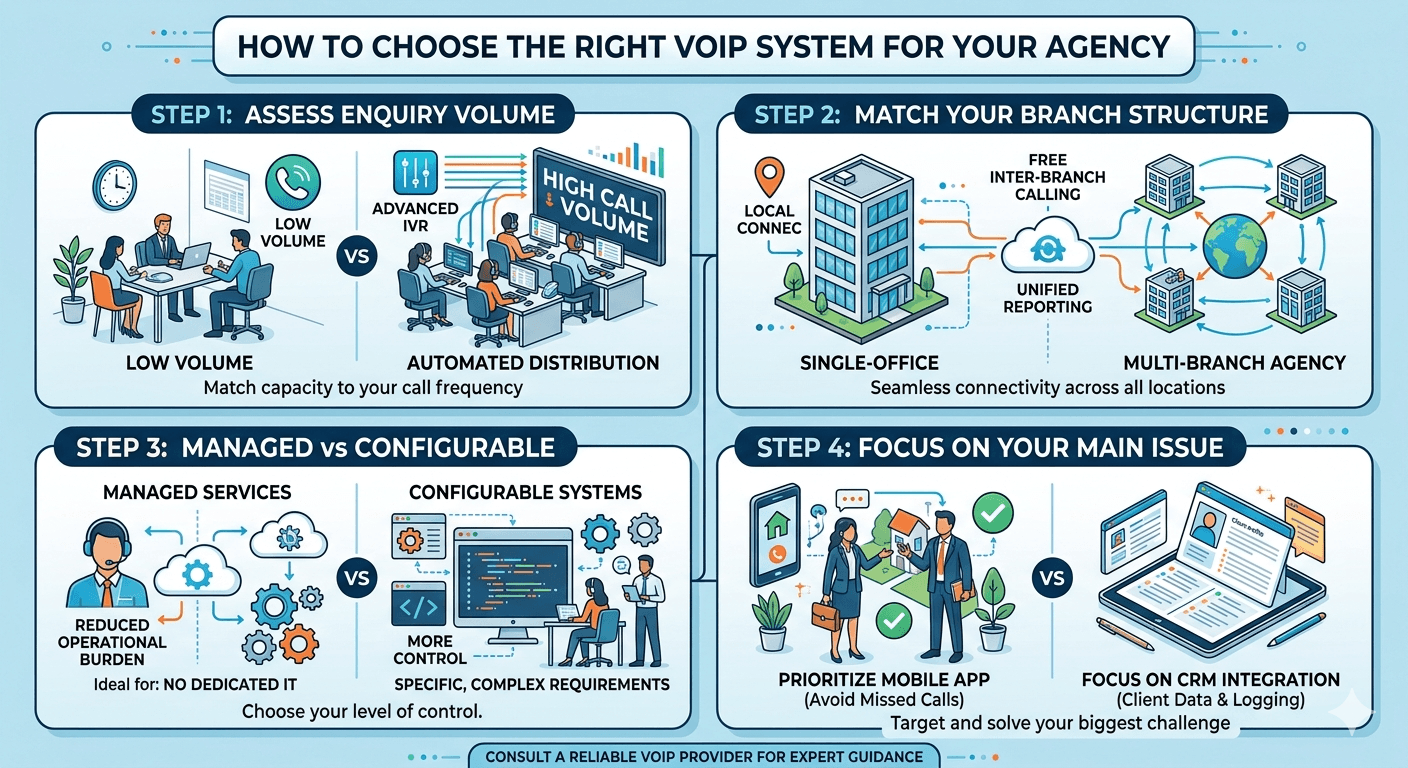
Step 1: Assess enquiry volume
High-volume agencies need strong call handling and queuing capabilities to ensure no caller is left waiting indefinitely. If your agency receives dozens of calls every hour, look for a system that offers advanced IVR and automated distribution. For smaller agencies with lower volumes, a simpler setup focusing on mobile flexibility might be more appropriate.
Step 2: Match your branch structure
Single-office setups can remain relatively simple, focusing on local connectivity and mobile apps. However, multi-branch agencies need centralized real estate office phone systems that allow for free inter-branch calling and unified reporting. The ability to see the status of an agent in a different city is a major advantage for larger organizations.
Step 3: Decide between managed vs configurable
Managed services reduce the operational burden on your staff because the provider handles all the setup and maintenance. This is often best for agencies without a dedicated IT department. Configurable systems offer more control over call flows and integrations, which may be preferred by larger agencies with specific, complex requirements.
Step 4: Focus on solving your main issue
Choose a system that directly addresses your biggest communication challenge. If your main problem is missed calls while agents are out on viewings, prioritize a provider with a top-tier mobile application. If your issue is a lack of client data, focus on a system that offers deep CRM integration and automated logging features.
Read More: VoIP Phone System for Schools and Education: Features and Benefits
Final Words
Transitioning to VoIP for Real Estate Agents is no longer just a technical upgrade; it is a fundamental business strategy for staying competitive in a digital-first market. By solving common communication bottlenecks and providing agents with the mobility they need, these systems ensure that every property lead is nurtured and every client feels valued. Whether you are a solo realtor or managing a large franchise, the benefits of HD call quality, CRM integration, and intelligent routing cannot be overstated. Embracing a modern real estate phone system allows you to focus on what you do best—closing deals and building lasting relationships—while the technology handles the complex task of keeping everyone connected.
FAQs
What is the best VoIP phone system for estate agents?
The best system is one that offers seamless mobile integration, CRM connectivity, and high reliability. Providers like RingCentral, Nextiva, and 8×8 are popular choices because they offer specialized features for the real estate industry, such as advanced call routing and mobile apps that allow agents to stay connected while on property viewings. Always look for a provider that offers 24/7 support and a high uptime guarantee to ensure your business stays online.
Is VoIP reliable for estate agencies?
Yes, VoIP is highly reliable as long as you have a stable internet connection. Modern providers use geographically redundant data centers to ensure that service remains active even if one server goes down. Furthermore, if your office internet fails, calls can be automatically rerouted to mobile devices or other branch locations, often making it more reliable than traditional landlines which are susceptible to physical wire damage.
Can VoIP handle multiple enquiries at once?
Absolutely. One of the primary benefits of this technology is its ability to handle an unlimited number of concurrent calls. Unlike traditional phone lines that may provide a busy signal if more than two people call, a digital system can place callers into an intelligent queue, play music or announcements, or route them to available agents across multiple locations, ensuring no lead is ever lost.
How long does it take to switch to VoIP?
The switch can often be completed in a matter of days. Most providers allow you to set up your virtual environment and start making calls from your computer or mobile app almost immediately. The longest part of the process is usually “porting” your existing phone numbers from your old carrier to the new one, which typically takes between 7 to 14 business days depending on the providers involved.
Do estate agents need technical knowledge to use VoIP?
No, modern systems are designed to be user-friendly and intuitive. Most agents only need to know how to use a standard smartphone app or a simple desktop interface. Administrators can manage the entire system through a visual web dashboard that does not require coding or advanced IT skills. Providers also offer onboarding and training sessions to help your team get up to speed quickly.
Will My Client’s Information Be Secure With VoIP?
VoIP is a very safe method of running your company and communicating with clients. Leading providers use end-to-end encryption for calls and messages, as well as multi-factor authentication to protect account access. Maintaining this security, however, should be a part of your overall cybersecurity strategy rather than being a one-time task. This includes using strong passwords and ensuring your office Wi-Fi is secure.
Can I use my existing desk phones?
In many cases, you can use your existing analog phones by using a small adapter called an ATA. However, to get the full benefit of HD voice and advanced features, most agencies choose to upgrade to IP-enabled desk phones or simply use “softphones” on their existing computers and mobile devices. Using softphones is often the most cost-effective and flexible option for modern real estate teams.
How does VoIP improve the buyer’s experience?
It improves the experience by reducing wait times and ensuring buyers are connected to the right expert quickly. Features like auto-attendants and smart routing mean buyers don’t have to repeat their information to multiple people. Furthermore, integration with CRMs allows agents to greet callers by name and have their property preferences ready, creating a personalized and professional interaction from the first second.