
The phonetic alphabet uk is a standardized system of code words used to identify letters in oral communication, ensuring that strings of letters and numbers are understood clearly regardless of the quality of the transmission. This method is particularly crucial in the United Kingdom, where a wide range of regional accents can make similar-sounding letters like B, P, D, and T difficult to distinguish over a phone line. By replacing each letter with a distinct, internationally recognized word such as Alpha, Bravo, or Charlie, professionals across various sectors can eliminate ambiguity and prevent costly misunderstandings. It serves as the backbone for clear communication in aviation, emergency services, and modern contact centres.
What is the Phonetic Alphabet UK?
The concept of a spelling alphabet is designed to solve the problem of phonetic similarity between letters of the English alphabet. In many professional environments, particularly those involving radio or telephonic communication, certain letters can be easily confused. The phonetic alphabet uk provides a structured list of twenty-six words that represent each letter, allowing for precise spelling. This is not a phonetic system in the linguistic sense, which describes how sounds are produced, but rather a practical tool for ensuring that the identity of a letter is conveyed without doubt during a conversation.
Definition of the Spelling Alphabet
A phonetic uk alphabet is technically defined as a word-based spelling system used to facilitate clear verbal communication. While the terms phonetic and spelling are often used interchangeably in this context, the goal remains the same: to provide a unique identifier for every letter from A to Z. Each word in the list was selected because it is distinct from others, even when the audio quality is poor or background noise is present. In the United Kingdom, this system is the standard for anyone requiring high-level accuracy in verbal data exchange.
Basic usage in Daily Communication
Using the alphabet phonetic system is straightforward but requires consistent practice to become second nature. When a person needs to spell out a piece of information, they simply replace each letter with its corresponding code word. For instance, if an agent needs to confirm a postcode like SW1 1AA, they would say Sierra Whiskey One One Alpha Alpha. This technique is remarkably effective for providing names, reference numbers, or digital identifiers where even a single mistake could lead to a failed transaction or a logistical error.
Who should care about the phonetic alphabet?
While often associated with the military, the phonetic alphabet england standard is vital for a broad spectrum of people. Customer service representatives, medical professionals, logistics coordinators, and administrative staff all benefit from its use. Even individuals who do not work in these fields find it useful when dealing with utility companies or banks. Knowing how to use the code for letters alpha bravo allows for a more efficient and professional interaction, ensuring that your personal details are recorded accurately without the frustration of constant repetition.
The NATO Phonetic Alphabet UK is currently in use
The version of the spelling system used across the United Kingdom today is the NATO standard. This globally recognized list was developed to be used by speakers of many different languages, ensuring that the words are recognizable even across international borders. Below is the primary list used for the phonetic alphabet in uk along with the phonic pronunciations to ensure correct delivery.
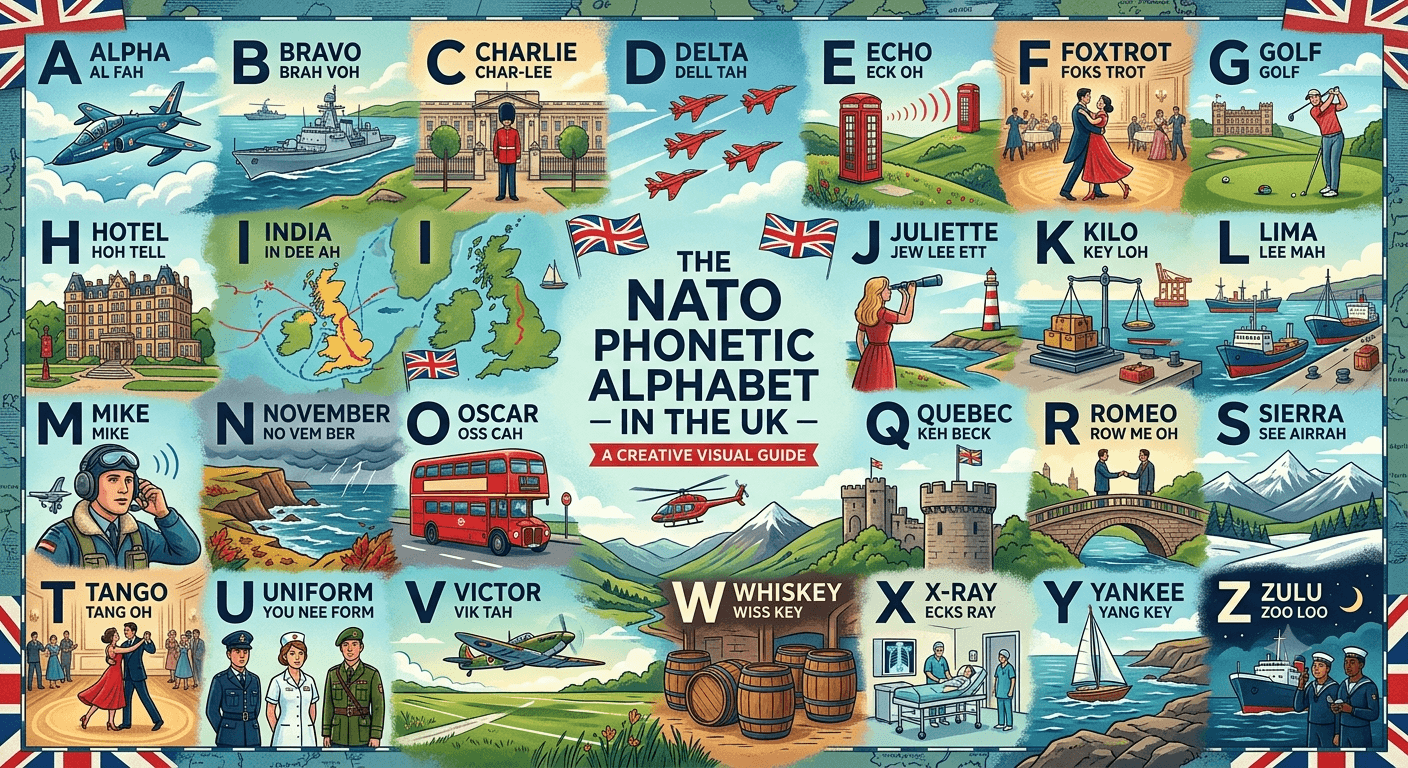
A – Alpha: AL FAH
B – Bravo: BRAH VOH
C – Charlie: CHAR-LEE
D – Delta: DELL TAH
E – Echo: ECK OH
F – Foxtrot: FOKS TROT
G – Golf: GOLF
H – Hotel: HOH TELL
I – India: IN DEE AH
J – Juliette: JEW LEE ETT
K – Kilo: KEY LOH
L – Lima: LEE MAH
M – Mike: MIKE
N – November: NO VEM BER
O – Oscar: OSS CAH
P – Papa: PAH PAH
Q – Quebec: KEH BECK
R – Romeo: ROW ME OH
S – Sierra: SEE AIRRAH
T – Tango: TANG OH
U – Uniform: YOU NEE FORM
V – Victor: VIK TAH
W – Whiskey: WISS KEY
X – X-Ray: ECKS RAY
Y – Yankee: YANG KEY
Z – Zulu: ZOO LOO
A Brief History of the Phonetic Alphabet UK
Spelling alphabets have been developed and used to clarify verbal communication since World War I. The first non-military, globally accepted spelling alphabet was initially adopted in 1927 by the CCIR, the predecessor of the International Telecommunication Union. These early efforts were focused on maritime and early radio communication, where signal interference was a constant challenge. As technology and international cooperation expanded, the need for a more robust and universal system became apparent to both military and civilian organizations.
During World War II, the International Air Transport Association acknowledged a need for a universal, standardised spelling alphabet that featured phonemes common in different languages such as English, French, Spanish, and Portuguese. In the late 1940s, linguist Jean-Paul Vinay worked with the International Civil Aviation Organisation to develop a spelling alphabet with those requirements to suit native English, French, and Spanish speakers. This research involved extensive testing with hundreds of thousands of phonetic combinations to find the most distinct words for international use.
In the late 1950s, the NATO alphabet was developed and later became universally used for military, civilian, and common radio communications. Designed by the NATO group to help with audio clarity, this new phonetic alphabet for the UK and US was introduced in 1955. It replaced several competing systems that were often incompatible with each other. Today, this standard is managed by the International Civil Aviation Organization, ensuring that it remains the global benchmark for safety and clarity in communication.
Different versions of the phonetic alphabet over the years
The journey to the current system involved several iterations that reflected the linguistic and operational needs of different eras. These older versions are still occasionally referenced in historical contexts or by those who served in specific military branches. Each version was a stepping stone toward the refined NATO system we use today.
Royal Navy (1914 – 1918)
During the Great War, the Royal Navy utilized a system that was distinct to British maritime operations. It featured words like Apples, Butter, and Charlie. While it served its purpose for the time, many of the words were too similar to common nouns used in everyday speech, which could lead to confusion during a combat situation. This system was largely localized and did not account for the needs of international allies who might have different pronunciations for the same words.
Western Front slang (1924 – 1942)
In the years following World War I, a hybrid system of official codes and informal military slang emerged. This era saw the use of words like Ack, Beer, and Don. This version was deeply entrenched in the British army culture but was found to be less effective as global aviation began to take flight. The move toward a more formal telephone alpha system was driven by the realization that military slang did not translate well to international civilian or cooperative military operations.
Royal Air Force (1943 – 1956)
The RAF developed its own distinct spelling alphabet during the Second World War to help pilots communicate clearly over the roar of engines and radio static. This version, known as the Able Baker alphabet, included words like Able, Baker, Charlie, and Dog. It became famous through wartime films and literature. However, as air travel became more globalized after the war, the limitations of this English-centric system led to its eventual replacement by the more inclusive NATO standard.
United States (1941 – 1956)
Across the Atlantic, the United States military used the Joint Army/Navy Phonetic Alphabet, which shared many similarities with the British RAF system. This alignment was helpful during joint operations but still faced challenges when interacting with non-English speaking allies. The decision to adopt the modern code for letters alpha bravo in 1956 was a significant diplomatic and technical achievement, creating a unified language for the defense of the Western world.
Why the phonetic alphabet UK is vital in contact centres
In the modern business world, particularly in UK-based contact centres, the use of a spelling alphabet chart is a critical component of high-quality customer service. Accuracy is paramount when dealing with financial records, personal identification, and delivery instructions. When an advisor uses the phonetic alphabet uk, they are employing a tool that ensures the information is captured correctly the first time, which is the foundation of a positive customer journey and operational efficiency.

1. It makes recording information easier for advisors
One of the primary benefits of using the phonetic alphabet england standard is the ease with which advisors can record complex data. When a customer provides a reference code or a surname, the advisor can use the standardized words to verify each character. This reduces the cognitive load on the agent, as they no longer have to guess if the customer said N or M. By using “November” and “Mike,” the distinction is clear, allowing the advisor to focus on other aspects of the customer’s needs without worrying about spelling errors.
2. It makes conveying information easier for customers
Effective communication is a two-way street, and the phonetic uk alphabet helps the customer just as much as the advisor. When a customer needs to write down a voucher code or a tracking number, hearing the advisor use clear, distinct words makes the process much smoother. It prevents the customer from having to ask the advisor to repeat themselves multiple times, which can be a significant source of frustration. This efficiency shows respect for the customer’s time and ensures they leave the interaction with the correct information.
3. It helps when there are different dialects or accents involved
The United Kingdom is a nation of diverse accents, from the Scottish Highlands to the southern coast of England. These regional variations can sometimes make certain letters sound identical over a phone line. The uk phonetic alphabet acts as a universal translator that bridges these regional gaps. Regardless of whether a person has a thick Geordie accent or a refined RP accent, the words “Tango” and “Sierrra” remain distinct and recognizable, ensuring that communication remains clear across the entire country.
4. It conveys professionalism and builds trust
There is a psychological aspect to using the british phonetic alphabet in a professional setting. It signals to the customer that the advisor is well-trained and that the company values precision. When an agent confidently uses the NATO terms, it creates a sense of authority and reliability. Customers are more likely to trust a business that handles their data with such meticulous care. In contrast, using inconsistent words like “A for Apple” or “B for Banana” can sometimes feel less professional and may lead to doubts about the accuracy of the overall service.
Negative effects of poor communication in customer service
When communication breaks down, the consequences for a business can be severe. Failing to use the phonetic alphabet uk often leads to minor errors that snowball into significant operational problems. These mistakes are not just inconvenient; they carry a real financial and reputational cost. In a competitive market, no business can afford to let poor communication undermine its relationship with its customers or its efficiency.
1. Loss of potential sales and profit
Accuracy in data collection is directly tied to a company’s bottom line. If a customer’s email address is recorded incorrectly because the agent confused an S with an F, that customer may never receive their order confirmation or marketing materials. This results in lost sales opportunities and the cost of rectifying the error. Furthermore, incorrect shipping details lead to failed deliveries and additional shipping costs. Using the england phonetic alphabet helps ensure that every piece of data is a step toward a successful transaction rather than a costly mistake.
2. Loss of customer loyalty and satisfaction
Customer loyalty is built on a foundation of ease and reliability. If a customer has to call back because their name was misspelled on an insurance policy or their address was wrong on a delivery, their satisfaction levels will plummet. They will perceive the company as incompetent and may seek out a competitor for their next purchase. By neglecting the telephone alpha standards, companies create unnecessary friction in the customer experience, which is a leading cause of customer churn in the UK service industry.
3. Tainted brand reputation in the digital age
In today’s interconnected world, a single bad experience can be broadcast to thousands of potential customers via social media or review platforms. A brand that is seen as unable to perform basic tasks like spelling a name correctly will quickly gain a reputation for poor quality. The phonetic alphabet uk is a simple tool, but its consistent application is a marker of a high-quality organization. Protecting a brand’s reputation requires a focus on the fundamentals, and there is nothing more fundamental than clear, accurate communication between a business and its clients.
Implementation of the phonetic alphabet uk in the contact centre
Integrating the phonetic alphabet uk into a contact centre’s workflow requires a strategic approach. It is not enough to simply provide a list of words; the system must be part of the culture and training of the organization. When properly implemented, the use of the spelling alphabet letters becomes a natural part of every call, leading to better outcomes for both the staff and the customers. This integration starts at the induction phase and continues through ongoing quality monitoring and support.
Used as Part of Induction Training: New recruits should be introduced to the phonetic alphabet uk as soon as they join. Providing a phonetic alphabet to print and study allows them to build their skills before they even take their first live call.
Strong Correlation Between Net Promoter Scores (NPS) and the Phonetic Alphabet: Data from UK service providers suggests a strong link between phonetic clarity and customer satisfaction scores. Research indicates that calls handled with standardized phonetics are rated higher for efficiency.
A study conducted by Call Centre Helper found that teams using the NATO standard consistently outperformed those using informal spelling methods in terms of first-call resolution.
Use A for Apple as Some Customers Struggle: While the NATO standard is the goal, advisors must remain flexible. If a customer does not understand “Alpha,” the advisor should be trained to pivot to a more common word like “Apple” to ensure the customer doesn’t feel confused or alienated.
It Helps Customers and Advisors Spell Correctly: The system provides a shared framework that eliminates the need for “guessing.” This is particularly important for legal and financial services where every character in a document must be verified for compliance.
Which industries use the phonetic alphabet uk most?
The phonetic alphabet uk is an essential tool in any sector where the transmission of information must be perfect. While call centres are a major user, many other industries rely on these codes for safety and operational success. In the medical field, it is used to transmit patient identifiers and pharmacy codes. In the financial sector, it is used to verify transaction IDs and security questions. The reach of the phonetic alphabet england standards is vast, touching almost every part of professional life in the British Isles.
Improves Quality and Reduces Errors: In the logistics and manufacturing sectors, the phonetic alphabet uk is used to confirm part numbers and delivery codes, which prevents expensive mistakes in the supply chain.
Use S for Sugar: In some traditional British industries, informal words like “Sugar” for S are still common. While not part of the official NATO list, they are part of the local british phonetic alphabet heritage.
Printed Sheets During Training: Most training environments keep phonetic alphabet print out sheets visible at all times to reinforce learning and provide a quick reference for new staff.
Use M for Muhammad in Islamic countries: British companies operating internationally often adapt their phonetic choices to be culturally appropriate, demonstrating the versatility of the phonetic alphabet in uk settings.
Use Words the Customer Understands: The ultimate goal of any alphabet for phone calls is successful communication. Skilled advisors know when to stick to the script and when to adapt to the customer’s specific needs.
To Build Rapport Mirror the Customer: Mirroring a customer’s way of speaking, including their choice of spelling words, can help build a stronger rapport and make the customer feel more understood during a difficult call.
Strategies for memorising the phonetic alphabet UK
Learning the phonetic alphabet uk is a valuable skill that can be achieved with a few simple techniques. For many people, the challenge is not in knowing the words but in recalling them instantly under pressure. By using targeted memorisation strategies, anyone can master the full A-Z list and use it confidently in any professional or personal situation. Consistency is the key to moving these words from short-term memory into long-term, subconscious recall.
1. Use flashcards to help with memorisation
Flashcards are one of the most effective tools for learning the phonetic alphabet print out materials. On one side, you have the letter, and on the other, the corresponding NATO word. This allows for rapid self-testing and helps to cement the connection between the letter and its code word. Many modern learners use mobile apps that employ spaced repetition algorithms to ensure that the most difficult letters, like the phonetic alphabet q or j, are reviewed more frequently until they are mastered.
2. Use Real-time Assist (RTA) cards
In a live work environment, Real-time Assist cards provide a safety net for staff who are still perfecting their skills. These cards are typically placed on the desk or attached to the computer monitor, providing a quick glance at the phonetic alphabet chart printable when needed. This reduces the stress of the interaction and ensures that the advisor never has to guess a word. Over time, the advisor will find themselves looking at the card less and less as the alphabet phonetic list becomes deeply ingrained in their memory.
Easily confused spoken letters and their solutions
The English language contains several letters that are phonetically similar, especially when heard through the limited frequency range of a telephone. Letters like M and N, or F and S, are the most frequent causes of spelling errors. The phonetic alphabet uk was specifically designed to solve these specific acoustic problems. By choosing words with different vowel sounds and distinct starting consonants, the designers of the NATO system ensured that “Mike” and “November” could never be mistaken for one another, even in the worst conditions.
The modified and simplified UK phonetic alphabet
While the NATO standard is the gold standard for professional communication, there are simplified and modified versions of the phonetic alphabet uk used in more informal settings. These variations often arise from local traditions or the specific needs of a particular community. For example, some people prefer a version of the phonetic alphabet to print that uses more common household objects or familiar names. However, for anyone working in a regulated or high-stakes environment, sticking to the official military alphabet q and other NATO terms is always the safest course of action to avoid any possibility of confusion.
A simplified phonetic alphabet uk list often removes the pronunciation guides and just provides the essential word pairings. This is ideal for quick reference in a busy office or for including in a company handbook. While it doesn’t provide the historical depth of the full system, it offers the immediate practical utility required for daily tasks like alphabet telephone communication. Whether using the full system or a simplified version, the goal remains the same: ensuring that every letter is heard, understood, and recorded with total accuracy.
Read More: Spam Risk Meaning: A Comprehensive Guide
Final Thought
The phonetic alphabet uk is more than just a list of words; it is a vital tool for ensuring precision and professionalism in a world where clear communication is increasingly difficult. From its origins in the battlefields of World War I to its modern-day application in high-tech call centres, the system has proven its value time and again. By mastering the 26 words from Alpha to Zulu, individuals can enhance their communication skills, reduce errors, and provide a higher level of service to their clients. As we continue to rely on verbal communication in our digital age, the importance of a standardized spelling alphabet remains as relevant as ever, serving as a bridge of clarity across diverse accents and technical challenges.
Frequently Asked Questions
What is the 26 phonetic alphabet uk list?
The full 26-word phonetic alphabet uk used in the NATO standard consists of: Alpha, Bravo, Charlie, Delta, Echo, Foxtrot, Golf, Hotel, India, Juliette, Kilo, Lima, Mike, November, Oscar, Papa, Quebec, Romeo, Sierra, Tango, Uniform, Victor, Whiskey, X-ray, Yankee, and Zulu. These words are universally recognized in the UK for spelling out letters over the phone or radio.
Why do pilots say tango foxtrot romeo?
Pilots use these words because they are part of the standard phonetic alphabet uk designed for maximum clarity. Tango, Foxtrot, and Romeo represent the letters T, F, and R. Using these distinct words ensures that air traffic control and other pilots can understand the letters clearly even with background noise or radio interference, which is critical for aviation safety.
Why did zebra change to zulu in the alphabet?
The change occurred to improve international clarity. While “Zebra” is a common word, “Zulu” was found to be phonetically more distinct and easier for non-native English speakers to recognize during global tests. This shift was part of the finalization of the NATO phonetic alphabet in 1956 to create a truly universal spelling system for both the UK and its allies.
Are the UK and US phonetic alphabets the same today?
Yes, both the UK and the US have adopted the NATO phonetic alphabet as their official standard for military and civilian communication. While they historically used different systems like the RAF and Able Baker alphabets, they unified their systems in 1956 to ensure that all allied forces and international pilots were using the same code words.
What is q in the phonetic alphabet uk?
In the phonetic alphabet uk, the letter Q is represented by the word Quebec. It is one of the most important letters to use correctly, as the sound of the letter Q can often be confused with U or K when spoken quickly. Using Quebec ensures that there is no doubt which letter is being referenced.
Is there a difference between a phonetic and a spelling alphabet?
In common usage, they are the same, but in linguistics, they differ. A true phonetic alphabet, like the IPA, uses symbols to represent specific sounds. A spelling alphabet, like the phonetic alphabet uk, uses words to represent letters. Most people mean the spelling alphabet when they use the term phonetic in a business or military context.
How can I get a phonetic alphabet printable chart?
Many websites offer a phonetic alphabet printable or a phonetic alphabet pdf that you can download for free. These charts are excellent tools for offices, call centres, or even home use. Having a physical copy helps you learn the words quickly and serves as a reliable reference during important phone calls where accuracy is required.
Why is the phonetic alphabet uk so common in call centres?
It is common because it dramatically reduces the number of errors made when taking down customer information. In a fast-paced environment, mishearing a single letter in a postcode or email can lead to significant problems. The phonetic alphabet uk provides a standard that all employees can follow to ensure they are getting the details right the first time.