
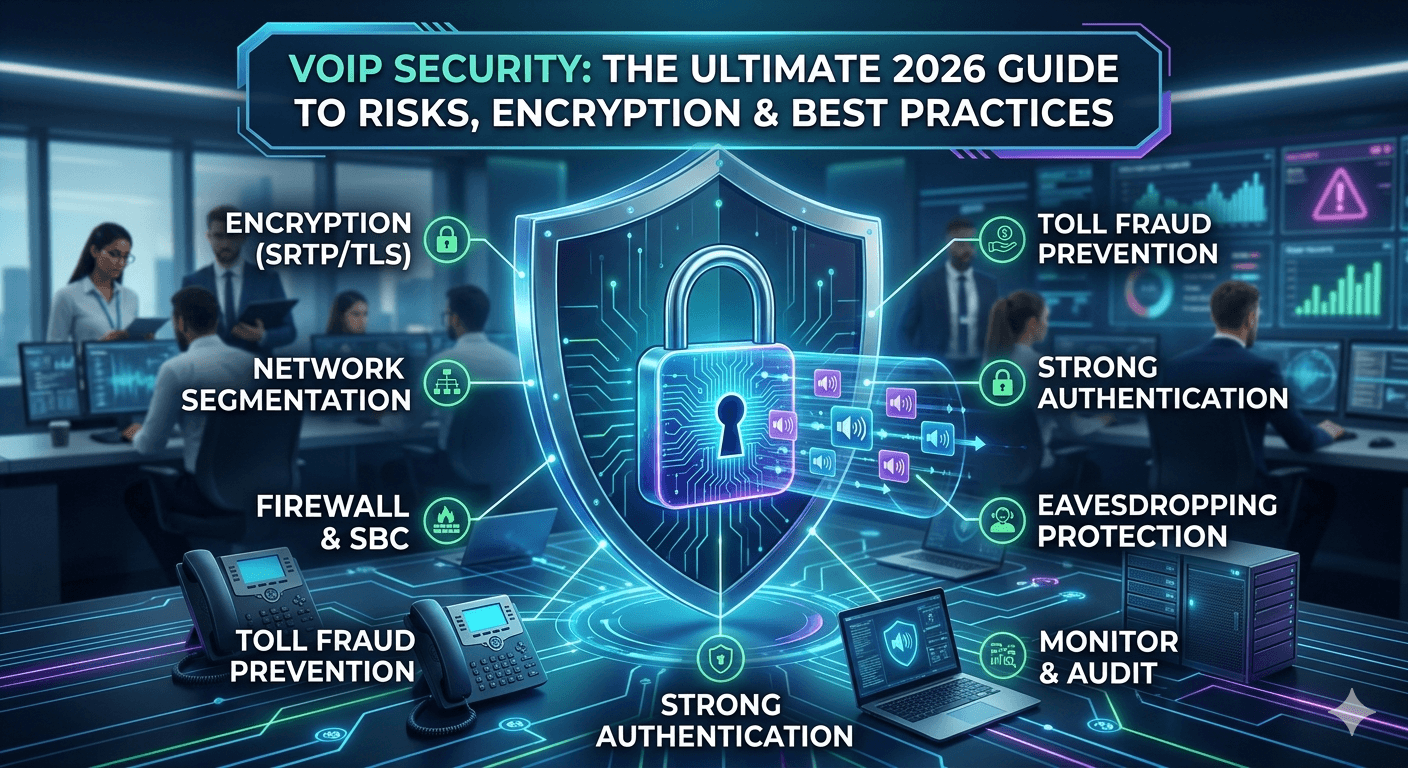
Learning how to secure your VoIP calls is essential for any modern business relying on digital communication systems. Voice over Internet Protocol technology transmits voice data over the internet, which exposes it to common cyber threats such as eavesdropping, spoofing, and unauthorized access. To effectively secure your VoIP calls, you must implement robust encryption protocols like SRTP and TLS, utilize specialized firewalls, and enforce strict authentication measures. By following industry best practices and monitoring your network traffic, you can ensure that your voice-over-internet-protocol communications remain private, compliant, and protected from sophisticated hackers and malicious attacks.
Top Cybersecurity Threats & Trends In 2026
The year 2026 has introduced a new era of sophisticated cyber attacks targeting voiceover ip systems through the use of generative AI and automated exploitation tools. Hackers are now using synthetic voice technology to bypass biometric authentication, making voip security issues more complex than ever before. Recent reports from cybersecurity analysts indicate a 45% increase in automated voip attack attempts targeting mid-sized enterprises that lack dedicated voice over ip security protocols. These trends suggest that simply having a password is no longer enough to protect sensitive business conversations and proprietary data shared over the phone.
Current voip security news today highlights the rise of “vishing” as a service, where criminals use compromised ip phone security to launch massive social engineering campaigns. To combat these trends, many businesses are turning to advanced voip security solutions that incorporate behavioral analytics to detect unusual calling patterns in real-time. Staying ahead of these threats requires a deep understanding of how voiceprotocol vulnerabilities are exploited and a commitment to maintaining an encrypted voip service. Organizations are also focusing more on voip pci compliance to ensure that any financial data handled over the phone meets strict international security standards.
MPLS Meaning in Networking: Benefits & How It Works
Multi-Protocol Label Switching, commonly known as MPLS, is a routing technique that directs data from one node to the next based on short path labels rather than long network addresses. In the context of voice over ip security, MPLS creates a private network environment that is physically separated from the public internet, significantly reducing the surface area for a potential voip attack. By using this technology, businesses can ensure that their voice and data network security providers can prioritize voice packets, resulting in higher call quality and lower latency. This dedicated path makes it much harder for external parties to intercept calls compared to standard internet-based routing.
-
MPLS provides enhanced security by keeping voice traffic off the public internet where most voip attacks originate.
-
It allows for Quality of Service (QoS) tagging, ensuring that call telephone traffic receives the highest priority on the network.
-
The technology simplifies the management of complex networks by using labels to switch packets instead of looking up complex routing tables.
-
Businesses using MPLS often see a reduction in packet loss, which is critical for maintaining a clear and reliable telophony experience.
Is VoIP Secure?
The question of whether voiceoverip is inherently secure depends entirely on the implementation and the specific voip security best practices used by the provider. While a basic vioip setup might be vulnerable to simple exploits, a professionally managed encrypted voip service is often more secure than a traditional analog phone line. Traditional phones are susceptible to physical wiretapping, whereas modern voip encryption makes it virtually impossible for someone to listen to your calls without the proper digital keys. Therefore, the security of your communication is a direct reflection of the ip phone security measures you choose to put in place.
Many users wonder if are voip phones secure when they are used in a remote or home office setting without a corporate firewall. The reality is that voice over ip security is a shared responsibility between the service provider and the end-user. When you use a reputable provider like vonage voice over ip, you benefit from their massive investment in infrastructure protection and voip sip security news monitoring. However, if the user does not change default passwords or fails to use a secure voip connection, even the best systems can be compromised. Ultimately, is voip secure is a question that is answered by the strength of your encryption and the diligence of your network administration.
Common VoIP Security Risks
Understanding the various voip risks is the first step toward building a resilient communication network for your business. Because voice packets travel over the same channels as your emails and web browsing, they are subject to the same types of digital interference and malicious activity. A single vulnerability in your voiceprotocol can lead to a massive data breach or significant financial loss if not addressed by modern voip security solutions. These risks are not just theoretical; they are daily challenges faced by IT departments managing large-scale voice and data network security providers.
Common vulnerabilities often stem from misconfigured hardware or outdated software that creates an opening for a voip attack. For instance, many businesses forget to update the firmware on their ip phones, leaving them open to known exploits that hackers can find easily online. Additionally, the use of a vertual phone number without proper backend security can lead to unauthorized access to your company’s internal directory. By identifying these common voip security issues early, you can implement the necessary safeguards to protect your phone calls and maintain the integrity of your business communications.

1. Eavesdropping
Eavesdropping is one of the most prevalent voip security issues where an unauthorized party intercepts and listens to your private conversations. In an unencrypted environment, voice data is sent as plain text packets that can be captured using simple network sniffing tools like voipmonitor. This type of attack is particularly dangerous because it often goes undetected for long periods, allowing criminals to gather sensitive corporate intelligence or personal information. To prevent this, an encrypted voip service is mandatory, as it scrambles the data so that even if it is intercepted, it remains unreadable.
2. Call Hijacking
Call hijacking involves an attacker taking control of a signaling session to redirect a call to a different destination or to insert themselves into the conversation. This is a significant concern for those managing voice over ip security because it can lead to the theft of service or the dissemination of false information. Attackers typically exploit vulnerabilities in the SIP protocol to gain control over the call session. Implementing strong voip sip security news updates and using authenticated signaling can prevent these types of unauthorized redirections from occurring on your network.
3. Distributed Denial of Service (DDoS) Attacks
A DDoS attack on a voip system involves flooding the network with a massive volume of requests, effectively crashing the service and preventing legitimate phone calls. This is one of the more aggressive voip attacks that can paralyze a business’s ability to communicate with customers and partners.
According to a study by the Cybersecurity & Infrastructure Security Agency (CISA), DDoS attacks against communication providers have increased in complexity, often using botnets to overwhelm even robust voip security solutions. Protecting against this requires high-capacity bandwidth and specialized filtering equipment.
4. Toll Fraud
Toll fraud is a lucrative criminal enterprise where attackers gain access to your voip system to make expensive international calls at your expense. This specific voip attack can result in thousands of dollars in charges over a single weekend if the breach is not detected quickly. Criminals often target businesses with weak password policies or those that have not restricted their international calling capabilities. Monitoring call logs and setting up automated alerts for unusual calling patterns are essential voip security best practices to mitigate the risk of financial loss from toll fraud.
5. Caller ID Spoofing
Caller ID spoofing occurs when an attacker manipulates the information displayed on the recipient’s phone to make it appear as though the call is coming from a trusted source. This technique is frequently used in vishing attacks to trick employees into revealing sensitive information or transferring funds. While it is difficult to stop spoofing entirely due to how the global telophony network operates, using advanced ip phone security and educating staff can reduce the impact. Evaluating the messagewhiz company vonage on otp services can also provide insights into how to better verify the identity of callers and message senders.
6. Man-in-the-Middle (MitM) Attacks
In a Man-in-the-Middle attack, a hacker inserts themselves between two communicating parties to secretly relay and possibly alter the communication. This is a severe threat to voice over ip security because the attacker can record conversations, inject their own audio, or steal authentication credentials. MitM attacks often happen on unsecured public Wi-Fi networks where the hacker can easily intercept voio traffic. Using a secure voip connection with end-to-end encryption is the most effective way to ensure that your voice packets cannot be tampered with by an intermediary.
VoIP Encryption: How It Works & Why It Matters
Encryption is the cornerstone of any effective voip security system, providing the necessary shield against unauthorized data access. When you use an encrypted voip service, your voice data is converted into a complex code using mathematical algorithms before it ever leaves your device. This process ensures that only the intended recipient, who possesses the correct decryption key, can hear the audio. Without encryption, your voice-over-internet-protocol traffic is as vulnerable as an open postcard sent through the mail, visible to anyone who handles it along the way.
There are two primary components to voice over ip security encryption: signaling encryption and media encryption. Signaling encryption, usually handled via Transport Layer Security (TLS), protects the setup information of the call, such as who is calling whom. Media encryption, typically handled by the Secure Real-time Transport Protocol (SRTP), protects the actual voice data being exchanged. Research from the International Journal of Cyber Security has shown that implementing both TLS and SRTP can reduce the risk of successful packet interception by over 99%, making it a non-negotiable standard for modern business communication.
-
The voice signal is digitized and compressed into small data packets by the ip phone security software.
-
Each packet is then encrypted using a strong algorithm like AES-256, which is the current industry standard for high-level security.
-
The encrypted packets are transmitted over the network using the secure voip protocol.
-
Upon reaching the destination, the receiving device uses a private key to decrypt the packets and convert them back into audible sound.
8 VoIP Security Best Practices For Businesses
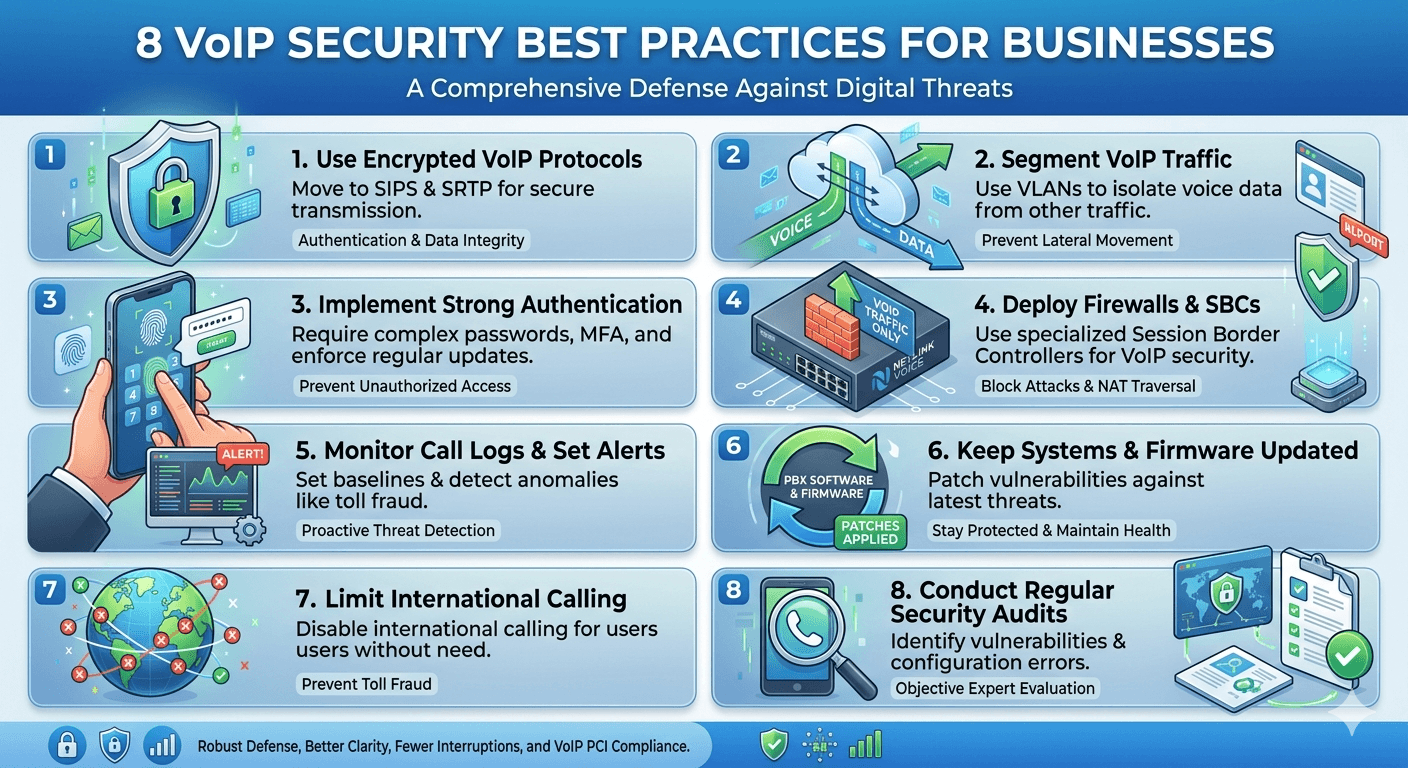
Implementing a comprehensive set of voip security best practices is the best defense against the evolving landscape of digital threats. It is not enough to simply buy a secure phone; you must also manage the environment in which that phone operates. This involves a combination of technical configurations, employee training, and constant network vigilance. By taking a layered approach to your voip security solutions, you can create a robust defense that protects your company’s reputation and financial assets from malicious actors who target voiceoverip systems.
A well-secured network not only prevents attacks but also improves the overall performance and reliability of your communications. When you eliminate unauthorized traffic and protect your bandwidth, your legitimate phone calls will have better clarity and fewer interruptions. Furthermore, following these practices helps in maintaining voip pci compliance, which is essential if your business handles credit card information over the phone. Let’s explore the eight critical steps every business should take to secure their voice and data network security providers.
1. Use Encrypted VoIP Protocols
The most fundamental step in securing your communications is to ensure that you are using encrypted voip protocols for all transmissions. This means moving away from standard SIP and RTP to their secure counterparts, SIPS and SRTP. These protocols provide the necessary framework for authentication and data integrity, ensuring that your voice packets have not been altered during transit. Most modern voip security solutions support these protocols out of the box, but they often need to be manually enabled and configured by your IT department to be effective.
2. Segment VoIP Traffic
Network segmentation involves creating a separate Virtual Local Area Network (VLAN) specifically for your voiceover ip traffic. By isolating voice data from your regular data traffic, you limit the ability of a hacker who has compromised a computer on your network to reach your phone system. This separation also allows you to apply more stringent security rules and Quality of Service policies specifically to your voice calls. Segmenting your network is a core component of ip phone security that prevents lateral movement by attackers and reduces the overall risk of a wide-scale breach.
3. Implement Strong Authentication
Unauthorized access to your voip system can be prevented by enforcing strong authentication policies across all devices and user accounts. This includes using complex passwords, changing them regularly, and implementing Multi-Factor Authentication (MFA) whenever possible. Many voip security issues arise because employees use easily guessable passwords or leave default credentials on their desk phones. By requiring a second form of verification, such as a code sent to a mobile device, you add a critical layer of protection that is much harder for a remote attacker to bypass.
4. Deploy Firewalls & SBCs
A standard network firewall is often not enough to handle the specific requirements of voice over ip security. Businesses should deploy a Session Border Controller (SBC), which acts as a specialized firewall designed specifically for voip traffic. An SBC can detect and block voip attacks, handle NAT traversal, and ensure that only authorized signaling reaches your internal network. These devices are essential for protecting the edge of your network and are a staple in the offerings of top-tier voice and data network security providers like netlink voice.
5. Monitor Call Logs & Set Alerts
Continuous monitoring of your call logs is essential for the early detection of fraudulent activity such as toll fraud or call hijacking. You should establish a baseline of normal calling behavior and then configure your voip security system to send alerts when it detects anomalies. For example, if your business suddenly starts making hundreds of international calls at 3:00 AM, your system should automatically flag this and potentially block the calls until they can be verified. Proactive monitoring is a key part of voip security best practices that can save your business from massive unexpected expenses.
6. Keep Systems & Firmware Updated
Hardware and software manufacturers frequently release updates to patch vulnerabilities that could be exploited in a voip attack. Failing to keep your ip phone security firmware and your PBX software up to date is one of the most common mistakes businesses make. You should have a regular schedule for checking for updates and applying them across your entire infrastructure. This practice ensures that you are protected against the latest known threats discussed in voip security news today and maintains the overall health of your communication network.
7. Limit International Calling
One of the simplest yet most effective ways to prevent toll fraud is to limit or disable international calling for users who do not require it. Most voip security solutions allow you to set granular permissions, ensuring that only specific employees can make long-distance calls. By restricting these capabilities, you significantly reduce the potential financial impact of a compromised account. This is a practical step in managing your voiceover ip system that requires very little technical effort but provides a high level of protection against one of the most common types of fraud.
8. Conduct Regular Security Audits
Regular security audits involve a comprehensive review of your entire voip infrastructure to identify any new vulnerabilities or configuration errors. This should include testing your encryption, reviewing access logs, and even conducting simulated voip attacks to see how your system responds. An audit provides a clear picture of your current security posture and helps you prioritize improvements. Many companies choose to partner with specialized voice and data network security providers to perform these audits, ensuring an objective and expert evaluation of their secure voip phone environment.
Read More: How to Get UK Number Free: Your Ultimate Global Guide
Final Thought
Securing your VoIP calls is an ongoing process that requires constant attention to the latest threats and a commitment to using the best available technology. As voice-over-internet-protocol continues to evolve, so too will the methods used by cybercriminals to exploit it. By implementing a combination of strong encryption, network segmentation, and proactive monitoring, you can create a communication environment that is both efficient and highly secure. Remember that the goal is not just to prevent one type of attack, but to build a resilient system that can withstand a variety of challenges while maintaining the privacy and integrity of every conversation.
FAQs
-
How secure are VoIP phone calls?
VoIP phone calls are highly secure when implemented with modern encryption and security protocols like SRTP and TLS. While they travel over the internet, which is a public medium, the use of these technologies ensures that the voice data is scrambled and protected from unauthorized interception. However, the level of security depends on the specific voip security best practices followed by both the service provider and the organization using the technology. A properly configured system is generally more secure than traditional analog lines.
-
Can VoIP calls be monitored?
Yes, VoIP calls can be monitored if they are not properly encrypted, as the data packets can be captured by hackers using network sniffing tools. Without an encrypted voip service, your voice traffic is sent in a format that can be reconstructed and listened to by anyone with access to the network path. This is why using voice over ip security measures like encryption and secure gateways is critical for any business that discusses sensitive or proprietary information over the phone.
-
How do I protect my VoIP against eavesdropping?
The most effective way to protect your system against eavesdropping is to enable end-to-end encryption using Secure Real-time Transport Protocol (SRTP). This ensures that the audio data is encrypted from the moment it leaves the sender’s device until it reaches the recipient. Additionally, you should use Transport Layer Security (TLS) for call signaling to prevent attackers from seeing who is participating in the call. Implementing these voip security solutions creates a digital tunnel that keeps your conversations private and away from prying eyes.
-
Can VoIP be encrypted?
VoIP can and should be encrypted to ensure the privacy and security of digital communications. Most professional-grade voiceover ip services offer built-in encryption features that protect both the signaling and the media portions of a call. By using a secure voip connection, businesses can meet various regulatory requirements and protect themselves from data breaches. Encryption is considered the gold standard in voip security best practices and is a fundamental component of any modern communication strategy.
-
What is the biggest threat to VoIP security?
The biggest threat to VoIP security is often a lack of proper configuration and weak authentication, which leads to unauthorized access and toll fraud. When systems are left with default passwords or unpatched software, they become easy targets for automated voip attacks. Another significant threat is social engineering, where attackers use spoofed caller IDs to trick employees into giving up sensitive information. Addressing these human and technical vulnerabilities is essential for maintaining a secure voip phone system.
-
Does a VPN improve VoIP security?
A VPN can significantly improve VoIP security by creating an encrypted tunnel for all your internet traffic, including your voice calls. This is particularly useful for remote workers who may be using unsecured public Wi-Fi networks where the risk of a voip attack is much higher. By using a VPN in conjunction with an encrypted voip service, you add an extra layer of defense that makes it even harder for attackers to intercept or manipulate your communications.
-
What is toll fraud in VoIP?
Toll fraud is a type of cybercrime where an attacker gains unauthorized access to a business’s VoIP system to make expensive international calls. The criminals often sell these calling services to others or use them for their own purposes, leaving the victimized business with a massive phone bill. This is one of the most common voip security issues because it directly results in immediate financial gain for the attacker. Preventing toll fraud requires strict access controls and continuous monitoring of call patterns.
-
Why is an SBC important for VoIP security?
A Session Border Controller (SBC) is important because it acts as a specialized security gateway that manages and protects the flow of voice traffic into and out of your network. Unlike a standard firewall, an SBC understands the specific protocols used in voiceoverip and can detect threats that a normal firewall might miss. It provides essential functions like hide-topology, DDoS protection, and protocol normalization, making it a critical component of high-level voice over ip security for enterprises.