
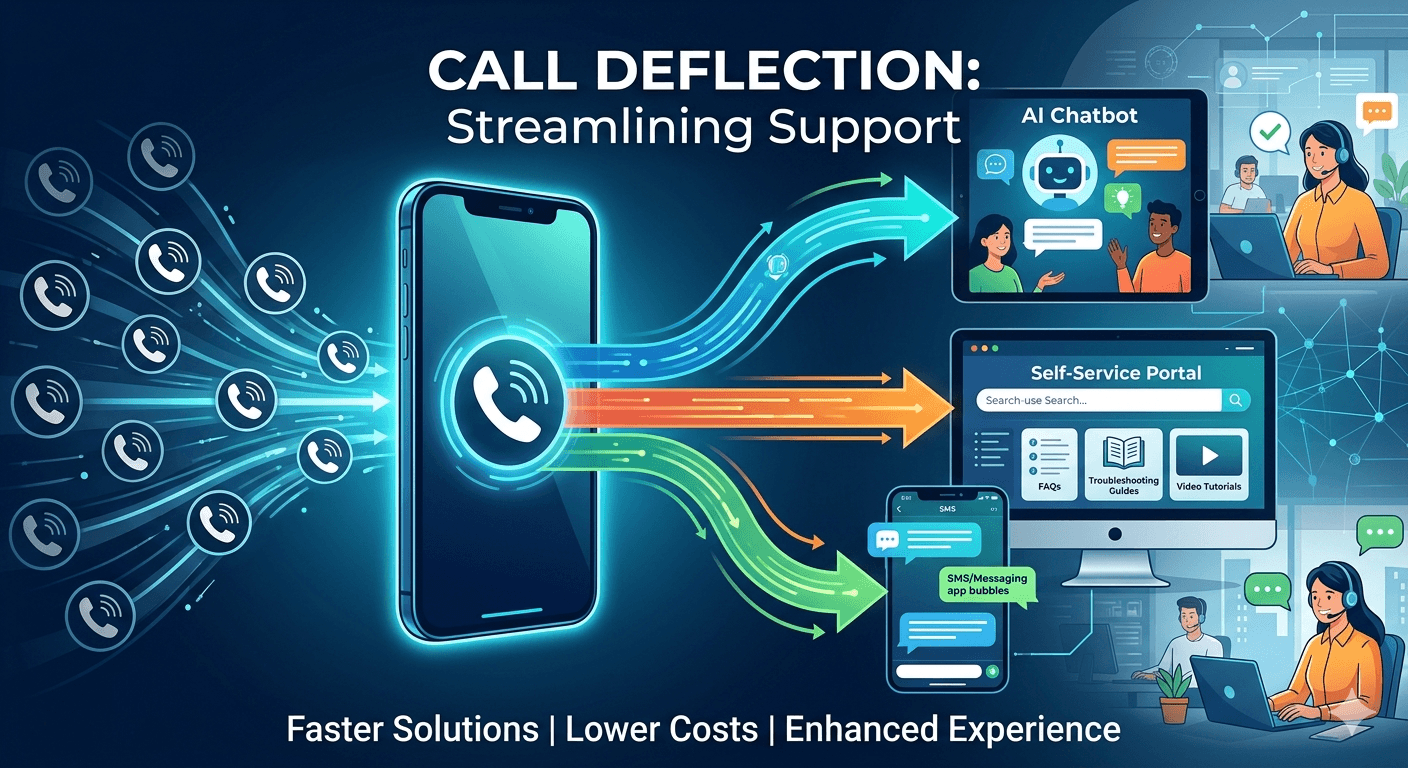
Call deflection is a customer service technique used to reroute incoming phone inquiries to alternative, lower-cost digital channels such as chatbots, self-service portals, or messaging apps. By providing customers with faster ways to solve their problems without waiting for a human agent, organizations can reduce operational costs and improve satisfaction scores. Successful call deflection does not mean avoiding customers but rather empowering them with resources that offer immediate resolutions. Implementing these strategies effectively allows contact centers to manage high call volumes while ensuring that complex issues receive the dedicated attention of live representatives.
What is Call Deflection?
The call deflection meaning involves the strategic shift of customer interactions from traditional voice calls to digital self-service or assisted-service channels. This process is essential for businesses that face fluctuating call volumes and want to maintain a high level of service without exponentially increasing their headcount. When a customer reaches out, the system identifies the nature of their query and offers a more efficient path, such as an SMS link to a troubleshooting guide or a live chat option. This ensures that the telephone line remains open for urgent or highly sensitive matters that truly require human empathy and complex decision-making.
In the broader context of customer support, what is call deflection remains a core question for managers looking to optimize efficiency. It integrates various digital touchpoints to create a seamless ecosystem where the customer finds the path of least resistance to a valid solution. A common misconception is that this practice is intended to hide from customers or make support inaccessible. In reality, modern customer case deflection is about providing choice and speed, as nearly 70% of customers prefer using self-service channels for simple inquiries rather than waiting on hold to speak with a human representative.
How to Measure Call Deflection Rate
Understanding your call deflection rate is vital for evaluating the success of your digital transformation efforts. This metric measures the percentage of customer inquiries that were successfully resolved through alternative channels compared to the total number of attempted contacts. To find the deflection rate meaning in a practical sense, you need to track how many users started a journey toward a call but were satisfied by a knowledge base article or a chatbot interaction instead. A rising rate typically suggests that your self-service tools are becoming more intuitive and helpful for the average user.
Calculating this metric accurately requires a deep dive into data from multiple touchpoints across the contact center. You must compare the volume of calls handled by agents against the number of unique visitors to your FAQ pages and the number of successfully closed chatbot sessions. If your chatbot deflection rate is high, it indicates that your automated scripts are effectively addressing common pain points. However, it is important to monitor the “bounce” rate as well, where a customer tried a digital channel but eventually ended up calling anyway because they could not find the answer they needed.
Common Reasons Call Deflection Strategies Fail
Many organizations struggle because their call deflection strategies are poorly designed or focus too much on cost reduction at the expense of usability. One major pitfall is offering deflection without a valuable destination; for example, if an IVR suggests a customer visit the website for help, but the website is difficult to navigate or lacks the necessary information, the customer will simply call back frustrated. This creates a loop that increases the workload rather than reducing it. A successful strategy must ensure that every alternative channel is fully equipped to handle the specific inquiries it is meant to resolve.

Another failure point involves treating automated systems as a static layer on top of existing processes rather than an integrated part of the journey. If your AI agents cannot access real-time customer data, such as order status or billing history, they will inevitably fail to provide personalized assistance. This forces the customer to repeat their information multiple times when they finally reach a live agent. To avoid this, businesses must ensure that their digital tools are deeply connected to their CRM and backend databases, allowing for a truly intelligent and helpful automated interaction.
1. Callbacks Rearrange Work Rather than Reduce It
Using callbacks is often mistaken for a deflection success, but it frequently just moves the labor to a different time of day. While it improves the customer experience by preventing long hold times, it does not actually reduce the number of tickets your agents must handle. True call deflection occurs when the customer is empowered to solve the issue independently, removing the task from the agent’s queue entirely.
Relying solely on callbacks can lead to a backlog that overwhelms staff during low-volume hours. To solve this, contact centers should integrate ai-powered ticket deflection that resolves the query during the initial contact. This ensures that the workforce remains focused on high-priority tasks rather than playing catch-up with a long list of outbound calls that could have been handled by a bot or an FAQ page.
2. Deflection Without a Destination Fails Customers
A common mistake in customer service is sending a caller to a generic homepage instead of a specific solution. When voice deflection meaning is interpreted as just getting the caller off the line, the brand reputation suffers. Customers expect that the link they receive via SMS or the suggestion made by an IVR will lead them directly to the answer they are seeking without further searching.
-
Ensure links sent via SMS lead to specific, mobile-optimized help articles.
-
Provide a clear path to return to a live agent if the digital destination is unhelpful.
-
Use deep-linking to take users directly to their specific account or order page.
-
Regularly audit the destination pages to ensure they are updated with the latest service information.
3. Treating AI as a Layer on Top of Existing Systems
Many companies try to implement AI as a separate silo, which prevents the system from being truly effective. For case deflection types to work, the AI must have the same level of access to data as a human agent. If the bot is just a search interface for the website, it will only be able to answer the most basic questions, leading to a high rate of escalation and customer frustration.
Modern leading platforms for voice ai in call deflection require deep integration with existing software stacks. This allows the AI to perform actions like processing a refund or updating a shipping address. When the AI is a core part of the system rather than an added layer, it can provide resolutions that genuinely deflect the need for a human conversation.
How AI Agents are Changing Call Deflection
The introduction of Generative AI and advanced Natural Language Processing has fundamentally changed what we expect from automated support. In the past, chatbots were often limited to simple keyword matching and rigid decision trees, leading to a low chatbot deflection rate because they could not understand nuance. Today, AI agents can engage in complex, multi-turn conversations that feel almost human. These systems are capable of understanding intent and sentiment, allowing them to provide much more accurate and helpful responses.
These AI-driven systems are particularly effective at handling high-volume, predictable inquiries like password resets and delivery tracking. By deploying ai-powered ticket deflection, businesses can automate the most repetitive tasks, freeing up human staff to deal with more creative and empathetic work. As AI continues to learn from every interaction, the accuracy and efficiency of these tools only increase over time, making them the most productive members of the support team.
Call Deflection Best Practices
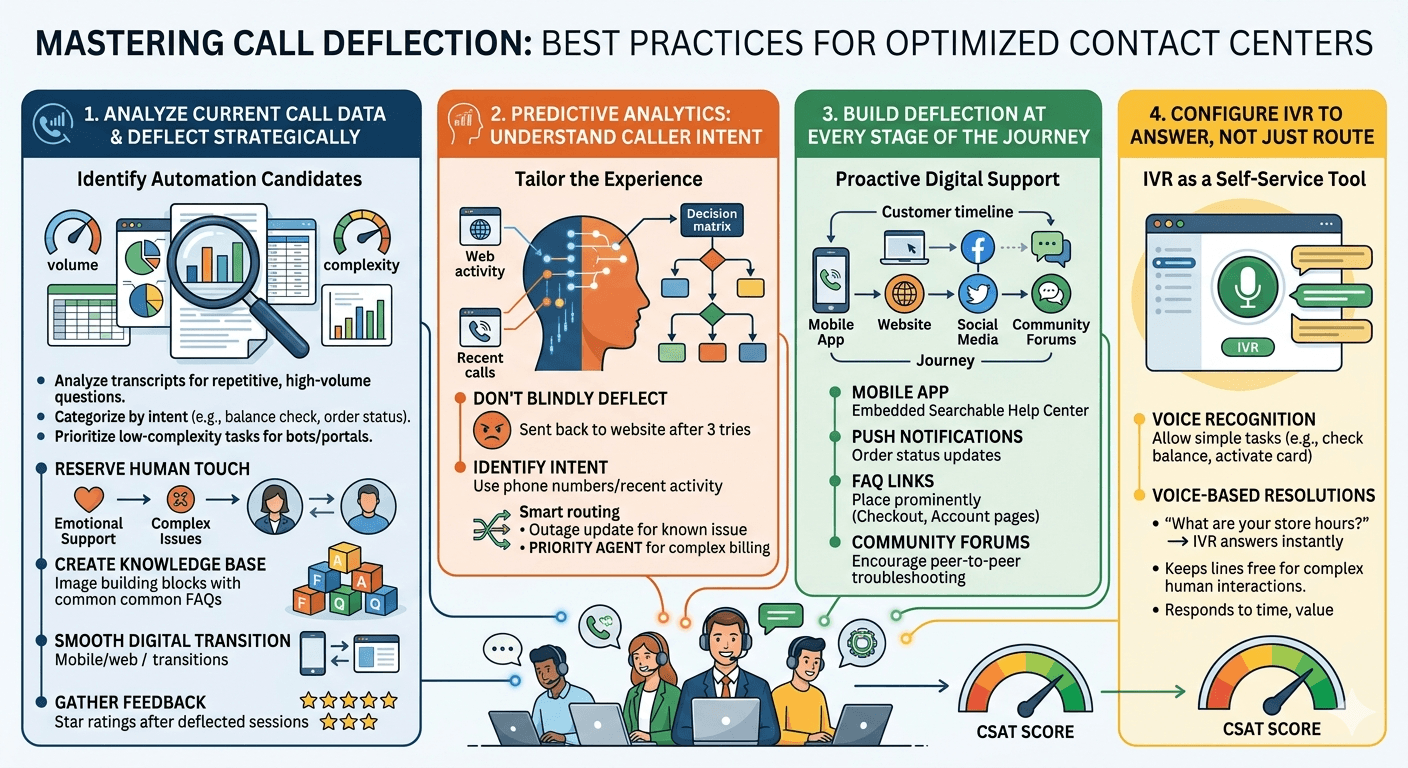
To optimize your contact center, you must start by analyzing your current call data to identify which inquiries are the best candidates for automation. Not every call should be deflected; complex emotional issues or high-value sales inquiries often benefit from a human touch. Use your contact center software to categorize calls by intent and focus your deflection efforts on high-volume, low-complexity tasks that are easy to resolve through a digital portal or bot.
-
Analyze call transcripts to find the most common repetitive questions.
-
Build a comprehensive knowledge base that addresses these specific pain points.
-
Make the transition from voice to digital as smooth as possible with clear instructions.
-
Gather feedback after every deflected session to measure actual resolution success.
-
Understand Why Customers are Calling Before Deflecting Them
Blindly deflecting every caller is a recipe for disaster and will likely result in poor CSAT scores. You must use predictive analytics to understand what is call deflection meant to solve for each specific user. For example, if a customer has already visited your website three times in the last hour, they likely already tried self-service. In this case, deflecting them back to the website will only increase their anger.
By identifying the caller’s intent through their phone number or recent activity, you can provide a more tailored experience. If the system knows they are calling about a known outage, it can provide an automated status update. If they are calling about a complex billing dispute, the system should prioritize getting them to a human agent rather than attempting a deflection that is doomed to fail.
-
Build Deflection at Every Stage of the Customer Journey
True call deflection starts long before the customer dials your number. It involves placing help resources at every digital touchpoint, from your mobile app to your social media profiles. This proactive approach ensures that the customer finds the answer they need while they are still in the digital environment. When support is contextual and easily accessible, the urge to pick up the phone naturally diminishes.
-
Embed a searchable help center within your mobile application.
-
Use proactive push notifications to update users on order statuses.
-
Place FAQ links prominently on checkout and account management pages.
-
Encourage users to use community forums for peer-to-peer troubleshooting.
-
Configure Your IVR to Answer, Not Just Route
Modern IVR systems should be more than just a digital switchboard; they should be capable of solving problems. Through ivr deflection, you can use voice recognition to allow customers to perform simple tasks like checking an account balance or activating a card without ever speaking to an agent. This transforms the IVR from a hurdle into a valuable self-service tool that respects the customer’s time.
When the IVR can provide a direct answer, the need for routing vanishes. For instance, if a customer asks for store hours, the IVR can simply provide the information and ask if there is anything else they need. This is a perfect example of how voice deflection meaning can be expanded to include voice-based automated resolutions that keep the phone line free for more complex human-to-human interactions.
Effective Call Deflection Strategies for Success
To achieve a balanced support ecosystem, you must implement both proactive and reactive strategies. Proactive call deflection strategies focus on preventing the need for a call before it even happens by reaching out to the customer with necessary information. This might involve sending an automated alert about a service delay or a reminder about an upcoming appointment. By being one step ahead of the customer’s needs, you build trust and significantly reduce the incoming volume of simple queries.
Reactive strategies occur once the customer has already initiated contact and are designed to provide a faster alternative to waiting on hold. For example, your system might offer a “text-to-chat” option where the caller receives a link to continue the conversation in a messaging app. This is highly effective for customers who are on the go and do not have the time to sit on hold.
According to research from Genesys, these multi-channel approaches are essential for managing modern consumer expectations and high-volume traffic.
Call Deflection Examples
The health insurance industry provides some of the most compelling call deflection examples. In one instance, a healthcare provider found that their agents were overwhelmed by calls regarding claim statuses. By implementing a series of automated yes/no questions via voice recognition, the IVR was able to provide an overview of the claim, its status, and expected resolution dates. This allowed the provider to highlight additional resources like the healthcare portal or app, reducing the need for live agent intervention for general enquiries.
In the telecommunications sector, operators often use chatbots to handle data plan top-ups. A customer might connect with a chatbot on the app to ask how to increase their data. The chatbot asks security questions and then provides options to top up via a video guide or a direct text command. In both cases, the customer is given the option to resolve their issue before speaking to an agent, supporting the process of reactive deflection and maintaining high efficiency.
-
NHS Cambridge University Hospitals Success
NHS Cambridge University Hospitals implemented a conversational reminder text system to handle appointment cancellations and rebookings. Previously, staff had to call patients individually, which was a time-consuming and disjointed process. The new system allowed patients to confirm or change their appointments directly through the text message, significantly reducing the administrative burden on the hospital staff.
This strategy resulted in a 27% decrease in missed appointments, giving the Trust one of the lowest “Did Not Attend” rates in the country. By providing an easy, digital way to manage appointments, the hospital effectively deflected thousands of calls that would have otherwise gone to busy receptionists. This example shows that call deflection can have a direct and positive impact on public health services and operational outcomes.
-
Centrica Utility Provider Success
Centrica, a leading utility provider, receives over 9 million customer calls every year and struggled with long queue times during peak hours. To address this, they implemented a contact centre deflection strategy using WhatsApp and SMS channels. When a customer calls, the IVR offers them the choice to switch the interaction to a digital messaging platform instead of waiting for a live agent.
This shift allowed customers to send photos of their meters and receive updates on their accounts in a format that suited their lifestyle. The company saw a significant improvement in their chatbot deflection rate and overall customer satisfaction. By giving customers the choice to move to a digital channel, Centrica managed to maintain high service levels despite the massive volume of incoming voice traffic.
Best Practices for Voice Deflection Meaningful Impact
When focusing on voice deflection meaning, it is important to ensure that your resource center is easy to find and use. A well-organized knowledge base acts as the foundation for all your deflection efforts. If customers can find high-quality troubleshooting guides and videos on their own, they are far less likely to call for help. Regularly updating this content based on common agent feedback ensures that the information remains relevant and helpful for the current user base.
-
Resource Center: Build a searchable hub with diverse content types like FAQs and video guides.
-
Proactive Notifications: Alert customers to issues before they feel the need to pick up the phone.
-
Troubleshooting: Provide interactive step-by-step guides for common technical problems.
-
Agent Training: Ensure staff can guide customers toward digital tools during live calls.
-
Analyze KPIs: Regularly review your deflection metrics to identify areas for improvement.
Using leading platforms for voice ai in call deflection allows you to integrate these best practices into a single, cohesive system. These platforms provide the analytics necessary to see which digital paths are successful and which cause customers to drop out. By constantly refining these journeys, you can ensure that your deflection strategy remains effective as customer behaviors change. Ultimately, the goal is to create a support environment where the customer feels supported and valued, regardless of the channel they choose.
Read More: How To Bypass DND? Tips and Tricks
Final Thought
Mastering call deflection is a transformative journey for any contact center aiming to balance efficiency with excellence. It is not merely about reducing the number of phone calls, but about re-imagining the customer journey to favor speed, accuracy, and user empowerment. By leveraging AI-powered tools, proactive communication, and robust self-service portals, organizations can ensure that their human agents are reserved for the moments that truly matter. As digital channels continue to evolve, the most successful companies will be those that view call deflection as a way to enhance, rather than limit, the support they provide to their valued customers.
FAQs
-
What is a call deflection?
Call deflection is a strategy used by customer service centers to redirect incoming phone calls to digital self-service channels. This might include sending a caller an SMS link to an FAQ page, directing them to a chatbot, or offering a web-based portal. The goal is to resolve the customer’s query faster while reducing the workload on live agents.
-
What is the call deflection rate?
The call deflection rate is a KPI that measures the percentage of customer inquiries resolved through self-service or digital channels compared to the total number of attempted contacts. A high deflection rate indicates that your digital resources, like chatbots and knowledge bases, are successfully helping customers without the need for a phone conversation.
-
What do you mean by deflection?
In a contact center context, deflection means guiding a customer away from a high-effort channel, like a voice call, toward a lower-effort digital channel. It is a way of managing traffic by providing the most efficient resolution path for the specific problem at hand, often using automated or AI-driven tools to assist the user.
-
What is a contact deflection?
Contact deflection is a broader term that encompasses all efforts to prevent a customer from needing to reach out for support in the first place. This includes proactive notifications, clear product manuals, and intuitive user interfaces that answer the customer’s questions before they feel the need to start a formal support session.
-
Can I mass-block calls to improve deflection?
No, deflection is about providing alternative help, not blocking access. Mass-blocking callers would severely damage customer trust and brand reputation. Instead, use an IVR to offer the choice of a digital channel, ensuring that those who truly need to speak to a person are still able to do so after a reasonable wait.
-
Why does my number show up as a spam risk during deflection?
If your automated system is making outbound calls or sending texts that are frequently ignored or reported, carriers may flag your number. To avoid this, ensure your communications are highly relevant and that you are using verified caller ID services to maintain the integrity of your outbound support efforts.
-
Are call deflection strategies the same as robocalls?
No, call deflection is a legitimate support tactic requested or initiated by the customer during their journey. Robocalls are typically unsolicited and unwanted automated messages. Deflection is a tool for customer empowerment and service efficiency, whereas robocalls are generally used for mass marketing or scams.
-
Does call deflection save money?
Yes, call deflection is highly cost-effective because the cost of an automated chatbot or a self-service page view is a tiny fraction of the cost of a live agent’s time. By shifting high-volume, simple queries to these digital channels, companies can significantly reduce their operational expenses while maintaining or improving service levels.