
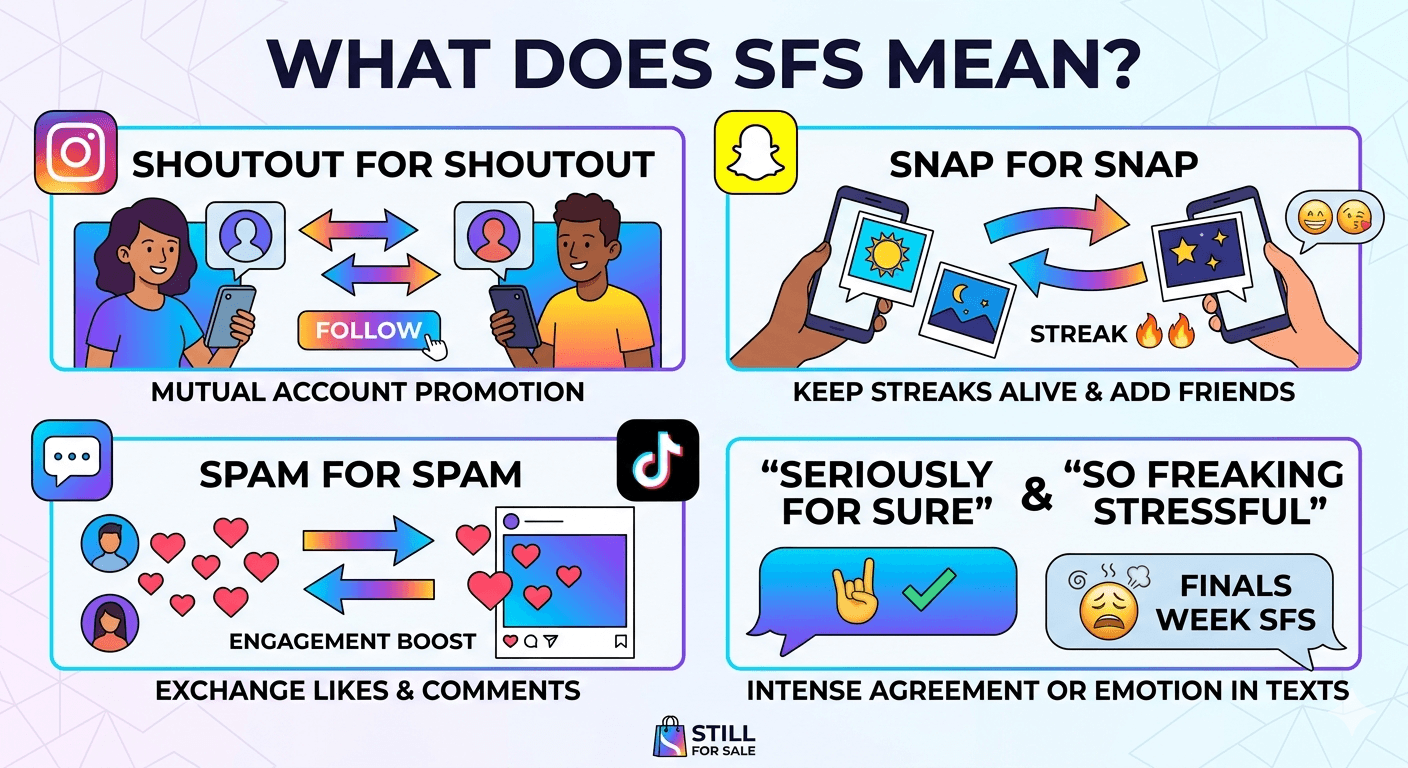
The term what does sfs mean refers to several popular acronyms used across social media platforms like Instagram, Snapchat, and TikTok to boost engagement and personal interaction. Most commonly, it stands for Shoutout for Shoutout, a practice where two users agree to promote each other’s accounts to their respective audiences to increase followers. It can also mean Snap for Snap on Snapchat or Spam for Spam in comment sections. Additionally, in casual texting, what does sfs mean might translate to So Fucking Stressful or Seriously For Sure, depending on the emotional context of the conversation.
The Core Definition of What Does SFS Mean
In the rapidly evolving world of digital communication, the acronym SFS primarily serves as a transactional tool for mutual promotion, most commonly defined as Shoutout for Shoutout. This collaborative strategy allows influencers and casual users to share each other’s content, effectively reaching new demographics and expanding their audience base. Another prominent interpretation is Spam for Spam, where users engage in a rapid exchange of likes on each other’s posts. This activity is designed to boost engagement metrics and signal to platform algorithms that the content is popular, thereby increasing its visibility in discovery feeds.
Outside of marketing tactics, the acronym takes on a more personal meaning in casual conversations, often standing for So Freaking Stressful. In this context, it serves as an emotional shorthand to convey frustration or exhaustion when describing a difficult day or situation. Recognizing these varied definitions—ranging from professional networking strategies to personal venting—is essential for modern digital literacy. By understanding the nuances between promotional requests and emotional expressions, users can respond appropriately to a sender’s intent and avoid potential social misunderstandings.
The Origin and Popularity of the SFS Acronym
The history of the acronym SFS, or “Shoutout for Shoutout,” traces its roots back to the early days of Instagram and the tail end of the MySpace era. As social media evolved from text-based status updates to visual-centric content, users discovered that collaborative growth was more effective than individual competition, leading to a culture where creators traded profile mentions to build mutual influence. Research by the Pew Research Center indicates that nearly 95% of teens utilize social media, making such acronyms foundational to how younger generations establish social capital and navigate digital communities through these strategic, organic growth strategies.
The popularity of SFS skyrocketed with the introduction of Instagram Stories, which offered a low-pressure, temporary environment to share others’ profiles without cluttering a permanent feed. This convenience transformed a niche tactic into a global phenomenon used by both personal accounts and major corporations to maximize reach through efficient, disappearing promotions. The term eventually migrated to platforms like Snapchat, where it often signifies “Snap for Snap” to maintain engagement streaks, and TikTok, where it relates to duets and mentions. The enduring presence of the term across diverse platforms underscores its utility; as long as users seek to expand their digital footprint, this transactional shorthand will remain a vital tool for online engagement.
What Does SFS Mean in Text and Chat
In the realm of personal messaging, “sfs” often functions as a linguistic intensifier rather than a social media growth tactic. Most commonly, it stands for “Seriously For Sure,” serving as a high-intensity form of agreement that carries more weight than a standard “yes” or “I agree.” When used in this capacity, the acronym validates a speaker’s point or opinion with significant emphasis, allowing the sender to show they are completely aligned with what was just said. This usage streamlines digital communication, providing a quick yet powerful way to signal shared perspective and strong conviction within a fast-paced conversation.
Beyond simple agreement, the acronym is frequently used to convey extreme emotions, most notably as “So Fucking Stressful.” This version is a staple among younger generations who use it as shorthand for overwhelming situations, such as finals week or a difficult day at work, allowing them to seek immediate empathy without typing out a lengthy explanation. On the opposite end of the emotional spectrum, it can mean “So Fucking Sweet” when reacting to a kind gesture or a touching story. Because the meaning can shift from intense frustration to genuine admiration, the surrounding context is the ultimate guide for interpretation; understanding the tone of the conversation is essential to knowing whether the sender is seeking support, expressing delight, or simply nodding in agreement. 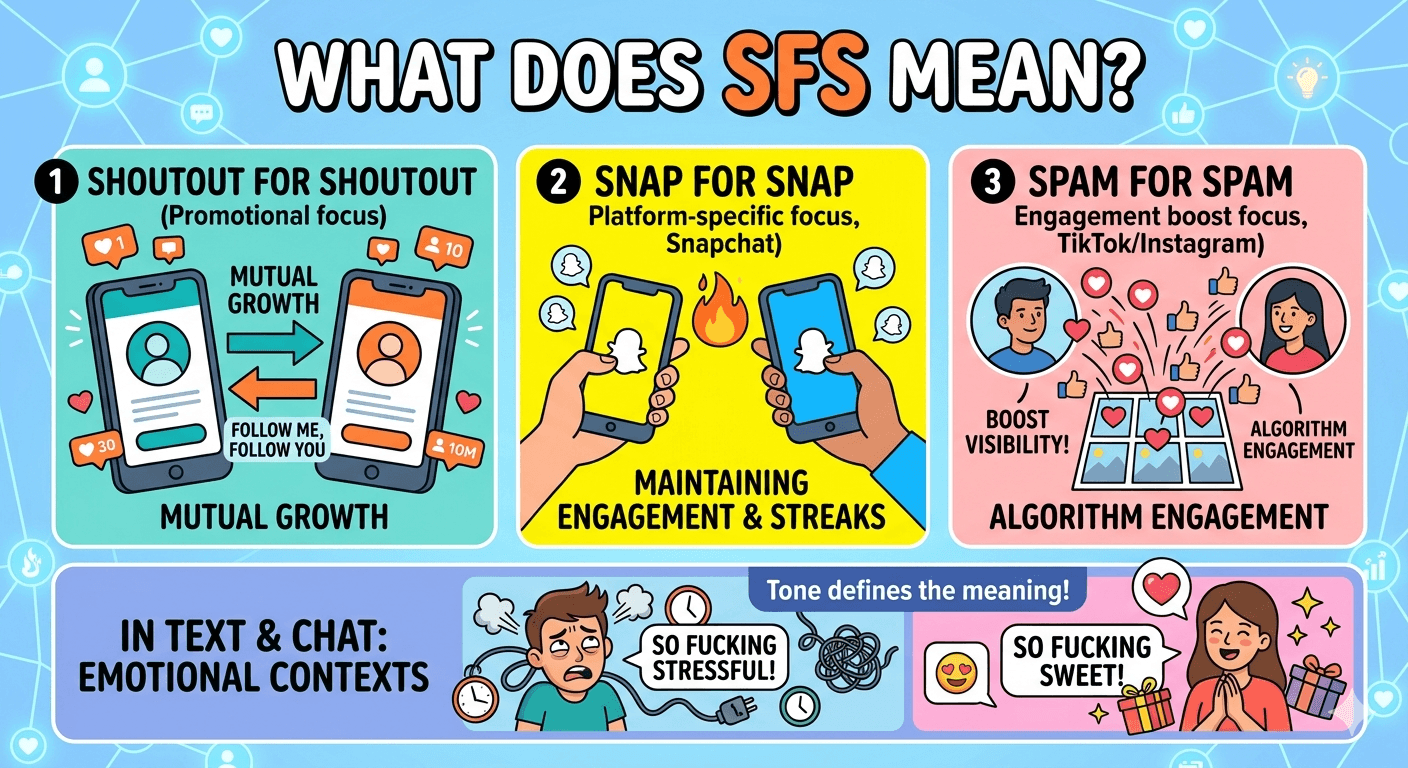
SFS Meaning Instagram and Social Media Platforms
Instagram is the natural home for this term, and it is where most users first encounter it. On this platform, the acronym is almost exclusively tied to growth and engagement. You will often see it in the captions of photos or, more frequently, in the comments section. Users will comment the acronym on a popular post to catch the attention of the account holder or other followers, signaling that they are open to a mutual exchange of likes, comments, or shoutouts.
-
On Instagram
On Instagram, the practice is a sophisticated part of the influencer ecosystem. Small to mid-sized accounts use it to break through the algorithm. When two accounts with similar niches—for example, two fitness influencers—participate in a shoutout exchange, they are essentially sharing their fanbases. This is a high-trust activity. By recommending another account, the influencer is putting their reputation on the line, which is why these exchanges are often planned and coordinated through direct messages.
-
On Snapchat
When we look at what does sfs mean on Snapchat, the focus shifts to direct interaction and streaks. Snapchat rewards users for consistent communication. The Snap for Snap interpretation encourages users to send a photo to each other to keep their friendship “streak” alive. It is also used on Snapchat Stories. A user might post a photo of a friend’s Snapcode and ask their followers to add them, with the expectation that the friend will do the same. This helps users broaden their circle of friends and increases their overall Snapchat score.
-
On TikTok
TikTok has a slightly different take on the term. While it still involves shoutouts, it is often linked to the “link in bio” or “follow for follow” trends. A creator might post a video saying they are doing a round of shoutouts for anyone who likes and comments. This drives up the video’s engagement, which in turn helps it land on the For You Page (FYP). On TikTok, the acronym is a tool for virality, helping creators signal to the audience that they are active participants in the community and willing to reward their followers with exposure.
How to Use SFS Correctly in Your Content
To use social media growth strategies effectively, you must understand proper etiquette by avoiding spam and instead targeting accounts with similar niches and follower counts through polite direct messages. When performing an actual exchange, quality is paramount; rather than simply posting a screenshot, you should provide a brief, genuine reason why you appreciate their content to ensure the recommendation feels organic. This professional approach fosters trust with your followers, making them more likely to engage with the recommended account and resulting in a much more successful, authentic partnership.
-
Identify accounts with similar sizes and interests.
-
Send a private message to propose a mutual exchange.
-
Choose a high-quality post or story from the other user to share.
-
Include a clear call to action, like “Follow them for great recipes!”
-
Ensure the other person completes their half of the deal.
Using the term correctly also involves timing. Many users find that posting these requests during peak hours—typically early evening—yields the best results. This is when the most people are active on their phones and likely to see the story or post. By being strategic about when and how you use the term, you can maximize the increase in your follower count and improve your overall engagement rate without annoying your existing audience.
Responding to SFS on Snapchat and Instagram
When receiving a shoutout request, it is essential to be selective and only partner with accounts that align with your brand values and content quality. If you choose to proceed, clear communication regarding the specific content and the duration of the shoutout is vital to avoid misunderstandings. By maintaining a professional approach and prioritizing genuine alignment, you can ensure the exchange is mutually beneficial and avoids the pitfalls of bot-like or incompatible partnerships.
-
Review the requester’s profile to ensure it is high quality.
-
Confirm the terms of the exchange via direct message.
-
Set a specific time for both of you to post the shoutouts.
-
Tag the other person correctly so the link is clickable.
-
Thank the person once the exchange is finished to build a long-term connection.
Responding to the acronym in a texting context is much simpler. If someone says “SFS” meaning “Seriously For Sure,” a simple acknowledgement like “I know, right?” or an emoji is usually enough. If they mean “So Fucking Stressful,” the appropriate response is empathy. Asking “What’s wrong?” or saying “I’m sorry you’re going through that” shows that you have correctly interpreted their emotional state and are there to support them.
Other Possible Meanings and Slang Contexts
Beyond the context of social media growth, the acronym is frequently used in online marketplaces like eBay or Depop to mean “Still For Sale,” serving as a functional status update to let buyers know an item is available. Additionally, in various digital subcultures and fan communities, it acts as emotive shorthand for “So Fucking Sweet,” allowing users to quickly express intense positivity or adoration toward a post or piece of news.
While there are niche technical interpretations, such as “Standard File System” in computing, these are rarely encountered in social settings. Ultimately, understanding these diverse meanings—ranging from practical sales updates to sentimental expressions—is key to navigating different online environments, though the social media and commerce-related definitions remain the most prevalent.
Common Mistakes or Misinterpretations of SFS
The meaning of digital acronyms depends entirely on context, as misinterpreting a “shoutout” for a “sale” can lead to confusing or awkward interactions. Furthermore, even when used correctly for growth, the strategy should be applied sparingly to maintain a healthy balance between promotional content and authentic personal voice. Over-saturating your feed with shoutouts risks alienating followers who prioritize genuine engagement, making moderation and situational awareness essential for a successful social media presence.
-
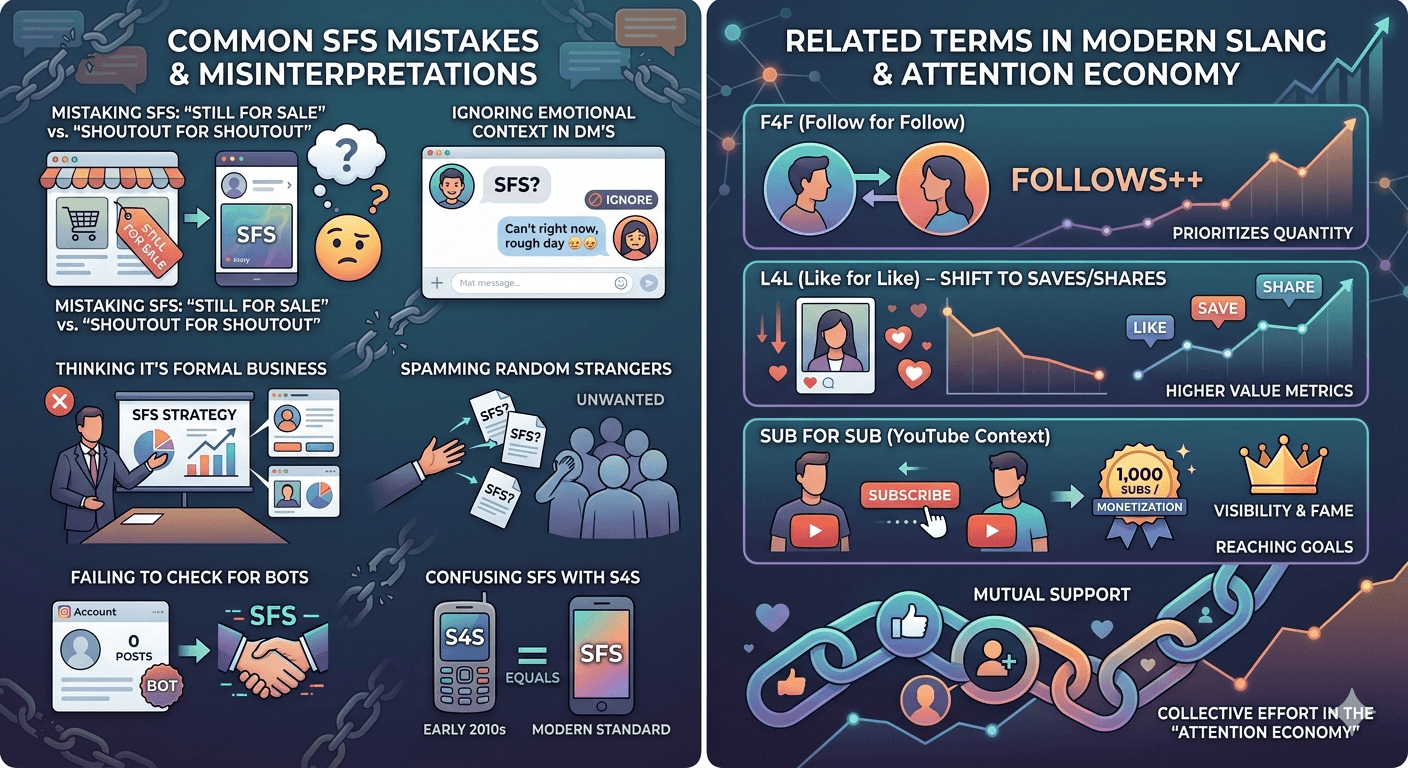
Mistaking “Still For Sale” for “Shoutout for Shoutout.”
-
Ignoring the emotional context in a private text message.
-
Thinking the acronym is a formal business term.
-
Using the term as a way to spam random strangers.
-
Failing to check if an account is a bot before agreeing to an exchange.
Finally, some users confuse the acronym with S4S, which stands for Shoutout 4 Shoutout. While they mean the exact same thing, some communities prefer one over the other. S4S was more common in the early 2010s, while the version without the “4” has become the modern standard. Understanding that these are interchangeable will help you navigate different social circles without feeling out of the loop.
Similar or Related Terms in Modern Slang
The acronym is part of a broader ecosystem of reciprocal engagement strategies, such as F4F (Follow for Follow) and L4L (Like for Like), which involve direct agreements to boost specific metrics. While F4F is often considered a lower-tier strategy because it prioritizes raw follower counts over genuine interest, L4L has also seen a decline as modern algorithms on platforms like Instagram and TikTok shift focus away from likes. Instead, users are increasingly prioritizing “saves” and “shares,” which are seen as more valuable indicators of content quality.
On platforms like YouTube, this same logic applies to “Sub for Sub,” where creators exchange subscriptions to reach monetization milestones. Collectively, these terms represent the building blocks of the “attention economy,” a system where users trade small digital actions to help one another gain visibility and fame. Understanding these related terms provides a comprehensive view of how creators navigate social media growth through calculated, mutual support.
Strategic Benefits of Using SFS for Influencers
For aspiring professionals, this acronym serves as a vital tactical tool for audience diversification and algorithmic success. By tapping into “warm” audiences through strategic partners, creators can overcome growth plateaus and generate high-quality leads without any financial investment. Additionally, the high volume of traffic coming from external profiles signals to the platform’s algorithm that an account is trending, which can land content on the Explore page and trigger a powerful snowball effect of organic visibility.
Beyond immediate metrics, these exchanges are essential for fostering professional networks and a positive industry reputation. Establishing oneself as a reliable and collaborative partner can lead to future high-level collaborations and lucrative brand deals in an otherwise competitive field. Ultimately, participating in these mutual exchanges transforms social media growth from an isolated endeavor into a collaborative career path, opening doors to long-term professional opportunities.
The Cultural Impact of Gen Z Slang
The rise of acronyms like these is a hallmark of Gen Z’s impact on global communication. This generation prioritizes efficiency and community in their digital interactions. By creating a coded language, they can communicate complex social and professional requests in a way that feels native to the platforms they inhabit. This shorthand serves as a social shibboleth; knowing the terms indicates that you are an active part of the digital culture.
Critics often argue that these acronyms degrade language, but sociolinguists see it differently. They view it as an evolution of language to fit a new medium. In a fast-paced environment where people scroll past content in seconds, being able to convey a message in three letters is a specialized skill. It reflects a high level of adaptability. As communication continues to move toward more visual and ephemeral formats, we can expect to see even more acronyms that prioritize speed and mutual benefit over traditional grammar.
-
Language adapts to the constraints of the technology used.
-
Acronyms create a sense of belonging among digital natives.
-
Digital shorthand allows for faster emotional expression.
-
Mutual growth strategies reflect a collaborative cultural mindset.
-
Social media slang often bridges the gap between different global cultures.
This collaborative mindset is a shift from the individualistic approach of earlier internet eras. Instead of trying to be the only star, many young creators realize that they can all succeed together. The acronym is a verbal manifestation of this community-driven approach to the internet. It turns the vast, often cold world of social media into a space where people can find partners and build something together, one shoutout at a time.
Read More: What is Call Whisper? Navigating a win-win feature for Companies, Call Agents, and Clients
Final Thought
In the modern digital landscape, the phrase what does sfs mean represents a vital intersection between social media strategy and casual slang. Whether it is being used to grow an Instagram following through Shoutout for Shoutout, maintaining a Snapchat streak, or expressing intense emotions in a text message, its versatility is its greatest strength. By understanding the specific context of each platform and following the proper etiquette for engagement, users can leverage this acronym to build stronger communities and expand their digital footprint. As language continues to evolve alongside technology, staying informed about these terms is essential for anyone looking to navigate the online world with confidence and clarity.
FAQ
-
What does SFS mean in Snapchat?
In the context of Snapchat, the acronym primarily stands for Snap for Snap or Shoutout for Shoutout. When users send this in a message or post it on their story, they are looking to exchange photos or profile mentions. This is often done to increase a user’s Snap Score, which goes up based on the number of snaps sent and received. It also helps users maintain their streaks, symbolized by the fire emoji, which indicates how many consecutive days two people have been snapping each other.
-
Is SFS slang or formal?
The term is strictly considered informal slang and should not be used in professional emails or business documents unless you are working specifically in social media marketing. It is a product of internet culture and is designed for quick communication on mobile devices. Using it in a formal setting might make you appear unprofessional or out of touch with standard business etiquette. However, within the niche of influencer marketing, it is a standard industry term.
-
What’s the difference between SFS and S4S?
There is no functional difference between the two terms. Both stand for Shoutout for Shoutout. The “4” in S4S is simply a stylistic choice that was more common during the early days of texting and social media. SFS has become the more popular version in recent years because it is slightly faster to type and looks cleaner in captions and bios. You can use either one, and people will understand that you are looking for a mutual promotion.
-
How do you reply to SFS?
How you reply depends entirely on the context. If it is a growth request on social media, you can reply by saying “Sure, DM me the details” if you are interested, or simply ignore it if you are not. If the term is being used as slang for “Seriously For Sure,” you can reply with a supportive comment or an emoji. If someone uses it to mean they are stressed, the best reply is a supportive question like “What’s going on?” or an offer to help.
-
Where is SFS most used?
The acronym is most frequently used on Instagram, Snapchat, and TikTok. It is also found on social marketplaces like Depop and Facebook Marketplace. While it occasionally appears in standard text messaging, its primary home is on platforms where users are looking to either grow their following or sell items. It is a global term, recognized by English speakers and international users alike due to the universal nature of social media platforms.
-
When should you not use SFS?
You should avoid using the acronym when communicating with people who are not active on social media, as they likely won’t know what it means. Additionally, do not use it in professional settings, job applications, or formal academic writing. You should also avoid using it to spam celebrities or large accounts, as this is often considered annoying and can result in your account being flagged. Finally, don’t use it in a text if the meaning could be easily confused with something else in that specific conversation.
-
What is a sfs on Instagram?
A sfs on Instagram is a mutual promotion where two users share each other’s posts or profiles on their own Stories or Feeds. The goal is to cross-pollinate their audiences. For example, User A posts a photo of User B’s profile and tells their followers to go check them out. In return, User B does the exact same for User A. It is one of the most common and effective ways to gain new, real followers without having to pay for advertising.
-
What is sfs meaning?
The term has several meanings depending on where you see it. The most common are Shoutout for Shoutout, Snap for Snap, Spam for Spam, Still For Sale, Seriously For Sure, and So Fucking Stressful. To determine the correct meaning, you must look at the surrounding conversation or the platform you are using. On social media, it is usually about growth; in a text, it is usually about an emotion or agreement; on a sales app, it is about item availability.
-
What does SFS mean in Gen Z?
For Gen Z, the term is a versatile piece of shorthand that facilitates both social growth and emotional communication. It represents the “hustle culture” of young creators trying to build their own brands, but it also reflects the casual, abbreviated way this generation talks to one another. It is part of a larger vocabulary of acronyms that allow for high-speed interaction in a digital-first world. In this context, it is a symbol of both productivity and peer-to-peer connection.
-
What does go SFS mean?
The phrase “go SFS” is an instruction or a request for people to participate in a round of shoutouts. An account might post “Going SFS for the next hour!” which means they are actively looking for partners to exchange promotions with right now. It is a call to action for their followers or other creators to jump in and participate in a coordinated effort to boost everyone’s visibility simultaneously.