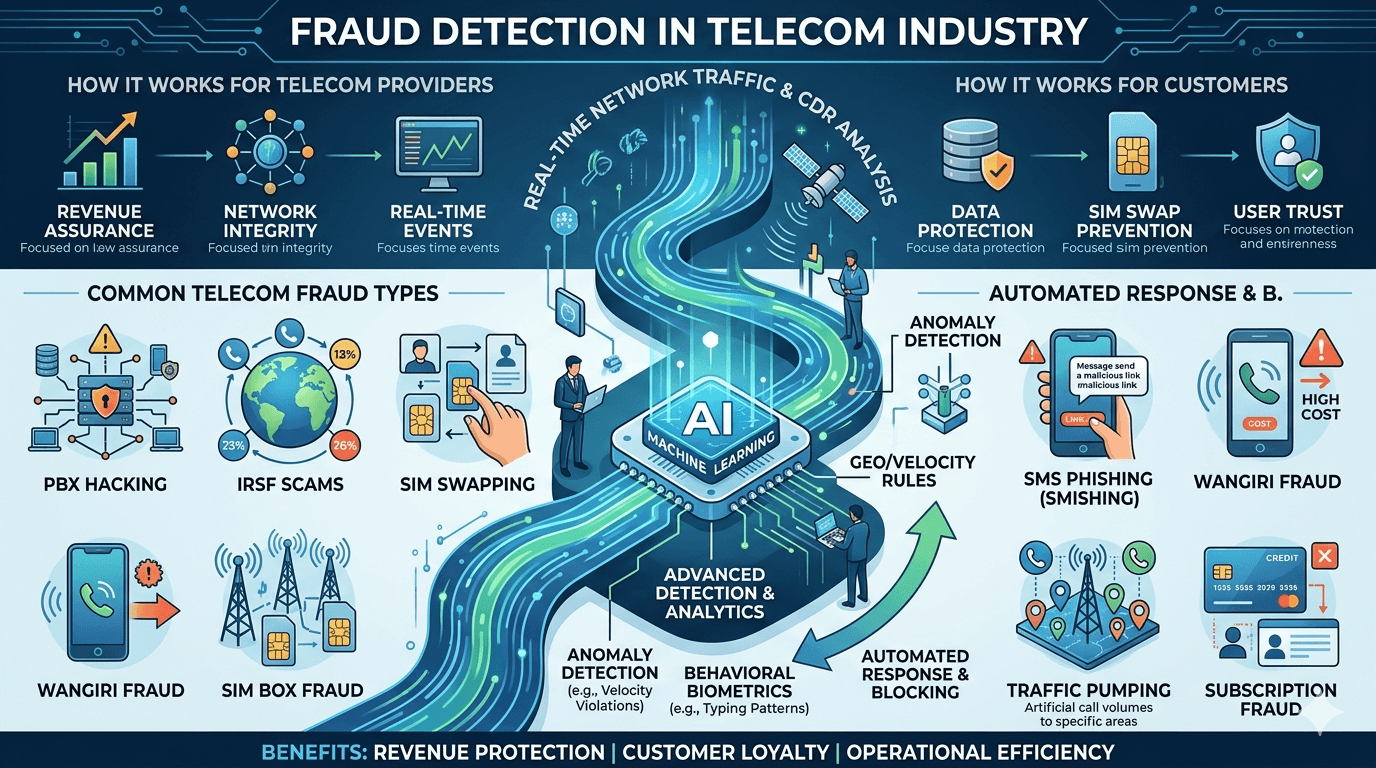
Fraud detection in telecom industry protocols is the systematic process of identifying and preventing malicious activities that exploit telecommunication networks for financial gain or data theft. This multi-layered approach combines real-time traffic monitoring, artificial intelligence, and historical data analysis to intercept threats like International Revenue Share Fraud, subscription fraud, and SIM swapping. By implementing a robust fraud detection in telecom industry strategy, service providers can safeguard their infrastructure, protect customer sensitive information, and minimize the multibillion-dollar annual losses attributed to global telecom scams. Effective management involves both automated systems and proactive behavioral analytics to stay ahead of sophisticated cybercriminals.
Telecom fraud detection at a glance
The landscape of modern communication is evolving rapidly, and with it, the sophistication of digital threats has reached unprecedented levels. Fraud detection in telecom industry frameworks serves as the primary defense mechanism against a variety of exploitative techniques that target both infrastructure and end-users. At its core, this discipline involves the constant scrutiny of network traffic to identify anomalies that deviate from standard usage patterns. Whether it is a sudden spike in international calls or an unusual volume of SMS messages originating from a single node, these indicators are the bread and butter of modern security operations.
The global impact of telecommunications fraud is staggering, with industry reports often citing losses that exceed tens of billions of dollars annually. For many organizations, the challenge lies in balancing seamless connectivity for legitimate users with the stringent security measures required to block fraudulent actors. Telecommunication fraud detection is no longer just a technical requirement; it is a fundamental component of business resilience. By leveraging big data and machine learning, companies can now predict potential breaches before they cause significant financial or reputational damage, ensuring that the network remains a safe environment for global commerce and personal interaction.
How telecom fraud detection works for businesses and customers
Understanding the mechanics of fraud detection in telecom industry systems requires looking at the ecosystem from two distinct perspectives. For the service providers, the focus is on network integrity and revenue assurance. For the end users, the priority is the protection of personal data and the prevention of unauthorized charges on their billing statements. Both sides of this equation are vital for maintaining a healthy telecommunications environment, as a breach on one side often leads to a compromise on the other.
-
For telecom companies
Fraud management in the telecom industry relies on sophisticated software that monitors billions of real-time events, such as Call Detail Records and signaling data, to proactively identify and stop known fraud types before financial losses escalate. By utilizing advanced analytics to establish profiles of normal network behavior, these systems can detect subtle deviations and anomalies across interconnect agreements and roaming partnerships where scams are frequently executed. Furthermore, the integration of enterprise-wide fraud management tools ensures that critical threat intelligence is shared across security, billing, and customer support departments, creating a unified and highly sensitive defense against evolving fraudulent activities.
-
For end users
For telecom customers, fraud detection often functions quietly in the background, becoming visible only when it successfully thwarts a suspicious transaction or alerts them to potential threats. This layer of security provides critical protection against identity theft, unauthorized account access, and dangerous maneuvers like SIM swapping, while also shielding users from malicious calls and SMS-based phishing attempts. By safeguarding sensitive personal information and protecting vulnerable populations from complex scams, these proactive measures foster significant consumer trust and long-term loyalty, ensuring that subscribers remain with a provider they perceive as a reliable guardian of their digital identity.
What is telecommunications fraud?
Telecommunications fraud is a broad term that encompasses any activity where a person or entity uses telecommunication services with the intention of avoiding payment or obtaining a financial advantage through deception. It is a global problem that affects landlines, mobile networks, and Voice over IP services. To truly understand what is telecommunications fraud, one must look at it as a form of cybercrime that exploits the complexity of modern networks. Fraudsters often take advantage of the gaps between different service providers or the lag in billing cycles to conduct their operations.
In the context of the global economy, telecom fraud is often linked to organized crime syndicates. These groups use the profits from telecom scams to fund other illegal activities, making fraud detection in telecom industry a matter of national and international security.
According to research by the Communications Fraud Control Association (CFCA), the telecommunications industry loses an estimated $39.89 billion annually to fraud.
This highlights the scale of the issue and why telecommunication fraud detection is a top priority for every major carrier in the world.
Common methods used by telecom fraudsters
Fraudsters employ a wide range of methods to exploit networks, often combining multiple techniques to maximize their gains. One of the most prevalent methods is the exploitation of weak security protocols in private branch exchange systems. By gaining unauthorized access to a business’s phone system, a criminal can route thousands of expensive international calls through that system, leaving the business with a massive bill. This is a classic example of how telecommunication fraud can devastate a small or medium-sized enterprise in a very short period.
Another common method involves the use of social engineering to perform subscription fraud in telecommunication. This occurs when a fraudster uses stolen or synthetic identities to sign up for expensive mobile contracts and high-end devices. Once they have the device, they disappear, and the service provider is left with the loss of the hardware and the unpaid service fees. Additionally, the rise of digital messaging has led to an explosion in SMS-based fraud, where deceptive links are sent to users to steal their credentials or install malware. These methods are constantly evolving, requiring telecom fraud management solutions to be equally dynamic.
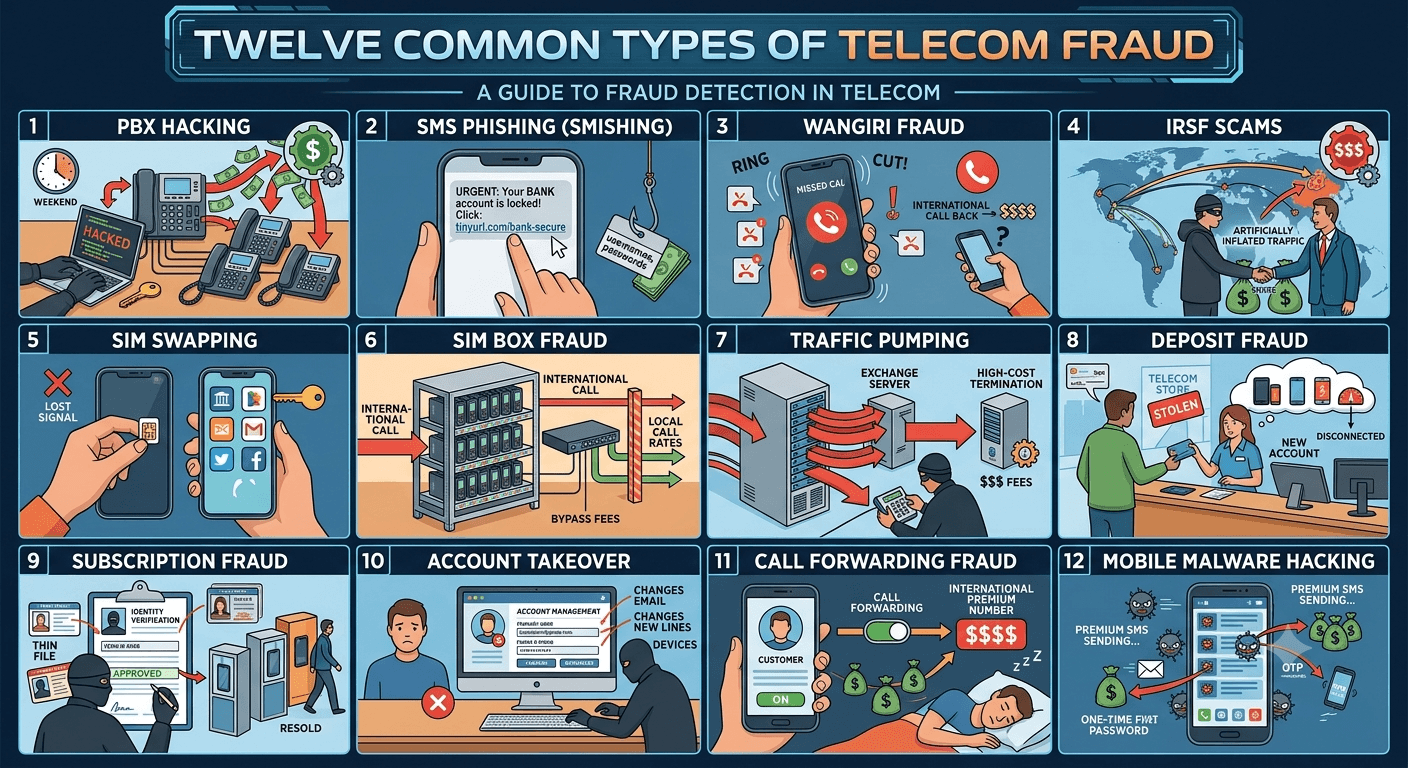
What is an example of telecom fraud? 12 common types
To effectively implement fraud detection in telecom industry measures, it is necessary to categorize the various threats. Each type of fraud has its own unique signature and requires a specific detection strategy. Here are twelve of the most common types of fraud currently plaguing the industry.
1. PBX hacking
PBX hacking involves unauthorized access to a business’s internal telephone system. Fraudsters search for systems with default passwords or unpatched software vulnerabilities. Once inside, they use the system to place thousands of international calls to premium numbers they control. This type of telecom fraud can occur over a single weekend, resulting in charges that can bankrupt a small business.
2. SMS phishing
Commonly known as smishing, this involves sending deceptive text messages that appear to be from legitimate sources like banks or government agencies. The goal is to trick the recipient into clicking a malicious link or providing sensitive personal information. This is a major component of telecom scams that target the end-user’s digital identity.
3. Wangiri fraud
Wangiri is a Japanese term meaning “one ring and cut.” In this scenario, a fraudster calls a large number of random mobile phone numbers and hangs up after just one ring. The hope is that the recipient will see the missed call and call back. The return call is routed to a high-cost international premium rate number, generating revenue for the fraudster.
4. IRSF scams
International Revenue Share Fraud (IRSF) is one of the most lucrative forms of telecommunication fraud. It involves routing traffic to specific international numbers that have high termination rates. The fraudster partners with a corrupt carrier or service provider to share the revenue generated by this artificially inflated traffic.
5. SIM swapping
This is a highly targeted form of fraud where a criminal convinces a mobile carrier to transfer a victim’s phone number to a new SIM card controlled by the criminal. Once they have control of the number, they can bypass two-factor authentication on the victim’s bank accounts, email, and social media.
6. SIM box fraud
SIM box fraud involves the use of hardware that houses hundreds of SIM cards to bypass international call rates. By routing international calls over the internet and then terminating them as local calls through the SIM box, fraudsters avoid paying the correct interconnect fees to the local mobile network operator.
7. Traffic pumping
Also known as access stimulation, this involves increasing the volume of calls to a specific service provider in a high-cost area. The fraudster benefits from the high access charges that the originating carrier must pay to the terminating carrier. This is a significant challenge for fraud management in telecom.
8. Deposit fraud
This occurs when a fraudster opens a new account using a stolen credit card or a fraudulent check to pay the initial deposit and first month’s bill. They then use the service as much as possible before the payment is flagged as fraudulent and the service is disconnected.
9. Subscription fraud
Subscription fraud in telecommunication is a massive problem involving the use of false identities to obtain services. Fraudsters may use “thin file” identities or stolen personal data to pass credit checks. Once the account is active, they may resell the minutes or simply use the high-end hardware for their own gain.
10. Account takeover
Similar to SIM swapping but broader in scope, account takeover involves gaining full access to a customer’s carrier account. From there, the criminal can add new lines, purchase expensive devices, or change the contact information to prevent the real owner from regaining control.
11. Call forwarding fraud
In this scheme, a fraudster gains access to a user’s account and sets up unconditional call forwarding to an expensive international number. Any calls made to the victim are then forwarded at the victim’s expense, often without them realizing it for an entire billing cycle.
12. Mobile malware hacking
The proliferation of smartphones has led to the development of specific malware designed to exploit telecom services. This malware can silently send premium-rate SMS messages in the background or intercept one-time passwords, making it a difficult target for traditional fraud detection in telecom industry tools.
How telecom fraud detection works (behind the scenes)
The “behind the scenes” operation of fraud detection in telecom industry systems is a feat of modern engineering. It begins with the ingestion of massive amounts of data from various network elements. This data includes call records, signaling logs, and data session details. These logs are processed through a series of rules and algorithms that check for consistency and legitimacy. For example, if a SIM card is used in London and then five minutes later in New York, the system flags a “velocity violation,” as it is physically impossible for the user to have traveled that distance in that time.
Advanced systems now use behavioral biometrics and machine learning to create a unique “fingerprint” for every user. This includes analyzing how a person holds their phone, their typing speed, and their common navigation paths within an app. If a session deviates significantly from this fingerprint, the telecom fraud management system can request additional authentication. This layer of security is particularly effective against automated bot attacks and account takeovers, as bots cannot easily replicate human behavioral patterns.
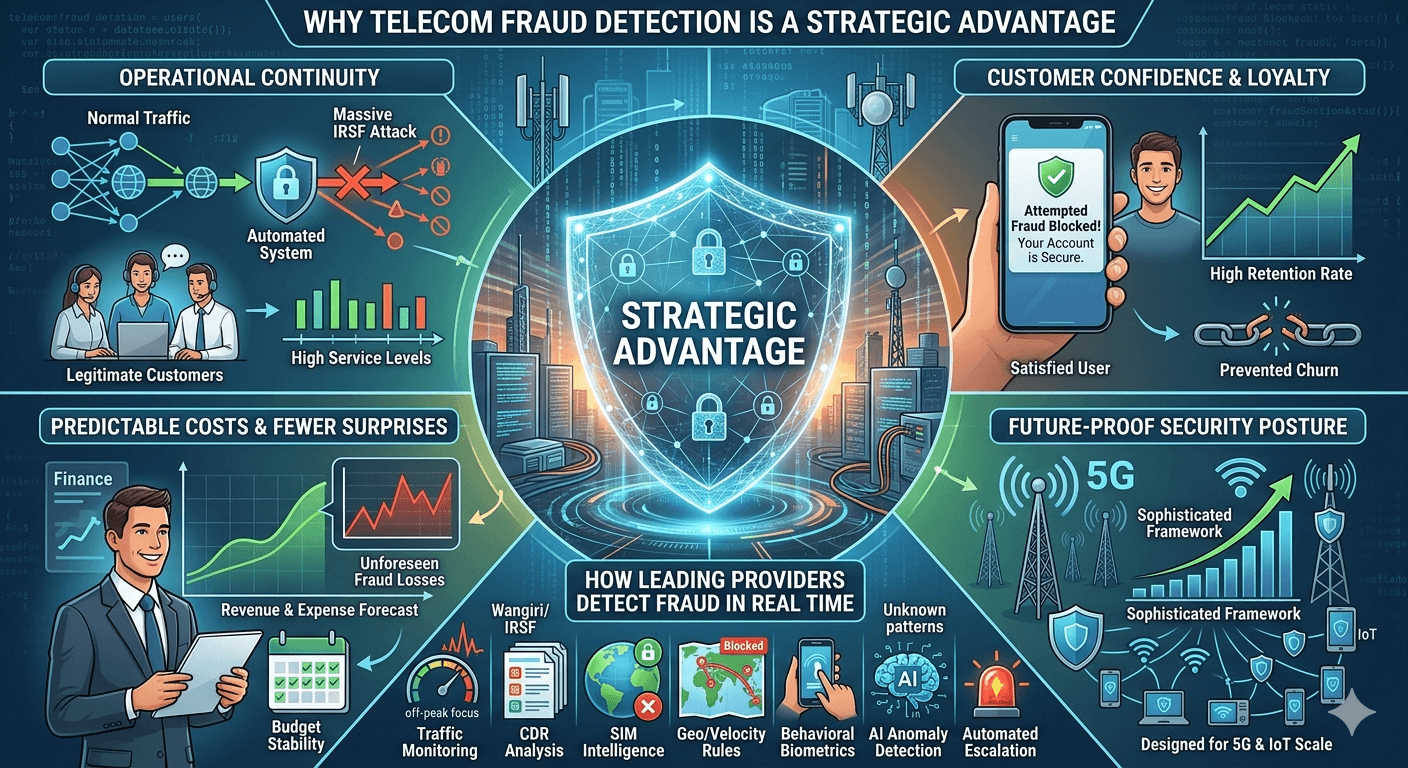
Why telecom fraud detection is a strategic advantage
Implementing robust fraud detection in telecom industry solutions is not just about stopping theft; it is about building a sustainable and competitive business. In a market where profit margins are often thin, the ability to eliminate unnecessary losses can be the difference between a profitable year and a loss. Furthermore, security is increasingly becoming a brand differentiator. Customers are more aware of digital threats than ever before and are choosing providers that demonstrate a commitment to protecting their data and their wallets.
-
Operational continuity
A major fraud event can disrupt network operations and overwhelm customer service teams. By using automated telco fraud prevention tools, companies ensure that their resources are focused on serving legitimate customers rather than dealing with the fallout of a massive IRSF attack. This operational stability allows the company to maintain high service levels even during peak periods.
-
Customer confidence & loyalty
Trust is the currency of the digital age. When a provider successfully identifies and blocks a fraudulent attempt before the customer is even aware of it, it reinforces the value of the service. On the other hand, failing to manage fraud in telecom industry leads to high churn rates, as customers who have been victimized often blame their service provider for the security lapse.
-
Future-proof security posture
The world of telecommunications is moving toward 5G and IoT, which introduces billions of new connected devices. Each device is a potential entry point for a fraudster. A sophisticated fraud detection in telecom industry framework is designed to scale with these new technologies, ensuring that the network remains secure as it grows more complex.
-
Predictable costs and fewer surprises
For the finance department, telecom fraud management provides a level of predictability. Unforeseen losses from fraudulent activities can wreak havoc on quarterly budgets. By implementing a telecom fraud management system, organizations can more accurately forecast their revenue and expenses, leading to better long-term financial planning and investor confidence.
How leading telecom providers detect fraud in real time
The transition from reactive to proactive security is the hallmark of a leading service provider. Real-time fraud detection in telecom industry protocols requires the ability to analyze data as it flows through the network, rather than waiting for the billing cycle to end. This is achieved through several key technologies and methodologies.
-
Traffic pattern monitoring: Systems continuously look for sudden spikes in traffic to specific destinations or unusual concentrations of calls during off-peak hours.
-
Call Detail Record (CDR) Analysis: CDRs are analyzed in real-time to identify signatures of known fraud types like Wangiri or IRSF.
-
SIM and number intelligence: Utilizing global databases to check the reputation of a phone number before allowing a call or message to proceed.
-
Geo and velocity rules: Blocking transactions that originate from high-risk geographic locations or that violate physical travel limitations.
-
Behavioral biometrics: Analyzing how a user interacts with their device to ensure they are who they claim to be.
-
AI-based anomaly detection: Using machine learning to find new, previously unknown fraud patterns that do not fit traditional rule-based models.
-
Automated escalation and blocking: Immediately disconnecting a call or suspending an account when a high-confidence fraud trigger is met.
Key features to look for in a telecom fraud detection platform
When selecting a telecom fraud management solution, businesses must ensure the platform is comprehensive enough to handle the modern threat landscape. A siloed approach is no longer effective; the platform must provide a holistic view of the entire network and all communication channels.
A top-tier platform should offer real-time traffic monitoring as its foundation. Without real-time capabilities, the system is essentially just an accounting tool rather than a security tool. Additionally, API-based number intelligence is crucial for verifying the status and history of any number interacting with the network. This helps in identifying ported numbers or those associated with known fraud syndicates.
Integration is another critical factor. The fraud detection in telecom industry software must work seamlessly with existing billing systems, CRM tools, and network infrastructure. It should also provide omnichannel coverage, protecting not just voice calls but also SMS, data, and IoT connections. Finally, compliance and audit support are essential for meeting regulatory requirements like GDPR or various national telecommunications acts, ensuring that data is handled legally while it is being monitored for fraud.
What is telecommunications fraud detection vs. prevention?
While often used interchangeably, detection and prevention represent two different stages of the security lifecycle. Fraud detection in telecom industry refers to the process of identifying a fraudulent event as it is happening or after it has occurred. It is about discovery and identification. Detection systems are designed to raise an alarm so that action can be taken.
Prevention, on the other hand, is about stopping the fraud from happening in the first place. This involves setting up barriers like multi-factor authentication, robust password policies, and strict identity verification during the onboarding process. Telco fraud prevention is proactive, whereas detection can be both proactive and reactive. An effective strategy requires a balance of both; you need prevention to reduce the volume of attacks and detection to catch the sophisticated threats that manage to bypass your initial defenses.
How can telecom fraud be detected and prevented by the customer?
While carriers carry most of the responsibility, customers play a vital role in the ecosystem of fraud detection in telecom industry. A vigilant customer is often the first line of defense against social engineering and account-level fraud. There are several steps an individual or a business customer can take to protect themselves.
-
Monitor and understand bills regularly to spot any unauthorized charges or unusual call patterns.
-
Be alert when dealing with unknown numbers and avoid calling back missed calls from international or unfamiliar prefixes.
-
Protect personal information by never sharing OTPs or account passwords over the phone or via suspicious links.
-
Use the do not call registry and other privacy tools provided by the carrier to limit exposure to potential scammers.
By staying informed about common telecom scams, customers can significantly reduce their risk profile. For example, knowing that a carrier will never ask for a password via text message can prevent a successful phishing attempt.
Four top telecom fraud trends to look out for
The landscape of fraud detection in telecom industry is constantly shifting as criminals find new ways to exploit emerging technologies. Currently, there are four major trends that security professionals are watching closely. First is the rise of AI-driven social engineering, where deepfake audio is used to impersonate executives or family members to authorize fraudulent transfers. Second is the targeting of IoT devices, which often lack the robust security found on smartphones.
Third, we are seeing an increase in interconnection fraud related to the global rollout of 5G. The increased speed and capacity of 5G allow fraudsters to move larger volumes of traffic more quickly, potentially causing more damage in a shorter window. Finally, there is a growing trend of “fraud-as-a-service,” where specialized criminal groups sell pre-packaged fraud kits and access to compromised networks on the dark web, lowering the barrier to entry for novice criminals.
Why is telecom fraud a growing problem?
Telecom fraud continues to grow because it is a low-risk, high-reward activity for criminals. Many types of telecommunication fraud can be executed from a different country, making it extremely difficult for local law enforcement to track down and prosecute the offenders. Additionally, the increasing complexity of global networks creates more “blind spots” where fraudulent activity can hide. The transition to IP-based networks has also opened up new vulnerabilities that did not exist in traditional circuit-switched networks.
Furthermore, the rapid digitalization of services means that a phone number is no longer just a way to make a call; it is a central key to a person’s entire digital life. This increases the incentive for criminals to engage in activities like SIM swapping and account takeovers. As long as the potential profits remain high and the technical hurdles manageable, fraud detection in telecom industry will remain a critical and growing challenge for the foreseeable future.
The hidden costs of failing to manage telecom fraud
The financial loss from unpaid bills is only the tip of the iceberg when it comes to the impact of telco fraud. The hidden costs can be far more damaging in the long run. Reputation damage is perhaps the most significant. In an era of social media, a major security breach can go viral in minutes, causing a company’s stock price to tumble and driving customers to competitors. Once a brand is perceived as “unsecure,” it is incredibly difficult to win back consumer trust.
1. Reputation damage and churn
When customers feel their privacy has been compromised, they don’t just complain; they leave. High churn rates caused by fraud in telecom industry can lead to a long-term decline in market share. The cost of acquiring a new customer is significantly higher than the cost of retaining an existing one, making fraud-induced churn a major financial burden.
2. Legal and regulatory fallout
Governments are increasingly holding telecom providers accountable for protecting consumer data. Failing to implement adequate fraud detection in telecom industry measures can lead to massive fines from regulatory bodies. In some jurisdictions, carriers can be held liable for the financial losses suffered by their customers if it can be proven that the carrier’s security was negligent.
3. Employer brand and team morale
Constantly fighting a losing battle against fraudsters can be demoralizing for security and customer support teams. High levels of fraud often lead to increased stress and turnover among staff. Conversely, a company that invests in a top-tier telecom fraud management system empowers its employees with the tools they need to succeed, leading to a better workplace culture and a stronger employer brand.
4. Wasted potential and lost opportunities
Every dollar spent on covering the costs of fraud is a dollar that cannot be spent on innovation. Companies that are bogged down by telecommunications fraud are less able to invest in new technologies like 5G expansion or AI-driven customer service. In the long run, this lack of investment can cause a company to fall behind its more secure and efficient competitors.
How can telecom fraud solutions help businesses?
For a modern business, a telecom fraud management solution is an essential investment in infrastructure. These platforms provide the visibility and control needed to navigate a dangerous digital world. By automating the process of fraud detection in telecom industry, businesses can protect their bottom line without needing to hire an army of manual analysts. These solutions offer a scalable way to monitor global operations, providing a single source of truth for all security-related events.
Moreover, these solutions provide valuable data that can be used to improve other areas of the business. For example, the insights gained from analyzing fraud patterns can help the product team design more secure features or help the marketing team identify high-quality leads. In essence, a good fraud management telecom system doesn’t just block the bad guys; it helps the entire organization run more smoothly and securely.
The battle against fraud in the telecom industry is an ongoing arms race. As fraudsters become more sophisticated, the tools used for fraud detection in telecom industry must also evolve. By combining advanced technology, behavioral analytics, and a proactive security culture, service providers can protect their revenue and their customers from the ever-present threat of telecom scams. The future of telecommunications depends on our ability to create a secure environment where innovation can thrive without the constant shadow of criminal exploitation.
Frequently asked questions
-
What is telecom fraud detection?
Fraud detection in telecom industry is the use of specialized software and data analysis to identify and halt unauthorized or malicious use of communication networks. This includes monitoring for spikes in international traffic, identifying known scam numbers, and using machine learning to spot unusual behavioral patterns that suggest a security breach.
-
How does telecom fraud affect businesses?
Telecommunications fraud can cause severe financial loss through unpaid charges, damage a company’s reputation, and lead to regulatory fines. It also diverts resources away from legitimate operations and can result in the loss of sensitive corporate data if an account takeover occurs.
-
What are the most common types of telecom fraud?
The most prevalent forms include International Revenue Share Fraud (IRSF), PBX hacking, SIM swapping, and subscription fraud. Other common threats are Wangiri (one-ring scams) and SMS phishing, both of which target the end-user to generate illicit revenue.
-
What tools help with telecom fraud detection?
Businesses use a variety of tools, including Call Detail Record (CDR) analyzers, real-time traffic monitoring platforms, and AI-based anomaly detection systems. Many also integrate API-based number intelligence to verify the reputation of callers in real-time.
-
How can businesses prevent telecom fraud?
Prevention involves implementing strong authentication protocols, regular security audits of PBX systems, and educating employees about social engineering. Using a comprehensive telecom fraud management system that blocks suspicious activity automatically is also a critical preventive measure.
-
Can users help detect or prevent telecom fraud?
Yes, users can help by monitoring their bills, using two-factor authentication, and being cautious of unexpected calls or texts from unknown international numbers. Reporting suspicious activity to their service provider immediately is also a key step in stopping fraud.
-
Is telecom fraud detection automated?
Modern fraud detection in telecom industry systems are highly automated. They use algorithms to scan millions of events per second, only flagging the most suspicious cases for human review. This automation is necessary to keep up with the speed and volume of modern network traffic.
-
What is the most common type of fraud in the telecom industry?
International Revenue Share Fraud (IRSF) remains the most common and costly type of fraud. It involves criminals routing unauthorized traffic to high-cost international numbers, where they take a cut of the termination fees paid by the carrier.
-
What are the 7 types of fraud?
In a general sense, the seven common types of fraud include identity theft, credit card fraud, insurance fraud, mail fraud, investment fraud, telemarketing fraud, and wire fraud. In the telecom sector specifically, these manifest as subscription fraud, SIM swapping, and premium-rate service scams.