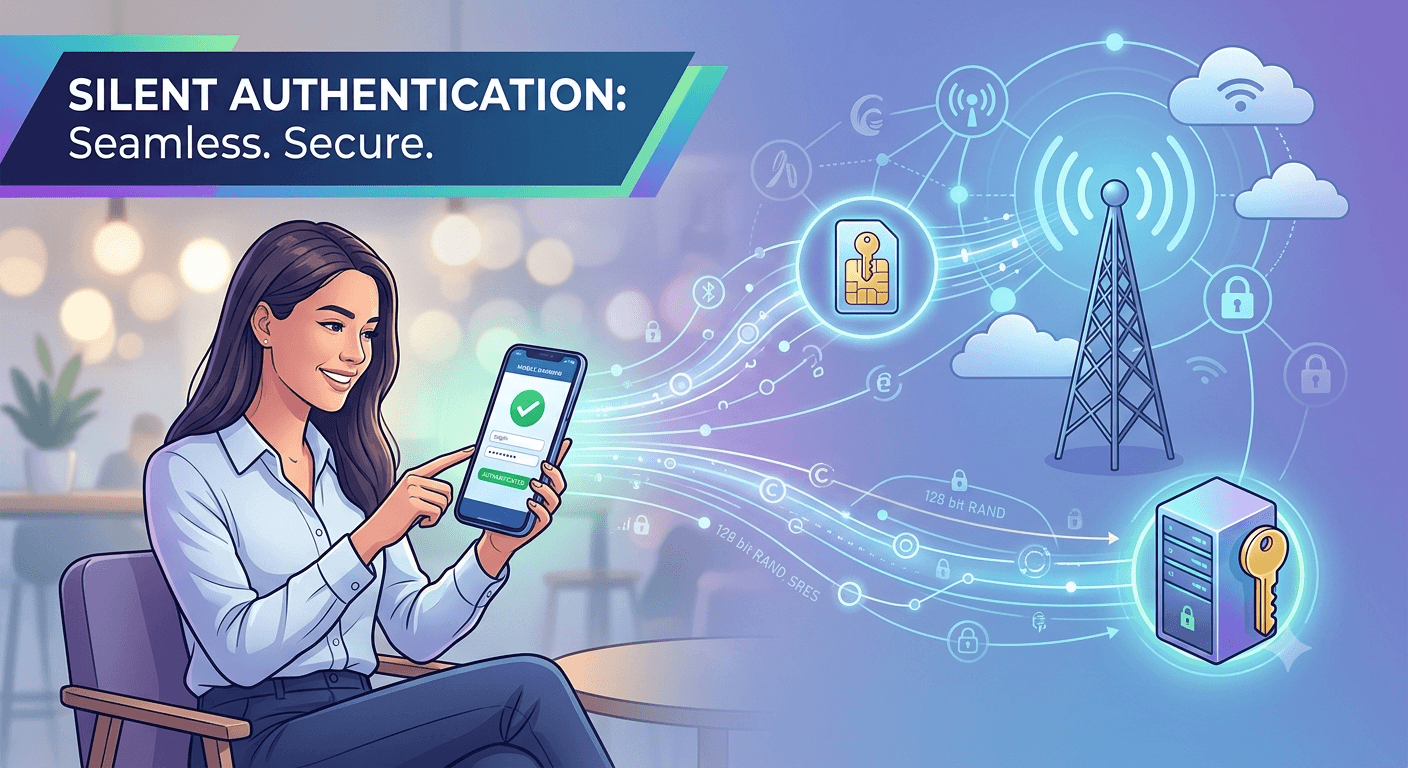
Silent authentication is a powerful security mechanism that verifies a user’s identity without requiring any active input, such as entering passwords or manual one-time codes. By leveraging background processes like browser cookies or mobile network signals, this technology creates a frictionless experience for the silent user. Specifically, silent network authentication utilizes direct communication between a mobile operator and a device’s SIM card to confirm identity. This method eliminates common vulnerabilities like phishing and SMS interception while significantly reducing login abandonment. As businesses prioritize user experience, silent authentication has become a vital tool for balancing high-level security with seamless digital interactions.
What is Silent Network Authentication?
Silent network authentication represents a major leap forward in the world of cybersecurity and mobile identity. Unlike traditional methods that force a person to wait for a text message or open an authenticator app, this technology works entirely behind the scenes. When we ask what is silent authentication, we are referring to a process where the mobile network verifies the subscriber’s identity using the data already present on the SIM card. Because the verification happens at the carrier level, it is incredibly difficult for hackers to intercept or spoof the credentials.
This technology is primarily used to secure mobile applications and web services. For a silent account to be verified, the application communicates with the mobile network operator to confirm that the phone number being used belongs to the device currently attempting to log in. This creates a secure link between the hardware and the digital account. It effectively turns the mobile device into a physical security token that the user does not even have to interact with.
The move toward this technology is driven by the increase in the sophistication of cyberattacks. Traditional two-factor authentication (2FA), particularly SMS-based codes, is increasingly vulnerable to “SIM swapping” and phishing.
According to a report by the Federal Trade Commission, identity theft reports involving mobile accounts have seen a steady rise, highlighting the need for more secure, automated solutions. Silent network authentication solves this by removing the human element from the verification loop, ensuring that only the legitimate owner of the SIM card can gain access.
What is the end user experience with Silent Network Authentication?
From the perspective of a silent user, the experience is almost magical. Imagine opening a banking app or a retail site and being logged in instantly without ever seeing a password prompt or an OTP (One-Time Password) screen. This is the hallmark of a high-quality silent authentication implementation. The user simply opens the app, and the system verifies their identity in the background while the loading screen is visible.
This seamless flow is crucial for modern businesses because any friction during the login or checkout process leads to “churn.” Churn happens when a customer becomes frustrated by a slow or complicated security check and decides to leave the app. By using silent authentication, companies can keep their users engaged without compromising on safety. It feels like there is no security at all, even though the backend is performing a highly sophisticated cryptographic handshake with a global telecommunications network.
In many cases, the user might not even realize that an authentication event has occurred. This is particularly useful for sensitive actions like high-value transactions or updating personal account details. Instead of interrupting the user’s flow with a “Verify your identity” popup, the app silently confirms the network credentials. If the verification is successful, the transaction proceeds; if not, the system can then “step up” to a more traditional verification method like biometric scanning or a secondary password.
How does Silent Network Authentication work?
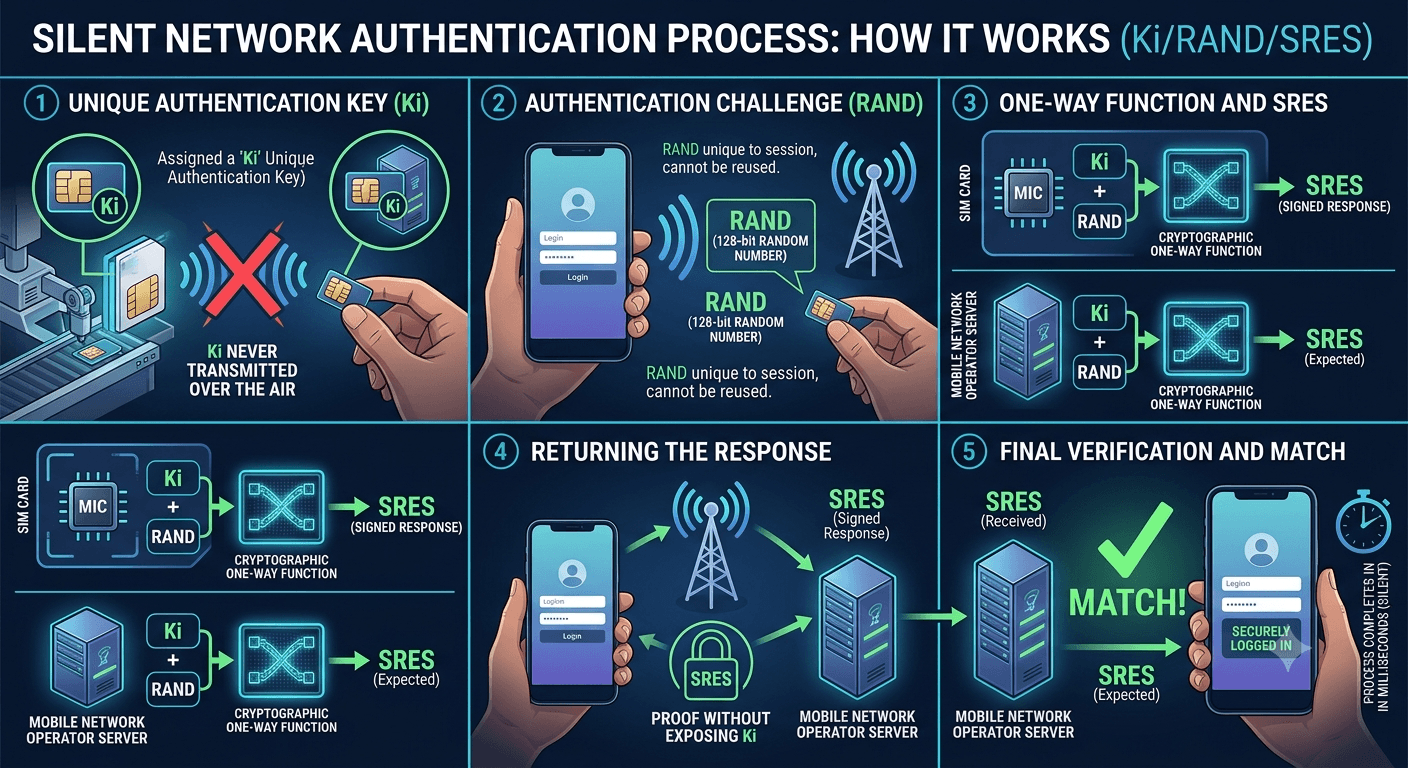
Understanding how does silent network authentication work requires looking at the specialized communication between a mobile device and the cellular tower. This process is grounded in the same security principles that allow your phone to connect to a cellular network in the first place. It relies on a series of cryptographic exchanges that ensure both the device and the network are who they claim to be.
Step 1: The Unique Authentication Key
The process begins long before a user tries to log into an app. When a mobile network carrier activates a SIM card, it assigns a unique authentication key known as the Ki. This key is stored securely on the SIM card and is also kept in the carrier’s protected database. One of the most important aspects of this key is that it is never transmitted over the air. It acts as a shared secret that both the card and the network know, providing a foundation for all future security checks. This ensures that even if someone intercepts the network traffic, they cannot “steal” the Ki.
Step 2: The Authentication Challenge
When an app requests silent authentication, the mobile network initiates a challenge. It generates a 128-bit random number, known as a RAND. This number is sent over the cellular network to the SIM card in the user’s phone. At this point, both the mobile network and the SIM card have two critical pieces of data: the shared secret (Ki) and the new, temporary random number (RAND). This RAND is unique to this specific session, meaning it cannot be reused by an attacker later.
Step 3: The One-Way Function and SRES
Once the SIM card receives the RAND, it uses its internal processor to perform a calculation. The SIM takes the Ki and the RAND and runs them through a specialized cryptographic one-way function. This is a mathematical process that is easy to perform in one direction but impossible to reverse. The result of this calculation is called a “signed response” or SRES. Simultaneously, the mobile network operator performs the exact same calculation on its own servers using its copy of the Ki and the same RAND.
Step 4: Returning the Response
The SIM card then sends its generated SRES back to the mobile network. Because the SRES was created using the Ki (which never leaves the SIM), it serves as proof that the SIM card is genuine. This step is what makes what is silent network authentication so robust; it provides a way to verify identity without ever exposing the actual password or secret key to the internet or the cellular airwaves.
Step 5: Final Verification and Match
In the final step, the mobile network compares the SRES received from the phone with the SRES it calculated itself. If the two values match perfectly, the user is authenticated, and the app is notified that the login is secure. This form of symmetric key cryptography makes it nearly impossible for an attacker to spoof the SRES. This entire five-step process happens in milliseconds, allowing the user to continue their journey without any manual input. This is a perfect silent authentication example of how backend complexity can create frontend simplicity.
What are the benefits of Silent Network Authentication?
The adoption of silent authentication provides transformative benefits for both the business and the consumer. By moving away from visible security checks, companies can improve their bottom line while simultaneously hardening their defenses against account takeover attacks.
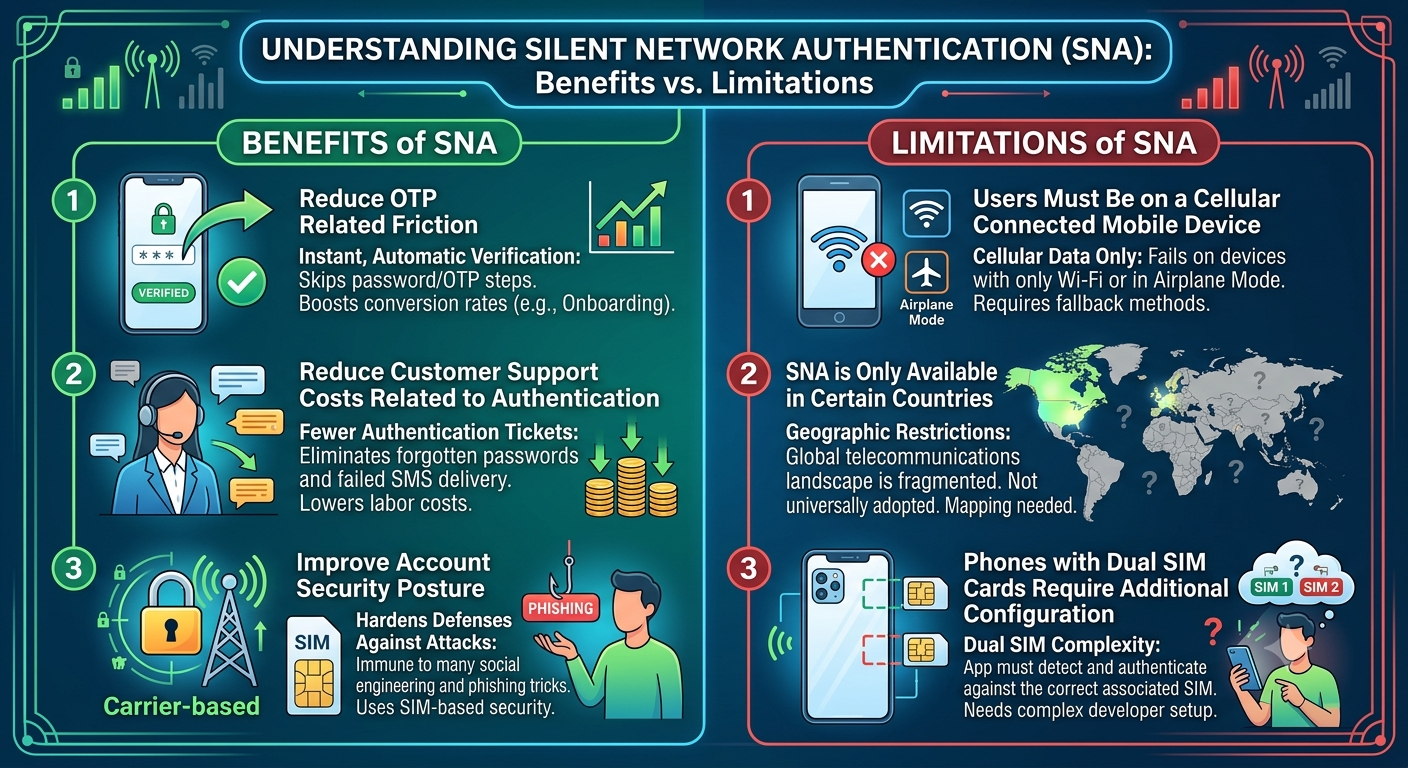
1. Reduce OTP Related Friction
One-time passwords are one of the most significant sources of friction in digital apps. Users often have to leave the app, open their messaging client, copy a code, and return to the original app to paste it. If the code expires or the message is delayed, the user experience is ruined. Silent authentication removes this entire loop. By automating the verification, businesses see a significant increase in successful login rates.
A study by Twilio suggests that reducing this type of friction can improve conversion rates for onboarding by as much as 20%, as users are much less likely to abandon the process.
2. Reduce Customer Support Costs Related to Authentication
Authentication issues are a leading cause of customer support tickets. Whether it is a forgotten password, a blocked account, or an SMS code that never arrived, these problems cost companies millions of dollars in support labor. When a silent user is verified automatically, these points of failure disappear. There is no password to forget and no SMS delivery to fail. By implementing a silent network authentication system, businesses can drastically lower the volume of support requests, allowing their teams to focus on more complex customer needs.
3. Improve Account Security Posture
While it might seem that a “silent” process is less secure, the opposite is true. Silent authentication is immune to many of the most common social engineering attacks. Phishing relies on tricking a user into giving away their code or password. Since there is no code or password involved in a silent account verification, there is nothing for the user to accidentally give away. Furthermore, because the authentication is tied to the physical SIM card and the carrier’s network, it is significantly more secure than software-only solutions.
What are the limitations of using Silent Network Authentication?
Despite its many advantages, silent authentication is not a universal “silver bullet.” There are specific technical and geographical requirements that must be met for the system to function correctly. Understanding these limitations is essential for any business planning its security strategy.
1. Users Must Be on a Cellular Connected Mobile Device
The most significant limitation of silent network authentication is that it requires a direct connection to a mobile network. If a user is on a device that only has Wi-Fi (like some tablets) or if their phone is currently in “Airplane Mode” with Wi-Fi enabled, the system cannot communicate with the SIM card via the carrier. In these scenarios, the application must have a fallback method ready, such as biometric authentication or a traditional password, to ensure the user isn’t locked out.
2. SNA is Only Available in Certain Countries
The global telecommunications landscape is fragmented. For silent network authentication to work, the mobile network operator must support the specific protocols required for the cryptographic handshake. While major carriers in the US, UK, and parts of Europe have widely adopted this technology, it is not yet available in every country. Companies with a global user base must carefully map out where SNA is supported and where they need to rely on alternative authentication methods.
3. Phones with Dual SIM Cards Require Additional Configuration
The rise of eSIM and dual-SIM phones has added a layer of complexity to the silent authentication process. When a device has two active SIMs, the app needs to know which one is associated with the user’s account. Without proper configuration, the system might attempt to authenticate against the “wrong” SIM, leading to a failed verification. Developers must ensure their apps are “dual-SIM aware” to provide a consistent experience for users who travel frequently or use separate lines for work and personal life.
Silent Authentication vs Refresh Token: Key Differences
It is common to confuse silent authentication vs refresh token, as both are used to keep a user logged in without requiring constant password entries. However, they serve very different purposes in a security architecture. A refresh token is a piece of data used to obtain a new access token when the current one expires. It is part of the OAuth 2.0 framework and relies on the fact that the user has already logged in once using a traditional method.
In contrast, silent authentication is about the initial or recurring identity verification itself. While a refresh token maintains an existing session, silent authentication can create a new session or verify a sensitive action by checking the network status. Silent authentication is a “who are you” check, whereas a refresh token is a “stay logged in” mechanism. Furthermore, refresh tokens are stored in the app’s local storage or a cookie, which can be stolen if the device is compromised. Silent authentication is tied to the network and the SIM, providing an external layer of verification that does not rely solely on stored local data.
Real-World Silent Authentication Example and Use Cases
The versatility of silent authentication makes it applicable across various industries. In the banking sector, it is used to verify “High-Risk” actions. For instance, if a user attempts to transfer a large sum of money to a new recipient, the bank’s app can perform a silent check to ensure the SIM hasn’t been recently swapped or that the device is indeed on the expected network.
Another example is in the world of E-commerce. Retailers use silent network authentication to verify users during the “Guest Checkout” process. By identifying the user via their mobile network, the retailer can offer a personalized experience and prevent fraudulent orders without forcing the user to create a full account with a password. This balance of convenience and security is exactly what a modern silent account needs to flourish.
In the gig economy, apps like Uber or DoorDash use silent authentication to verify drivers. This ensures that the person operating the vehicle is the actual owner of the account, preventing account sharing which can lead to safety and tax complications. Because drivers are always on the move and using cellular data, this technology is a perfect fit for their workflow.
Why Businesses are Choosing the Silent Path
The shift toward silent authentication is not just about technology; it’s about the return on investment (ROI). Frictionless security leads to higher engagement, and higher engagement leads to more revenue. Research indicates that organizations that prioritize user-centric security designs see a 15% higher customer retention rate over three years compared to those that stick to rigid, high-friction models.
Moreover, the regulatory environment is changing. With the introduction of Strong Customer Authentication (SCA) requirements in various regions, businesses are legally obligated to provide multi-factor security. Silent authentication allows them to meet these legal requirements without destroying the user experience. It provides the “Possession” factor (the SIM card) and the “Inherence” or “Knowledge” factors can be added if needed, creating a compliant and user-friendly security stack.
Read More: Understanding VoIP Encryption for Secure Business Communication
Final Thought
Silent authentication represents the future of digital identity. By moving the burden of proof from the human user to the mobile network, we can create a digital world that is both more secure and significantly easier to navigate. While limitations like cellular dependency and geographic availability exist, the benefits of reduced friction, lower support costs, and hardened security make it an essential tool for any forward-thinking organization. As we continue to move away from the era of passwords, the silent user will become the standard, enjoying a seamless and protected experience across all their digital touchpoints.
Frequently Asked Questions (FAQs)
-
What is silent authentication?
Silent authentication is a security process that verifies a user’s identity in the background without requiring active input like passwords or SMS codes. It benefits the user by providing a frictionless, “magical” login experience while maintaining high security by using encrypted network signals or browser tokens to confirm identity.
-
What is silent network authentication?
What is silent network authentication? It is a specific type of silent verification that relies on the mobile carrier. It performs a cryptographic handshake with the SIM card on a mobile device. Unlike cookie-based silent auth, it is tied to the physical hardware and the cellular network, making it much more resistant to digital spoofing.
-
How does silent network authentication work?
It works through a 5-step process: (1) Using a unique key (Ki) on the SIM, (2) receiving a random challenge (RAND) from the network, (3) calculating a signed response (SRES) using a one-way function, (4) sending that response back to the carrier, and (5) matching the response on the carrier’s server to grant access.
-
What is a silent user?
A silent user is a customer or client whose identity is verified by an application without their direct intervention. These users experience fewer interruptions and prompts, as their “silent account” is validated by background processes like device fingerprints, network checks, or existing session tokens.
-
Can silent authentication prevent SIM swapping?
Yes, because silent network authentication happens in real-time with the carrier, many providers can detect if a SIM card has been recently replaced or “swapped.” If the carrier sees that the SIM’s unique identifiers have changed recently, the silent check will fail, and the system will alert the user or block the transaction.
-
Does silent authentication work on Wi-Fi?
Traditional silent network authentication (SNA) requires a cellular data connection to talk to the carrier’s towers. If a user is on Wi-Fi, the system may need to briefly switch to cellular in the background or use a fallback method like a refresh token or biometric check.
-
What is the difference between silent authentication and a refresh token?
Neither is “better,” as they serve different roles. Silent authentication verifies the user’s identity (the “who”), while a refresh token is used to maintain an existing session (the “how long”). Silent authentication is generally more secure as it can involve external network-level verification.
-
Is silent authentication expensive to implement?
While there is an initial integration cost, silent authentication usually saves money in the long run. By reducing the number of SMS OTPs sent (which carriers charge for) and lowering customer support tickets related to login issues, the technology often pays for itself within the first year of deployment.