
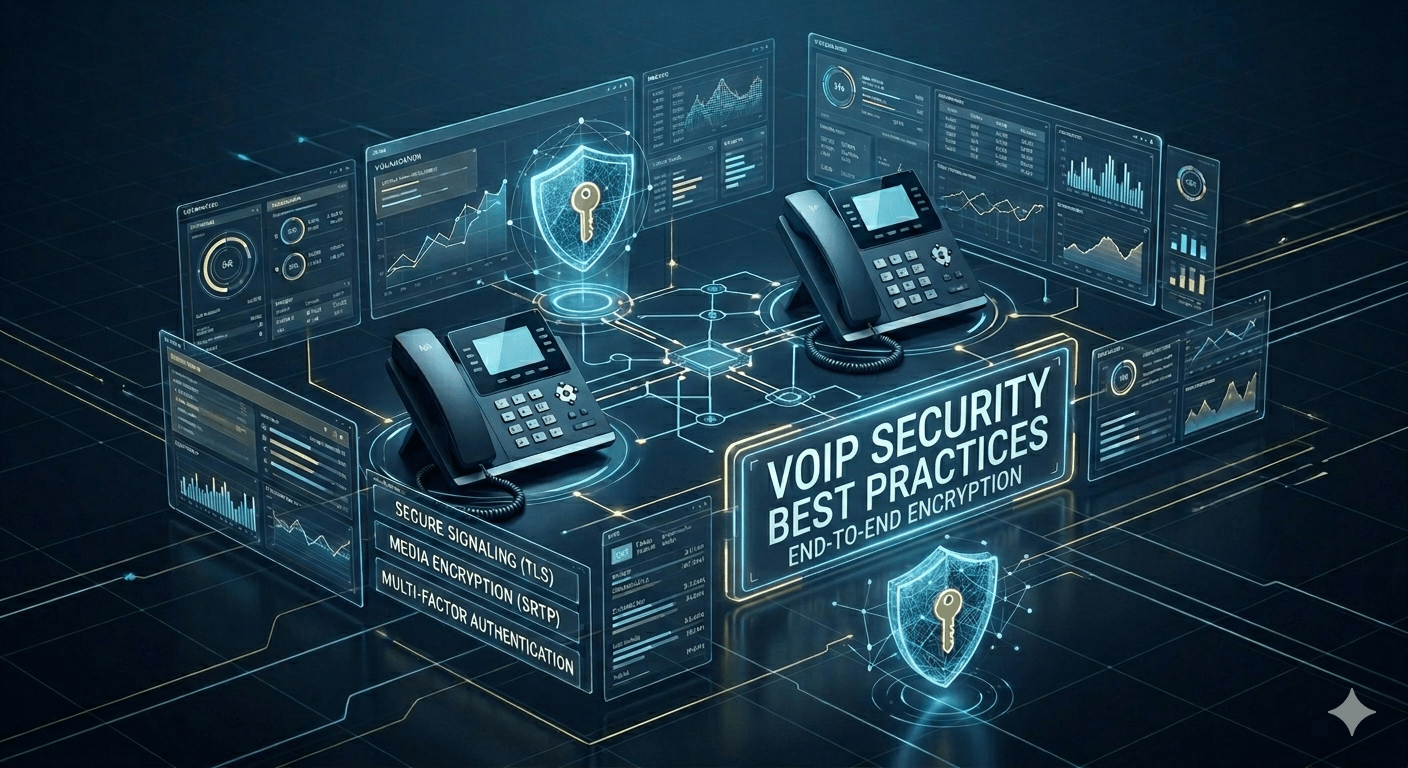
VoIP security best practices involve a comprehensive framework of protocols, encryption methods, and administrative policies designed to protect voice communications from digital threats. As businesses transition from traditional landlines to cloud-based systems, ensuring voice over IP security becomes paramount to preventing eavesdropping, toll fraud, and data breaches. Key measures include implementing Transport Layer Security for signaling, using Secure Real-time Transport Protocol for media encryption, and enforcing multi-factor authentication. By regularly auditing systems and educating employees on vishing risks, organizations can create a robust defense against cyberattacks that specifically target internet-based communication channels and sensitive corporate data.
Are VoIP phones secure?
The fundamental question of whether a modern communication system is safe often leads to a nuanced answer. When evaluating if are voip phones secure, one must understand that these devices are essentially small computers connected to the internet. Unlike traditional analog phones that used dedicated copper lines, internet-based phones transmit data packets over public or private networks. This connection makes them susceptible to the same types of attacks that plague computers and servers. However, with the right configuration and voip security system, these phones can actually be more secure than traditional telephony because they allow for advanced encryption and monitoring that analog systems simply cannot support.
The security of an IP-based system depends heavily on the underlying network architecture. In many cases, users wonder is voip secure when they are using public Wi-Fi or unencrypted connections. Without proper protections, voice data can be intercepted by anyone with the right tools on the same network. This is why ip phone security relies on a multi-layered defense strategy. When a provider uses high-level encryption and secure data centers, the risk of a breach is significantly minimized. Most modern businesses find that the benefits of digital communication far outweigh the voip risks, provided they take the necessary steps to harden their infrastructure against potential intruders.
Understanding VoIP vulnerabilities and threats
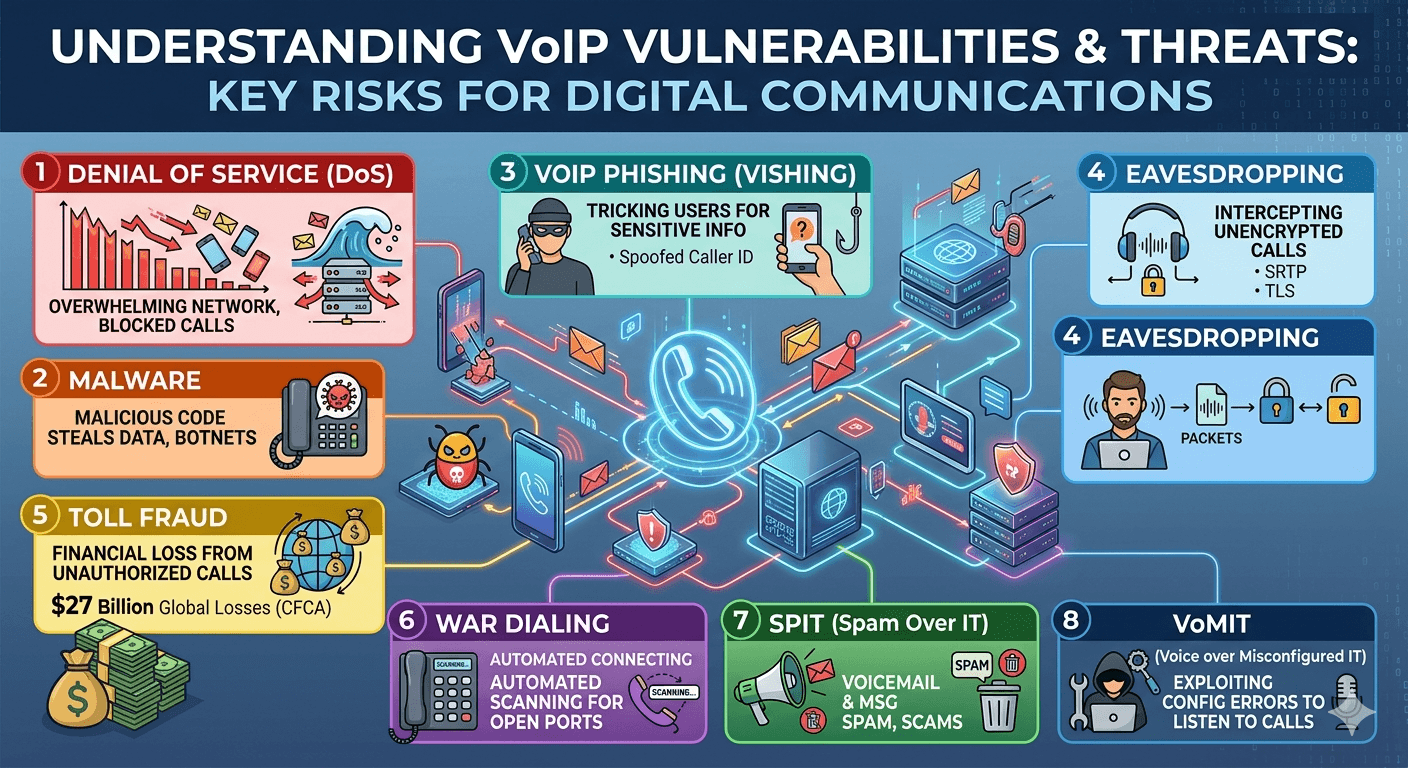
To build a strong defense, it is essential to recognize the common voip-associated vulnerabilities that attackers frequently exploit. These threats range from simple social engineering to complex technical exploits aimed at bringing down entire networks. Understanding these voip security issues is the first step in creating a resilient communication strategy.
1. Denial of Service (DoS) Attacks
A Denial of Service attack is designed to overwhelm your voip security system by flooding it with a massive volume of data packets. This creates a “traffic jam” that prevents legitimate calls from going through. For a business, this can mean a total loss of communication with customers, leading to lost revenue and a damaged reputation. These voip attacks often target the Session Initiation Protocol (SIP) by sending a barrage of call requests that the server cannot process.
2. Malware
Because VoIP devices run on operating systems and software, they are targets for malware and viruses. Malicious code can be used to steal credentials, listen to private conversations, or turn the phone into a “zombie” device that participates in larger botnet attacks. This is why treating ip phone security with the same level of urgency as computer security is vital for any organization.
3. VoIP Phishing (Vishing)
Vishing is a form of social engineering where attackers use voice calls to trick individuals into revealing sensitive information, such as passwords or credit card numbers. Attackers often spoof their caller ID to look like a legitimate organization, such as a bank or a government agency.
According to the 2023 Verizon Data Breach Investigations Report, social engineering remains a primary vector for initial access in corporate breaches, highlighting the need for voip security best practices that include employee awareness.
4. Eavesdropping or Call Interception
Without voip encryption, voice data packets travel across the internet in a format that can be easily read if intercepted. This is often referred to as a “man-in-the-middle” attack. When users ask which technology can be used to protect voip against eavesdropping, the answer is almost always a combination of SRTP and TLS. These protocols ensure that even if a packet is captured, the content remains unreadable to the interceptor.
5. Toll Fraud
Toll fraud is perhaps the most financially damaging of all voip security threats. In this scenario, hackers gain access to a business’s phone system to make expensive international calls or call premium-rate numbers that they own. The Communications Fraud Control Association (CFCA) has estimated that global losses from telecom fraud exceed $27 billion annually. Implementing strict calling permissions is a core part of how to secure voip and prevent these unexpected charges.
6. War Dialing
War dialing involves using automated software to call a large range of telephone numbers in an attempt to find open ports or vulnerable systems. Once a vulnerability is found, the attacker can use it to gain unauthorized access to the corporate network. This highlights why a secure voip phone must be configured to reject unrecognized or suspicious automated requests.
7. Spam over Internet Telephony (SPIT)
Similar to email spam, SPIT involves sending recorded advertisements or malicious messages to thousands of VoIP accounts simultaneously. While it is often just a nuisance, it can also be used as a delivery mechanism for vishing or other scams. Advanced voip cyber security tools often include filters that can identify and block these automated spam attempts before they reach the user.
8. Voice over Misconfigured Internet Telephones (VoMIT)
VoMIT is a specific type of attack where a hacker uses specialized tools to intercept and reassemble voice packets from a misconfigured network. This allows them to listen to calls in real-time or record them for later analysis. This threat underscores the importance of professional installation and regular configuration audits to ensure that no part of the network is left exposed.
How to choose a more secure VoIP service
Not all providers are created equal when it comes to safeguarding your data. When shopping for an encrypted voip service, you must look beyond the surface-level features and dive deep into their security infrastructure. A truly secure voip provider will be transparent about their protocols and their commitment to protecting client privacy.
Security and compliance accreditation
The first thing to check is whether the provider holds recognized security certifications. Look for SOC 2 Type II compliance, which indicates that a third-party auditor has verified their security, availability, and privacy controls. If you are in the healthcare or financial sectors, ensure they offer HIPAA or PCI-DSS compliant environments. These certifications are a strong indicator that the provider follows voip security best practices at every level of their operation.
Encryption
Ask specifically: is voip encrypted by default on your platform? A reputable provider should offer end-to-end voip encryption for both signaling and media. This means using Transport Layer Security (TLS) for the “handshake” between devices and Secure Real-time Transport Protocol (SRTP) for the actual voice data. Without these, your calls are essentially traveling on a postcard that anyone can read. An encrypted voip service should provide these protections without significantly impacting call quality or latency.
Help and support in the event of issues
Cybersecurity is an ongoing battle, and even the best systems can face challenges. Evaluate the provider’s support structure. Do they have a dedicated security operations center (SOC)? How quickly do they respond to reported voip security risks? A provider like Vonage or Nextiva often provides detailed vonage security documentation or dedicated support teams to help businesses navigate voip security issues. Having a partner who can provide immediate assistance during a suspected breach is a critical component of a secure voip strategy.
Other VoIP security best practices
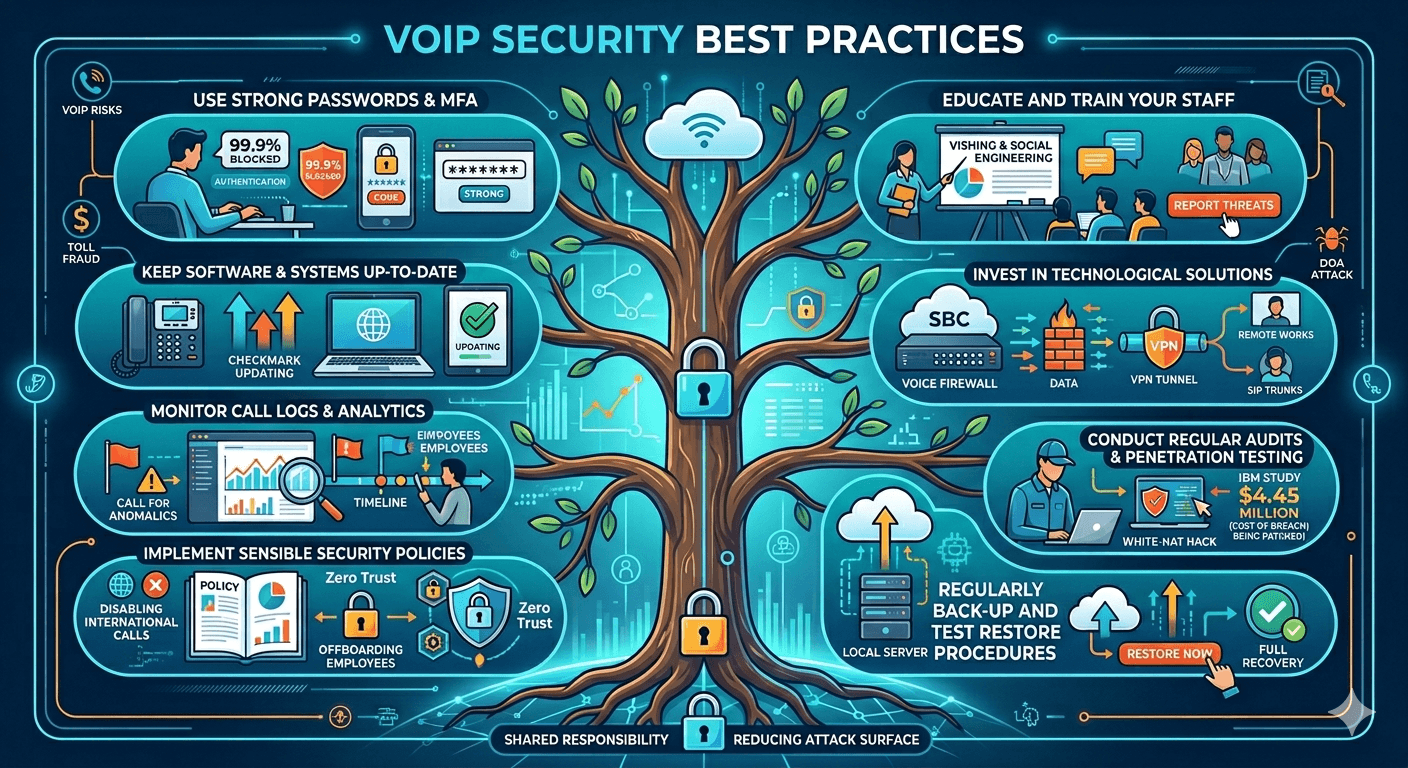
While your provider handles the heavy lifting of the network, your internal policies play a massive role in maintaining a secure voip environment. Security is a shared responsibility, and implementing the following steps will significantly reduce your attack surface.
1. Use strong passwords and multi-factor authentication (MFA)
One of the simplest yet most effective voip security best practices is the enforcement of strong password policies. Many VoIP attacks succeed because users keep the default manufacturer passwords on their desk phones or use easily guessable passwords for their web portals. Every device and user account should have a unique, complex password that is changed regularly.
Multi-factor authentication (MFA) adds a vital second layer of defense. By requiring a code from a mobile app or a physical key in addition to a password, you can stop the vast majority of unauthorized access attempts. Research by Microsoft has shown that MFA can block over 99.9% of account compromise attacks. In the context of voip cyber security, MFA should be mandatory for all administrative accounts and remote user logins.
2. Keep all software and systems up-to-date
Hackers are constantly looking for software bugs to exploit. Manufacturers and software providers release updates to patch these vulnerabilities as soon as they are discovered. To maintain ip phone security, you must ensure that your desk phone firmware, mobile apps, and desktop clients are always running the latest versions. Neglecting updates is one of the most common ways that businesses fall victim to preventable voip attacks.
Many modern systems allow for automatic updates, which is a highly recommended setting. If your organization manages a large fleet of devices, use a centralized management tool to push updates simultaneously across the entire network. This ensures that no single device remains a weak link in your voip security system.
3. Monitor call logs and analytics for suspicious activity
Proactive monitoring is a hallmark of a secure voip environment. By regularly reviewing call logs, you can spot the early warning signs of toll fraud or unauthorized access. Look for patterns such as:
A high volume of international calls to destinations where you don’t have customers.
Calls made outside of normal business hours or during the middle of the night.
Repeated failed login attempts on specific user accounts.
A sudden spike in short-duration calls, which could indicate war dialing.
Many advanced VoIP platforms offer automated alerts that notify you when these thresholds are met. Utilizing these analytics allows you to react to voip security threats in real-time, often stopping an attacker before significant damage is done.
4. Implement sensible security policies
A technical solution is only as good as the policy that governs it. Your organization should have a clear set of rules regarding how communication tools are used. For example, you might choose to disable international calling for all employees except those in the sales department. You should also have a policy for offboarding employees, ensuring that their access to the VoIP system is revoked the moment they leave the company.
Consider implementing a “Zero Trust” model for your voice network. This means that no device or user is trusted by default, even if they are inside the corporate office. Every connection must be verified and encrypted. This approach is highly effective at mitigating voip security risks that originate from compromised internal devices.
5. Educate and train your staff in security
Your employees are often the first line of defense against voip security issues like vishing and social engineering. Regular training sessions can help them identify the red flags of a suspicious call. Teach them never to share passwords over the phone and to be skeptical of any “urgent” requests for sensitive data or wire transfers, even if the caller ID appears to be from an executive within the company.
Creating a culture of security awareness is a long-term investment. When employees understand the voip risks associated with their daily tasks, they become active participants in the company’s defense. Provide them with a simple way to report suspicious calls or activity to the IT department, and reward those who help identify potential threats.
6. Invest in technological solutions
Beyond the built-in features of your VoIP service, you can add additional layers of protection. A Session Border Controller (SBC) is a specialized device or software that acts as a firewall specifically for voice traffic. It inspects every data packet to ensure it follows the correct protocols and blocks anything that looks like a DoS attack or a malformed request.
Using a Virtual Private Network (VPN) is another excellent way to how to secure voip for remote workers. A VPN creates an encrypted tunnel between the employee’s device and the corporate network, ensuring that their voice data is protected even when using unsecure home or coffee shop Wi-Fi. This is an essential component of a modern, secure voip phone setup for distributed teams.
7. Conduct regular VoIP security audits and penetration testing
To truly understand if your system is resilient, you must test it. Periodic security audits can help you find misconfigured settings or forgotten accounts that could be exploited. For larger organizations, hiring a third-party firm to conduct penetration testing on your voip security system is a wise move. These experts will attempt to “hack” your system using the same methods as real criminals, providing you with a detailed report on your vulnerabilities.
According to a study by IBM, the average cost of a data breach is $4.45 million.
Compared to this potential loss, the cost of regular auditing and testing is a small price to pay for peace of mind. These audits should cover everything from the physical security of your server room to the technical configuration of your SIP trunks.
8. Regularly back-up and test restore procedures
In the event of a successful attack, such as ransomware or a DoS attack that corrupts your system, having a recent backup is your ultimate safety net. Ensure that your VoIP configuration, call recordings, and user data are backed up to a secure, off-site location. However, simply having a backup is not enough; you must also regularly test your restore procedures to ensure that you can actually bring the system back online quickly.
A robust disaster recovery plan should outline exactly who is responsible for each step of the restoration process. In the world of voice over ip security, downtime is measured in lost opportunities and customer frustration. A well-tested backup strategy ensures that even if you face one of the major voip attacks, your business can recover with minimal disruption.
Read More: Best VoIP Hardware for Businesses to Boost Productivity in 2026
Final Words
Securing your business communications is not a one-time project but an ongoing commitment to excellence. By following the voip security best practices outlined in this guide, you can create a communication environment that is both highly functional and incredibly resilient. The key is to balance the convenience of modern technology with a “security-first” mindset that anticipates and mitigates risks before they can impact your operations.
When you take the time to choose a provider that prioritizes encrypted voip and offers robust vonage security or similar protections, you lay the foundation for long-term success. Combined with internal measures like MFA, regular updates, and employee training, your VoIP system can become one of the most secure tools in your digital arsenal. NIST (National Institute of Standards and Technology) provides extensive documentation on the technical standards for these systems, which can serve as a valuable resource for your IT team as they work to harden your network.
FAQs
What are the biggest threats to VoIP systems?
The most significant threats to VoIP systems include toll fraud, where hackers make expensive calls on your tab, and vishing, which uses voice calls for phishing. Additionally, Denial of Service (DoS) attacks can paralyze your communication by overwhelming the network with fake traffic. Eavesdropping is also a concern if your calls are not properly encrypted, allowing unauthorized parties to listen to sensitive business conversations.
What security protocols should I use?
You should primarily use Transport Layer Security (TLS) for signaling encryption and Secure Real-time Transport Protocol (SRTP) for media encryption. Together, these protocols ensure that the “handshake” between devices and the actual voice data are protected from interception. Additionally, using a VPN for remote connections and an SBC for network edge protection are highly recommended practices for a secure voip phone.
How do I prevent Toll Fraud?
To prevent toll fraud, you should implement strict calling permissions that disable international or premium-rate calling for users who do not need it. Setting up automated alerts for unusual calling patterns or spikes in usage can also help you catch fraud early. Furthermore, ensuring that all administrative portals are protected by strong passwords and MFA is critical for preventing hackers from gaining the access needed to initiate fraudulent calls.
Why is MFA important for VoIP?
Multi-factor authentication is important because it prevents attackers from gaining access to your VoIP system using stolen or guessed passwords. Even if a hacker obtains a user’s credentials, they will still be blocked without the second verification factor, such as a code from a mobile device. This is one of the most effective voip security best practices for protecting administrative consoles and user accounts.
How do I protect remote workers on VoIP?
Protecting remote workers requires a combination of encrypted voip service and secure connection methods. Encourage the use of a VPN to create a secure tunnel to the corporate office, or ensure that the VoIP app itself uses end-to-end encryption. Providing remote staff with security training to identify vishing attempts is also essential, as they are often targeted when working away from the physical protections of the office network.
What role does a Session Border Controller (SBC) play?
A Session Border Controller acts as a specialized firewall for your voice network. It sits at the edge of your network and monitors all incoming and outgoing SIP traffic. Its primary role is to protect the network from DoS attacks, hide internal network topology from potential attackers, and ensure that all voice packets adhere to security standards, making it a vital part of any comprehensive voip security system.
Are VoIP phones secure enough for sensitive data?
Yes, VoIP phones are secure enough for sensitive data provided they are configured with end-to-end encryption and the network is properly hardened. Many government agencies and healthcare providers use encrypted voip service to maintain compliance with strict privacy laws. The key is to ensure that both the service provider and the end-user follow all recommended security protocols to prevent data leaks.
How often should I audit my VoIP security?
You should conduct a basic review of your call logs and user access weekly, while a more comprehensive voip security audit should be performed at least quarterly. Penetration testing and a full review of your security policies should happen annually or whenever there is a major change to your network infrastructure. Regular audits are the best way to catch new voip security risks before they are exploited.