
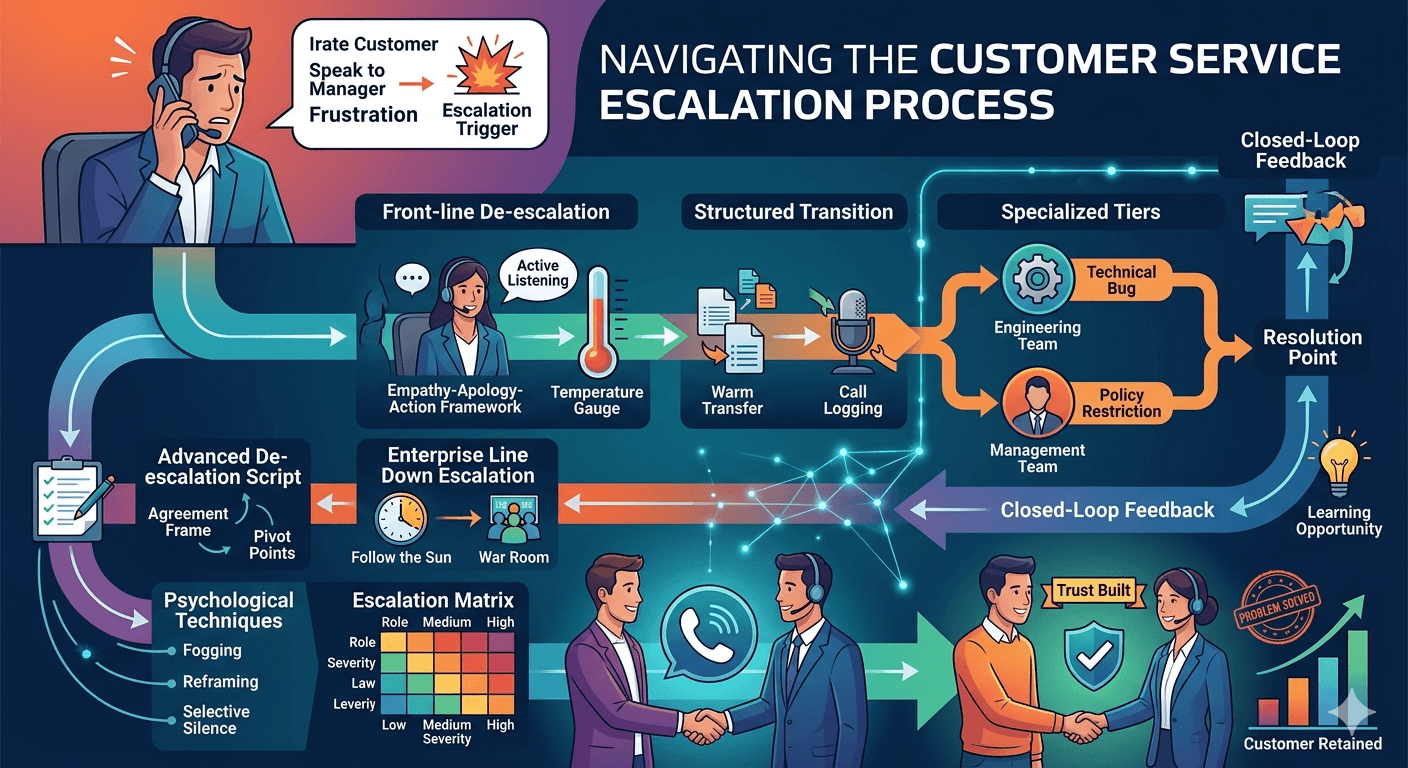
In the high-pressure world of customer support, the ability to navigate complex, high-stakes interactions is what separates a world-class support organization from a mediocre one. At the heart of this challenge lies a phenomenon known as the escalation call. For many support agents, hearing a customer demand to “speak to a manager” can be a source of significant stress, yet for a well-prepared organization, these moments are critical opportunities to build trust and demonstrate a commitment to resolution. Understanding the escalation call is not just about moving a problem up the chain of command; it is about a sophisticated interplay of psychology, technical process, and administrative strategy designed to salvage a customer relationship.
When an interaction reaches a point where the initial point of contact can no longer provide a satisfactory solution—whether due to technical limitations, policy restrictions, or emotional volatility—a structured call escalation becomes necessary. This transition is not a failure of the front-line agent; rather, it is a specialized tool within a broader escalation process that ensures every problem finds its appropriate home. In this comprehensive guide, we will break down the mechanics of the customer service escalation process, explore advanced de-escalation techniques for customer service call center environments, and provide a blueprint for creating a resilient support architecture.
Defining the Escalation Call and the Importance of a Robust Escalation Process
To master the art of support, one must first define the escalation call within the context of the modern contact center. An escalation call occurs when a customer’s inquiry or complaint is transferred to a higher-level agent, a specialized technician, or a management figure because the current representative lacks the authority, knowledge, or emotional leverage to resolve the issue. The escalation call meaning is deeply rooted in the concept of specialized tiers. Most support organizations operate on a tiered system where Tier 1 handles general inquiries, and Tier 2 or Tier 3 handles more technical or sensitive matters.
A well-defined escalation process is the framework that guides these transitions. Without such a process, escalations become chaotic, leading to long hold times, customer frustration, and agent burnout. The process defines exactly when and how a call should be moved. It involves identifying the “trigger points” that signify a call is no longer suitable for the current tier. By having a clear escalation procedure, an organization ensures that escalated calls are handled by the person best equipped to provide a solution, thereby improving the First Call Resolution (FCR) rate across the entire team.
Furthermore, the call center escalation process serves as a vital safety net for front-line employees. When agents know there is a clear path for call escalation, they feel more empowered to handle difficult situations, knowing they have the support of an escalation team behind them. This structural support is essential for maintaining morale and reducing the high turnover rates often seen in the support industry. A robust process also includes call logging and documentation, ensuring that the history of the escalated call follows the customer to the next tier, preventing them from having to repeat their story multiple times.
The Pillars of Effective Customer Escalation Management in Modern Support
Success in high-tier support requires a proactive approach to customer escalation management. This is the high-level strategy used to monitor, analyze, and optimize how an organization handles its most difficult cases. Effective management begins with the realization that an escalation call is a symptom of a larger issue—perhaps a product defect, a confusing policy, or a gap in training. By tracking the volume and nature of escalated calls, management can identify patterns and implement systemic changes that reduce the need for future escalations.
A primary pillar of customer escalation management is the establishment of clear ownership. When a call is moved to an escalation point, there must be no ambiguity about who is responsible for the final resolution. In complex enterprise environments, this often involves the use of an escalation matrix. This matrix is a document or software tool that maps out exactly which person or department should be involved based on the severity and type of the problem. For instance, a “line down” situation in a manufacturing environment would have a significantly different escalation procedure than a billing discrepancy.
Another critical pillar is the “closed-loop” feedback system. Once a call escalation has reached its conclusion, the details of the resolution should be shared back with the initial agent who handled the call. This turns every escalation call into a learning opportunity. If the Tier 1 agent understands how the Tier 2 specialist solved the problem, they may be able to solve similar issues themselves in the future. This continuous improvement cycle is the hallmark of a mature customer service escalation process and is essential for scaling a support team as the business grows.
Identifying the Correct Escalation Point for Rapid Issue Resolution
The efficiency of any call center escalation process depends on identifying the correct escalation point as quickly as possible. An escalation point is the specific individual, department, or tier that possesses the necessary tools or authority to fix the problem at hand. If a call is routed to the wrong point, it leads to a “ping-pong” effect where the customer is transferred multiple times, which is the quickest way to turn a frustrated customer into an irate one.
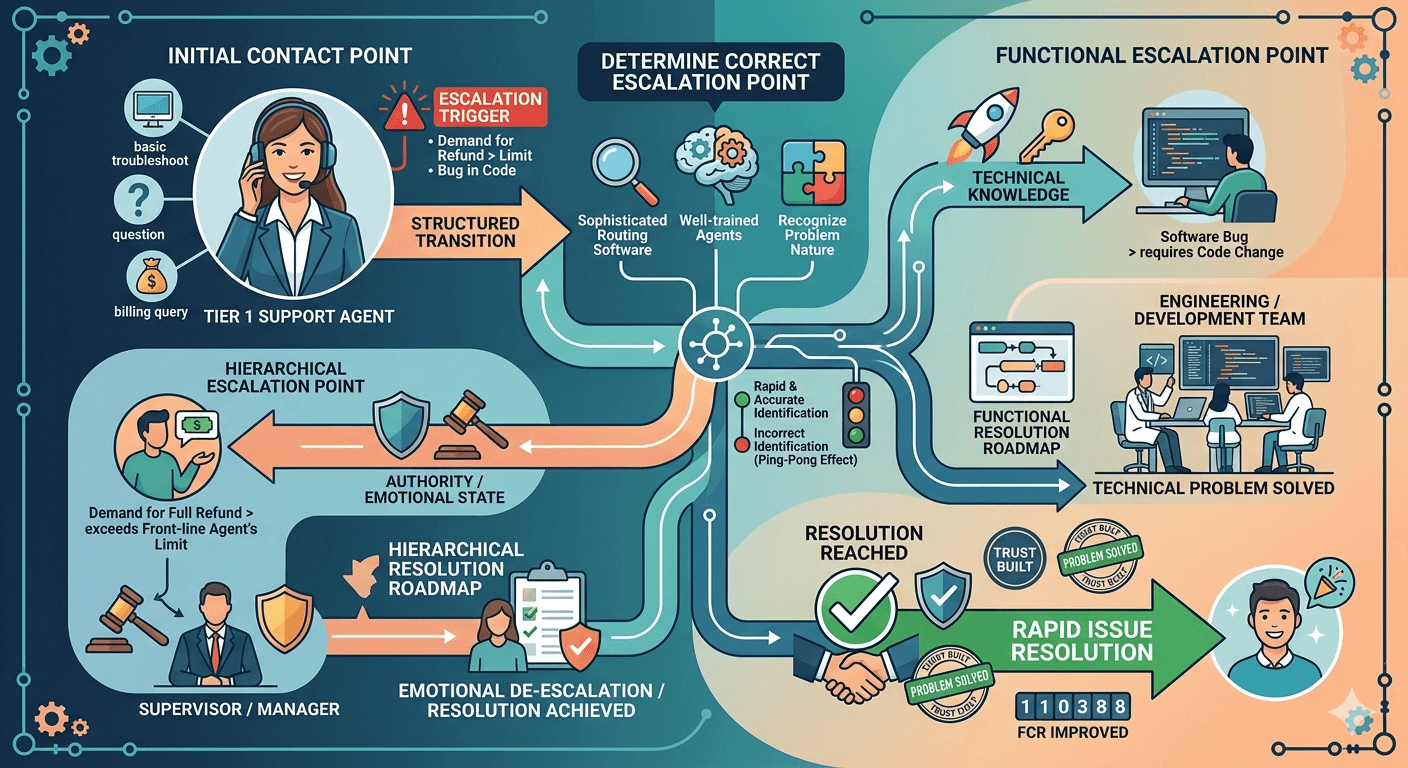
There are generally two types of escalation points in a support environment:
Functional Escalation Point: This is a transfer based on technical knowledge. For example, if a software user encounters a bug that requires a code change, the escalation process moves the call from general support to the engineering or development team.
Hierarchical Escalation Point: This is a transfer based on authority or the customer’s emotional state. If a customer is demanding a full refund that exceeds a front-line agent’s spending limit, the escalation call is moved to a supervisor or manager who has the financial authority to grant the request.
Determining the right escalation point requires sophisticated routing software and well-trained agents. Front-line staff must be taught to recognize the difference between a technical problem and a policy problem. By correctly identifying the nature of the escalated call early in the interaction, the agent can ensure the customer reaches a resolution faster, which significantly mitigates the negative impact of the original issue. This precision in escalation handling is what prevents support backlogs and keeps the operation running smoothly.
Advanced Escalation Handling Strategies for High-Stakes Interactions
When a representative is tasked with escalation handling, they are stepping into a situation that has already reached a high level of friction. These are not standard support calls; they are critical recovery missions. Advanced escalation handling requires a blend of deep technical expertise and superior soft skills. The goal is to move the conversation from an emotional battle to a collaborative problem-solving session. This often begins with “setting the stage”—confirming with the customer that you have the authority to help and that you have reviewed the notes from the previous agent.
One effective strategy in escalation handling is the “Summary and Confirm” technique. Before attempting a solution, the escalation specialist should summarize the customer’s entire journey up to that point. This demonstrates that the escalation process has worked correctly and that their time was not wasted during the transfer. Saying, “I understand you have been dealing with this software outage since 9 AM, and you have already tried a hard reset and a cache clear—is that correct?” shows the customer that you are fully up to speed and ready to take the next, more advanced step.
In the context of best practices for enterprise line down escalation, the stakes are even higher. These situations often involve thousands of dollars of lost revenue per hour. In these cases, escalation handling must be incredibly fast and transparent. The specialist should provide a “resolution roadmap,” informing the customer exactly what steps they are taking and when the next update will occur. Keeping a customer informed every 15 to 30 minutes, even if there is no new progress, prevents the vacuum of information that leads to panic and further customer service escalation.
Psychological De-escalation Techniques for Customer Service Call Center Professionalism
Before a call is even moved to a higher tier, agents should employ de-escalation techniques for customer service call center success. De-escalation is the art of reducing the intensity of a conflict through specific verbal and non-verbal cues. The goal of call center de escalation techniques is to resolve the customer’s emotional distress so that the technical problem can be addressed without needing to move the call up the chain. Psychological de-escalation begins with “active listening,” which involves giving the customer the floor to voice their frustrations without interruption.
A core principle of de escalation call center training is the “Empathy-Apology-Action” framework.
Empathy: Acknowledge the customer’s feelings. “I can hear how frustrated you are, and I would feel the same way if I were in your position.”
Apology: Offer a sincere apology for the situation, not necessarily admitting fault, but acknowledging the inconvenience. “I am truly sorry for the trouble this has caused you today.”
Action: Immediately move into what you can do to help. “Here is what we are going to do to get this fixed right now.”
Using these de escalation techniques for customer service call center environments helps to lower the customer’s “emotional temperature.” When a person is in a state of high anger, the logical part of their brain is often offline. By using calming tones and empathetic language, you help the customer move back into a logical state where they can understand the solution you are offering. This proactive de-escalation call center approach is the first line of defense in managing the overall volume of escalated calls and ensuring that only the most complex cases reach management.
Designing a Seamless Customer Service Escalation Process for Your Organization
Creating a high-functioning customer service escalation process requires careful planning and a deep understanding of your customer’s journey. A “seamless” process is one where the customer feels supported throughout the transition, rather than abandoned. The design phase should start with a clear “Call center escalation process flow” diagram. This visual map shows every path a call can take, from the moment a customer dials in to the moment their problem is resolved by a Tier 3 specialist or a manager.
Key elements of a seamless customer service escalation process include:
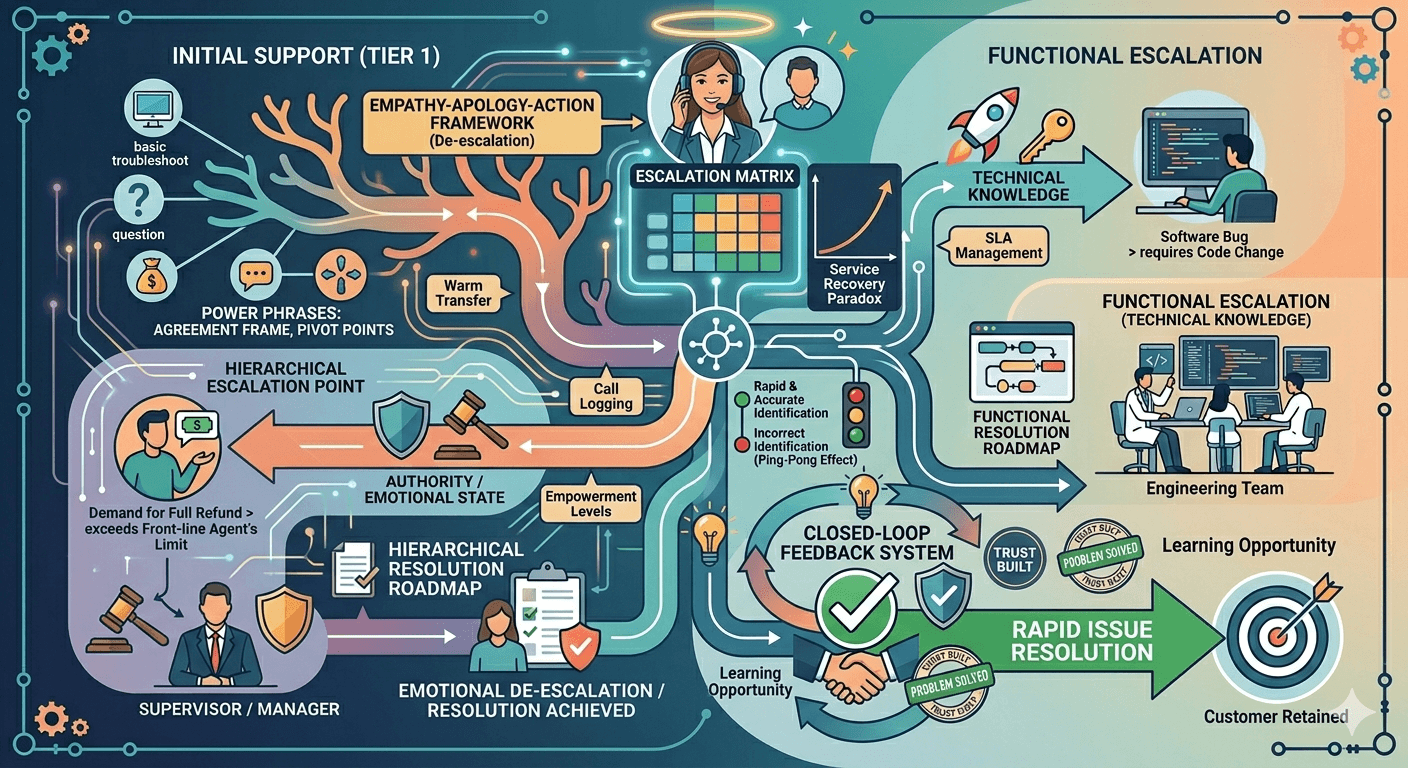
Warm Transfers: Never “blind transfer” an escalation call. The current agent should stay on the line to introduce the customer to the new specialist, providing a human bridge between the tiers.
Real-Time Collaboration: Use tools like Slack or Microsoft Teams so that front-line agents can get quick advice from the escalation team without having to transfer the call. This “hidden escalation” can often solve the problem while keeping the customer with their original agent.
SLA Management: Set Service Level Agreements (SLAs) for escalated calls. If a call is moved to Tier 2, there should be a guaranteed response time so the customer isn’t left in a digital limbo.
Empowerment Levels: Clearly define what a Tier 1 agent can do before they must trigger a call escalation. Sometimes, simply increasing an agent’s refund authority by $20 can reduce escalations by 10%.
By focusing on these structural details, an organization can turn a potentially negative escalated call into a positive “Wow” moment. When a customer sees that a company has a sophisticated escalation process and that multiple levels of the organization are dedicated to their success, it reinforces their loyalty. This strategic approach to the call center escalation process turns a reactive department into a proactive service powerhouse.
Creating a Powerful De-escalation Script Call Center Agents Can Rely On
In the heat of a difficult interaction, even the best agents can lose their words. This is why a well-crafted de-escalation script call center agents can follow is so valuable. A script should not be a rigid set of sentences to be read robotically; rather, it should be a collection of “power phrases” and “pivot points” that help the agent stay in control of the conversation. A good de escalation script call center focus is on moving the customer from “You” language to “We” language.
Instead of saying “You need to calm down,” which is one of the most inflammatory things an agent can say, the de escalation script call center might suggest: “I want to make sure I give this my full attention and get it right for you. Let’s look at the details together so I can find the best path forward.” This phrase shifts the focus from the customer’s behavior to the shared goal of finding a solution. It places the agent and the customer on the same team, which is the ultimate goal of any de-escalation call center strategy.
Another vital part of the de-escalation script call center toolkit is the “Agreement Frame.” This involves finding a point of agreement with the customer to de-arm their hostility. If a customer says, “This service is terrible and overpriced!” the scripted response might be: “I agree that you should be getting exactly what you pay for, and right now you aren’t. That is exactly what I am going to fix.” By agreeing with the customer’s right to be satisfied, you immediately lower the tension of the escalation call and create a path toward a productive resolution.
Crucial Call Center De-escalation Techniques to Calm Irate Callers
When dealing with a truly irate caller, general empathy is often not enough. You need specific, high-impact call center de escalation techniques to regain control. One such technique is “The Fogging Technique.” This involves calmly agreeing with any truth in what the customer is saying, or agreeing with the possibility of their point, without getting defensive. If a customer says, “You guys are incompetent!” an agent using this call center de escalation techniques would respond: “I can see how it would look that way given the delay you’ve experienced today.” This prevents the “argument loop” and forces the conversation back to facts.
Another crucial technique is “Selective Silence.” Often, when a customer is venting, the best thing an agent can do is stay completely silent for a few seconds after the customer finishes their rant. This gives the customer a chance to hear their own anger and often leads to them self-correcting or apologizing. Once the silence has settled, the agent can use a calm, low-pitched voice—a technique known as “The Late Night DJ Voice”—to re-enter the conversation. This low, steady tone is one of the most effective call center de escalation techniques for signaling authority and calm in the midst of chaos.
Finally, “Reframing” is a powerful tool in the de-escalation call center arsenal. This involves taking a customer’s negative statement and putting it into a positive context. If a customer says, “I’ve wasted two hours on this!” the agent might reframe it as: “I appreciate the time you’ve invested in helping us diagnose this. It’s because of your patience that we now have the information we need to solve it permanently.” This turns the customer’s frustration into a contribution, making them feel like a valued part of the escalation process rather than a victim of it.
Why Every Brand Needs a De-escalation Call Center Training Program
In today’s social media-driven world, a single poorly handled escalation call can go viral and cause immense brand damage. This is why a dedicated de-escalation call center training program is no longer optional—it is a requirement for brand protection. Such a program should focus on emotional intelligence (EQ) as much as it focuses on technical procedures. Agents need to be trained to recognize their own physiological triggers—like a rising heart rate or a tightening jaw—so they can remain calm during an escalated call.
A comprehensive de-escalation call center curriculum should include role-playing exercises where agents practice using their de escalation script call center phrases in high-stress simulations. These sessions help build “muscle memory,” so that when a real-life call escalation occurs, the agent doesn’t panic. Training should also cover the legal and policy boundaries of the escalation handling role, ensuring that agents know exactly what they can and cannot promise a customer in the heat of the moment.
Moreover, a de-escalation call center program should teach the importance of “Post-Call Processing.” After a particularly intense escalated call, agents need a few minutes to decompress and reset. Management should encourage this “mental health break” to ensure the agent doesn’t carry the stress of the previous escalation call into their next interaction. Investing in the emotional resilience of your support team is the most effective way to ensure a high-quality customer service escalation process that consistently delivers results.
Managing the Complexity of a Call Escalation within Enterprise Environments
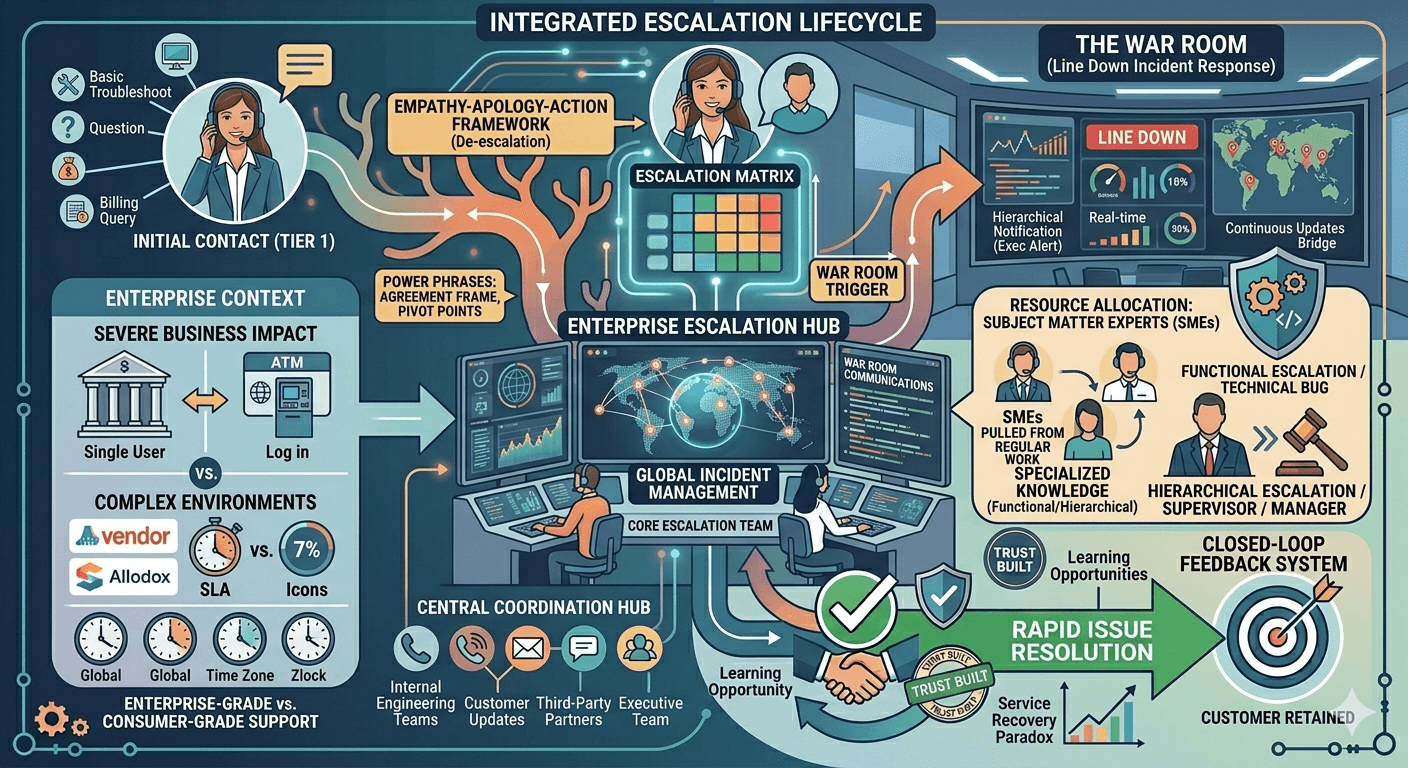
In the enterprise space, a call escalation is rarely as simple as a single transfer. These environments often involve multi-vendor relationships, complex service level agreements (SLAs), and global time zones. Managing an escalation call in this context requires a high level of project management skill. The escalation team must act as a central hub, coordinating between the customer, internal engineers, and sometimes third-party partners. This is where the call center escalation process must be integrated with the broader company-wide communication systems.
In an enterprise “Line Down” scenario, the escalation process often triggers a “War Room” or a high-priority incident response. The best practices for enterprise line down escalation include:
Hierarchical Notification: Automatically notifying executives if a high-value account is experiencing a critical failure.
Resource Allocation: Having a pre-defined group of “Subject Matter Experts” (SMEs) who can be pulled from their regular work to focus entirely on the escalated calls.
Continuous Updates: Providing a dashboard or a persistent bridge where the customer can see real-time progress without needing to initiate another call escalation.
This level of customer escalation management is what separates enterprise-grade support from consumer-grade support. It requires a deep understanding of the client’s business impact. An escalation call from a bank whose ATM network is down is vastly different from a single user who can’t log in. The escalation handling strategy must be tailored to the severity of the business risk, with the escalation team having the authority to bypass standard queues to get the right eyes on the problem immediately.
Mapping the Ideal Call Center Escalation Process for Maximum Efficiency
To achieve maximum efficiency, an organization must map its call center escalation process with clinical precision. This map should identify every possible escalation point and the exact “Hand-off Protocols” for each. A common mistake in the call center escalation process flow is the “Dead End,” where a call is transferred to a department that isn’t actually equipped to handle it, or to a voicemail box that is rarely checked. Mapping ensures that every escalation call has a clear destination and a defined “Success Exit.”
The ideal call center escalation process also includes “De-escalation Loops.” These are specific points in the process where an agent is prompted to try one more call center de escalation techniques before committing to the transfer. This “pause and reflect” moment can often prevent unnecessary escalated calls and keep the higher tiers focused on the truly difficult cases. By measuring the “Leaking Rate” (calls that should have been resolved at a lower level but were escalated), management can refine the escalation matrix and provide targeted training to the front-line.
Finally, the customer service escalation process should be supported by robust call logging and data analytics. By analyzing the “Time to Resolution” for escalated calls, you can find bottlenecks in your escalation process. If it takes four hours to get a response from Tier 2, you may need to increase staffing at that escalation point. Data-driven customer escalation management allows you to move from reactive “firefighting” to proactive “fire prevention,” creating a support environment that is as efficient as it is effective.
Research and Facts: The Impact of Escalations on Customer Retention
Research in the customer experience sector consistently shows that the way a company handles an escalation call is a “moment of truth” for the brand. According to a study by Zendesk, roughly 70% of customers expect a company’s internal departments to collaborate so they don’t have to repeat themselves. This underscores the vital importance of call logging and a seamless call center escalation process. When an organization fails to transfer information along with the escalated call, customer frustration increases by over 50%, regardless of the final outcome.
Furthermore, research from Salesforce indicates that 80% of customers say the experience a company provides is as important as its products or services. A high-quality customer service escalation process is a major part of that experience. Interestingly, “The Service Recovery Paradox” suggests that a customer who has a problem that is resolved through an excellent escalation handling experience often becomes more loyal than a customer who never had a problem at all. This highlights the hidden value in every escalation call; if you handle the call escalation with empathy and speed, you can turn a crisis into a long-term partnership.
Best Practices for Enterprise Line Down Escalation and Incident Management
In the world of B2B and enterprise support, the “Line Down” situation is the ultimate test of an escalation team. This is where the standard call center escalation process must be supercharged with emergency protocols. The best practices for enterprise line down escalation begin with “Immediate Visibility.” The moment a line-down is reported, the incident should be flagged in the CRM with a high-priority status that alerts management across the organization.
Another best practice is the “Follow the Sun” model. For global enterprises, a critical call escalation should be handed off between global regions to ensure that work on the resolution never stops. If a solution isn’t found during the US business day, the escalation process moves the ticket to the APJ or EMEA team. This ensures a 24/7 focus on the customer’s problem. Additionally, enterprise line down escalation should always include a “Post-Mortem” or Root Cause Analysis (RCA). Once the line is back up, the escalation team must document exactly why the failure happened and what changes are being made to the escalation procedure to prevent it from happening again.
Read More: What is Internet Calling: How Internet Calling Works?
Final Thought
An escalation call is not a sign of failure; it is a vital component of a sophisticated, tiered support strategy. By mastering the escalation process, implementing proactive customer escalation management, and training agents in advanced de-escalation techniques for customer service call center interactions, an organization can transform its most difficult challenges into its greatest strengths. The key is to view the call center escalation process as a journey of continuous improvement, where every escalated call provides the data and the human experience needed to build a better service for the future. Whether you are refining your de-escalation script call center tool or restructuring your entire escalation matrix, the goal remains the same: to ensure that every customer feels heard, valued, and supported, no matter how complex their problem may be.
Frequently Asked Questions (FAQs)
What is escalation call example?
An escalation call example would be a scenario where a customer is calling their internet service provider because their connection has been down for three days. The initial agent has tried all standard troubleshooting steps (resetting the router, checking cables), but the issue persists. The customer becomes frustrated and asks for a manager. The agent then performs a “warm transfer” to a Tier 2 technician or a supervisor who has the authority to send a field engineer to the customer’s house immediately.
What is the typical escalation call script?
A typical escalation call script for an agent might be: “I completely understand how important it is to get your business back online. While I have exhausted the troubleshooting steps I can perform here, I want to make sure we get this fixed for you right now. I am going to bring in one of our senior specialists who has more advanced tools for this specific issue. I will stay on the line to introduce you and ensure they have all the details I’ve already collected. Does that sound like a good plan?”
What is the escalation meaning in a call center?
In a call center, escalation meaning refers to the process of moving a customer’s issue to a higher level of authority or expertise. This can be a “Functional Escalation,” where the call is moved to someone with more technical knowledge, or a “Hierarchical Escalation,” where the call is moved to a supervisor or manager to handle a complaint or a request that exceeds the front-line agent’s permissions.
How to handle escalation calls effectively?
To handle escalated calls effectively, you should always start by validating the customer’s frustration and confirming that you have the authority to help. Use active listening to let them vent, then use a “Summary and Confirm” technique to show you understand the history of the issue. Focus on providing a clear timeline for the resolution and ensure you follow up exactly when you say you will.
What is call logging in the escalation process?
Call logging is the practice of documenting every detail of a customer interaction in a CRM or support database. In the escalation process, meticulous call logging is essential because it allows the next agent in the chain to see exactly what has already been tried, what the customer’s emotional state is, and what promises have been made. This prevents the customer from having to repeat themselves, which is a major factor in successful escalation handling.
What is an escalation matrix?
An escalation matrix is a structured guide or chart that defines exactly who should be contacted and when during the escalation process. It usually maps out different “severity levels” of problems and provides a list of contacts for each level, including their roles and response time expectations. This ensures that call escalation is always routed to the correct escalation point without delay.