
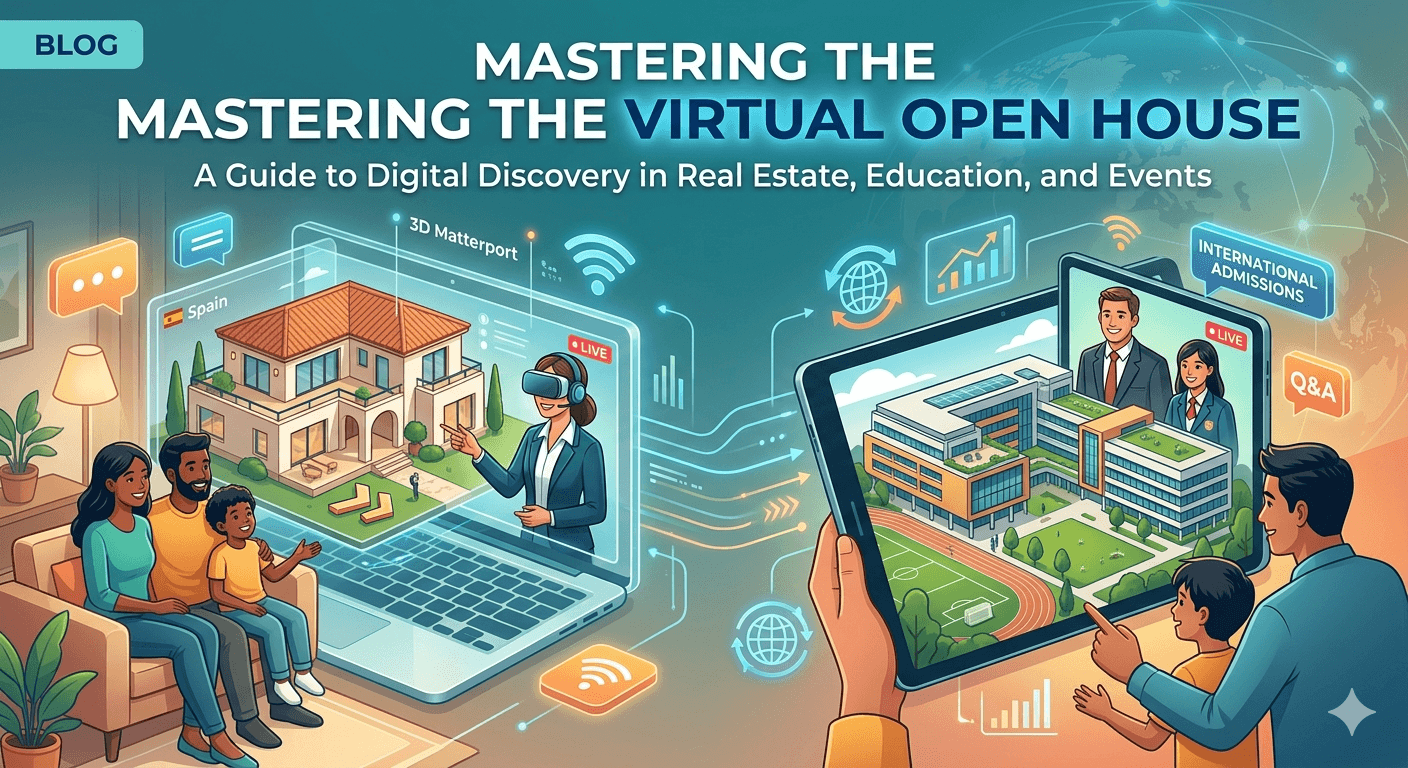
In the rapidly evolving landscapes of real estate, education, and professional events, the traditional “walk-in” model is no longer the sole gateway to discovery. The digital transformation has ushered in an era where physical distance is no longer a barrier to exploring a luxury villa in Spain or a prestigious campus in Singapore. This shift is centered around a singular, powerful concept: the digital event. To stay ahead of the curve, it is essential to understand the virtual open house meaning and how it can be leveraged to drive engagement, admissions, and sales.
Whether you are a real estate agent looking to master virtual home selling or an administrator planning a virtual open house for international school recruitment, the mechanics of these events have become a standard benchmark for success. A digital showing is far more than a simple video call; it is an immersive, strategic, and highly interactive experience designed to provide clarity, build trust, and facilitate decision-making from the comfort of a viewer’s screen. This guide provides a comprehensive look at how to execute these events with professional precision.
Defining the Virtual Open House Meaning: A New Digital Frontier
To truly grasp the impact of this technology, we must first establish the virtual open house meaning in a modern context. It is an online event where a property, school, or venue is showcased to a remote audience through live or pre-recorded digital media. Unlike a static photo gallery, this format allows participants to explore a space in real-time, ask questions, and interact with hosts. It bridges the gap between high-intent interest and physical visitation, often serving as the decisive factor for prospects who are unable to travel.
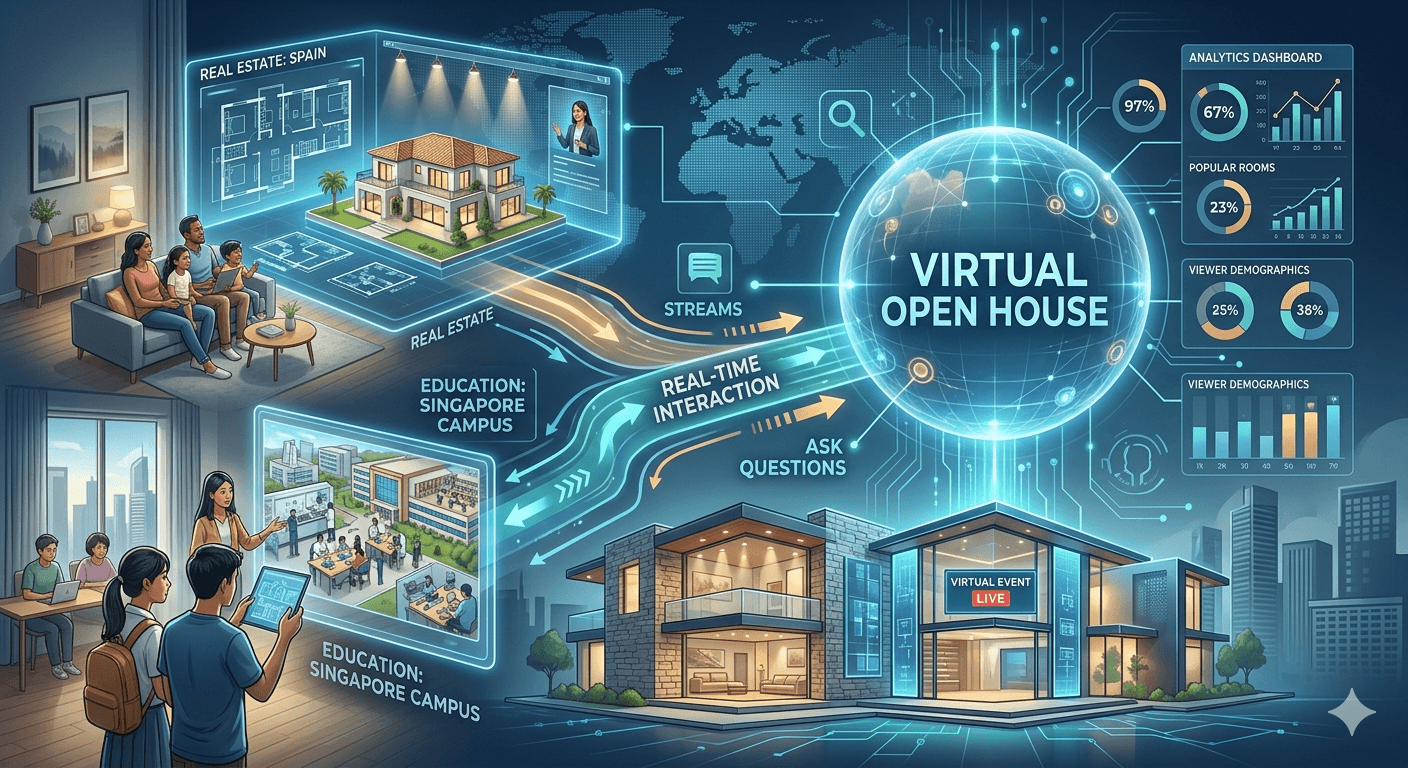
The core of this concept lies in its ability to democratize access. For a potential homebuyer, it represents an online open house that fits into a busy schedule without the need for a commute. For an institution, it represents a global stage where the culture and facilities of the organization can be broadcast to a worldwide audience. By moving beyond physical limitations, organizations can increase their reach exponentially, ensuring that their message reaches the most relevant stakeholders regardless of their geographic location.
Moreover, the digital nature of these events allows for data-driven insights that traditional gatherings cannot provide. Hosts can track how long a viewer stays engaged, which rooms or features garner the most attention, and exactly when a prospect decides to reach out for more information. This transition from a physical “guest book” to a digital “analytics dashboard” is what makes the modern digital showing a cornerstone of efficient marketing and sales operations.
What is a Virtual Open House and How Does it Function?
If you are asking what is a virtual open house from a technical standpoint, it is a sophisticated blend of streaming technology, 3D mapping, and interactive communication. It functions by using high-quality visual assets—such as 360-degree tours or high-definition live video—to simulate the experience of being physically present. Attendees join through a specific link, often via a web browser or a dedicated open house software platform, where they can navigate through the space at their own pace or follow a guided tour led by a professional host.
The functionality of a virtual showing can be categorized into two main types: synchronous (live) and asynchronous (on-demand). A live event involves a scheduled time where a host walks through the space, providing live commentary and answering questions through a chat box. On the other hand, an on-demand tour uses pre-recorded media or 3D models, such as those created by Matterport, allowing users to show a house or a classroom to themselves whenever they choose. Both formats are essential for a holistic digital marketing strategy.
Behind the scenes, the process involves capturing the space using specialized cameras or high-end smartphones. This imagery is then processed to create a “digital twin” or a high-quality video feed. When a participant joins, the software manages the bandwidth to ensure a smooth, lag-free experience. This technical execution is critical; a poorly functioning stream can quickly alienate a prospect, whereas a high-definition, interactive open house live event can leave a lasting, positive impression that leads directly to a conversion or a physical visit.
Why You Should Host a Virtual Open House for International School Admissions
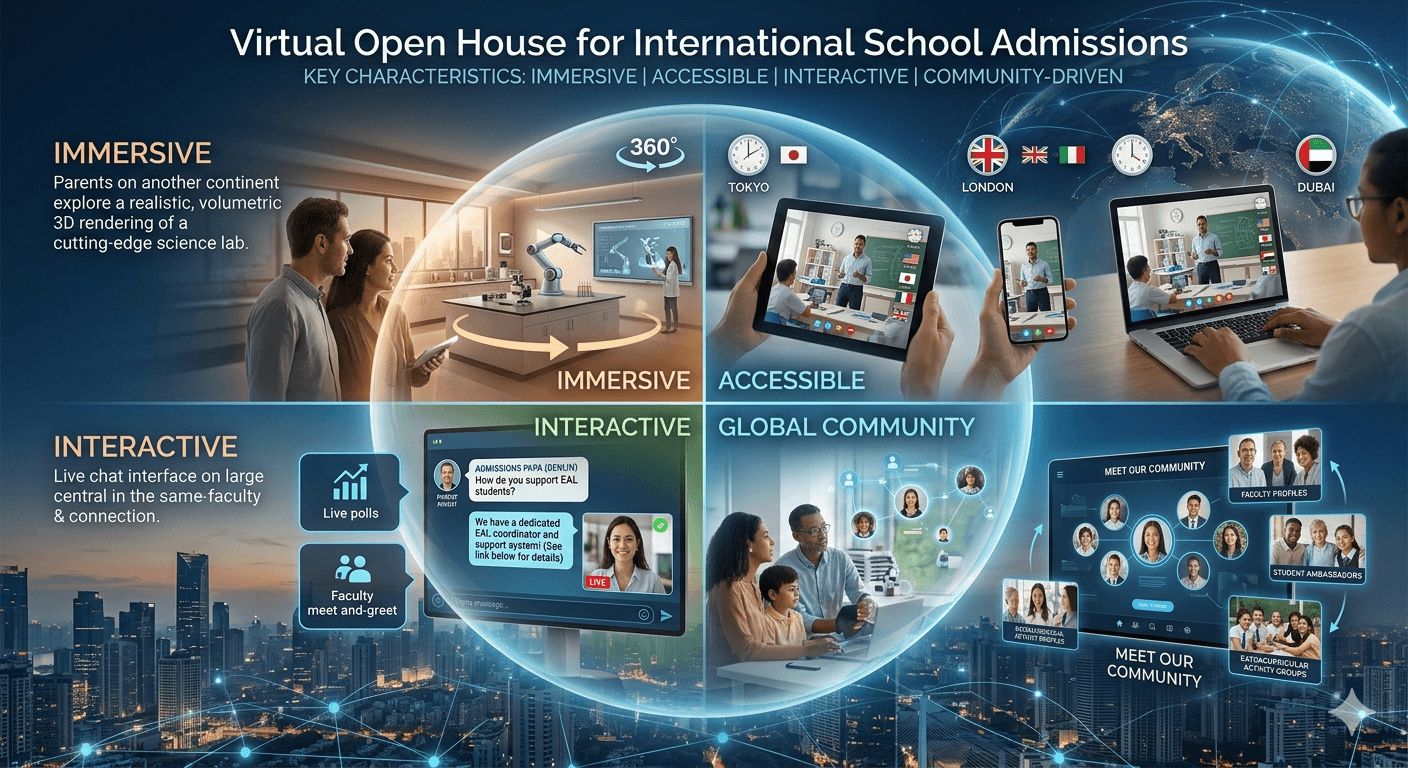
In the competitive world of global education, a virtual open house for international school recruitment is no longer a luxury—it is a necessity. International schools often cater to expatriate families who are moving from one country to another. These parents rarely have the opportunity to visit a campus in person before making a final enrollment decision. By hosting a digital event, a school provides these families with a vital lifeline, allowing them to meet the faculty, see the laboratories, and understand the school’s atmosphere from thousands of miles away.
The primary benefit of a virtual open house for international school success is the ability to build a sense of community before the student even sets foot on campus. Live Q&A sessions with the principal, student-led tours, and virtual “meet and greets” with teachers help humanize the institution. Parents can ask specific questions about the curriculum, language support, and extracurricular activities, receiving immediate answers that build confidence. This level of transparency is essential for high-stakes decisions like choosing an international education path.
Furthermore, a digital format allows schools to showcase their technological prowess. If a school claims to offer a cutting-edge STEM program, demonstrating that through a high-quality online open house validates that claim. It also allows schools to record these sessions and repurpose them as marketing assets for future prospects. By creating a library of digital tours and faculty interviews, an international school can maintain a “24/7 open door” policy, ensuring that their recruitment efforts never stop, regardless of time zones.
Key Characteristics of a Virtual Open House
A truly effective digital event is defined by several key characteristics that separate it from a standard video call or a photo slideshow. The most successful virtual open houses are immersive, meaning they provide a sense of depth and scale that photos simply cannot match. Whether through a 3D floor plan or a wide-angle live lens, the viewer should feel as though they are standing in the middle of the room. This immersion is the primary driver of emotional connection, which is vital for virtual home selling.
Accessibility is another hallmark of the digital model. A traditional open house is limited to a few hours on a Sunday afternoon. A virtual open house can be accessed from any device—smartphone, tablet, or desktop—at any time. It removes the barriers for individuals with disabilities, those without transportation, or those living in different time zones. This inclusivity not only expands the potential audience but also reflects a modern, forward-thinking brand identity for the host.
Interactivity is perhaps the most important characteristic. Unlike a television broadcast, a virtual showing allows for two-way communication. Viewers can request to see a specific corner of a kitchen, ask about the age of a roof, or inquire about the teacher-to-student ratio in a specific grade. This real-time feedback loop ensures that the information provided is highly relevant to the audience’s needs. When these characteristics—immersion, accessibility, and interactivity—are combined, the result is a powerful sales and engagement tool that outperforms traditional methods.
Virtual Open House vs. Related Event Formats
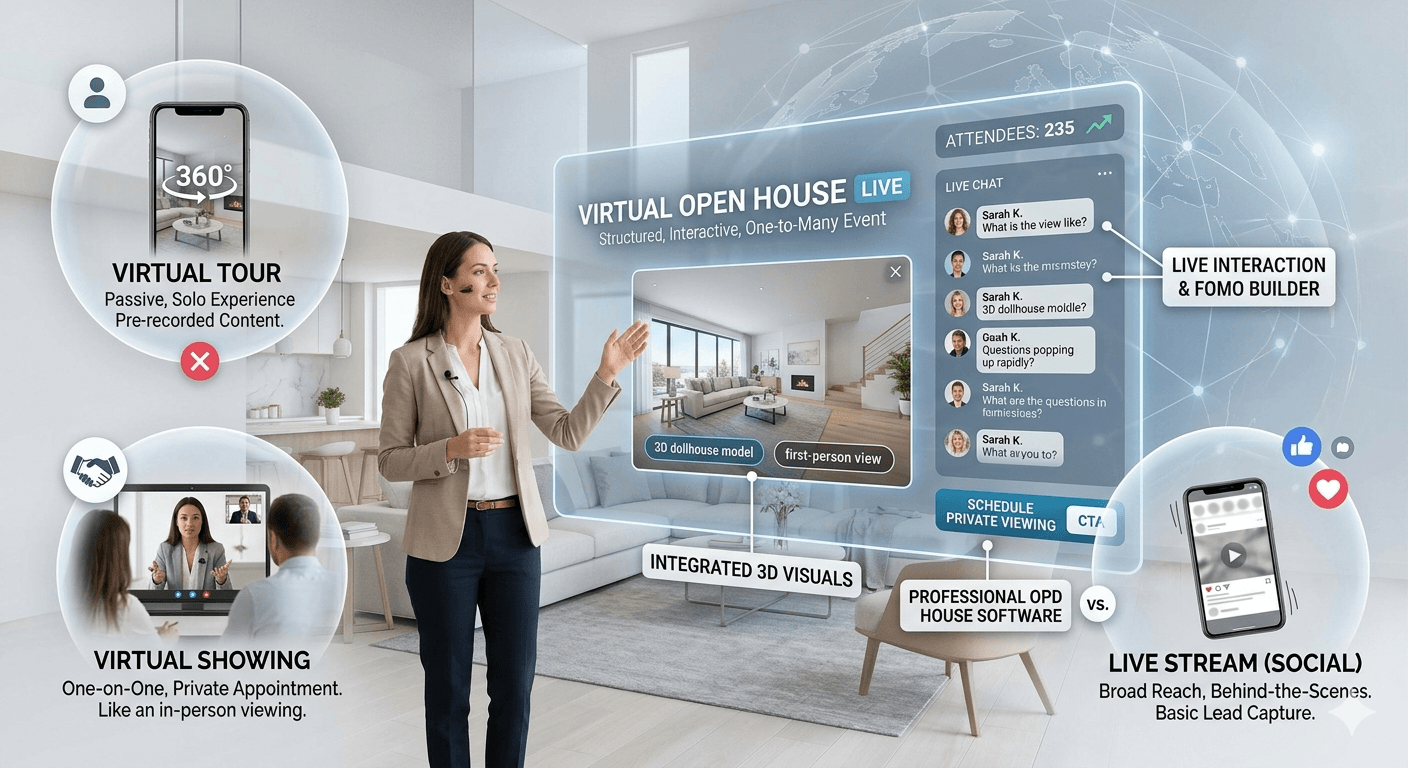
It is common to confuse different digital formats, but understanding the distinctions is key to choosing the right tool for your goals. A virtual open house is a comprehensive, structured event, whereas a “virtual tour” is often a passive, solo experience. While a tour might be a component of an open house, the “open house” implies a sense of occasion, often involving a live host, a specific presentation, and a dedicated time for interaction. It is a social event rather than a static piece of content.
Similarly, a “virtual showing” is usually a one-on-one interaction between a single prospect and a representative, akin to a private appointment. In contrast, virtual open houses are “one-to-many” events, designed to build momentum and social proof by showing that many people are interested in the property or school at the same time. Seeing multiple questions pop up in a live chat can create a “fear of missing out” (FOMO), which can be a powerful motivator in real estate and school admissions.
Finally, we must distinguish these from a standard “live stream” on social media. While you can host a digital showing on Facebook or Instagram Live, a professional online open house often utilizes dedicated open house software that allows for lead capture, integrated 360-degree models, and secure registration. While social media is great for broad reach and “behind-the-scenes” looks, a formal virtual event provides a more polished, controlled, and professional environment that is better suited for high-value transactions.
Essential Virtual Open House Components
To host a successful digital event, you must assemble several critical components. First and foremost is high-quality visual content. Whether you are using a professional videographer or a high-end 3D camera like Matterport, the visuals must be sharp, stable, and well-lit. Poor lighting or a shaky camera can make even the most beautiful space look unappealing. This is the foundation of how to do a virtual house viewing that actually converts prospects into buyers.
The second component is a reliable communication interface. This includes a clear microphone for the host and a robust chat or Q&A platform for the audience. Audio quality is often more important than video; if participants cannot hear the host clearly, they will quickly lose interest. Additionally, having a moderator to manage the chat allows the presenter to focus on the tour without getting distracted by technical questions or repetitive inquiries.
Thirdly, you need a strong call to action (CTA). The purpose of the virtual open house is to move the prospect to the next stage of the funnel. This might be “Schedule a private viewing,” “Download the school brochure,” or “Apply now.” Without a clear, easy-to-find CTA during and after the event, you risk losing the momentum you’ve built. Integrating these buttons directly into the open house software interface ensures that the path to conversion is as frictionless as possible for the viewer.
Choosing the Right Platform for Your Digital Event
Selecting the appropriate open house software is a strategic decision that depends on your specific industry and goals. For real estate, platforms that integrate with MLS (Multiple Listing Services) and provide 3D floor plans are ideal. These tools often allow users to toggle between a “dollhouse” view and a “first-person” walk-through, which is essential for understanding the layout of a home. In contrast, for a virtual open house for international school recruitment, you might prefer a webinar-style platform that supports high-capacity live streaming and breakout rooms for different departments.
When evaluating platforms, consider the user experience for the attendee. Does it require a heavy download, or can it be accessed directly in a mobile browser? In an era of “app fatigue,” browser-based solutions often see higher attendance rates. Additionally, look for platforms that offer robust lead-capture forms and analytics. Knowing who attended, how long they stayed, and what they clicked on allows for a much more targeted follow-up strategy, which is the key to virtual home selling success.
Finally, consider the integration capabilities. The best virtual open houses don’t exist in a vacuum; they should connect with your CRM (Customer Relationship Management) system. When a prospect signs up for your online open house, their information should automatically flow into your marketing database. This automation ensures that no lead is lost and that you can begin nurturing the relationship the moment the event concludes.
Designing Your Virtual Space for Maximum Impact
Just as you would stage a physical home or prepare a campus for visitors, you must design your digital environment. For a virtual showing, this means “digital staging.” Ensure that the space is clutter-free and that the camera path is logical. In a real estate context, you might use digital staging software to add furniture to an empty room, helping viewers visualize the potential of the space. This is a common tactic in how to do a virtual house viewing for new constructions or vacant properties.
For an international school, the “space” also includes the digital lobby and presentation slides. Your digital entrance should reflect the school’s branding and provide a warm welcome. Use high-resolution images and videos of students in action to create a vibrant, living atmosphere. Designing the flow of the event—starting with a broad overview before diving into specific classrooms or facilities—helps maintain a logical narrative that keeps the audience engaged from start to finish.
Lighting and sound are the “interior design” of the virtual world. When planning open house live events, ensure that the presenter is well-lit from the front and that there is no echoing in the room. If the physical space has poor acoustics, consider using a lapel microphone to ensure the voice is crisp. These small design details contribute to the overall perceived value of the property or institution, signaling a high level of professionalism and attention to detail.
Preparing Your Hosts and Presenters for the Spotlight
The host is the face of your virtual open house, and their preparation is vital. Unlike a physical event where they can wander and chat, a digital host is “on” for the entire duration of the stream. They must be comfortable speaking to a camera, managing transitions, and handling live questions with poise. For a virtual open house for international school success, using a charismatic faculty member or a well-spoken student ambassador can provide an authentic voice that resonates with parents.
Preparation should include a full rehearsal to test the camera angles and the timing of the presentation. The host should have a clear script or outline but should also be ready to improvise based on audience feedback. For example, if several viewers ask to see the backyard again, a good host will navigate back there and spend more time highlighting its features. This responsiveness is what makes virtual showing events feel personal and high-touch.
Training the host on the technical side is also important. They should know how to troubleshoot basic issues, such as a muted microphone or a lost connection, without panicking. Providing them with a “cheat sheet” of common questions and answers allows them to provide rapid, accurate information, which builds trust. A well-prepared host transforms the virtual open house from a technical demonstration into a compelling human story.
Building Interactive Elements to Drive Engagement
Interactivity is the “secret sauce” of a successful online open house. To keep viewers from multitasking or dropping off, you must give them reasons to participate. Live polls are a great tool; for example, you could ask, “Which room are you most excited to see?” and then tailor the tour based on the results. This makes the audience feel like they are co-creating the experience, which significantly increases their emotional investment in the virtual showing.
Another powerful interactive element is the “hotspot” within a 3D tour. As viewers navigate through a home in their open house software, they can click on hotspots that reveal more information, such as the brand of the appliances, the type of flooring, or a video of the view from the balcony. For a school, these hotspots could link to curriculum documents or faculty bios. These elements provide a “layered” experience where the user can choose how deep they want to dive into the details.
Q&A sessions are the most direct form of interactivity. Encourage viewers to submit questions throughout the event and dedicate a specific segment at the end to answering them. Addressing a participant by name—”That’s a great question, Sarah”—creates a personal connection that is often missing in digital marketing. This level of engagement is what makes virtual open houses feel like a real event rather than just a commercial, driving much higher conversion rates for virtual home selling.
Create Supporting Content for a Comprehensive Experience
A virtual open house should not stand alone; it needs a supporting ecosystem of content. Before the event, create “teaser” videos and blog posts to build anticipation. These should highlight a few “star features” of the property or school without giving everything away. This content is vital for your promotion strategy, especially when learning how to share virtual home tours on social media effectively.
During the event, provide downloadable resources that participants can take with them. For a real estate event, this could be a PDF of the floor plan, a list of recent upgrades, or a neighborhood guide. For a virtual open house for international school recruitment, provide the admissions handbook, a fee schedule, and a link to the application portal. These “digital handouts” ensure that the information stays with the prospect long after they’ve closed the browser.
After the event, the supporting content continues with the “replay” and follow-up emails. Many high-intent prospects may have missed the live event due to scheduling conflicts. Providing a high-quality recording ensures that they can still benefit from the information. You can also break the recording down into smaller “highlight” clips to share on social media, further extending the life of your content and maximizing the ROI of your virtual showing efforts.
The Virtual Open House Process: A Step-by-Step Blueprint
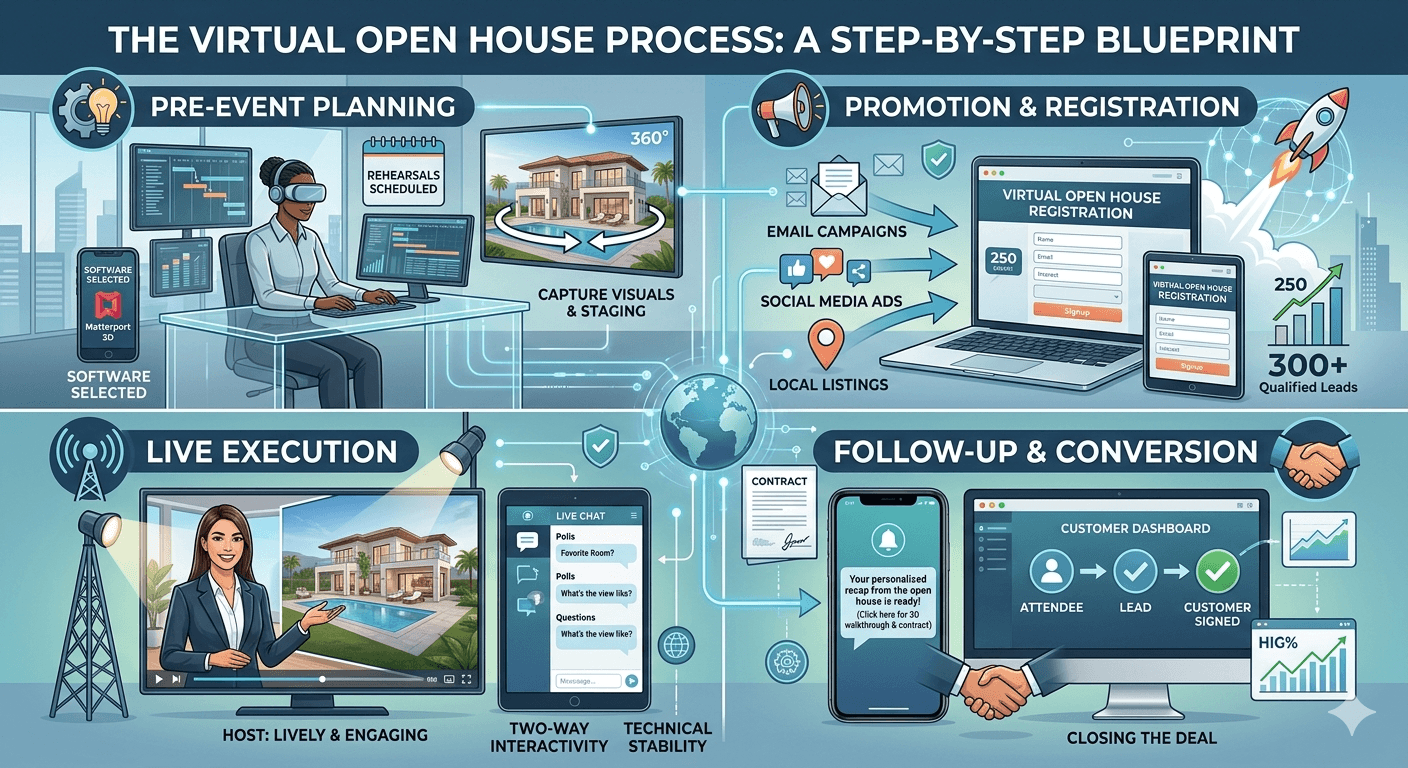
Executing a digital event requires a disciplined process to ensure nothing is overlooked. The first phase is the “Pre-Event Planning,” which involves setting your technical infrastructure and capturing your visuals. This is the time to decide on your open house software and schedule your rehearsals. Without a solid foundation of planning, the subsequent steps will be much more difficult to manage.
The second phase is “Promotion,” where you drive traffic to your registration page. This is a multi-channel effort involving email marketing, social media, and local listing sites. The goal is to build a “qualified” audience of individuals who are genuinely interested in the property or school. Effective promotion is what turns a virtual showing into a high-impact event with hundreds of attendees.
The third and fourth phases are “Execution” and “Follow-up.” During execution, the focus is on energy, interactivity, and technical stability. The follow-up is where the actual “selling” happens. Within 24 hours of the event, every attendee should receive a personalized message with the resources promised during the tour and a clear next step. This disciplined virtual open house process ensures that the event is not just a digital spectacle, but a meaningful step in the customer journey.
Set Clear Goals First to Measure Success
Before you even pick up a camera, you must ask: what does success look like? Are you aiming for a high volume of attendees, or are you looking for a small group of high-intent “VIP” prospects? Setting clear goals is essential for determining the format and tone of your virtual open house. If the goal is broad brand awareness for an international school, a highly produced, flashy presentation might be best. If the goal is to sell a luxury penthouse, a more intimate, detailed virtual showing is likely the better choice.
Quantifiable goals allow you to evaluate your performance objectively. These might include the number of registrations, the average “watch time,” the number of questions asked, or the percentage of attendees who click the “Schedule Visit” button. Without these metrics, you won’t know if your online open house was a success or how to improve for the next time. In the world of virtual home selling, data is your most valuable asset for refining your sales funnel.
Finally, your goals should align with your broader business objectives. If your international school needs to increase enrollment in the primary grades, your virtual open house for international school content should focus heavily on the early years’ curriculum and facilities. By keeping your “eye on the prize,” you ensure that every minute of the event is working toward your most important organizational milestones.
Plan Your Promotion Strategy Across All Channels
Driving attendance to a digital event requires a proactive, multi-faceted promotion strategy. Start with your existing database; send a series of “Save the Date” and “Final Call” emails to your leads. For real estate, list the event on major platforms like Zillow or Realtor.com, ensuring that the link to the virtual open house is prominent. The goal is to reach people where they are already searching for information.
Social media is a powerful engine for promotion. Learn how to share virtual home tours on social media by using “Reels” or “Stories” to show quick, 15-second previews of the space. Use targeted ads to reach specific demographics—such as parents interested in international education or high-net-worth individuals looking for property in a certain area. These ads should lead directly to a simple, mobile-optimized registration page for your online open house.
Don’t forget the power of “Social Proof.” If you’ve hosted successful digital events in the past, share testimonials or screenshots of the engagement you received. Mentioning that “over 200 families joined our last event” creates a sense of community and authority. A comprehensive promotion strategy ensures that your virtual showing has the audience it deserves, maximizing the impact of your time and resources.
Execute with Energy and Professionalism
On the day of the event, the focus shifts to execution. Start the stream 5-10 minutes early with a “Starting Soon” graphic and some upbeat background music. This gives attendees time to join and settle in, and it signals that the open house live event is professional and organized. When the host begins, they should greet the audience with high energy and a clear roadmap of what the next 30-60 minutes will look like.
During the tour, the host should act as the viewer’s “eyes and ears.” They should point out details that might not be obvious on camera, like the feel of the breeze on a balcony or the quietness of a study hall. This sensory storytelling helps bridge the gap between the screen and the physical reality. In a virtual open house for international school recruitment, the host should emphasize the “vibe” of the school—the sounds of laughter in the halls or the focused energy in a science lab.
Technical monitoring is equally important during execution. Have a dedicated team member monitoring the stream quality and the chat box. If the audio cuts out, the team should have a backup plan (like a secondary microphone or a pre-recorded backup clip) ready to go. This level of preparedness ensures that the virtual showing remains a premium experience, even if technical glitches occur.
Follow Up Fast to Close the Deal
The most common mistake in digital events is a slow or non-existent follow-up. The “heat” of interest is highest the moment the virtual open house ends. Within hours, attendees should receive a “Thank You” email containing the replay link and any promised documents. This is also the time to provide a “limited-time offer,” such as a waived application fee for the school or an early-bird viewing for the property, to encourage rapid action.
Personalization is key in the follow-up phase. If an attendee asked a specific question about the local park near a house, your follow-up email should include a link to that park’s website. This shows that you were listening and that you value their specific needs. For virtual home selling, this level of detail is often what distinguishes a top-tier agent from the competition.
Finally, use your analytics to prioritize your follow-up calls. If the open house software shows that a particular prospect watched the entire 45-minute tour and clicked on the “Pricing” link three times, they are a “hot lead” and should be called immediately. By focusing your energy on the most engaged participants, you can significantly increase your conversion rates and ensure that your virtual showing leads to a signed contract or enrollment.
Why Virtual Open House Matters for Business Objectives
In the modern marketplace, a virtual open house is a strategic asset that serves several critical business objectives. For real estate, it acts as a massive “top-of-funnel” filter. By providing a detailed digital showing, you ensure that only the most interested and qualified buyers schedule an in-person visit. This saves time for both the agent and the seller, making the entire sales process more efficient. It is a key component of a modern virtual home selling strategy.
For international schools, the digital model is about global brand building. An institution in Switzerland can compete with a school in London by providing a more immersive and accessible virtual open house for international school experience. It allows schools to project an image of innovation and care, showing that they are willing to go the extra mile to connect with families. This competitive advantage is vital in the saturated global education market.
Financially, the ROI of digital events is often much higher than traditional ones. While there is an initial investment in open house software and visual capture, the cost per lead is typically lower because you can reach thousands of people simultaneously. There are no catering costs, no physical staging costs for every weekend, and no travel costs for the prospects. When you look at the scalability and reach, the virtual open house meaning becomes synonymous with high-efficiency marketing.
Virtual Open House Best Practices for Success
To ensure your digital event is a success, follow these industry-vetted best practices. First, always “test your tech” in the exact environment where you will be filming. Check the Wi-Fi upload speed, the microphone clarity, and the platform’s compatibility with mobile devices. A technical failure in the middle of a virtual showing is the quickest way to lose credibility and audience trust.
Second, keep it concise and structured. While you may love every detail of a property or school, the audience has a limited attention span. Aim for a 30-45 minute total duration, including the Q&A. Use a clear “hook” at the beginning to keep them watching, such as “Stay until the end to see the hidden garden that most people miss.” This structure is essential for a high-performing online open house.
Third, leverage the “Power of People.” While the facilities are important, the people are what make a house a home or a school a community. Include short interviews with current homeowners, neighbors, students, or parents during your virtual open house. These authentic voices provide a level of social proof that a sales pitch simply cannot match. By following these best practices, you can turn a standard digital tour into a high-conversion event.
Common Virtual Open House Mistakes to Avoid
Even with the best intentions, it’s easy to fall into common traps. One major mistake is “The Boring Walk-through.” If you simply point a camera at a room and say, “This is the kitchen,” you will lose your audience. Instead, tell a story: “This kitchen was designed for family gatherings, with a custom island that’s perfect for morning breakfasts.” Emotional storytelling is what drives virtual home selling success.
Another mistake is ignoring the chat until the very end. If a viewer asks a question in the first five minutes and doesn’t get an answer until minute 40, they will likely have left the stream. Have a moderator “shout out” questions to the host in real-time to keep the conversation flowing. This responsiveness is what makes a virtual showing feel live and engaging rather than pre-recorded.
Finally, don’t forget to optimize for mobile. Over 60% of people will likely be viewing your online open house on a smartphone. If your text is too small, your videos are in the wrong aspect ratio, or your registration form is hard to fill out on a small screen, you will see high drop-off rates. Always do a “mobile-first” check of your open house software and content to ensure a smooth experience for the majority of your audience.
Research and Supporting Facts for Digital Events
The effectiveness of digital open houses is backed by significant industry research.
According to the National Association of Realtors (NAR), over 50% of homebuyers say that a virtual tour is a “very important” factor in their home search process.
Furthermore, properties listed with a 3D virtual tour receive 87% more views than those without one. This data proves that virtual home selling is not just a trend but a fundamental shift in buyer expectations.
In the education sector, data from International Schools Services (ISS) indicates that digital engagement has increased by over 300% since 2020. Schools that implemented a comprehensive virtual open house for international school strategy saw an average 15% increase in inquiry-to-application conversion rates. These facts highlight the real-world impact of investing in high-quality digital showing technology and strategies. It is a proven driver of growth for both real estate and global education.
Read More: How To Call China From UK
Final Thoughts
The emergence of the virtual open house has permanently changed the way we discover and evaluate physical spaces. Whether it’s a family finding their forever home or a parent choosing the best academic path for their child, the digital event provides the transparency, accessibility, and engagement needed for modern decision-making. By mastering the virtual open house meaning, investing in the right open house software, and following a disciplined execution process, you can reach a global audience with unprecedented efficiency. As technology continues to blur the lines between the physical and the digital, those who embrace the virtual showing as a core strategic tool will lead their industries into the future.
Frequently Asked Questions (FAQs)
Are virtual open houses worth the investment for real estate property?
Yes, virtual open houses offer a significant return on investment by filtering out unqualified leads and reaching a much broader audience than physical events. They reduce the “wear and tear” on a property and save time for agents, while providing the high-quality digital content that over 50% of modern buyers now expect as standard.
How do you make a virtual open house engaging?
To ensure your online open house is engaging, use live polls, interactive 360-degree hotspots, and a high-energy host who interacts with the chat in real-time. Sensory storytelling—describing things the camera can’t see—and using student or homeowner testimonials also help build an emotional connection with the audience.
How do you plan a virtual open house?
Planning a virtual showing involves several steps: defining your goals, capturing high-quality 3D or video visuals, choosing a mobile-friendly open house software, and executing a multi-channel promotion strategy. Always include a rehearsal to test the tech and the host’s script before going live to ensure a professional experience.
Why choose Matterport over Zillow 3D Home for virtual open houses?
Matterport is often preferred for high-end virtual open houses because it provides a more detailed “dollhouse” view and higher-resolution 3D models. While Zillow 3D Home is faster and free for Zillow listings, Matterport offers more advanced features like measurement tools and interactive hotspots, which are vital for virtual home selling.
Do I need special equipment to host a digital showing?
While a high-end smartphone can work for a basic open house live stream, using a 360-degree camera (like a Ricoh Theta or Matterport Pro3) provides a much more immersive experience. A professional external microphone is also highly recommended, as clear audio is critical for keeping viewers engaged during the tour.