
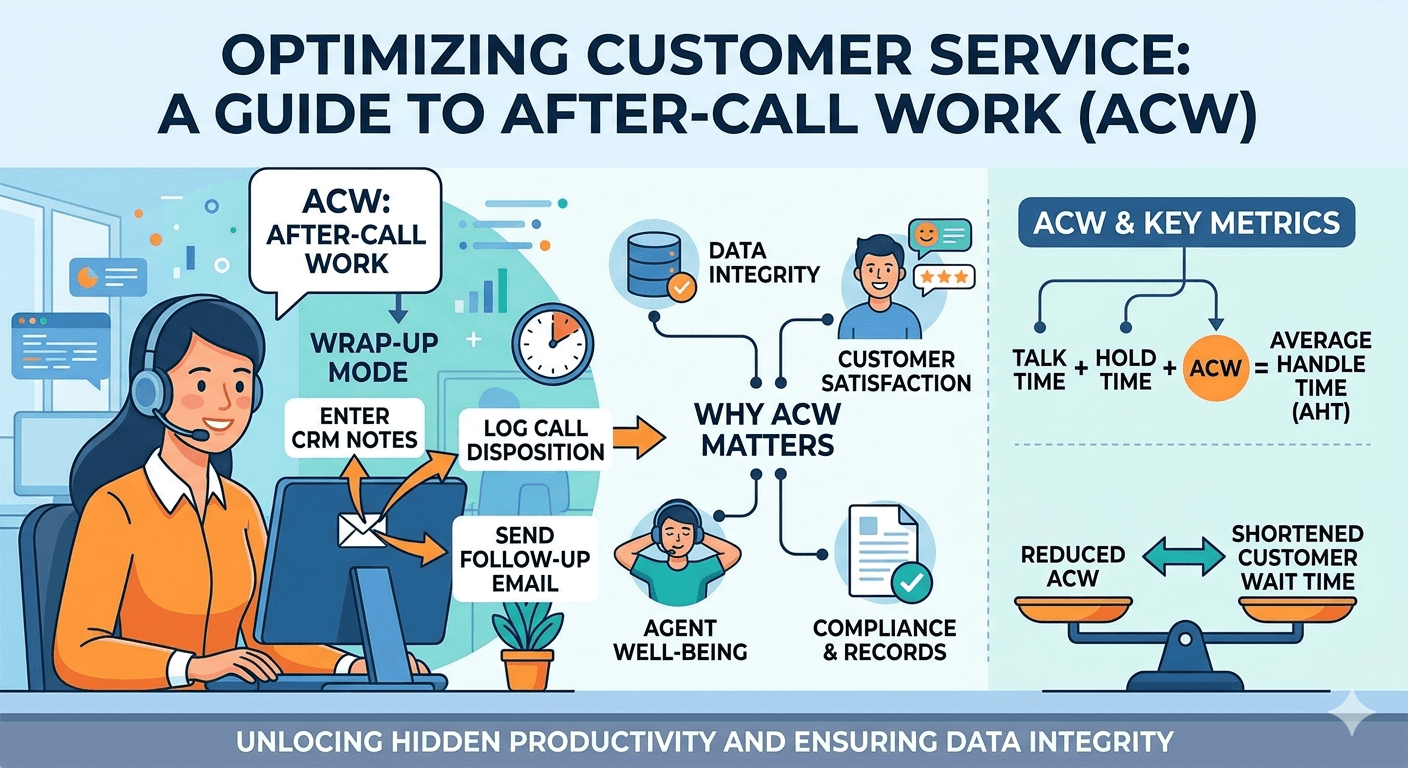
In the modern customer service landscape, efficiency is the currency of success. Every second a customer spends on the line or an agent spends behind the scenes contributes to the overall operational cost and the quality of the customer experience. One of the most critical yet often misunderstood metrics in this environment is ACW. To the uninitiated, the term might sound like technical jargon, but for professionals in the industry, understanding what is acw is the key to unlocking hidden productivity and ensuring data integrity across the entire organization.
Whether you are a seasoned manager looking to optimize your team’s performance or a new hire trying to grasp the workflow, a deep dive into acw meaning is essential. This metric doesn’t just measure a period of silence between calls; it represents the diligent work that ensures a customer’s issue is documented, resolved, and followed up on correctly. In this comprehensive guide, we will explore the nuances of After-Call Work, its impact on broader metrics like the call center average wait time, and the technology that supports it.
What is ACW? Defining the Core Metric
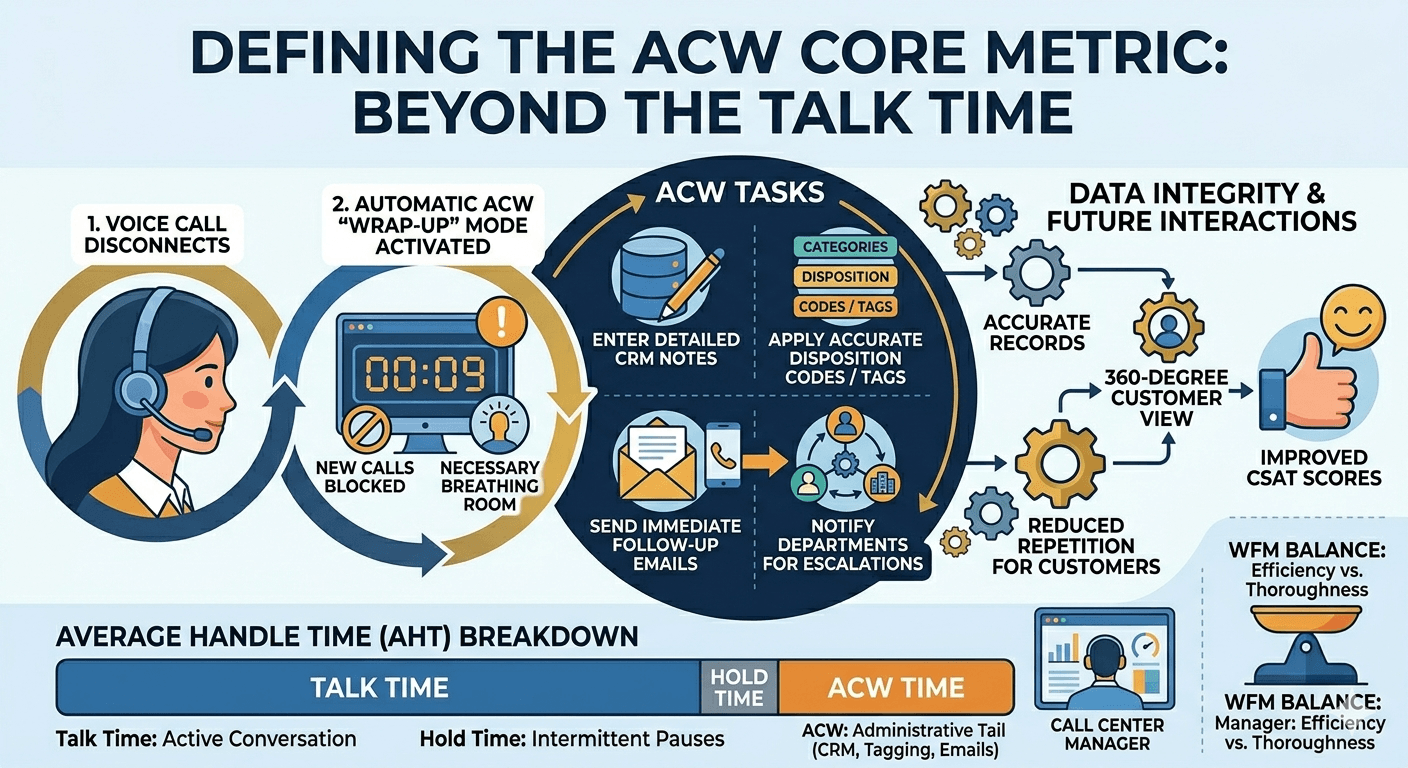
The acronym acw stands for After-Call Work. In the professional world of telecommunications and support, acw meaning in call center environments refers specifically to the set of tasks an agent must complete immediately after disconnecting a voice call or ending a live chat session. During this period, the agent is usually in a “Wrap-Up” or “Work” mode within their telephony system, which prevents new calls from being routed to them. This provides the necessary breathing room to finalize the details of the previous interaction before moving to the next one.
Understanding what is acw in call center contexts involves looking at the specific actions taken during this time. Typical activities include entering notes into the Customer Relationship Management (CRM) system, tagging the call for categorization, sending follow-up emails to the customer, and notifying other departments if further action is required. If these tasks are rushed or skipped, the organization loses vital data, leading to a fragmented customer history that can frustrate future agents and customers alike.
The term acw meaning extends beyond just “admin time.” It is a vital component of the Average Handle Time (AHT). While the “Talk Time” measures the active conversation, the acw measures the administrative tail of the call. A high-performing call center seeks a balance where the agent has enough time to be thorough but not so much that it inflates the customer wait time for the next person in the queue.
How to Calculate After-Call Work (ACW) and Its Components
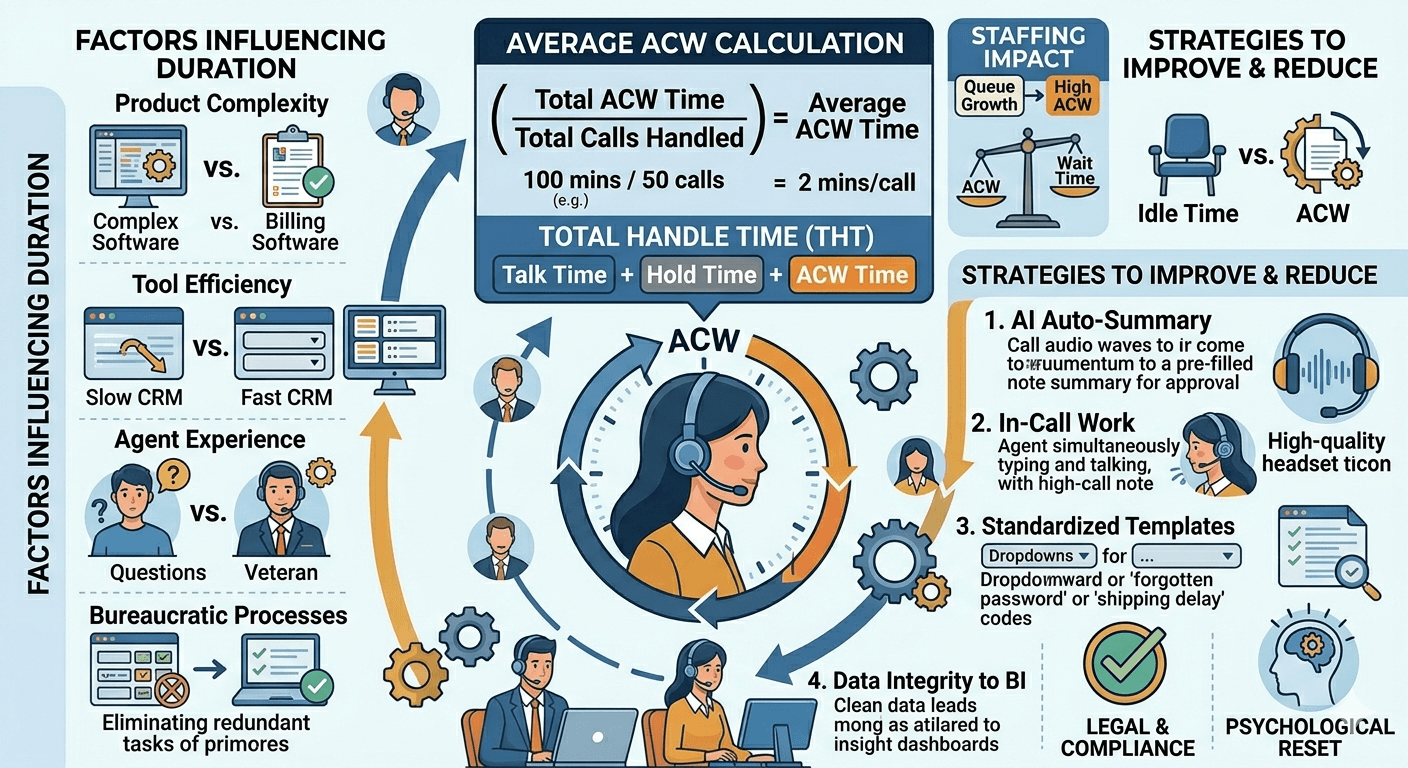
To manage what you measure, you must first know how to calculate it accurately. The calculation for acw is usually performed as an average across a specific period or a specific team. To find the average acw time, you take the total amount of time spent in the after-call work state and divide it by the total number of calls handled during that same period. For example, if an agent spent 100 minutes in wrap-up across 50 calls, their average acw would be two minutes per call.
This figure is often integrated into the average wait time formula used by workforce management software. When calculating the overall efficiency of a center, managers look at the “Total Handle Time,” which is the sum of Talk Time, Hold Time, and acw. By understanding these ratios, managers can predict how many agents are needed at any given time to keep the call center average wait time within acceptable limits. If the wrap-up time is too high, it effectively reduces the number of available “active” agents, causing the queue to grow.
It is also important to distinguish between acw and “Idle Time.” Idle time occurs when an agent is ready and waiting for a call but none are coming through. Conversely, acw is an active state where work is being performed. Many modern acw hardware setups, such as integrated headsets and dual-monitor workstations, are designed specifically to help agents navigate multiple windows during this phase, thereby shortening the time needed to finalize the record and return to an “available” status.
Why After-Call Work (ACW) Matters for Organizational Health
There is a common misconception that acw is simply “dead time” where no value is being produced. On the contrary, the quality of after call work is the primary driver of data accuracy. When an agent has sufficient time to document an interaction, they create a roadmap for any subsequent agent who might deal with that customer. This reduces the need for the customer to repeat their story, which is a major factor in improving Customer Satisfaction (CSAT) scores.
Furthermore, after call work call center protocols help in legal and compliance adherence. In many industries, such as banking or healthcare, specific notes must be recorded to meet regulatory standards. If an agent is forced back into the queue too quickly, they might miss a critical compliance checkbox. Therefore, acw is not just about efficiency; it is about risk management and ensuring that the business remains protected through meticulous record-keeping.
From an agent’s perspective, the acw meaning is often tied to their mental well-being. Constant “back-to-back” calls without a few moments to process the previous interaction can lead to high levels of stress and eventual burnout. A reasonable acw allowance acts as a psychological “reset” button, allowing the agent to clear their mind before dealing with a potentially difficult new customer. This balance is crucial for maintaining high morale and reducing staff turnover in a high-pressure environment.
Factors Influencing After-Call Work (ACW) Duration
Several variables can cause acw to fluctuate, and not all of them are within the agent’s control. One major factor is the complexity of the products or services being supported. A technical support agent dealing with complex software troubleshooting will naturally require more acw than a simple billing inquiry agent, as the technical notes and diagnostic steps are more extensive. Identifying what is acw in your specific niche requires benchmarking against similar industries rather than using a universal standard.
The efficiency of the tools provided—often referred to as acw hardware and software—plays a massive role. If an agent has to wait for a slow CRM to load or navigate through seven different tabs to log a single call, the wrap-up time will skyrocket. System latency and poor user interface design are often the silent killers of call center productivity. By streamlining the digital workspace, companies can significantly reduce after call work in a call center without putting undue pressure on the employees themselves.
Agent experience and training also influence these metrics. A new hire will inevitably take longer to find the right codes and summarize conversations than a veteran. However, if even seasoned veterans are struggling with high acw time, it may indicate that the post-call processes have become too bureaucratic. Regularly reviewing what is actually required during the wrap-up phase can help eliminate redundant tasks that add no value to the customer or the business.
Strategies to Improve and Reduce After-Call Work (ACW)
If a manager identifies that wrap-up times are negatively impacting the average wait time call center targets, they must implement strategic improvements. One of the most effective methods is the implementation of “Auto-Summary” tools powered by Artificial Intelligence. These tools can transcribe the call in real-time and provide a suggested summary, which the agent simply needs to review and approve. This dramatically changes what does acw stand for from a manual labor task to a quick verification process.
Another strategy involves “In-Call Work.” Agents can be trained to update the CRM while they are talking to the customer or while the customer is performing a task. This requires high levels of multitasking and proper acw hardware, such as high-quality noise-canceling headsets that allow the agent to type without the customer hearing the keyboard clicks. When done correctly, this can reduce the post-call burden to almost zero, allowing the agent to become available the moment the call ends.
Standardizing note-taking through templates and dropdown menus is another proven way to reduce after call work in a call center. Instead of writing long-form paragraphs, agents can use shorthand or select from pre-defined categories. This not only speeds up the acw phase but also makes the data easier to analyze for the business intelligence team. Clearer data leads to better insights into why customers are calling, which can eventually lead to fixing the root causes and reducing call volume altogether.
Related Terms: ACW, AHT, and Customer Wait Time
To fully grasp acw meaning in call center management, one must understand how it interacts with other Key Performance Indicators (KPIs). One such term is the customer wait time. This is the duration a customer stays in the queue before being connected to an agent. Because acw keeps an agent “unavailable,” every extra second of wrap-up time directly contributes to a longer wait for the next person. Balancing these two is the primary challenge of workforce management.
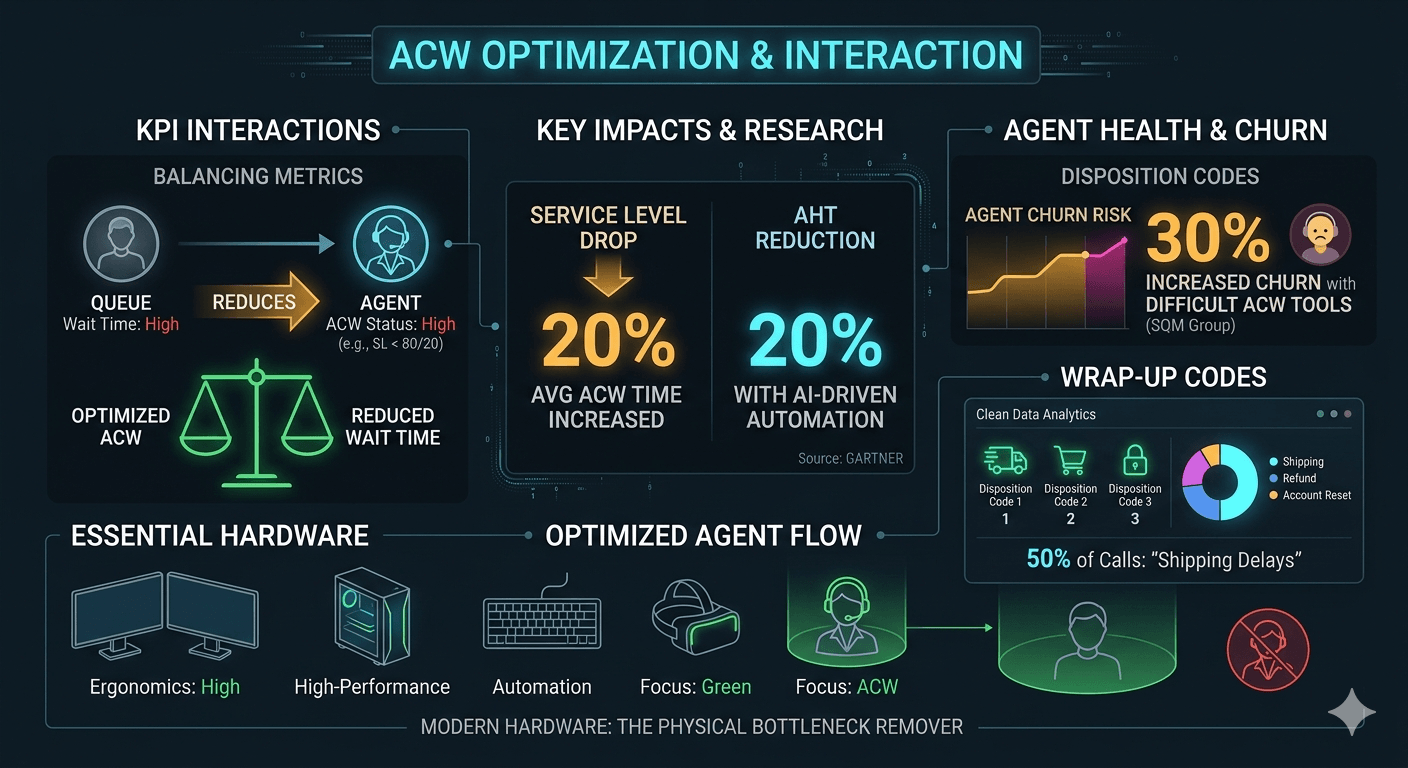
Another related concept is the “Service Level,” which is the percentage of calls answered within a specific timeframe (e.g., 80% of calls answered in 20 seconds). If the average acw increases unexpectedly, the service level will drop because fewer agents are available to “pull” calls from the queue. This is why many centers use the average wait time formula to constantly adjust their staffing levels in real-time, often asking agents to shorten their wrap-up during “peak” periods.
Lastly, there is the “Wrap-Up Code” or “Disposition Code.” This is a specific tag applied during the acw phase that identifies the reason for the call. These codes are the lifeblood of call center analytics. Without them, managers wouldn’t know if 50% of their calls are about “Forgotten Passwords” or “Shipping Delays.” Therefore, while the goal is to keep acw time low, it should never be at the expense of accurate dispositioning, as this data is vital for long-term strategic planning.
Research and Facts: The Real Impact of Optimized ACW
Recent industry research from the International Customer Management Institute (ICMI) suggests that the average acw across all industries is approximately 6 to 10% of the total handle time. However, in high-complexity fields like insurance and medical billing, this can rise to 20%. Interestingly, a study by Gartner found that companies that utilize AI-driven automation to assist in the wrap-up phase saw a 15-25% reduction in AHT without a corresponding drop in quality. This proves that technology is the most significant lever in managing after call work.
Furthermore, research into “Agent Effort” shows a direct correlation between difficult acw processes and employee churn. According to a SQM Group report, agents who feel they have inadequate tools to document their work are 30% more likely to leave their positions within the first six months. This highlights that optimizing what is acw in call center operations is not just about saving seconds; it’s about creating a sustainable work environment that keeps talented people in their seats.
The Role of ACW Hardware in Modern Centers
While much of the focus is on software, the physical tools—or acw hardware—cannot be ignored. A common bottleneck in wrap-up time is the physical speed of the agent’s workstation. If an agent is using a computer with insufficient RAM, switching between a heavy CRM and an email client can take 5 to 10 seconds of “spinning wheel” time. Multiplied by 60 calls a day, that is 10 minutes of pure waste per agent. High-performance PCs and fast solid-state drives are essential for a smooth post-call experience.
Ergonomics also play a role in after call work call center efficiency. Dual monitors allow an agent to keep the customer’s profile open on one screen while typing notes or looking up information on the other. This eliminates “window switching” fatigue and reduces the likelihood of errors. Additionally, programmable keyboards or “macros” can be used to automate repetitive typing tasks, allowing an agent to trigger a “follow-up email” template with a single keystroke during the acw phase.
Even the headset contributes to acw efficiency. Modern headsets often have “presence” lights that turn red when an agent is in the acw state. This visually signals to supervisors and colleagues that the agent is busy and should not be interrupted. Such small pieces of acw hardware help maintain the concentration required to accurately summarize a call, ensuring that the after call work meaning remains focused on quality rather than just surviving the workday.
The Human Side: Managing the Transition from ACW to Available
While it is easy to look at acw as a series of numbers on a dashboard, it represents a human transition. Moving from a high-emotion call—such as a frustrated customer—to a neutral administrative task is a significant cognitive shift. Managers who understand what does acw mean on a human level know that forcing an agent to jump immediately into another high-emotion call without any “buffer” leads to lower empathy and poor service quality.
Some forward-thinking centers have implemented “forced ACW” vs. “manual ACW.” In a forced setup, the system automatically gives the agent a set amount of time (e.g., 30 seconds) before pushing them back into the queue. In a manual setup, the agent decides when they are ready. While manual setups can be abused, they often lead to better data quality because the agent doesn’t feel the “ticking clock” pressure while trying to recall the details of a conversation.
Effective coaching also focuses on the after call work meaning by teaching agents how to summarize effectively. Instead of writing “Customer was unhappy about a late package and I told them it would be there tomorrow,” they are taught to write “Late delivery: tracking updated, ETA confirmed for 10/12, CSAT likely low.” This type of training helps the agent process the call faster and move back to the “Available” state, helping to maintain a low call center average wait time for the entire team.
Best Practices Across Different Industries
The definition of a “good” acw score varies by industry. In retail and e-commerce, where calls are often transactional, the goal is typically to keep the wrap-up under 30 seconds. Because the products are straightforward, the acw meaning in call center retail environments is usually just about confirming an order number or processing a refund. Speed is the priority here to ensure that the customer wait time remains as low as possible during seasonal spikes like Black Friday.
In contrast, the healthcare and legal sectors view acw through a lens of extreme precision. Here, the after call work might involve updating medical records or documenting legal advice where every word has massive implications. In these fields, managers often prioritize “Accuracy over Speed,” accepting a higher AHT to ensure that the acw time results in a perfect record. For these agents, acw is the most critical part of their job, as the conversation is merely the data-gathering phase for the actual “work” of documentation.
Finally, in technical support for SaaS (Software as a Service) companies, acw often involves reproducing a bug or filing a ticket with the engineering team. This means what is acw for a tech agent involves a high degree of technical writing and cross-departmental communication. These organizations often use specialized “Ticket Management” software that integrates directly with their telephony, ensuring that the acw performed in the phone system automatically syncs with the developers’ workflow, creating a seamless loop of information.
Read More: Wireless IP Phones vs. Mobile Apps: Deciding What’s Best for Your Remote Workforce
Final Thought
After-Call Work (ACW) is far more than a simple timer on a manager’s screen; it is the vital infrastructure that supports data integrity, agent health, and customer satisfaction. By understanding what is acw and how it influences broader metrics like call center average wait time, organizations can move beyond the “speed at all costs” mentality. The goal is to create a balanced ecosystem where agents have the right acw hardware, automated software tools, and professional training to document their work efficiently. When acw is managed correctly, it doesn’t just reduce the customer wait time; it transforms the entire service experience into a streamlined, data-driven operation that benefits the customer, the employee, and the business alike.
Frequently Asked Questions (FAQs)
What is acw in call center?
ACW in a call center stands for After-Call Work. It is the time an agent spends completing administrative tasks immediately after a call ends. These tasks include entering data into a CRM, writing notes, and sending follow-up emails. During this time, the agent is usually unavailable to take new calls so they can focus on finalizing the details of the previous interaction.
What is acw job?
ACW is not usually a standalone job but rather a specific phase or “state” within an agent’s daily workflow. However, in some contexts, there are “Back Office” or “Data Entry” roles that primarily handle the administrative tasks generated by other agents. Most often, though, it refers to the post-call duties that every customer-facing agent must perform to maintain accurate records.
What is ACW Wrestling or ACW War?
While in the professional world acw meaning refers to After-Call Work, the acronym is also used in other contexts. ACW Wrestling typically refers to “American Championship Wrestling,” a regional professional wrestling promotion. Similarly, ACW War or “African Civil War” is a historical or gaming term. It is important to distinguish these from the call center metric based on the context of the conversation.
What is acw agent?
An acw agent is simply a call center representative who is currently in the “After-Call Work” status. In the supervisor’s dashboard, the agent will appear as “In ACW” or “In Wrap,” indicating that they have finished their conversation but are still working on the documentation. It is a temporary status and not a specific job title or rank within the company.
How to reduce ACW in call center?
To reduce after call work in a call center, organizations should focus on several key areas. First, provide better acw hardware and faster software to reduce lag. Second, implement AI-powered auto-summary tools to handle the note-taking. Third, use standardized templates and dropdown menus to speed up data entry. Finally, train agents in “In-Call Work” techniques so they can document as they talk.