
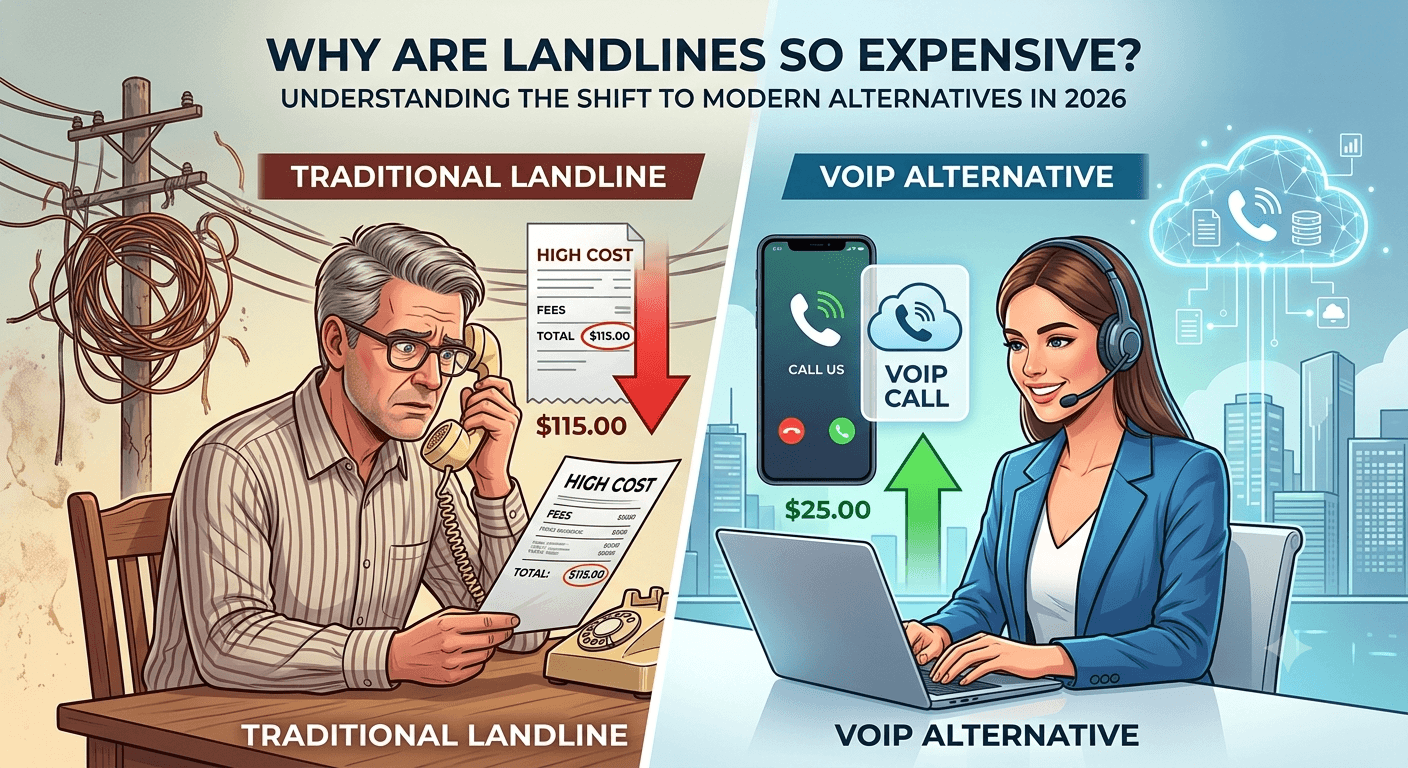
Landlines are becoming increasingly costly because the traditional copper wire infrastructure is aging and expensive to maintain. As most consumers transition to mobile and digital options, the remaining landline users must bear the brunt of the maintenance costs for a shrinking network. Furthermore, regulatory shifts from the FCC have allowed carriers to lift price caps, leading to market-based pricing that significantly inflates monthly statements. Many users now find that why landline phone bills are so expensive in 2026 is due to a combination of infrastructure decommissioning and a shift toward modern VoIP alternatives.
What Is a Traditional Landline?
A traditional landline, often referred to as Plain Old Telephone Service (POTS), relies on a physical network of copper wires to transmit voice data. These wires connect homes and businesses to a central office through a series of switches and underground or overhead cables. This technology has been the backbone of global communication for over a century, providing reliable voice quality and functioning even during local power outages because the lines carry their own low-voltage electricity.
Despite their historical reliability, these systems are analog and lack the data-handling capabilities of modern digital networks. The infrastructure requires constant physical upkeep to prevent signal degradation caused by weather, corrosion, or physical damage. Because this technology is based on dedicated physical circuits, it is far less efficient than modern packet-switched networks used by the internet, which contributes to the discussion of why are landlines so expensive today.
Landline costs at a glance
Understanding the cost for landline phone service requires looking beyond just the monthly subscription fee. When users ask how much does a telephone line cost, they are often surprised to see a base rate that has climbed from $20 or $30 a month to nearly $100 or more in some regions. This baseline price usually only covers local calling, with any additional features like caller ID or call waiting adding significant increments to the total.
The overall expense is also inflated by mandatory service fees and equipment rentals. While digital services often include hardware in the plan, landline providers may charge a monthly fee for the physical wiring maintenance inside your home. When you calculate how much does landline cost over a full year, the total often rivals or exceeds the price of a high-end high-speed internet connection or a premium mobile data plan.
The Cause: Regulatory Changes
One of the primary reasons why are landlines so expensive involves a significant shift in federal oversight. In August 2019, the Federal Communications Commission (FCC) issued Order 19-72, which effectively ended the requirement for major carriers to offer analog landline services at regulated, capped prices. This deregulation was intended to encourage carriers to invest in more modern technologies like fiber optics and 5G rather than pouring resources into dying copper networks.
This policy change meant that carriers like AT&T and Verizon could transition to market-based pricing for their legacy services. Without price caps, these companies began raising rates to reflect the actual cost of maintaining the labor-intensive copper lines. This regulatory pivot signaled the beginning of the end for affordable POTS, as the FCC set a deadline of August 2022 for carriers to begin offering alternative options to their customers, leading to the current high-cost environment.
Why Traditional Landline Phone Service Is Expensive
The physical nature of copper wires is the leading factor in why traditional landline phone service is expensive. Unlike digital signals that can be managed remotely, a break in a copper line requires a technician to physically locate the fault and repair it. As the workforce trained in these legacy systems retires, the cost of labor for these specialized repairs continues to climb, and those costs are passed directly to the consumer.
Additionally, the manufacturing of analog switching equipment has largely ceased. When a part in a central office fails, carriers often have to source refurbished parts or pay a premium for custom manufacturing. This scarcity of hardware combined with the high cost of manual labor creates a financial burden that makes the cost of landline phone service unsustainable for many providers without charging high monthly premiums.
Common Charges Included in a Landline Bill
Federal Universal Service Fee: A charge mandated by the government to help provide affordable service to low-income and rural areas.
911 Service Fee: A local or state-mandated fee that funds emergency response systems and dispatch centers.
Regulatory Cost Recovery Fee: An amount the carrier charges to cover the costs of complying with government regulations.
Subscriber Line Charge: A fee authorized by the FCC that helps the local phone company cover the costs of the local loop.
Local Number Portability Fee: A temporary charge allowed by the government to recover the costs of allowing customers to keep their numbers when switching.
Why Landline Costs Keep Increasing
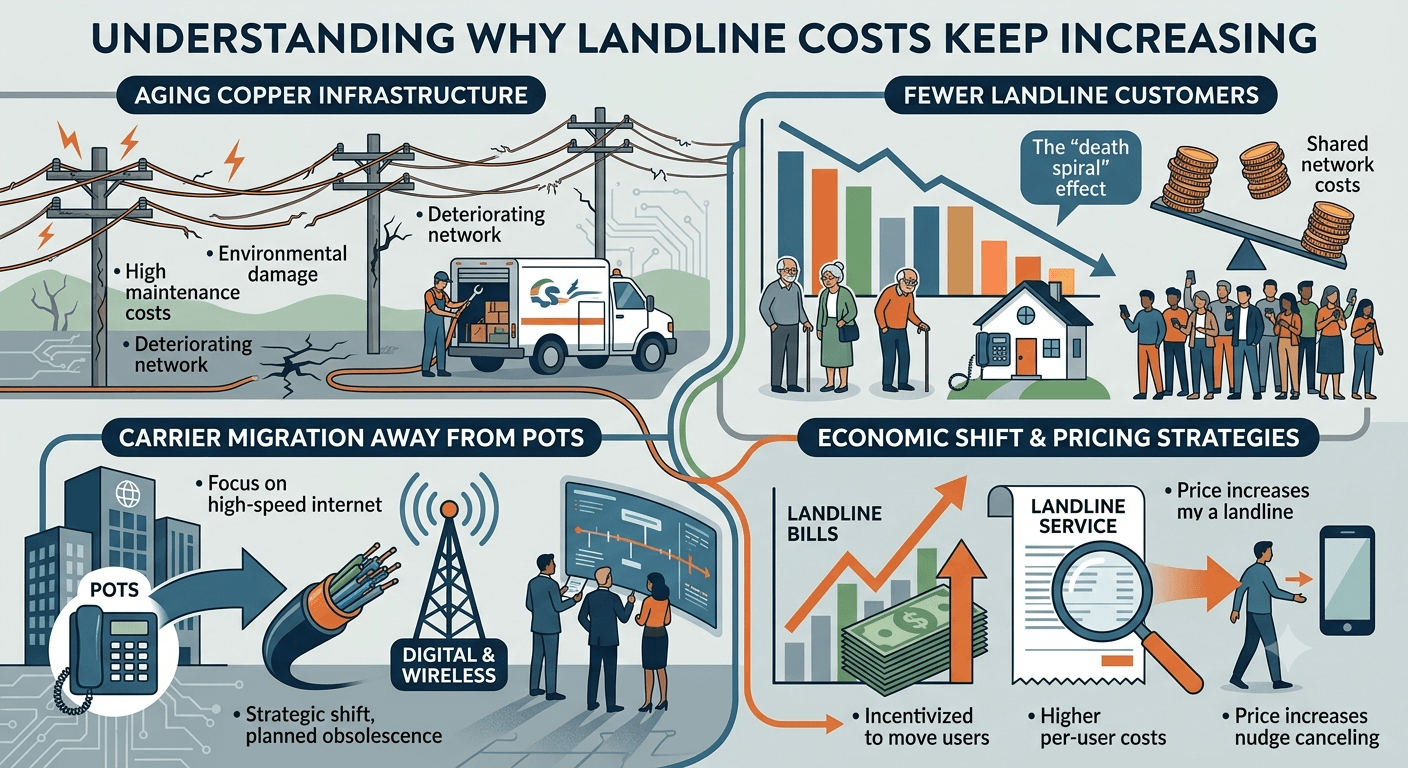
The trend of rising bills shows no signs of reversing because the economics of the industry have fundamentally shifted. Carriers are no longer incentivized to keep landlines affordable; instead, they are incentivized to move users toward digital platforms that are cheaper to operate. This creates a cycle where the cost of landline phone service increases to nudge customers toward canceling their legacy lines voluntarily.
As these prices rise, more people wonder how much is landline phone service worth in a world dominated by smartphones. For many, the answer is becoming “not much,” especially when considering that the same budget could fund multiple digital communication tools. The shrinking pool of users means that the fixed costs of the network are shared by fewer people, driving individual rates even higher.
Aging Copper Infrastructure
The copper lines that span across the country are often several decades old and are susceptible to environmental damage. Moisture, temperature fluctuations, and ground shifts can all cause the protective casing of these wires to fail, leading to static on the line or total service failure. Maintaining this massive physical web requires a fleet of service vehicles and a large staff of field technicians.
Because the infrastructure is deteriorating, the frequency of repairs is increasing. Providers are faced with the choice of completely replacing copper with fiber—an expensive capital project—or performing “band-aid” repairs on the existing copper. Most carriers have opted to let the copper network fade away, and the high maintenance costs associated with this deterioration are a major reason why are landlines so expensive.
Fewer Landline Customers
A concept known as the “death spiral” explains why the cost of landline service continues to climb. In the past, millions of households shared the cost of maintaining the telephone grid. Today, the majority of households have “cut the cord,” leaving a small fraction of the original user base to support the entire infrastructure. This results in a massive increase in the per-user cost of operation.
According to research from the National Center for Health Statistics, over 70% of American adults lived in wireless-only households as of late 2022. This exodus means that the revenue generated from landlines is plummeting while the fixed costs of maintaining the central offices and lines remain nearly the same. Carriers respond to this revenue gap by raising telephone line charges for the remaining loyal customers.
Carrier Migration Away From POTS
Major telecommunications companies are actively working to retire their POTS networks entirely. AT&T, for example, has stated its intention to reduce its copper footprint by 50% by 2025. This migration is a strategic move to simplify their operations and focus on high-speed internet and wireless data, which are far more profitable and easier to maintain than analog voice lines.
As part of this migration, carriers often implement aggressive pricing strategies. By making the landline service prohibitively expensive, they encourage customers to switch to their own digital or wireless alternatives. This planned obsolescence is a direct contributor to why are landlines so expensive, as it serves as a financial catalyst for technological transition.
Landline Phone Alternatives
Businesses and homeowners seeking alternatives to landline phone service are increasingly turning to cloud-based business communications. For many, the transition involves moving to Voice over Internet Protocol (VoIP), which allows calls to be made over a standard internet connection. This technology eliminates the need for dedicated copper wires and integrates seamlessly with existing computers and smartphones.
Other modern solutions include Unified Communications as a Service (UCaaS) and Contact Center as a Service (CCaaS). These platforms go beyond simple voice calls to offer a suite of tools like video conferencing, team messaging, and advanced analytics. By moving to the cloud, users can avoid the high telephone line charges associated with legacy systems while gaining access to a much wider range of features.
VoIP: Voice over Internet Protocol is phone service hosted by a third-party provider that allows users to make phone calls over the Internet, bypassing traditional phone lines.
UCaaS: Unified Communications as a Service is a cloud-based communication solution that integrates various, such as voice, video, messaging, and collaboration tools, into a single platform.
CCaaS: Contact Center as a Service is a cloud-based customer support solution that streamlines contact center operations with advanced features and sophisticated reporting.
How Much Cheaper Is VoIP Than a Traditional Landline?
When comparing the two, VoIP is almost always the more economical choice. While you might wonder do you have to pay for a landline even if you don’t use it much, VoIP providers typically offer flat-rate monthly plans that include unlimited nationwide calling for a fraction of the cost. Because VoIP uses the internet connection you are likely already paying for, it removes the need for a separate line charge.
Statistically, businesses that switch from traditional landlines to VoIP can see their communication costs drop by 30% to 50%. For residential users, the savings can be even more dramatic, with some VoIP services costing as little as $10 to $15 per month. This price gap is a significant reason why people are questioning how much is landline service compared to digital alternatives.
Traditional Landline vs VoIP Comparison
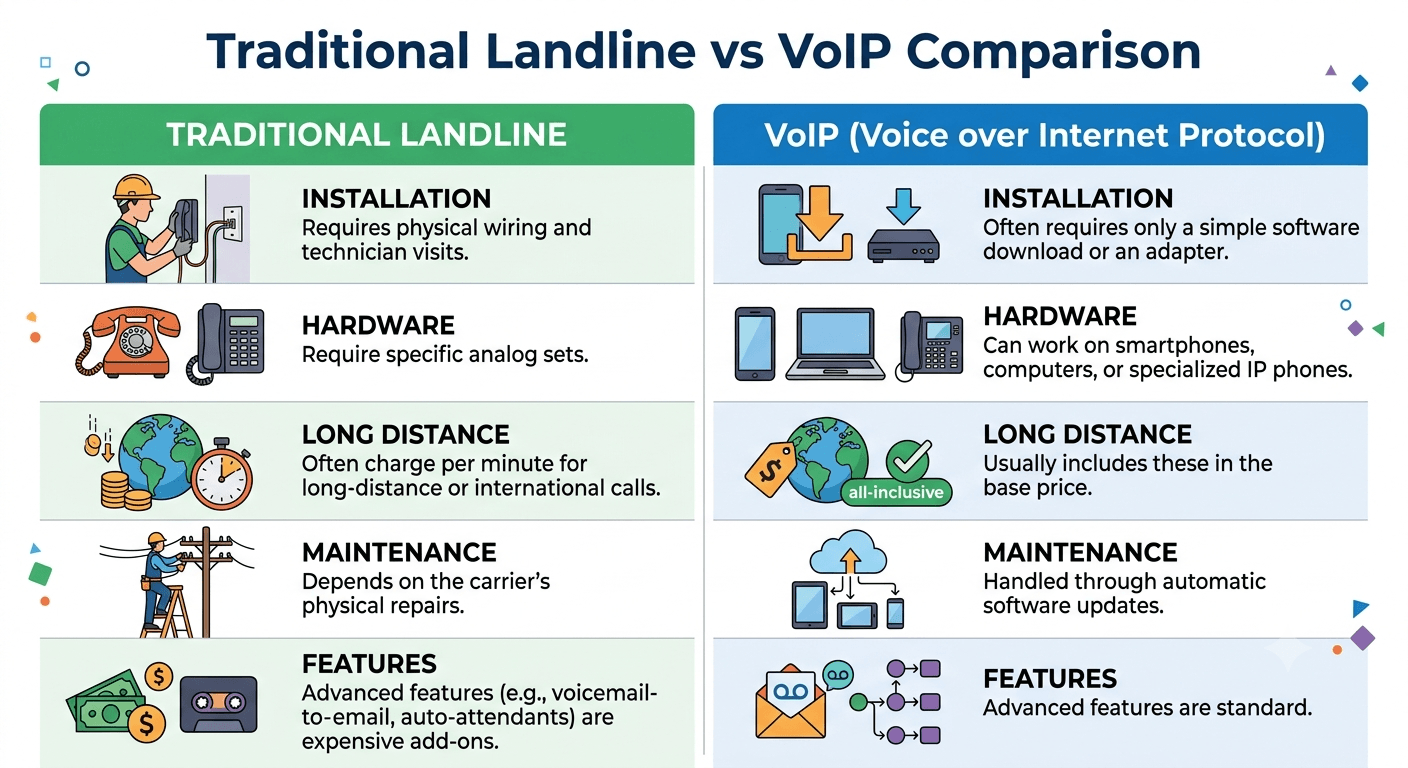
Installation: Landlines require physical wiring and technician visits, whereas VoIP often requires only a simple software download or an adapter.
Hardware: Traditional phones require specific analog sets, while VoIP can work on smartphones, computers, or specialized IP phones.
Long Distance: Landlines often charge per minute for long-distance or international calls, while VoIP usually includes these in the base price.
Maintenance: Landline maintenance depends on the carrier’s physical repairs; VoIP maintenance is handled through automatic software updates.
Features: Advanced features like voicemail-to-email or auto-attendants are expensive add-ons for landlines but standard for VoIP.
Example: Traditional Landline vs VoIP Annual Costs
A typical residential landline with basic features and a few long-distance calls can easily cost $800 to $1,200 per year when all taxes and fees are included. In contrast, a high-quality VoIP service might cost between $150 and $300 per year for the same level of usage. This $600 to $900 annual difference highlights why the cost for landline phone service is no longer competitive for the average consumer.
For small businesses with five lines, the annual savings can reach several thousand dollars. When you factor in the lack of maintenance fees and the reduced cost of hardware, the financial argument for leaving the copper network becomes overwhelming. Understanding how much does landline cost in the long run is essential for any budget-conscious household or business owner.
Potential Advantages of VoIP Home Phone Service
High Portability: You can take your VoIP adapter or app anywhere in the world and use your home number as long as you have an internet connection.
Superior Voice Quality: Modern VoIP codecs offer “HD Voice,” which provides much clearer audio than the limited frequency range of an analog landline.
Spam Protection: Most VoIP providers include advanced call-blocking tools that are much more effective at stopping robocalls than traditional landline features.
Integration: Your home phone can ring on your smartphone simultaneously, ensuring you never miss an important call even when you are away.
Virtual Numbers: You can often add a second “virtual” number with a different area code to your account for a very low monthly fee.
Potential Drawbacks of VoIP
The most significant drawback of VoIP is its reliance on a stable internet connection and electrical power. If your internet goes out, your phone service typically goes out with it, unless you have a mobile backup system. Traditional landlines are powered by the copper wires themselves, allowing them to work during a blackout, which is a feature many elderly users still value.
Another consideration is emergency services. While VoIP providers offer E911 services, you must manually update your physical address in the system if you move the device. If the internet is down or the power is out, reaching 911 through a VoIP phone may require a battery backup for both your modem and your phone adapter. These technical requirements are important to weigh against why are landlines so expensive.
The Cloud Advantage
Moving to a cloud-based communication system provides businesses with a level of agility that traditional hardware simply cannot match. Because the service is hosted in the cloud, there is no need for bulky on-site PBX equipment or complex wiring closets. This reduces the physical footprint of the office and eliminates the need for specialized IT staff to manage the phone system.
Cloud systems also provide “future-proofing.” As technology advances, the service provider updates the software on their end, giving users access to new features without them having to buy new hardware. This shift from a capital expenditure model to an operating expenditure model is a key reason why companies are moving away from the expensive and stagnant world of landlines.
Cost Savings: Cloud-based communication solutions typically have lower setup and operational costs than traditional landlines. VoIP, for example, enables cost-effective calls via the Internet, reducing the need for expensive hardware and phone lines.
Scalability: Cloud communication systems, such as UCaaS, allow businesses to easily scale up or down based on their needs, adding or removing users and features without significant costs or complications.
Improved Collaboration: UCaaS platforms integrate various communication tools, like voice, video, messaging, file sharing, and more, into a single platform. This facilitates seamless collaboration among team members, increasing productivity and efficiency.
Enhanced Mobility: With cloud-based communication services, employees can access their work tools from any location using their preferred devices. This flexibility enables remote work and supports a modern, mobile workforce.
Advanced Features: VoIP, UCaaS, and CCaaS offer advanced features, such as call routing, call recording, video conferencing, and analytics, which help businesses optimize their communication processes.
Can You Keep Your Existing Home Phone Number?
Yes, you can almost always keep your current phone number when switching from a landline to a digital service. This process is known as “number porting.” Under FCC rules, telecommunications providers are required to allow customers to take their numbers with them when they switch providers, provided they remain in the same geographic area.
To ensure a smooth transition, it is vital not to cancel your landline service until the new provider has successfully ported the number. Once the porting process is complete, your old landline service will usually be cancelled automatically. This allows you to avoid the high cost of landline phone service without the hassle of updating your contact information with friends, family, or banks.
Read More: Burger Phone: Comeback of 90s nostalgia
The Bottom Line
The era of the affordable landline has come to an end as the telecommunications industry moves toward a digital-first future. The primary reasons why are landlines so expensive involve a combination of aging infrastructure, a shrinking customer base, and the removal of government price protections. For most users, the traditional POTS line is no longer a cost-effective utility but an expensive relic of a previous age.
Transitioning to VoIP or other cloud-based services offers a way to maintain a home or business number while significantly reducing monthly expenses. By embracing the cloud, you gain access to superior features, better voice quality, and the flexibility that modern life requires. While the transition away from copper wires marks the end of an era, it opens the door to a more efficient and affordable way to stay connected.
Faqs
Why are landline phones so expensive?
Landlines are expensive because the infrastructure is old and requires high maintenance costs that are now shared by a smaller group of users. Additionally, the FCC has allowed carriers to charge market rates instead of capped prices, leading to significant bill increases.
Is VoIP cheaper than a traditional landline?
VoIP is significantly cheaper because it uses your existing internet connection rather than a dedicated copper wire network. It eliminates many of the taxes and maintenance fees associated with legacy telephone lines.
Are traditional landlines being discontinued?
Carriers are not legally allowed to stop service everywhere yet, but they are actively decommissioning copper lines and moving customers toward fiber or wireless alternatives. Many major providers have set goals to retire their copper networks within the next few years.
Can I keep my home phone number if I switch?
You can keep your number through a process called number porting. You should initiate the transfer with your new digital provider before canceling your old landline service to ensure the number remains active during the move.
Does VoIP work with cordless phones?
VoIP works perfectly with most modern cordless phone systems. You simply plug the base station of your cordless phone into the VoIP adapter or the phone port on your internet router.
Do traditional landlines still work during power outages?
Traditional copper landlines usually work during power outages because they are powered by the phone company’s central office. VoIP and digital lines require a battery backup for your modem and router to stay functional when the power is out.
What is the cheapest way to keep a home phone?
The cheapest way to maintain a home phone is usually through a low-cost VoIP provider or by using a mobile-linked home phone base. These options can cost as little as $10 per month compared to 60-100 for a traditional line.
Why are landline calls so expensive?
Calls on landlines are expensive because carriers apply high per-minute rates for long-distance connections and include numerous regulatory fees. These legacy pricing models have not been updated to reflect the low cost of modern data transmission.
Why don’t people use landlines anymore?
Most people have switched to mobile phones because they offer better value, portability, and integrated features like texting and internet access. The high monthly cost of a landline often doesn’t justify having a second, stationary phone line.