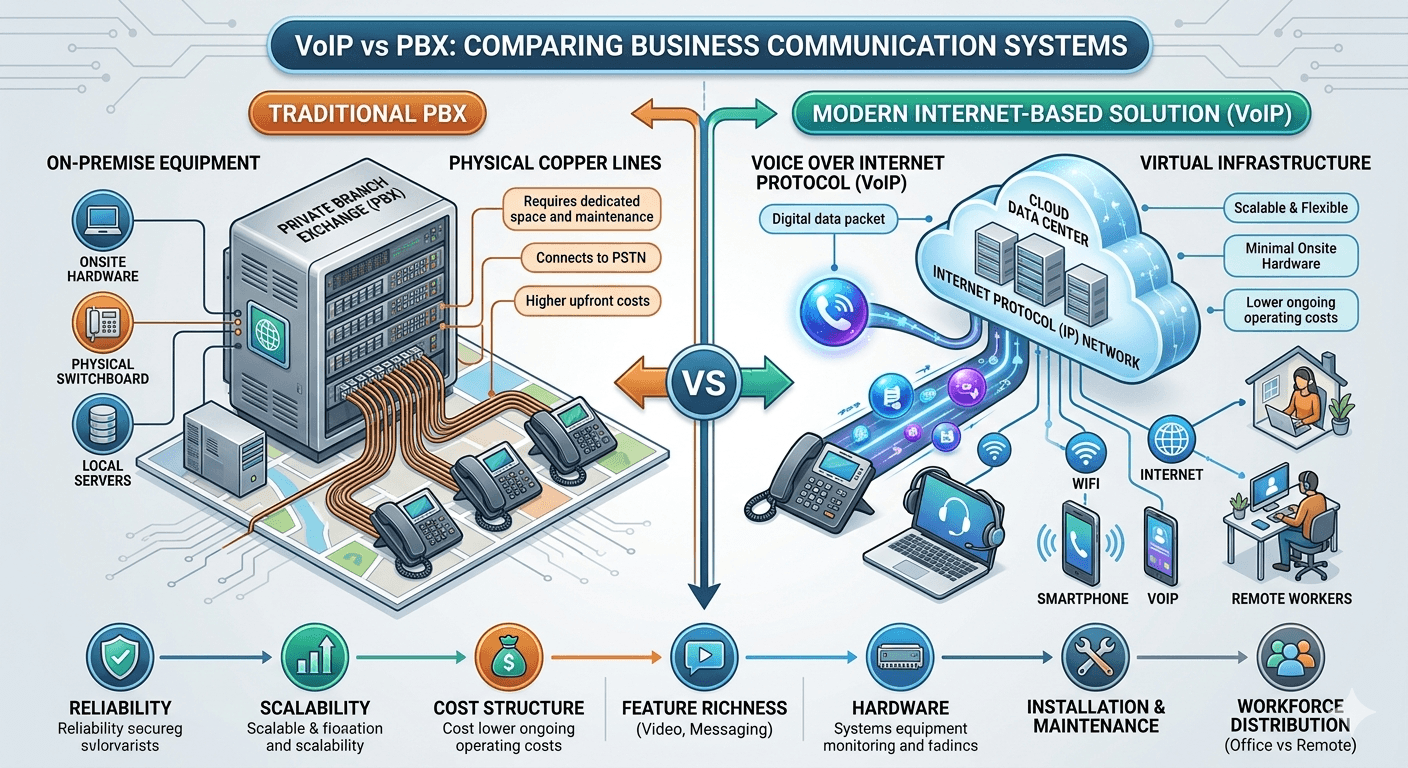
The decision between a traditional phone system and a modern internet-based solution depends on your organizational needs for reliability, scalability, and budget. When looking at VoIP vs PBX: Which Should You Choose?, businesses often weigh the physical hardware requirements of a Private Branch Exchange against the flexibility of Voice over Internet Protocol. While a traditional system relies on physical copper wires and local hardware to manage internal and external calls, modern internet-based systems transmit voice data over the web. Choosing the right path involves analyzing your current internet infrastructure, the geographical distribution of your workforce, and your long-term communication goals.
VoIP vs. PBX: Why Do People Compare PBX and VoIP?
The comparison between these two technologies arises because both serve the fundamental purpose of managing business communications, yet they operate on entirely different architectural foundations. Companies often find themselves at a crossroads when their legacy hardware reaches the end of its life cycle or when they start expanding into remote work environments. The pbx meaning refers to a private telephone network used within a company, allowing users to talk to each other and share a certain number of external phone lines. On the other hand, newer technologies use data packets to send voice signals, making the physical constraints of traditional wires obsolete.
Many decision-makers look at pbx vs voip because they want to balance the historical reliability of landlines with the advanced features of digital transformation. A pbx stands for Private Branch Exchange, which historically acted as a central hub for all office desk phones. As internet speeds increased and became more stable, the voip pbx system emerged as a hybrid solution, leading to confusion about which technology is superior for a specific business model. Understanding the evolution of these systems helps in recognizing why a company might prefer one over the other based on their existing investments and future growth projections.
The debate is further fueled by the shift toward unified communications where voice is just one part of the package. When comparing pbx phone system vs voip, organizations are often looking for more than just dial tones; they seek video conferencing, instant messaging, and CRM integrations. Because both systems can technically offer these features in various configurations, the comparison remains a hot topic for IT departments globally. The drive for cost efficiency also plays a major role, as the operational expenses associated with maintaining physical copper lines often exceed the subscription costs of cloud-based services.
VoIP vs. PBX: What is the Key Difference?
The fundamental difference between these two systems lies in how voice traffic is routed and the hardware required to facilitate those connections. A traditional system is a localized network that connects to the Public Switched Telephone Network through physical trunk lines. This means that if you want to understand what does pbx stand for in a practical sense, it is essentially a private switchboard located on the business premises. In contrast, voice over ip pbx utilizes the internet to route calls, bypassing the need for heavy physical infrastructure and allowing for a more virtualized communication environment.
Another significant distinction involves the medium of transmission. Traditional setups use analog signals transmitted over copper wiring, which requires a dedicated technician for installation and repairs. However, an ip pbx vs voip comparison shows that modern systems use internet protocol to convert voice into digital packets. These packets travel over the same network as your email and web browsing data. This convergence of voice and data networks is what differentiates a standard pabx voip setup from an older analog one, providing a more streamlined approach to office technology management.
Ownership and control also represent a major point of divergence. With an on-site system, the company owns the equipment and is responsible for all upgrades and security. With a voip pbx phone system, especially a hosted version, the service provider manages the servers and software updates in a remote data center. This means the pbx system meaning has evolved from a physical box in a closet to a cloud-resident service. The difference in maintenance requirements is a primary factor when businesses decide to move from a local pbx to voip solutions.
Types of PBX Phone Systems
Understanding the various types of systems available is crucial for making an informed choice. The most traditional form is the Analog PBX, which connects to the phone company via copper lines. While these are becoming less common, they are still found in areas with poor internet connectivity. The pbx meaning phone in this context refers to a reliable but limited system that lacks modern features like mobile integration or voicemail-to-email. These systems are often characterized by high upfront costs and the need for significant physical space within the office building.
As technology advanced, the ip pbx emerged as a bridge between the old and new worlds. This system uses internet protocol to manage internal calls while still potentially connecting to traditional external lines. An ip pbx system is often preferred by companies that want to keep some control over their hardware while benefiting from the flexibility of digital call routing. This setup allows for the use of ip phone pbx hardware, which looks like a standard desk phone but plugs into an ethernet port instead of a traditional telephone jack.
The most modern iteration is the cloud or hosted system. In a hosted pbx vs voip scenario, the service provider hosts the entire infrastructure in their own data center, and the business simply connects to it via the internet. This removes the need for any on-site pbx voice hardware other than the phones themselves. There is also the hybrid pbx with voip, which combines the reliability of an on-site system with the cost-saving benefits of internet-based external calling. This variety ensures that no matter the size or location of a business, there is a configuration that fits its specific operational needs.
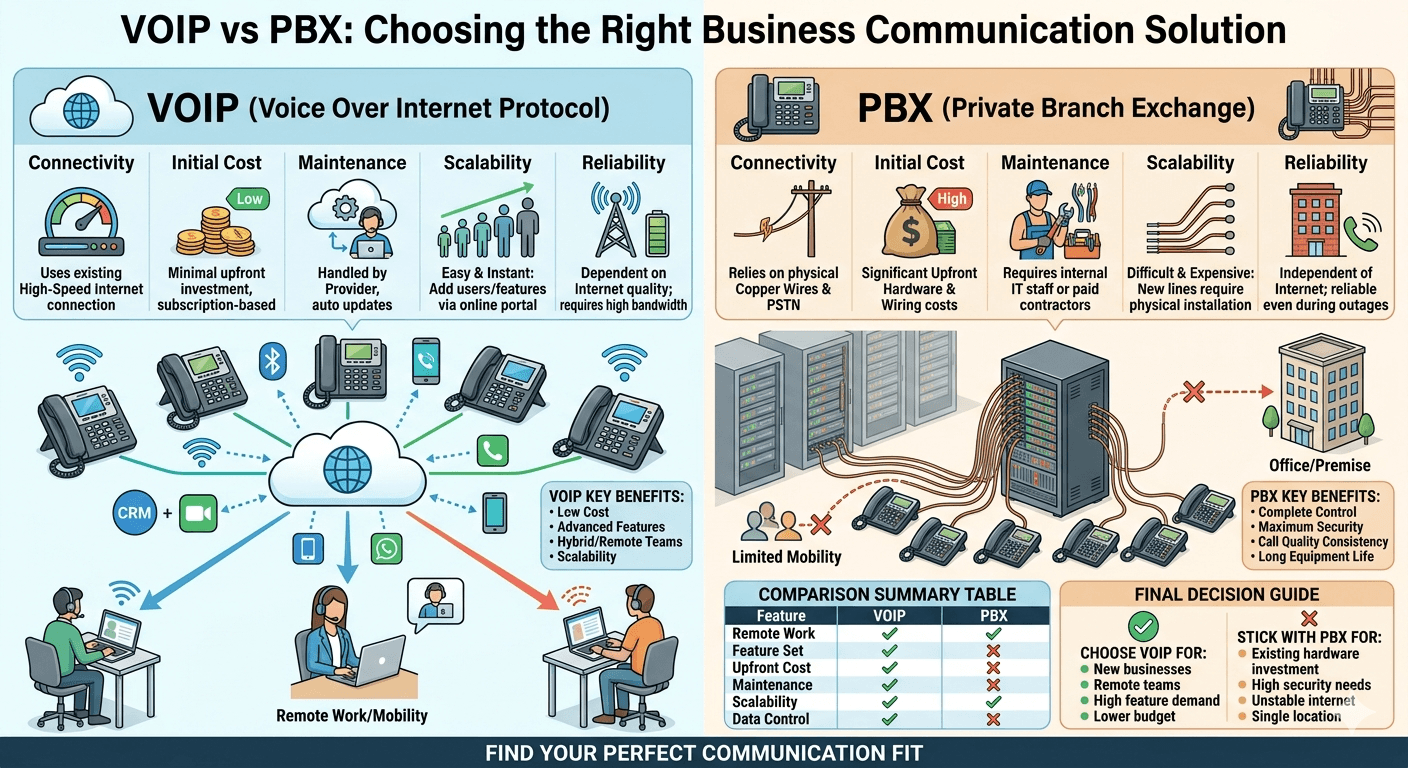
| Feature | Traditional PBX | VoIP | IP PBX (Hybrid) |
| Connectivity | Copper wires (PSTN) | High-speed Internet | Both IP and PSTN |
| Initial Cost | High (Hardware/Wiring) | Low (Setup/Phones) | Moderate (Server/IP Phones) |
| Maintenance | Requires onsite tech | Managed by provider | Managed by IT or provider |
| Scalability | Difficult/Expensive | Instant/Easy | Moderate |
| Reliability | High (not internet dependent) | Depends on ISP | High (Redundancy options) |
| Feature Set | Standard Calling | Advanced (AI, Video, CRM) | Advanced Features |
PBX System Benefits
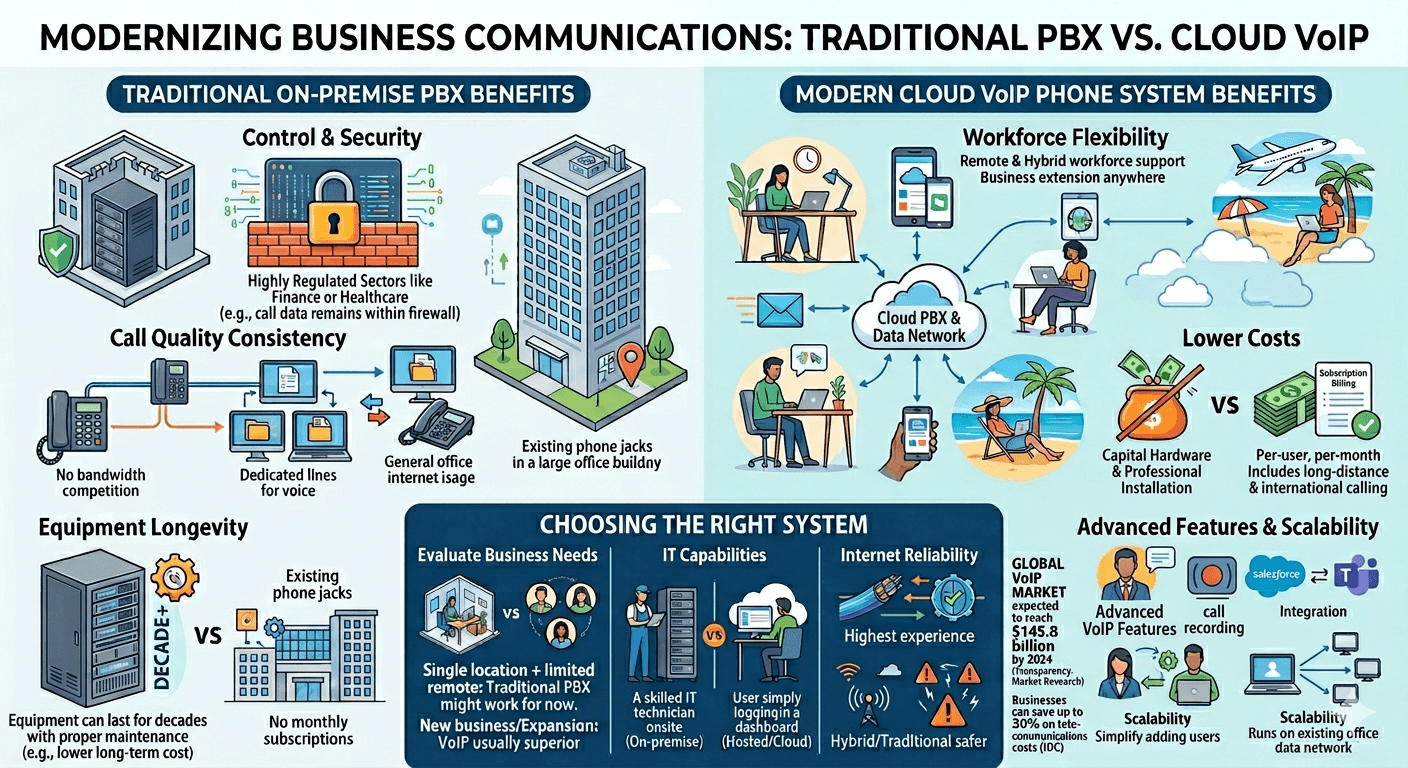
Despite the rise of cloud technologies, traditional and on-premise systems offer specific advantages that keep them relevant in certain industries. One of the primary benefits is the level of control a company has over its own data and security. Because a pbx phone system meaning implies a private network, call data remains within the company’s firewall. For organizations in highly regulated sectors like finance or healthcare, the ability to manage every aspect of the pbx abbreviation hardware and software is a significant security advantage.
Another benefit is the consistency of call quality in environments where internet bandwidth might be unstable. Since a traditional pbx stands for a system that uses dedicated lines, it does not compete with other data-heavy applications for bandwidth. This ensures that voice pbx communications remain crystal clear even if the office network is under heavy load from large file transfers or video streaming. Reliability during power outages is also a factor, as traditional landlines often continue to function when local internet services are interrupted.
Furthermore, the longevity of the equipment is a notable benefit for many businesses. Once the initial investment in pbx phone system definition hardware is made, the system can last for decades with proper maintenance. This can lead to a lower total cost of ownership over a very long period compared to monthly subscription models. For a company with a massive office building and thousands of existing phone jacks, the cost of re-wiring for a pure voip ip pbx might be higher than simply maintaining their current infrastructure.
VoIP vs PBX: Why VoIP Phone System over Analog PBX?
The shift toward internet-based communication is driven by the unparalleled flexibility and feature density that modern systems provide. When evaluating voip vs pbx, the ability to support a remote or hybrid workforce is often the deciding factor. A voip pbx allows employees to take their business extension with them anywhere in the world using a laptop or a mobile app. This level of mobility is impossible with a traditional system, which ties an extension to a specific physical desk in a specific office building.
Cost is another major driver for choosing a voip pbx phone system over an analog one. Traditional systems require expensive hardware, professional installation, and ongoing maintenance fees for the physical lines. Conversely, internet-based calling typically operates on a per-user, per-month subscription model that includes long-distance and international calling. Businesses can significantly reduce their monthly overhead by switching to a cloud pbx vs voip model, as they no longer need to pay for multiple individual trunk lines from a local carrier.
-
Modern systems offer advanced features like auto-attendants, call recording, and integration with popular business software like Salesforce or Microsoft Teams without needing additional hardware modules.
-
Scalability is simplified because adding a new user only requires a few clicks in an online dashboard and a new handset or software license, rather than a visit from a telephone engineer.
-
The infrastructure requirements are minimal since the system runs on the existing office data network, eliminating the need for separate telephone wiring throughout the building.
Choosing Between VoIP And PBX
Making the final choice requires a deep dive into the specific circumstances of your business environment. If your company operates from a single location with a stable, existing phone system and limited need for remote work, sticking with a traditional pbx mean approach might be the most cost-effective solution for now. However, if you are starting a new business or planning a major expansion, the agility of pbx voip systems usually makes them the superior choice. You must also consider your IT staff’s capability to manage the system; an on-site server requires hands-on expertise, while a hosted system is largely hands-off.
Internet reliability is perhaps the most critical technical factor in this decision. Since voip and pbx systems that rely on the web need consistent bandwidth, you must ensure your local internet service provider can guarantee high uptime and low latency. If your office is in an area with frequent internet outages, a hybrid or traditional ip pbx meaning setup might be safer. On the other hand, if you have a fiber-optic connection with built-in redundancy, a full cloud solution will likely provide the best experience for your team.
According to a report by Transparency Market Research, the global VoIP market is expected to reach $145.8 billion by 2024, driven by the increasing adoption of cloud-based services among small and medium-sized enterprises.
This statistic highlights a clear trend: businesses are moving away from rigid, expensive hardware toward flexible, software-driven communication tools. Additionally, research from IDC suggests that businesses can save up to 30% on their telecommunications costs by migrating to a hosted environment, making the financial case for internet-based systems very strong.
How To Choose The Right VoIP PBX Phone System?
Once you have decided to move toward a digital solution, selecting the right provider becomes the next priority. Start by assessing the specific features your team needs to be productive. Do you require advanced analytics for a call center, or just simple call forwarding for a small office? A true what is voip pbx solution should offer a comprehensive suite of tools that go beyond simple voice calls. Look for providers that offer high-definition audio, robust security protocols, and a user-friendly management interface that doesn’t require a computer science degree to navigate.
The quality of customer support is another vital consideration when choosing a voip hosted pbx. Since your business communication is the lifeblood of your operations, you need a provider that offers 24/7 support and has a proven track record of uptime. Check for Service Level Agreements (SLAs) that guarantee at least 99.99% uptime. Furthermore, consider the hardware compatibility; some providers lock you into their own expensive handsets, while others allow you to use any standard pbx with voip compatible ip phone.
-
Evaluate the mobile application’s functionality to ensure your remote workers have the same communication power as those sitting in the physical office.
-
Check for integration capabilities with your existing software stack, such as your CRM, email, and helpdesk tools, to create a seamless workflow.
-
Analyze the total cost of ownership, including any hidden fees for international calling, additional extensions, or premium features that might not be in the base price.
Setting up a PBX system
The setup process varies significantly depending on whether you are installing a physical server or a virtual one. For an on-premise pbx telephone system, the process begins with installing the physical cabinet in a climate-controlled server room. Technicians must then run wires to every desk in the office and connect them to the central unit. This is followed by configuring the software to manage extensions, hunt groups, and external line access. It is a labor-intensive process that usually takes several days or even weeks for larger installations.
Setting up a modern pbx voip system is considerably faster and less invasive. Because it uses the existing internet connection, there is no need to tear open walls or run new cables. Once you sign up with a provider, you simply configure your users and call flows in an online portal. The ip pbx system hardware, if you choose to use physical phones, arrives pre-configured. You simply plug them into an internet-connected port, and they automatically download their settings from the cloud. This “plug and play” nature is a hallmark of modern voice pbx solutions.
For businesses opting for a hybrid approach, the setup involves connecting the local server to the internet via a SIP trunk. This allows the company to use its existing internal hardware while routing external calls over the internet to save money. Regardless of the type, the setup phase must include a rigorous testing period. You should test call quality under heavy network load and ensure that emergency services like E911 are correctly configured to identify the physical location of the caller, a step that is often overlooked in digital transitions.
Tips for choosing the right PBX
When finalizing your decision, focus on future-proofing your investment. Technology moves fast, and you don’t want to buy a pbx stands for system today that will be obsolete in three years. Choose a platform that receives regular software updates and has an open architecture for future integrations. If you are looking at pbx means for a long-term strategy, prioritize vendors that have a strong roadmap for incorporating Artificial Intelligence and advanced data analytics into their platforms.
Consider the user experience for both your employees and your customers. A system that is difficult for employees to use will lead to frustration and decreased productivity. Similarly, if your what is pbx stand for system has a confusing automated menu, it will negatively impact your customer satisfaction scores. Opt for a system that offers a simple, intuitive interface and provides clear, high-quality audio. Testing the system with a small group of users before a full company-wide rollout is always a wise strategy.
Finally, do not ignore the importance of data security and compliance. As voice calls are now digital data, they are subject to the same risks as any other part of your IT infrastructure. Ensure your pbx abbreviation provider uses encryption for all voice traffic and has robust measures in place to prevent toll fraud and unauthorized access. By following these tips and carefully weighing the pros and cons of voip pbx systems, you can choose a communication solution that will serve your business reliably for years to come.
Read More: Why Hosted PBX Phone System is the New Standard for Businesses?
Final Thought
Deciding between VoIP and a traditional PBX is no longer just about choosing a phone system; it is about choosing a foundation for your company’s digital collaboration. While traditional systems offer a sense of permanence and local control, the shift toward global connectivity and remote work makes internet-based solutions increasingly attractive for the modern enterprise. By evaluating your specific infrastructure, budget, and growth plans, you can select a system that not only facilitates clear conversations but also enhances your overall business efficiency.
FAQs
-
Can I use VoIP with my existing PBX system?
Yes, you can use VoIP with an existing system by using a technology called SIP trunking. This allows your traditional on-site hardware to connect to the internet to make and receive calls, effectively giving you the cost benefits of modern calling while keeping your existing handsets and internal wiring.
-
What’s the difference between SIP trunking and VoIP?
While the terms are often used interchangeably, VoIP is a broad term for any voice call made over the internet, whereas SIP trunking is a specific method used to connect a physical PBX system to the internet. Think of VoIP as the technology and SIP trunking as the “pipe” that brings that technology to your on-premise hardware.
-
How does cloud PBX differ from on-premise PBX?
A cloud system is hosted and managed by a third-party provider in a remote data center, requiring no hardware on your premises other than the phones. An on-premise system involves a physical server located in your office building that your IT team must maintain and update manually.
-
Can VoIP improve customer experience for support teams?
Modern internet-based systems significantly enhance customer experience by offering features like intelligent call routing, CRM integration, and detailed analytics. These tools allow support agents to see customer history instantly and ensure that callers are directed to the right department without long wait times.
-
What does PBX stand for in simple terms?
PBX stands for Private Branch Exchange, which is essentially a private telephone network used within a company. It allows users to communicate internally with each other and externally with the rest of the world using different communication channels like analog, ISDN, or the internet.