
Call handling is the process of managing incoming and outgoing phone calls professionally to ensure clear communication and customer satisfaction. It includes answering calls politely, understanding customer needs, resolving issues efficiently, transferring calls correctly, and maintaining proper call etiquette. Strong call handling skills improve customer experience, reduce misunderstandings, and help businesses build trust and professionalism.
Effective call handling refers to the comprehensive process of managing inbound and outbound telephonic communications between a business and its customers. It involves every stage of a conversation, from the initial greeting and identifying the caller’s needs to providing a resolution and closing the interaction professionally. Mastery of call handling ensures that customer calls are managed efficiently, reducing wait times and increasing satisfaction. By integrating advanced technology and refined communication techniques, organizations can transform simple phone handling into a strategic advantage that fosters long-term brand loyalty and improves overall operational performance in any modern call center environment.
What is Call Handling?
When we examine what is call handling, we are looking at the backbone of modern business communication. It is the tactical management of telephone interactions to ensure that every caller receives a consistent and helpful experience. While many people associate this term strictly with customer support, it actually encompasses all aspects of telephone call handling, including sales inquiries, technical assistance, and general administrative routing. The goal is to balance speed with quality, ensuring that issues are resolved quickly without making the customer feel rushed or undervalued.
In a professional setting, this process is often governed by a specific call guide or a script that helps agents navigate complex scenarios. However, true call handling experience goes beyond reading from a page; it involves active listening, emotional intelligence, and the ability to navigate software tools while maintaining a natural conversation. Whether it is a small business or a massive call center call handling operation, the fundamental principle remains the same: treat every call as a vital touchpoint for the brand.
How does call handling work?
The process begins the moment a system receives a signal from the public switched telephone network or a VoIP service. In a sophisticated call handling service, the call is first greeted by an Automated Attendant or an Interactive Voice Response (IVR) system. This technology gathers initial data to determine where the call should be routed. Once the call is assigned to a human agent, the actual phone handling begins. The agent follows a series of call handling steps designed to verify the caller, understand the issue, and access the necessary database tools to provide a solution.
Behind the scenes, call center call handling relies on a variety of technologies such as Automatic Call Distributors (ACD) and Computer Telephony Integration (CTI). These tools ensure that customer calls are sent to the person best equipped to handle them. For example, a technical issue might be routed to a specialist, while a billing question goes to the accounting department. Throughout this entire cycle, data is collected, providing insights into call duration, hold times, and resolution rates, which are essential for refining future interactions.
Inbound vs. outbound call handling
Understanding the difference between inbound and outbound interactions is crucial for any business strategy. Inbound call handling occurs when the customer initiates the contact. These calls are typically focused on support, order status, or complaints. The agent’s role here is reactive, requiring them to be a problem-solver who can quickly adapt to the caller’s mood and needs. Most customer service call handling falls into this category, where the primary metric of success is how effectively the agent resolves the incoming inquiry.
Outbound operations, on the other hand, involve the business reaching out to the customer. This might include follow-up calls, proactive customer care, or sales telemarketing. The skill set for outbound phone handling is slightly different, focusing more on persuasion and lead nurturing. Regardless of the direction, both types require a disciplined approach to callhandling to ensure that the brand image remains professional and that the time of both the agent and the customer is respected.
Why is Call handling important?
The significance of this process cannot be overstated in a world where customer experience is the primary brand differentiator. Research indicates that approximately 67% of customers have hung up the phone in frustration because they could not reach a human being or were kept on hold for too long. This statistic highlights why efficient call handling is a survival skill for businesses. When a company manages its customer calls well, it signals that it values the customer’s time and is dedicated to solving their problems.
Furthermore, proper telephone call handling has a direct impact on the bottom line. Efficient processes lead to lower operational costs because agents can handle more inquiries in less time without sacrificing quality. It also prevents customer churn. A customer who has a seamless experience when calling a support line is significantly more likely to remain loyal to the company, even if they originally called to complain. In essence, your call handling strategy is the front door to your business; if it is difficult to open, customers will simply go elsewhere.
Components of proper call handling
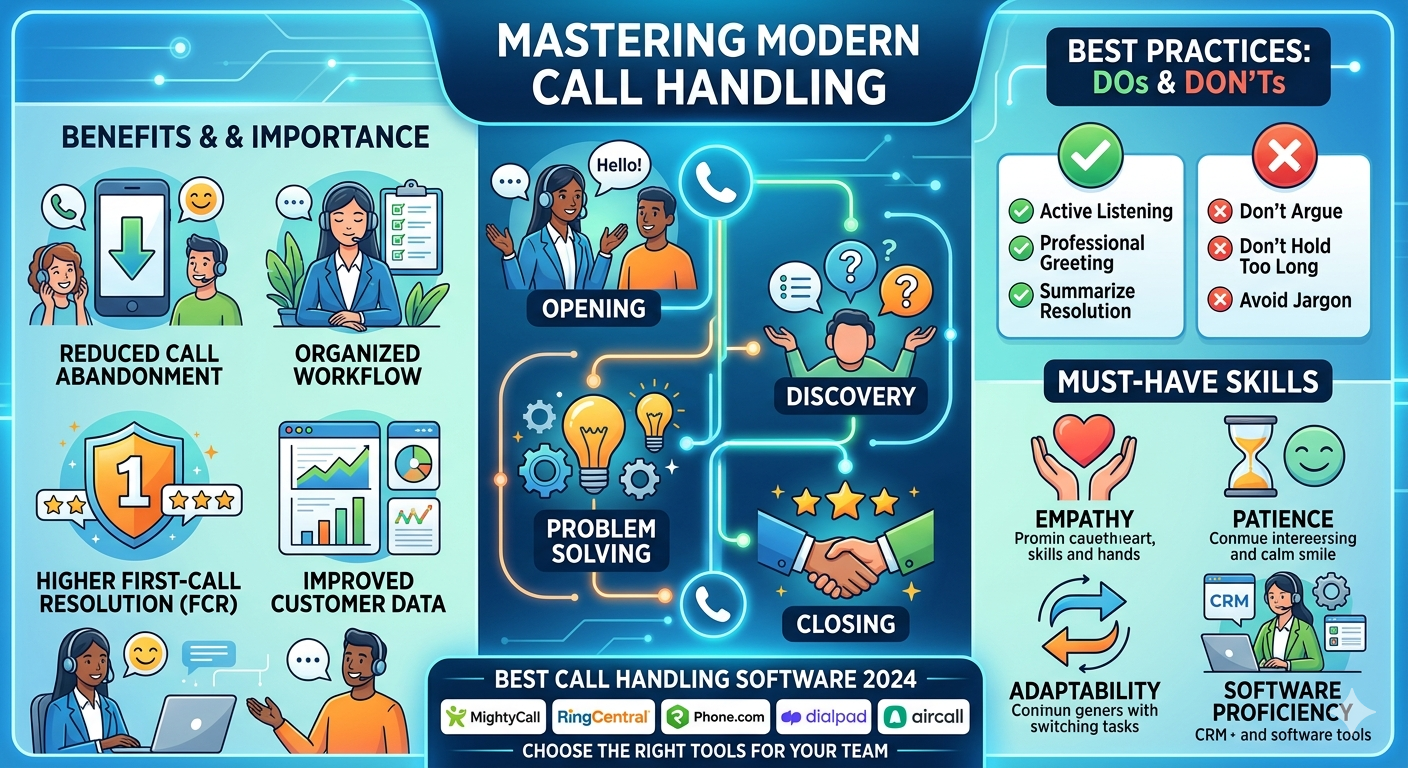
Successful management of phone conversations is not a singular event but a series of interconnected components. It starts with the Opening, where the agent uses a professional greeting to set the tone. This is followed by Discovery, where the agent asks probing questions to understand the root cause of the caller’s concern. Without these two steps, the interaction can quickly become disorganized and frustrating for the customer.
The next phase is Problem Solving, which involves the agent using their call handling experience to find a solution or escalate the issue appropriately. Finally, the Closing ensures that the customer is satisfied with the outcome and knows the next steps. Throughout these components, maintaining a call guide helps ensure that no vital information is missed. According to MightyCall, integrating these components into a unified workflow is what separates amateur support from professional-grade call handling customer service.
Benefits of call handling
Implementing a structured approach to your communications offers a wide range of advantages that ripple through the entire organization. When everyone understands the call handling steps, the entire office operates with a higher level of synchronicity and purpose.
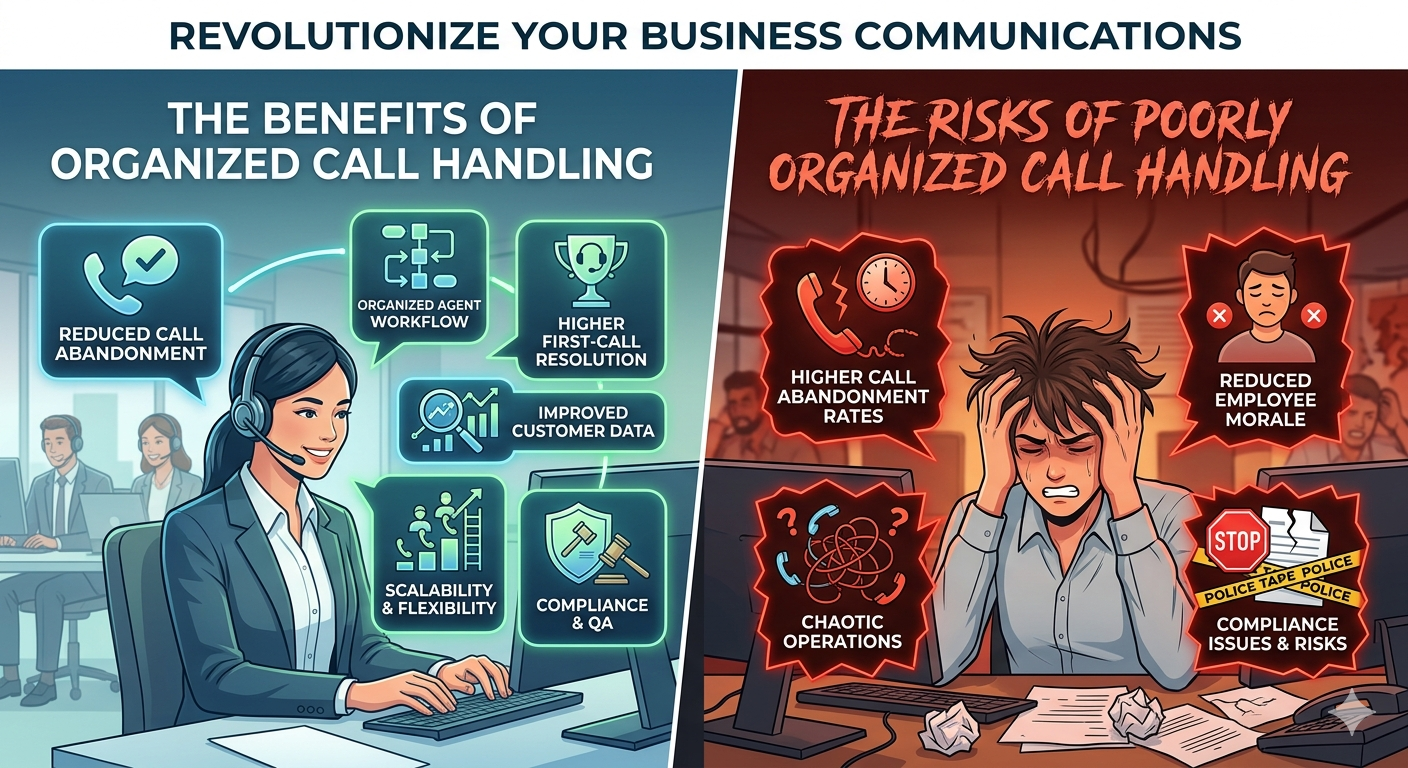
Reduced call abandonment
One of the most immediate benefits of improved call handling is a drastic reduction in abandoned calls. Abandonment happens when a caller hangs up before reaching an agent, usually due to long wait times or confusing IVR menus. By optimizing routing and ensuring agents are prepared, businesses can keep customers on the line and ensure their needs are met, preventing the loss of potential sales or the escalation of customer frustration.
Organized workflow for agents
A clear strategy provides agents with an organized workflow, reducing the cognitive load required to handle each interaction. When agents know exactly how to handle calls in customer service using a consistent framework, they experience less stress and burnout. This organization allows them to focus on the human element of the conversation rather than worrying about which button to press or where to find specific data.
Higher first-call resolution
First-Call Resolution (FCR) is a holy grail metric in the industry. Proper call handling ensures that the agent has the tools and authority to solve a problem the first time a customer reaches out. This eliminates the need for follow-up calls, which saves the company money and greatly increases customer satisfaction levels. Research by the Ascent Group shows that companies with high FCR rates also see much higher overall customer satisfaction scores.
Improved customer data
Every interaction in a well-managed system is an opportunity to gather data. By tracking call handling metrics, businesses can identify recurring problems with their products or services. This data allows for proactive improvements, shifting the business from a reactive state to one where they can anticipate customer needs before the phone even rings.
Scalability and flexibility
A standardized call handling service makes it much easier for a business to scale. When processes are documented and software is properly configured, bringing on new staff becomes a seamless transition. This flexibility is vital during seasonal peaks or periods of rapid growth, ensuring that the quality of service remains high even as the volume of customer calls increases.
Compliance and quality assurance
In many industries, following specific protocols is a legal requirement. Standardized callhandling procedures allow for better monitoring and recording of calls. This ensures that agents are following legal guidelines and internal quality standards, protecting the company from liability and ensuring that every customer receives a fair and professional experience.
Risks of a poorly organized call handling service
Ignoring the importance of call handling can lead to a cascade of negative outcomes that can jeopardize a company’s reputation.
Higher call abandonment rates
Without a plan, wait times naturally increase. Customers today have very little patience for being placed on indefinite hold. When abandonment rates spike, you aren’t just losing a call; you are likely losing a customer for life. Furthermore, high abandonment rates often lead to customers calling back repeatedly, which further clogs the lines and worsens the problem for everyone else.
Reduced employee morale
Agents who are forced to work in a chaotic environment without clear call handling steps quickly become demotivated. Dealing with angry customers who have been on hold for twenty minutes is exhausting. This leads to high turnover rates, which is incredibly expensive for businesses that must constantly spend money on recruiting and training new staff.
Chaotic operations
A lack of structure in telephone call handling leads to chaotic operations where calls are misrouted, messages are lost, and customers are forced to repeat their information to multiple people. This lack of professionalism reflects poorly on the entire brand and suggests that the company is disorganized and unreliable.
Compliance issues
Many regions have strict laws regarding how customer data is handled and how calls are recorded. A disorganized call handle process increases the risk of violating these regulations. This can result in heavy fines and legal action, particularly in sectors like healthcare or finance where privacy is paramount.
Missed business opportunities
Every call is a potential opportunity. If your inbound call handling is poor, you might be missing out on sales leads or important partnerships. A customer who calls to inquire about a product but is met with a rude or confused agent will likely take their business to a competitor who handles their calls with more grace and efficiency.
Who should be responsible for the call handling process?
For a call center call handling operation to be successful, there needs to be a clear hierarchy of responsibility. It is not just the job of the person answering the phone; it is a team effort.
1. Call Center Manager
The manager is responsible for the high-level strategy. They determine the KPIs, such as average handle time and FCR, and ensure that the overall call handling service aligns with the company’s broader goals. They are also responsible for budgeting for the necessary software and hardware tools.
2. Team Leaders/Supervisors
Supervisors focus on the day-to-day execution of the call guide. They provide real-time coaching to agents, handle escalations that are too complex for front-line staff, and monitor call queues to ensure that wait times remain within acceptable limits.
3. Quality Assurance (QA) Analysts
These individuals review recorded calls to ensure that the call handling customer service standards are being met. They look for areas where agents can improve their communication skills and ensure that the technical steps of the process are being followed correctly.
4. IT Support Staff
Technology is the backbone of modern phone handling. IT staff ensure that the VoIP systems, CRM integrations, and internet connections are stable. Without them, even the best-trained agents would be unable to perform their duties.
5. Agents
The agents are the most visible part of the process. They are responsible for the actual execution of the call handling experience. Their ability to remain calm under pressure and follow the established protocols is what ultimately determines the success or failure of the customer interaction.
Call handling best practices
To excel in this field, organizations should adopt a list of “dos and don’ts” that guide every interaction. Following call handling best practices ensures a baseline of quality that customers can rely on.
What to do
Always use a professional greeting: Start every call with a clear, friendly introduction that includes the company name and your own name.
Listen actively: Allow the customer to speak without interruption. This shows respect and ensures you gather all the necessary facts.
Use the customer’s name: Personalizing the conversation makes the caller feel like an individual rather than just another ticket number.
Ask for permission to hold: If you need to look up information, always ask the customer if they mind being placed on hold and give them an estimated wait time.
Summarize the resolution: Before hanging up, repeat the steps taken or the solution provided to ensure both parties are on the same page.
What not to do
Don’t use overly technical jargon: Speak in a way that the average customer can easily understand.
Avoid interrupting the caller: Even if you know the answer, letting the customer finish their thought is essential for rapport.
Never argue with a customer: Even if the customer is wrong, remain professional. De-escalation is a key part of how to handle calls in customer service.
Don’t leave a customer on hold for too long: If a task is taking longer than expected, check back in with the caller every 60 to 90 seconds.
Avoid eating or drinking while on a call: The microphone picks up these sounds easily and it sounds highly unprofessional.
Must-have call handling skills
To be effective at callhandling, an individual needs a mix of “hard” and “soft” skills. Hard skills include the ability to use complex software and fast typing speeds for note-taking. However, soft skills are often more important for a positive customer outcome.
Empathy is perhaps the most critical skill. Being able to understand and share the feelings of a frustrated caller can turn a negative situation into a positive one. Patience is also vital, as agents often have to explain the same concepts multiple times to different people. Additionally, strong communication skills—both verbal and written—ensure that the agent can convey information clearly and concisely. Finally, adaptability is necessary because no two customer calls are ever exactly the same; an agent must be able to pivot their approach based on the unique needs of each caller.
Best call handling software
The tools you use are just as important as the people you hire. Here is a breakdown of the top software options available for managing business communications in 2024.
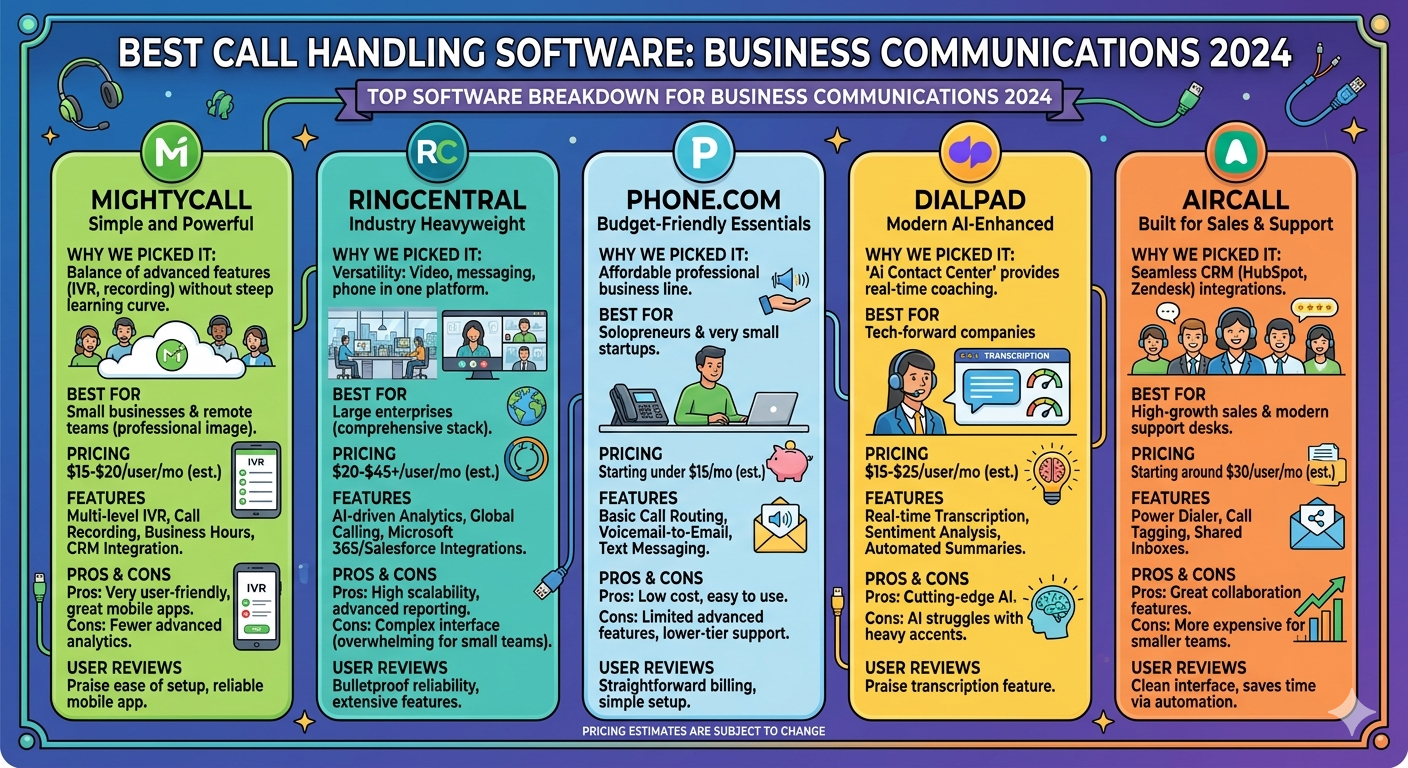
1. MightyCall
MightyCall is a cloud-based solution that emphasizes simplicity and power for small to mid-sized businesses. It provides a robust set of features that make call handling intuitive for teams of all sizes.
Why we picked it: It offers an excellent balance of advanced features like IVR and call recording without the steep learning curve found in enterprise-grade software.
Best for: Small businesses and remote teams looking for a professional image.
Pricing: Plans usually start around $15 to $20 per user per month.
Features: Multi-level IVR, call recording, business hours settings, and CRM integration.
Pros & Cons: Pros include a very user-friendly interface and great mobile apps. Cons include fewer advanced analytics compared to enterprise rivals.
User reviews: Users frequently praise the ease of setup and the reliability of the mobile application.
2. RingCentral
RingCentral is a heavyweight in the industry, offering a massive suite of tools that go far beyond simple phone calls.
Why we picked it: Its versatility is unmatched, combining video, messaging, and phone into one platform.
Best for: Large enterprises that need a comprehensive communication stack.
Pricing: Tiered pricing ranging from $20 to $45+ per user per month.
Features: Advanced AI-driven analytics, global calling, and deep integrations with Microsoft 365 and Salesforce.
Pros & Cons: Pros include high scalability and advanced reporting. Cons include a complex interface that may overwhelm small teams.
User reviews: Often cited for its “bulletproof” reliability and extensive feature list.
3. Phone.com
Phone.com is a budget-friendly option that focuses on providing the essentials of telephone call handling at a low price point.
Why we picked it: It is one of the most affordable ways to get a professional business line.
Best for: Solopreneurs and very small startups.
Pricing: Very competitive, with plans starting under $15 per month.
Features: Basic call routing, voicemail-to-email, and text messaging.
Pros & Cons: Pros include low cost and ease of use. Cons include limited advanced features and lower-tier customer support.
User reviews: Valued for its straightforward billing and simple setup process.
4. Dialpad
Dialpad is a modern platform that uses artificial intelligence to enhance the call center call handling experience.
Why we picked it: Its “Ai Contact Center” features provide real-time coaching to agents during calls.
Best for: Tech-forward companies that want to use AI to improve their FCR.
Pricing: Mid-range, usually starting around $15 to $25 per user.
Features: Real-time transcription, sentiment analysis, and automated post-call summaries.
Pros & Cons: Pros include cutting-edge AI features. Cons include the AI sometimes struggling with heavy accents.
User reviews: Users love the transcription feature which makes it easy to review what was said without listening to the whole call.
5. Aircall
Aircall is built specifically for sales and support teams who rely heavily on CRM data to manage their interactions.
Why we picked it: Its integration with tools like HubSpot and Zendesk is seamless.
Best for: High-growth sales teams and modern support desks.
Pricing: Starting around $30 per user per month.
Features: Power dialer, call tagging, and shared team inboxes.
Pros & Cons: Pros include great collaboration features. Cons include being one of the more expensive options for smaller teams.
User reviews: Highly rated for its “clean” interface and how much time it saves agents through automation.
Improve business calls with call handling
To truly improve your business communications, you must treat call handling as an evolving discipline. It is not a “set it and forget it” task. Regularly reviewing your call handling steps and updating your call guide based on customer feedback is essential. Companies that invest in ongoing training for their agents see a significant return on investment in the form of higher customer lifetime value.
Furthermore, leveraging technology like AI-driven analytics can reveal hidden patterns in your customer calls. You might discover that most complaints happen on Tuesday mornings or that certain agents are particularly good at de-escalating angry callers. By acting on these insights, you can continuously refine your approach, ensuring that your call handling service remains a source of pride for your company and a source of satisfaction for your clients.
Read More: Can You Use Google Voice in China? Complete Guide
Conclusion
Ultimately, the goal of all these processes is to keep the customer happy. Reliable callhandling means that when a customer reaches out, they know they will be heard and helped. In a competitive market, this reliability is your most valuable asset. It builds a foundation of trust that can survive even the occasional product failure or service delay. When a customer knows they can pick up the phone and receive expert assistance, they feel secure in their relationship with your business.
Investing in a high-quality call handling service is an investment in your brand’s future. Whether you are using a simple phone handling setup or a complex multi-national call center, the human element remains at the heart of the interaction. By combining the right technology with well-trained, empathetic staff, you can ensure that every phone call is an opportunity to strengthen your business and delight your customers.
FAQs
What is the meaning of call handling?
The meaning of call handling is the end-to-end management of a telephone conversation between a company representative and a customer. It includes the technological routing of the call, the interpersonal communication during the call, and the administrative tasks required after the call is finished. The objective is to provide a helpful, efficient, and professional experience that resolves the caller’s inquiry while maintaining the company’s standards.
What is the average handle time (AHT) in a call center?
Average handle time is a metric that measures the total duration of a transaction, including the time spent on hold, the actual talk time, and the “wrap-up” time spent on notes after the call ends. While the ideal AHT varies by industry, most call centers aim for a balance where the call is short enough to be efficient but long enough to ensure the customer’s problem is fully resolved. Reducing AHT without sacrificing quality is a primary goal of call handling best practices.
How is a call handled when all phone lines are busy?
When all lines are busy, a professional call handling service uses several strategies to manage the overflow. Most systems place callers in a queue with “music on hold” or provide recorded updates about the estimated wait time. Advanced systems offer a “callback” feature, where the customer can hang up and the system will automatically call them back when an agent becomes available. This prevents the customer from having to wait on the line and reduces frustration.
How can businesses improve customer satisfaction through call handling analytics?
Businesses can improve satisfaction by using analytics to identify bottlenecks in their process. For example, if data shows that customers are waiting too long in the IVR menu, the menu can be simplified. If certain types of customer calls always take a long time to resolve, the business can create a specialized call guide or provide extra training for agents in that specific area. Analytics allow for data-driven decisions that directly improve the customer experience.
What are the 7 P’s of call handling?
The 7 P’s are a framework used to ensure quality in telephone call handling: Preparation, Polite greeting, Professionalism, Patience, Problem-solving, Positive attitude, and Post-call summary. Following these principles ensures that the agent covers all the emotional and technical bases required for a successful interaction. They serve as a mental checklist for agents to maintain a high standard of service regardless of the call volume.
What is the #21 # code?
The *#21# code is a universal telephony command used on many mobile devices to check the status of call forwarding. While not a direct part of call center call handling software, it is a tool used by individuals to see if their calls are being diverted to another number. Understanding these types of codes can be helpful for IT support staff who are troubleshooting connectivity issues for remote agents using mobile devices.
What is SOP for call handling?
A Standard Operating Procedure (SOP) for call handling is a documented set of instructions that tells agents exactly how to perform their duties. It typically includes the specific greeting to use, how to verify a customer’s identity, steps for escalating a call to a supervisor, and instructions on how to log the call in the CRM system. Having a clear SOP ensures consistency across the team and is a vital part of training new hires.