
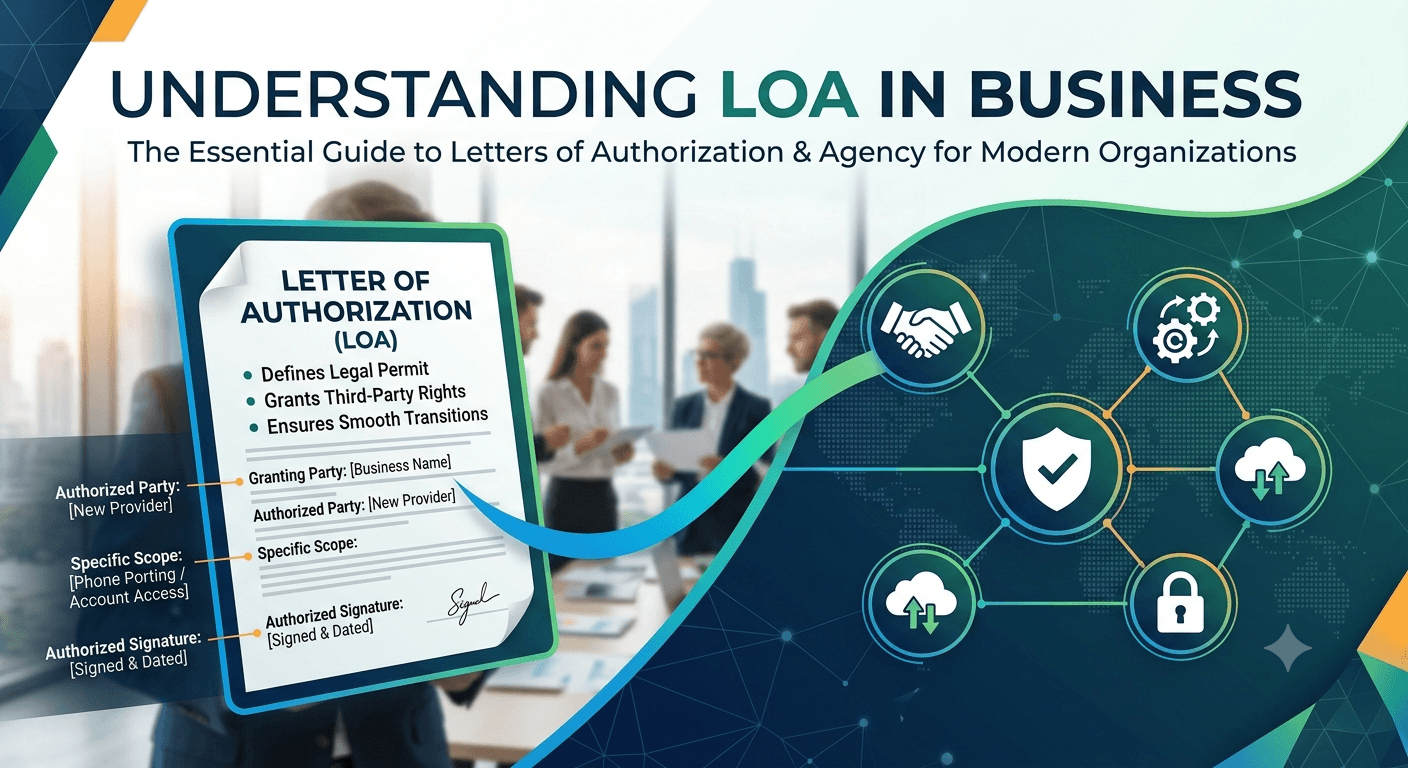
LOA meaning in business generally refers to a Letter of Authorization or a Letter of Agency. This legal document acts as a formal permit, allowing a third party to act on behalf of a person or a company in a professional capacity. Most frequently, businesses use this document during the process of switching service providers, such as telecommunications or utility companies, to ensure a seamless transition of data or services. It serves as a protective layer, confirming that the person requesting a change has the legal right to do so. By formalizing this permission, organizations prevent unauthorized access to sensitive accounts and maintain strict regulatory comfpliance across various industries.
LOA Meaning: Letter of Authorization Defined
The broad LOA meaning in business covers several specific legal and administrative functions. Primarily, it stands for Letter of Authorization, a document that provides written proof that someone is allowed to perform a specific action or access specific information. In a legal sense, it is a limited power of attorney that focuses on a single task or a narrow scope of responsibilities. This ensures that the agent cannot exceed their boundaries or make decisions that were not explicitly agreed upon by the original account holder.
Beyond just a simple permission slip, the document is a critical component of professional accountability. When a define loa request is made, it typically includes the names of all parties involved, the specific dates the authorization is valid, and a detailed list of the actions the authorized party can take. This level of detail is necessary to satisfy the internal audits of large service providers who must verify that they are not violating privacy laws or corporate governance standards when they fulfill a request from an agent.
Why is My New Phone Company Asking for an LOA?
The most common reason you will encounter the loa meaning in business is when you decide to switch your communication systems. When you sign up with a new VoIP or traditional phone provider, they must legally prove to your old provider that you have given them permission to “port” or take over your existing phone numbers. Without this document, your current provider would be prohibited by law from releasing your numbers to another company, as this would be considered a breach of your contract and privacy.
The phone company requires this document to ensure that the transition is legitimate. In the telecommunications sector, unauthorized carrier changes are known as “slamming,” and they carry heavy legal penalties. By providing a signed letter, you are verifying your identity and your intent to move. This process protects your business from having its lines cut or moved without your knowledge, which could lead to significant operational downtime and lost revenue.
Why is an LOA required?
An LOA is required because it functions as the definitive proof of consent in a regulated environment. In the United States, the Telephone Consumer Protection Act and various state-level privacy laws mandate that companies must have explicit permission before accessing or moving customer data. This legal requirement protects the consumer from fraud and ensures that service providers are held to high standards of verification. Without a formal letter, there is no way to verify that a request is coming from a legitimate source.
Furthermore, the document serves as a record for all parties involved. If a dispute arises later regarding an account change, the service provider can produce the document to show they acted in good faith based on the instructions provided. This is particularly important in business insurance and finance, where unauthorized changes can have massive financial implications. The requirement for a written, signed document adds a layer of security that verbal agreements simply cannot provide in a court of law.
Who Prepares the Letter of Authorization?
In most business scenarios, the entity that is receiving the authority is the one that prepares the template. For instance, if you are moving to a new cloud service provider, that provider will likely have a standard loa form for you to fill out. They design these templates to include all the specific legal language required by the industry and the losing provider to ensure the request is processed without rejection. This saves the business owner time and ensures that the document meets all technical specifications.
While the provider creates the template, the responsibility for accuracy lies with the business owner. You must ensure that the information, such as the company name and account numbers, matches exactly what is on file with your current provider. Any discrepancy, even a minor typo in the address, can result in the request being denied. Once the template is prepared, the authorized officer of the business must review and sign it, often using a digital signature platform for faster processing.
How an LOA works when switching to providers
When a business decides to switch its communication platform to a provider, the process follows a specific set of steps. First, the business owner provides a list of numbers they wish to keep. Providers then generates a specific letter of authorization that the customer must sign. This document is then submitted to the “losing” carrier. The losing carrier checks the signature and account details against their internal records to confirm that everything is valid before releasing the numbers to providers.
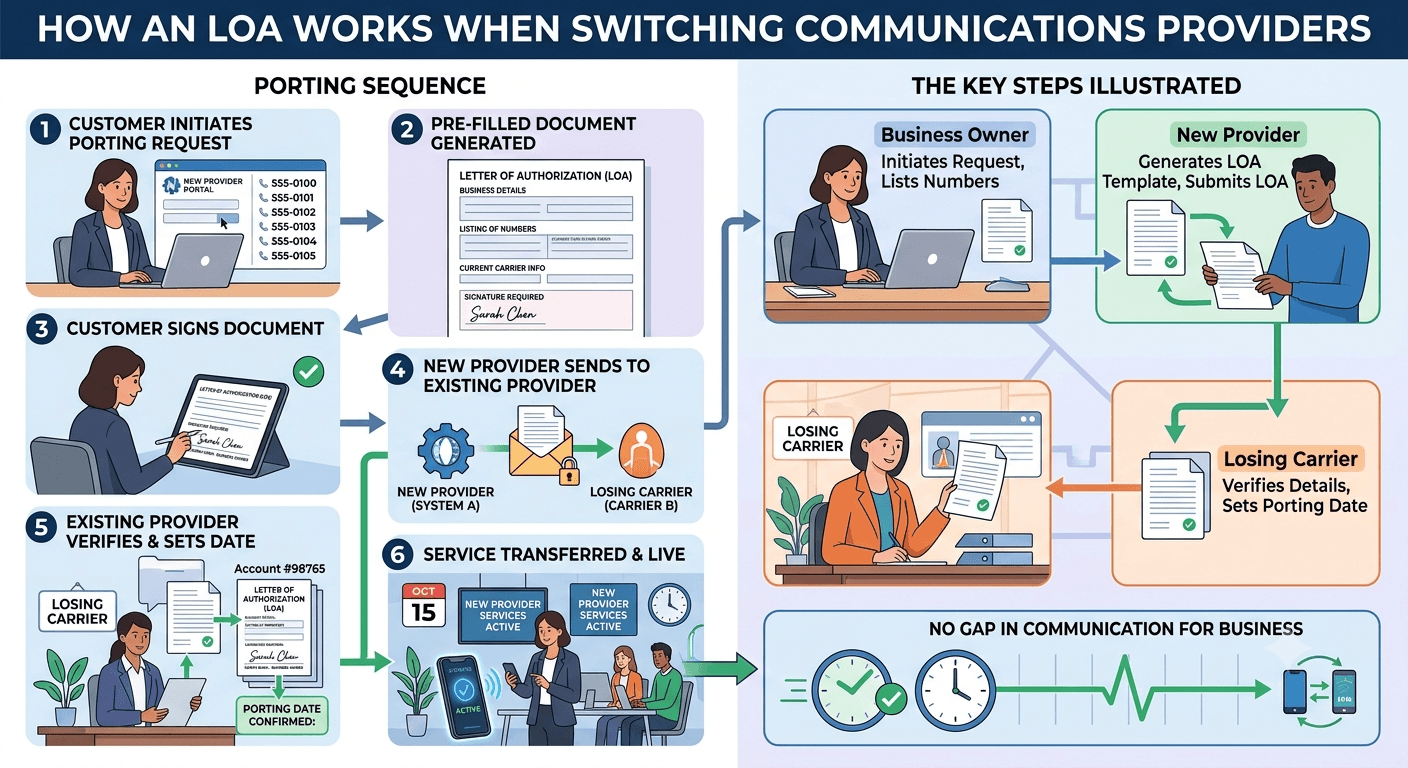
The customer initiates a porting request through the new provider’s portal.
A pre-filled document is generated containing the customer’s account details.
The customer signs the document, often electronically, to confirm their intent.
The new provider sends this document to the existing service provider.
The existing provider verifies the details and sets a porting date.
On the scheduled day, the service is transferred to the new platform seamlessly.
This sequence ensures that there is no gap in communication for the business. By using a structured loa template, the transition becomes a routine administrative task rather than a complex legal hurdle. This efficiency is why most modern service providers have integrated the authorization process directly into their onboarding workflows.
Is an LOA legally binding?
Yes, a letter of authorization is a legally binding document that carries significant weight in professional dealings. When you sign one, you are creating a legal agency relationship. This means that the actions taken by the authorized party within the scope of the letter are viewed by the law as if you had taken them yourself. This is why it is crucial to read the terms carefully and ensure that the scope of authority is not broader than what is actually needed for the task at hand.
Because of its binding nature, the document can be used as evidence in legal proceedings. If an agent exceeds their authority, the letter can be used to show where they stepped outside the agreed-upon boundaries. Conversely, if a business tries to claim they never authorized a change, the service provider can use the signed document to defend their actions. The legal strength of the document is why many industries require it to be refreshed periodically or when there is a change in the company’s executive leadership.
When don’t you need an LOA?
There are certain situations where the loa meaning in business does not apply, and a formal letter is unnecessary. If you are making changes to an account that you personally own and you are dealing directly with the service provider, your standard login credentials or phone verification are usually sufficient. In these cases, there is no “third party” involved, so the concept of agency does not apply. You are acting on your own behalf, which is your inherent right as the account holder.
Additionally, if a person already holds a comprehensive Power of Attorney (POA) for a business, they may not need a separate letter for every individual transaction. A POA is a much broader document that often covers all administrative and legal actions. Some companies also have internal “authorized user” lists where employees are pre-approved to make specific changes. In these established relationships, the need for a separate loa document for every minor update is often waived to improve operational speed.
Do companies have a deadline to respond to a letter of agency?
In many regulated industries, there are specific timeframes within which a company must respond to a request. For example, in the telecommunications industry, the “losing” carrier generally has a specific window, often between 24 to 48 hours, to acknowledge a porting request made via an LOA. If they reject the request, they must provide a valid reason, such as incorrect account information or an unauthorized signature. This prevents companies from “holding numbers hostage” to stop customers from leaving.
While there are industry standards, the actual “deadline” can vary based on the complexity of the request. A simple port of a single landline is usually fast, but moving a complex system with hundreds of numbers and interconnected data circuits may take longer.
Research suggests that the average time to complete a full business service transition is approximately 7 to 14 business days, depending on the cooperation between the two service providers involved.
What’s a Letter of Agency?
A Letter of Agency is effectively the same thing as a Letter of Authorization in most business contexts, particularly in telecommunications. The term “agency” highlights the legal relationship being created, where one party acts as an agent for another. The FCC often uses this term specifically when referring to the documents required to change a consumer’s preferred long-distance carrier or local exchange carrier. It is the formal instrument that establishes the agent’s right to represent the principal.
It identifies the customer and their contact information clearly.
It specifies the service being transferred or managed by the agent.
It includes a clear statement that the customer is choosing the new provider.
It must be signed and dated by someone with the authority to make changes.
It often includes a notice that only one provider can be designated for a specific service.
Understanding this term is helpful because some service providers may use “Letter of Agency” in their documentation while others use “Letter of Authorization.” Regardless of the name used, the purpose is to fulfill the legal requirements of consent. Businesses should treat both terms as interchangeable when dealing with service transitions or third-party management tasks.
Do LOAs Need to be Notarized?
In the majority of standard business transactions, such as switching phone or internet providers, a notary is not required. A standard handwritten or digital signature is usually enough to verify the intent. Most modern service providers accept electronic signatures through platforms like DocuSign, which are legally valid under the ESIGN Act in the United States. This makes the process much faster and more convenient for busy professionals who need to manage their accounts remotely.
However, there are high-stakes situations where notarization is mandatory. For instance, in real estate transactions, high-value financial transfers, or when granting authority to handle sensitive medical records, a notary provides an extra layer of identity verification. The notary ensures that the person signing the document is truly who they claim to be. If you are unsure whether your document needs notarization, it is best to check the specific requirements of the institution that will be receiving the letter.
Ready to Switch phone service Providers?
If your business is ready to move to a new communication platform, understanding the loa meaning in business will make the process significantly smoother. Before you begin the transition, gather your current billing statements to ensure you have the exact account names and addresses on hand. This preparation prevents the most common cause of delay: a mismatch between the information on your authorization letter and the information in the old provider’s database.
When you are ready to start, reach out to your new provider and ask for their standard template. By using their approved format, you reduce the risk of technical rejections. Taking the time to double-check every field in the document might seem tedious, but it is the best way to ensure that your business stays connected throughout the move. A well-executed transition allows you to take advantage of new features and better pricing without any unnecessary interruptions to your daily operations.
LOA in Other Industries
While we often focus on office administration, the LOA acronym appears in several other vital sectors. In the world of international shipping, LOA stands for Length Overall, which is the maximum length of a vessel’s hull measured parallel to the waterline. This is a critical measurement for determining docking fees and ensuring a ship can safely navigate specific channels or ports. It is a completely different application of the term but equally important in its respective field.
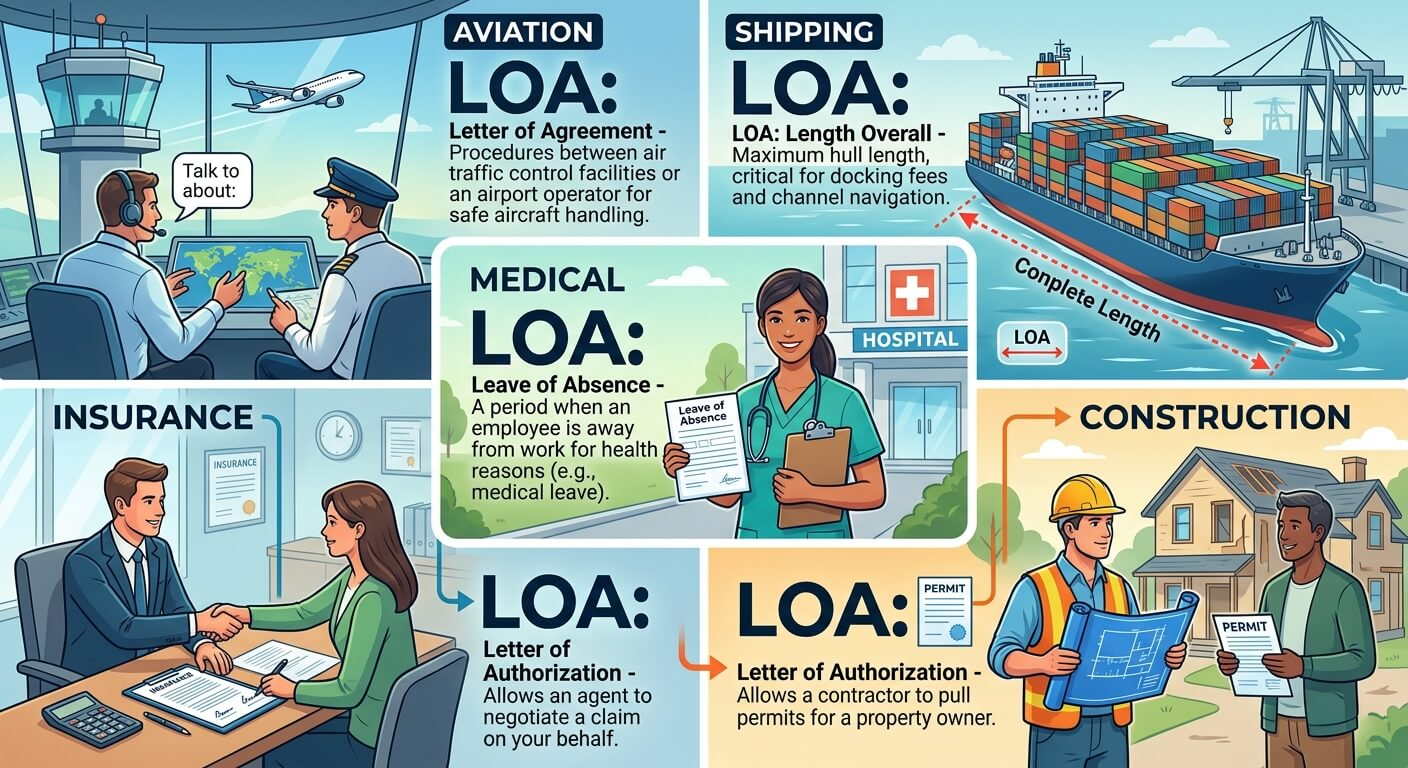
In the aviation industry, an LOA is often a Letter of Agreement. This is a document between air traffic control facilities or between a facility and an airport operator. It outlines specific procedures for handling aircraft in certain areas to ensure safety and efficiency. Furthermore, in medical terms, LOA can sometimes stand for Leave of Absence, referring to a period when an employee is away from work for health reasons. Clearly, the context is everything when determining which definition applies to your situation.
Aviation: Used for operational procedures between pilots and controllers.
Shipping: Refers to the physical dimensions of a boat or ship.
Medical: Can refer to a leave of absence or a letter of authorization for records.
Insurance: Authorization to allow an agent to negotiate a claim on your behalf.
Construction: A letter allowing a contractor to pull permits for a property owner.
Managing the LOA Process Efficiently
To manage these documents effectively, businesses should maintain a centralized digital repository of all active authorizations. Knowing exactly who has permission to act on behalf of the company is a key part of risk management. When an employee who was previously an authorized signer leaves the company, those letters should be revoked or updated immediately. This prevents former staff members from continuing to have access to corporate accounts or making unauthorized changes.
Using digital tools can significantly streamline the creation and tracking of these letters. Many companies now use automated workflows that trigger a review of all authorizations on an annual basis. This ensures that the business remains in compliance with its internal policies and that all third-party agents are still required for current operations. By staying organized, a business can avoid the administrative headaches that often come with outdated or lost documentation.
Common Mistakes to Avoid with Letters of Authorization
One of the most frequent errors in handling an LOA is providing incomplete or vague information. A letter that simply says “I authorize John Doe to manage my account” is often too broad for a bank or a utility company to accept. They need to know exactly which account number is involved and what specific actions John Doe is allowed to take. Being as specific as possible protects you and ensures the document is accepted on the first attempt.
Another common mistake is failing to verify the expiration date. Many authorizations are intended to be temporary, yet they are written without a clear end date. This can lead to security vulnerabilities if an agent retains access long after their job is finished. Always include a “valid until” date or a clause that states the authorization expires upon completion of a specific project. This keeps your business security tight and ensures that permissions are only active when they are truly necessary.
Always use the exact business name as it appears on official government records.
Specify the exact account numbers or service IDs to be managed.
Include a clear expiration date for the authority granted.
Ensure the person signing has the legal authority to bind the company.
Keep a copy of the signed document in your own permanent records.
The Role of LOA in Data Privacy and Security
In an era where data breaches are a constant threat, the letter of authorization is a vital tool for cybersecurity. It acts as a gatekeeper, ensuring that only verified individuals can make changes to sensitive systems. For example, in the telecommunications sector, an LOA prevents “SIM swapping” and other forms of identity theft by requiring a physical or digital document that can be audited. This is a major part of why the LOA meaning in business is so closely tied to security protocols.
Companies that take their security seriously treat the LOA as a high-value document. They often require multi-factor authentication even after a letter is submitted to provide an additional layer of protection. By integrating the authorization process into a broader security strategy, businesses can protect their intellectual property and customer data from unauthorized access. The document is not just a piece of paper; it is a critical link in the chain of corporate trust.
According to research by the Internal Revenue Service (IRS), formalizing third-party authorization is the most effective way to prevent unauthorized individuals from gaining access to tax records and sensitive financial data. This supporting evidence reinforces why the document is a non-negotiable part of professional business operations. Whether you are dealing with the government or a private vendor, the requirement for formal authorization is a sign of a healthy, secure business environment.
Read More: What Does Teleconference Mean? Working, Types, and Advantages
Final Words
The LOA meaning in business is a fundamental concept that ensures security, legal compliance, and operational efficiency. Whether you are porting phone numbers, managing insurance claims, or delegating financial tasks, the Letter of Authorization provides the necessary structure to protect your assets. By understanding how to prepare, sign, and manage these documents, you can navigate business transitions with confidence and ensure that your organization remains in control of its data and services. Always remember that while it may seem like just another form, it is a powerful legal instrument that defines the boundaries of professional agency.
FAQs
What is an LOA contract?
An LOA contract is a formal agreement that grants one party the legal right to act on behalf of another for specific tasks. While it is often a standalone letter, it functions as a limited contract because it outlines responsibilities and permissions. It is legally binding and is used to prove to third-party service providers that an agent has the necessary consent to manage or move an account. In most cases, these contracts are used for administrative purposes like switching utility or phone service providers.
What is LOA for company?
For a company, an LOA is an essential administrative tool used to delegate authority to employees or external consultants. It allows a business to function more efficiently by letting specialists handle technical changes or negotiations with vendors. For example, a company might issue an LOA to an IT firm to manage their internet service provider account. It ensures that the company’s executive leadership doesn’t have to be personally involved in every minor account update or service request.
What is an LOA document?
An LOA document is the physical or digital paperwork that records the granting of authority from a principal to an agent. It typically contains the names of the involved parties, the specific scope of authority, the dates of validity, and the signature of the authorizing officer. This document serves as the primary evidence needed to satisfy the security requirements of service providers who must verify that a request for an account change is legitimate and authorized by the account owner.
What does LOA stand for in work?
In a workplace setting, LOA most commonly stands for Letter of Authorization or Leave of Absence. If the context involves managing accounts or third-party vendors, it refers to the Letter of Authorization. If the context involves an employee taking time off for personal or medical reasons, it refers to a Leave of Absence. It is important to clarify the context with your human resources or administrative department to ensure you are using the correct form for your specific needs.
How long does a Letter of Authorization remain valid?
The validity of a Letter of Authorization depends on the language used within the document itself. Some are written to be valid for a single transaction, such as a one-time phone number port. Others may be “standing” authorizations that remain in effect until they are formally revoked in writing. Best practices suggest including a specific expiration date on the document to ensure that permissions do not remain active indefinitely, which helps maintain higher security standards for the business.
Can an LOA be signed electronically?
Yes, most industries and jurisdictions recognize electronic signatures on a Letter of Authorization as being just as valid as a handwritten signature. Under the ESIGN Act and the Uniform Electronic Transactions Act (UETA), digital signatures provided through secure platforms are legally binding. This has made the process of authorizing third parties much faster, as documents can be signed and returned in minutes rather than days, which is particularly helpful during urgent business transitions.
What information is required on a standard LOA?
A standard LOA must include the full legal name of the person or business granting authority, the name of the party being authorized, and a clear description of the tasks they are allowed to perform. It should also list specific account numbers or service addresses to avoid any confusion. Finally, it must include a date and the signature of an authorized representative. Providing precise details is the best way to ensure that the document is accepted by service providers without delay.
Is a Letter of Agency different from a Letter of Authorization?
In the context of business and telecommunications, a Letter of Agency and a Letter of Authorization are virtually identical. Both documents serve the same primary purpose: providing written proof of consent for one party to act on behalf of another. The term “Letter of Agency” is more common in regulatory environments, such as those governed by the FCC, while “Letter of Authorization” is the more general term used across various other industries like finance and insurance.