
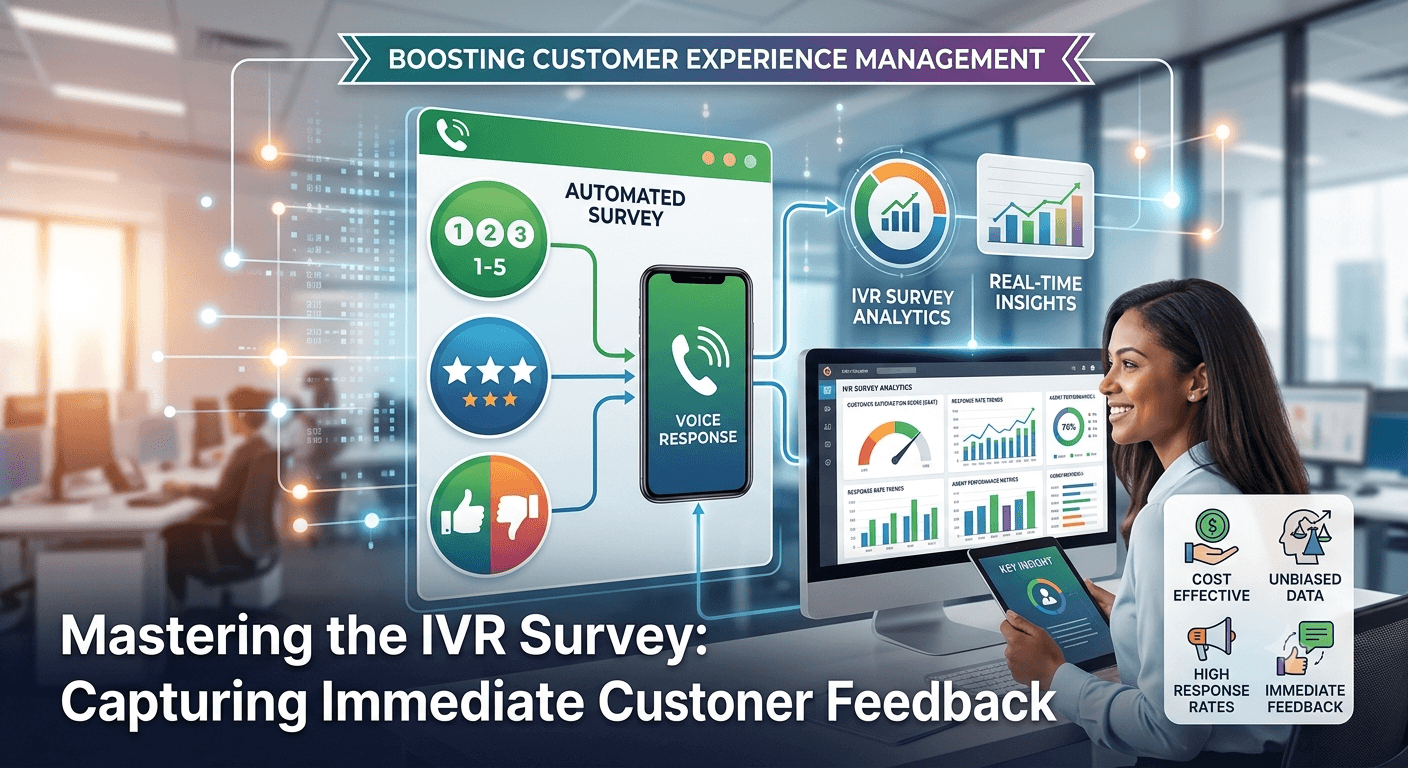
IVR surveys are automated voice polling systems that allow businesses to collect real-time feedback from customers immediately following a call center interaction. These interactive voice response survey tools prompt callers to answer questions using their phone keypad or voice commands. By leveraging ivr survey software, companies can capture the voice of the customer while the experience is fresh. This automated phone survey method provides high response rates and objective data, making it a cornerstone of modern contact center strategy and customer experience management. Organizations use these tools to measure performance, improve service quality, and gain deep insights into the traditional ivr customer experience.
What is an IVR Survey?
An interactive voice response survey is a pre-recorded automated system that interacts with callers to gather data. This technology allows customers to provide feedback by pressing numbers on their telephone keypad or by speaking their responses. Unlike manual surveys conducted by live agents, these systems operate independently, ensuring that every customer has an equal opportunity to share their thoughts without the bias of a human interviewer.
The system works by routing the caller to a survey module at the end of a support call or during a dedicated outbound campaign. Modern ivr analytics allow businesses to track how callers interact with these menus, identifying where they drop off or which questions cause confusion. By using custom ivr surveys for customers, brands can tailor the language and tone to match their specific audience, ensuring a more personal feel despite the automated nature of the tool.
Benefits of IVR survey use
Implementing ivr surveys offers a range of logistical and analytical advantages for modern enterprises. These systems are highly scalable, allowing a business to process thousands of feedback entries simultaneously without increasing staffing costs. Because the data is collected digitally, it can be immediately integrated into ivr data analytics platforms for real-time reporting and trend identification.
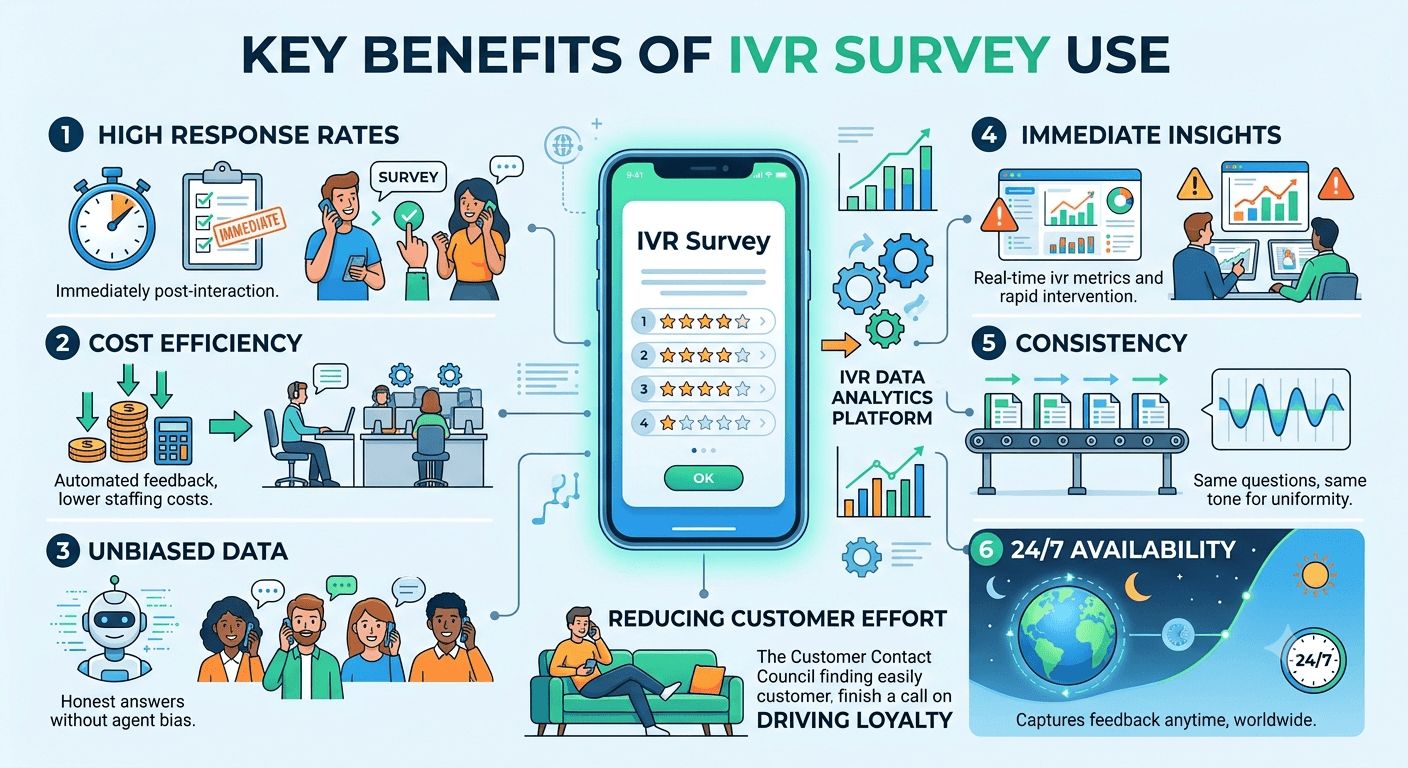
High response rates: Customers are more likely to respond when the survey is presented immediately after their interaction.
Cost efficiency: Automated systems eliminate the need for manual data entry or live survey agents.
Unbiased data: The absence of a live person removes social desirability bias, leading to more honest answers.
Immediate insights: Managers can view ivr metrics as they happen, allowing for rapid intervention if a service issue arises.
Consistency: Every customer hears the same questions in the same tone, ensuring data uniformity across the board.
24/7 availability: These surveys can run at any time, capturing feedback from international callers in various time zones.
According to a study by the Customer Contact Council, reducing customer effort is the most significant driver of loyalty. IVR surveys facilitate this by providing a low-friction way for users to voice their concerns without having to wait for a follow-up email or separate phone call.
Drawbacks of IVR surveys
While powerful, these tools are not without limitations. One primary concern is the lack of nuance in keypad responses; a customer might press a 3 for neutral, but the system cannot capture the “why” without complex speech recognition. Additionally, if the survey is too long, callers may hang up, leading to incomplete data sets that skew the final ivr analysis.
Another challenge involves the technical reliability of the system under stress. Companies must seek the best solutions for load testing ivr systems reliability peak traffic to ensure the survey does not crash during high-volume periods. If the system fails, it leaves a negative final impression on the customer, potentially damaging the brand more than if no survey had been offered at all.
Top IVR survey use cases
The versatility of the interactive voice response survey makes it applicable across various departments and industries. From retail support to healthcare appointment follow-ups, these automated tools help bridge the gap between company assumptions and actual customer feelings.
Post-interaction customer satisfaction
The most common use case is measuring satisfaction immediately after a support call. By asking a few quick questions, the system captures the raw emotion of the caller. This provides a clear picture of how the agent handled the request and whether the issue was resolved to the caller’s satisfaction.
Product and service feedback
Companies often use these surveys to gather specific data on new product launches. By targeting customers who have recently purchased a specific item, businesses can use an interactive voice response example to ask about ease of use or initial impressions. This direct line to the consumer helps product development teams make data-driven adjustments.
‘Voice of customer’ program integration
A robust Voice of the Customer (VoC) program relies on multiple data streams. Integrating ivr surveys into this program ensures that voice-based interactions are weighted equally with web and email feedback. This holistic view is essential for understanding the complete customer journey and identifying systemic pain points.
Process improvement identification
By analyzing where callers struggle within the survey itself, companies can refine their ivr self service best practices. If a high percentage of users drop off during a contact information survey, it indicates the questions may be too intrusive or the instructions are unclear. This leads to continuous refinement of the automated system.
Typical IVR survey response rates
Response rates for these surveys are generally higher than for email counterparts, often ranging between 10% and 20%. This is because the request occurs while the customer is still on the line and engaged with the brand. Research from industry experts suggests that voice-based feedback feels more personal and urgent than a digital link sent hours later.
8 IVR survey best practices for actionable insights
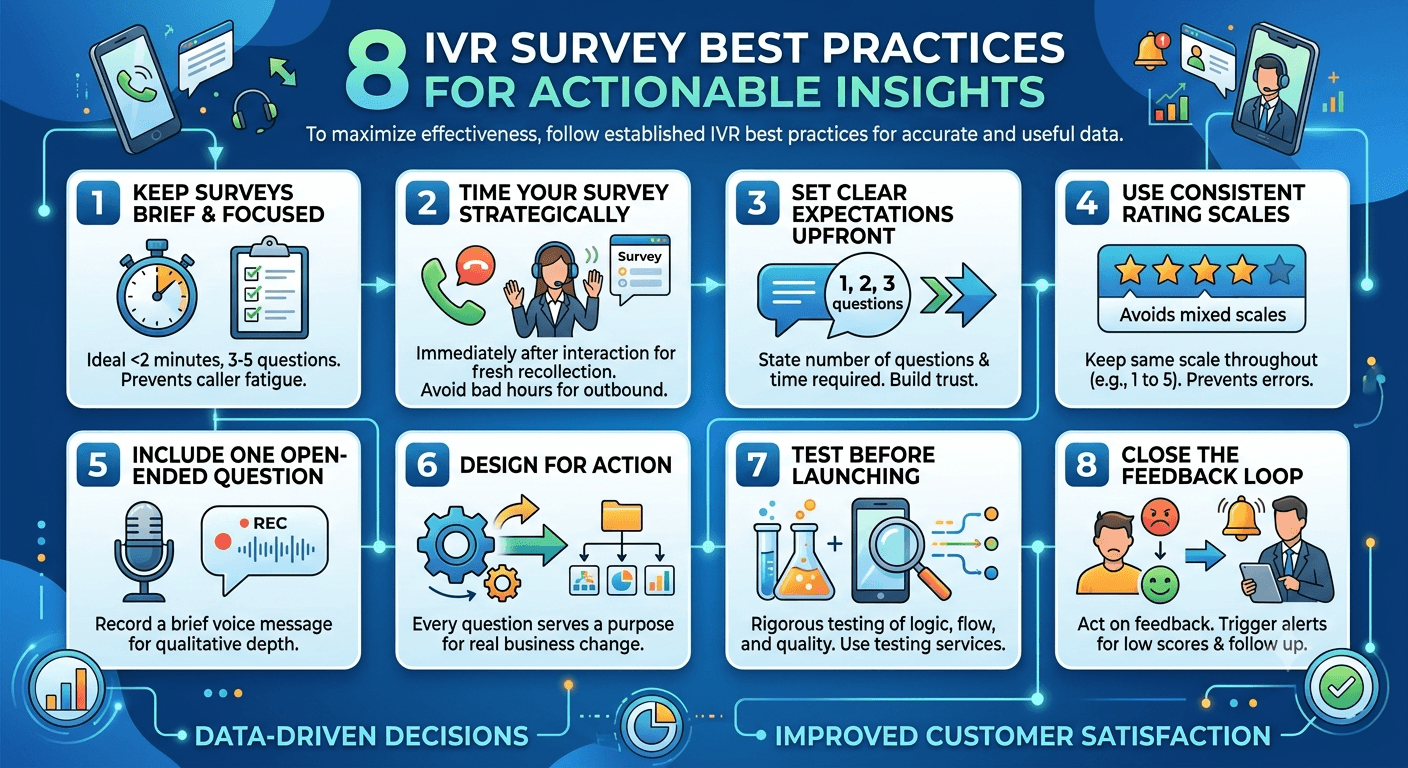
To maximize the effectiveness of your feedback loop, you must follow established ivr best practices. A poorly designed survey will not only result in bad data but also frustrate your customers. Following a structured approach ensures that the insights you gather are both accurate and useful for making business decisions.
1. Keep surveys brief and focused
Respect your customer’s time by limiting the number of questions. Ideally, a survey should take no more than two minutes to complete. Focusing on three to five essential questions ensures a higher completion rate and prevents caller fatigue, which is a common cause of survey abandonment.
2. Time your survey strategically
The timing of the survey request is critical for data accuracy. Offering the survey immediately after the agent disconnects ensures the experience is fresh in the caller’s mind. For outbound campaigns, avoid calling during dinner hours or very early in the morning to maintain a positive brand image.
3. Set clear expectations upfront
At the start of the survey, inform the caller exactly how many questions will be asked and how much time it will take. This transparency builds trust and makes the caller more likely to stay on the line until the end. Clear instructions on how to use the keypad or voice commands should also be provided.
4. Use consistent rating scales
Changing the scale from question to question confuses the caller. If you start with a scale of 1 to 5, where 5 is excellent, stay with that format throughout the entire interaction. Consistency in ivr design best practices prevents “reverse scoring” errors where customers accidentally provide the wrong rating.
5. Include one open-ended question
While numeric ratings are great for quantitative analysis, open-ended questions provide qualitative depth. Allowing the customer to record a brief voice message gives them a chance to explain their rating. These recordings are invaluable for ivr analytics and identifying specific issues that numbers alone cannot reveal.
6. Design for action
Every question in your survey should have a specific purpose. If you are not going to use the data to change a process or reward an agent, do not ask the question. Designing for action ensures that your ivr metrics are aligned with your organizational goals and key performance indicators.
7. Test before launching
Rigorous ivr testing is essential to ensure the logic and flow of the survey are correct. This includes checking that all paths lead to a proper conclusion and that the recording quality is high. Utilizing ivr testing as a service can help identify technical glitches that might occur across different carriers or devices.
8. Close the feedback loop
The final step is to act on the feedback received. If a customer provides a very low score, the system should trigger an alert for a supervisor to follow up. Closing the loop proves to the customer that their opinion is valued and can turn a negative experience into a positive one.
Is it worth using IVR survey software?
Investing in dedicated ivr survey software is often the best path for companies looking to scale their feedback mechanisms. These platforms offer advanced features like sentiment analysis, multi-language support, and deep integration with CRM systems. While basic IVR functions might come with your phone system, specialized software provides the ivr data analytics needed for serious business intelligence.
Using a professional tool like nice ivr allows for better management of the survey lifecycle. These platforms often include built-in ivr self service best practices, making it easier to design surveys that convert. Furthermore, they provide the infrastructure needed for an ivr test to ensure that the system remains stable during unexpected traffic spikes.
Professional software also simplifies the process of ivr analysis by generating automated reports. Instead of manually crunching numbers, managers can receive weekly summaries of customer sentiment and agent performance. This automation saves time and allows leadership to focus on implementing changes rather than just collecting data.
IVR survey question examples to get you started
Choosing the right questions is the foundation of any successful automated phone survey. Your questions should be simple, direct, and easy to answer using a standard telephone keypad. Avoid using complex jargon or multiple-part questions that might confuse the caller during the interactive voice response survey.
Customer Satisfaction (CSAT) questions
These questions are designed to measure a customer’s immediate happiness with a specific interaction. They are usually rated on a scale of 1 to 5 or 1 to 7.
On a scale of 1 to 5, how satisfied were you with the service you received today?
How well did our agent meet your expectations during this call?
Based on your experience today, how likely are you to continue using our services?
Net Promoter Score (NPS) questions
NPS is a standard metric used to gauge long-term brand loyalty. It typically uses a 0 to 10 scale.
How likely are you to recommend our company to a friend or colleague?
On a scale of 0 to 10, how would you rate your overall loyalty to our brand?
How satisfied are you with our brand’s ability to meet your needs over time?
Agent performance questions
These questions help call center managers evaluate individual staff members and identify training needs.
Was the agent you spoke with today knowledgeable about your issue?
How would you rate the professionalism of the agent who assisted you?
Did the agent treat you with courtesy and respect throughout the call?
Process efficiency questions
Understanding how easy it is to work with your company is vital for reducing customer effort.
On a scale of 1 to 5, how easy was it to get your issue resolved today?
Did you have to repeat your information to multiple agents during this call?
How would you rate the speed at which your call was answered?
Open-ended question examples
These allow for the collection of qualitative data through voice recordings.
In a few words, please tell us the main reason for your score today.
Is there anything else you would like to share about your experience with us?
How can we improve our service to better serve you in the future?
Read More: Webrtc vs Sip: A Comprehensive Guide
Using an IVR survey: Final thoughts
Integrating ivr surveys into your customer experience strategy is a powerful way to gain real-time, actionable insights. By following call center ivr best practices, such as keeping surveys short and testing the system regularly, you can ensure a high response rate and high-quality data. These tools not only help in measuring current performance but also serve as a roadmap for future improvements. As technology evolves, the ability to conduct an ivr analysis with sophisticated analytics will only become more critical for staying competitive. Ultimately, the success of these surveys depends on your commitment to listening to the voice of the customer and taking meaningful action based on their feedback.
Faqs
What is an IVR survey?
An ivr survey is an automated telephone feedback system that allows customers to respond to questions using their voice or keypad. It typically occurs at the end of a customer service interaction to gather immediate data on the experience. These systems are managed by ivr survey software and provide a cost-effective way to gather large volumes of data without human intervention.
What does the IVR stand for?
IVR stands for Interactive Voice Response. It is a technology that allows a computer to interact with humans through the use of voice and DTMF tones input via a keypad. In the context of surveys, it enables a two-way communication channel where the system prompts the user and the user provides data in return.
What are some good IVR examples?
A classic interactive voice response example is the post-call satisfaction survey where a caller is asked to rate their experience from 1 to 5. Other examples include automated appointment reminders that ask for a confirmation, or a contact information survey used to update a customer’s records.
How is an IVR survey handled?
The process begins when a call is transferred to the survey module, either by an agent or automatically by the system. The ivr survey then plays pre-recorded prompts, and the customer provides responses. These responses are captured, stored, and then analyzed using ivr data analytics tools to produce reports for the management team.
What is ivr testing and why is it important?
It is the process of verifying that the automated voice system works as intended. This includes checking call flows, audio quality, and database integration. It is important because it ensures that customers don’t encounter errors, which helps maintain the reliability of the ivr metrics collected.
How can I improve my ivr analysis?
To improve analysis, you should integrate your survey data with other customer touchpoints in your CRM. Using advanced ivr analytics software can also help you identify patterns in caller behavior, such as specific times of day when satisfaction drops or common points where users abandon the survey.
What are the best practices for ivr design?
Key ivr design best practices include keeping the menu structure simple, using natural-sounding voice prompts, and ensuring the most important options are presented first. It is also vital to provide an easy way for customers to opt-out or speak to a human if they become frustrated.
Why should I use custom ivr surveys for customers?
Customization allows you to tailor the survey experience to specific customer segments or product lines. This makes the survey feel more relevant to the caller, which can significantly increase completion rates and provide more specific, actionable data for your business.
What are the key ivr metrics to track?
Important metrics include the survey completion rate, the average score (CSAT or NPS), the drop-off rate for specific questions, and the time taken to complete the survey. Monitoring these helps you refine the survey over time for better results.