
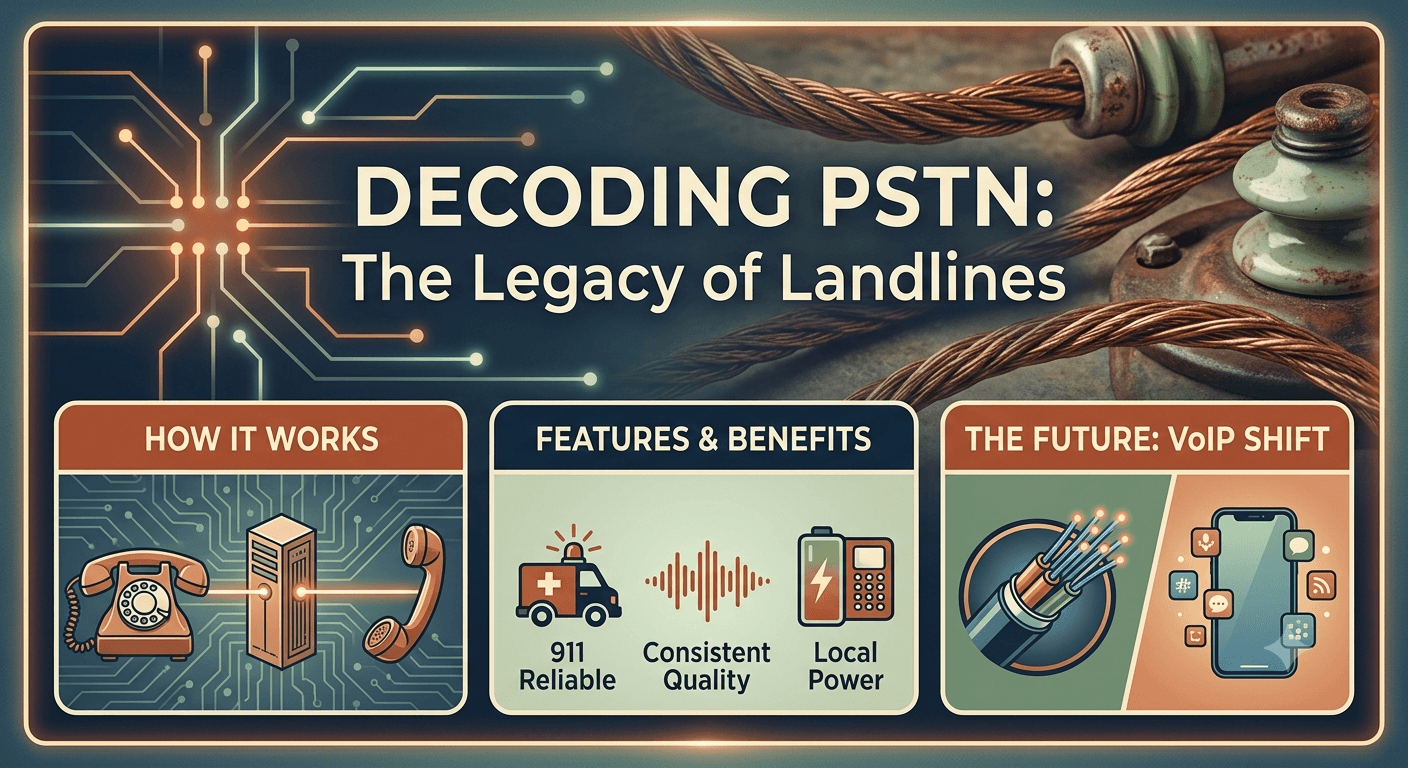
The Public Switched Telephone Network, commonly known as PSTN, is the traditional circuit-switched telephone system that has powered global communication for over a century. What is PSTN? It is the aggregate of the worlds circuit-switched telephone networks that are operated by local, regional, or national telephony operators, providing the infrastructure for public telecommunication. This network relies on copper wires, fiber optic cables, switching centers, and satellites to transmit analog voice data. While modern technology has introduced digital alternatives, the PSTN remains a foundational element of the global communication landscape, offering high reliability and consistent voice quality for landline users.
What Is PSTN?
The public switched telephone network pstn is the infrastructure behind traditional landline phone services. It started in the late 19th century as a system of manual switchboards where operators physically connected wires to complete a call. Over time, it evolved into an automated system of electronic switches. When people ask what is pstn, they are usually referring to the legacy copper-wire system that connects homes and businesses to a central provider.
This system is often called POTS, which stands for Plain Old Telephone Service. It utilizes a dedicated circuit between two points for the duration of a call. Unlike modern internet-based systems that break data into small packets, a pstn phone line establishes a continuous path for the signal. This dedicated path ensures that the connection remains stable, which is why pstn networking has been the gold standard for reliability for decades.
In the modern era, the pstn meaning has expanded to include a mix of analog and digital components. While the final link to a residential home might still be an analog pstn line, the core of the network is largely digital. Huge underground cables and undersea fiber optics carry vast amounts of pstn calls across continents, using sophisticated pstn switch technology to route traffic efficiently.
How Does PSTN Calling Work?
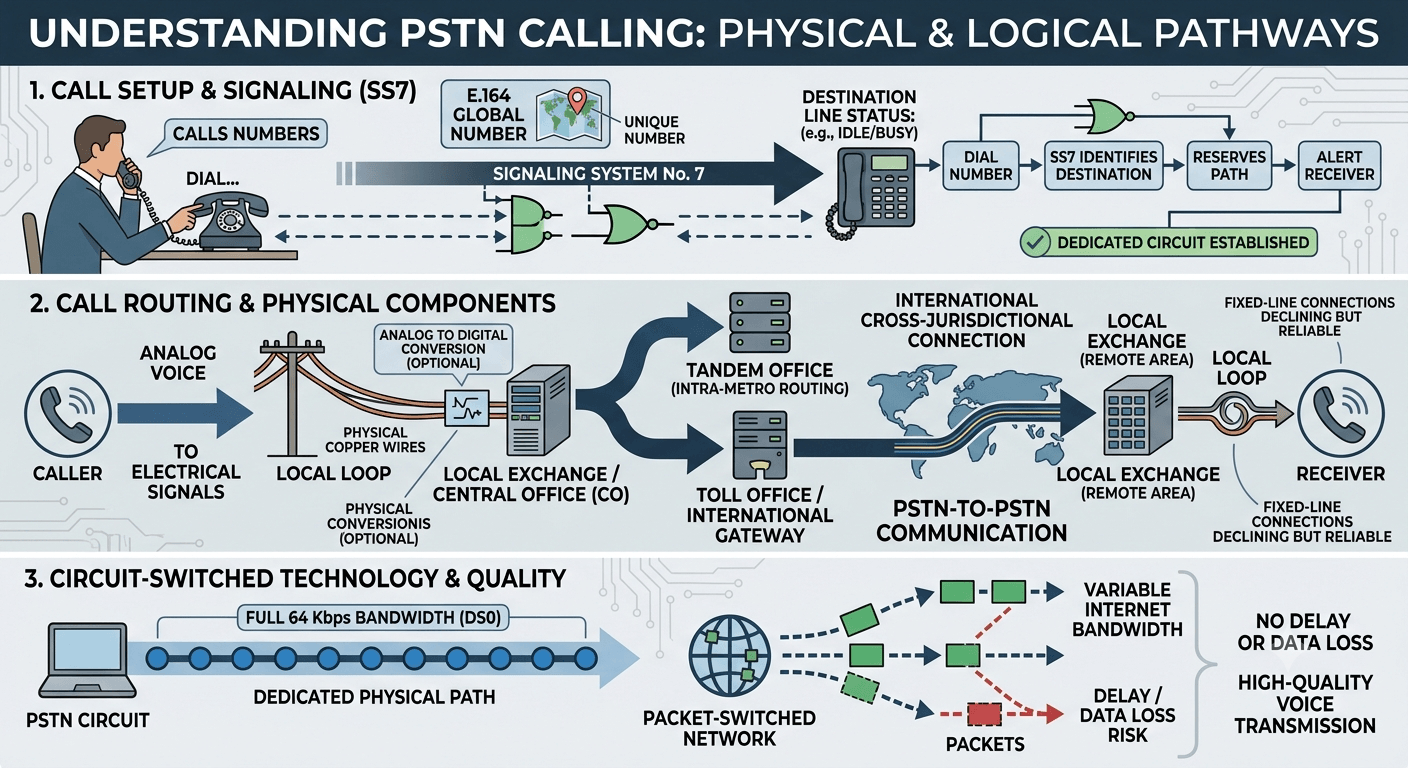
Understanding how pstn calls travel from one point to another requires a look at the physical and logical pathways involved. When you pick up a pstn phone and dial a number, your voice is converted into electrical signals. These signals travel through the pstn telephone network via a series of exchanges. The process is instantaneous, but it involves several layers of technology to ensure the right person answers on the other end.
Components of PSTN
The architecture of the public switched telephone system relies on several critical components. The most basic element is the local loop, which is the physical wire connecting a subscriber to the nearest central office. This is often the pstn phone line you see running from a telephone pole into a building. From there, the signal enters the larger network.
Central offices are connected to tandem offices, which handle calls within a specific metropolitan area. For long-distance communication, the signal moves to a toll office or an international gateway. These gateways act as the bridge for pstn to pstn communication across different countries and regulatory jurisdictions. Every pstn telephone is assigned a unique number based on the E.164 standard, ensuring global compatibility.
Call Setup and Routing Process
The routing of a pstn call involves a protocol known as Signaling System No. 7. This protocol handles the setup, management, and teardown of calls. When you dial a number, the SS7 protocol looks for the most efficient path through the pstn network to reach the destination. It checks if the receiving line is busy before actually establishing the voice circuit.
Once the connection is established, the dedicated circuit remains open until one party hangs up. This is a fundamental characteristic of the public switched telephone network. The signals are transmitted as analog waves over the local loop but are often converted into digital pulses at the central office for long-distance transport. This hybrid nature allows for a pstn gateway to interface between different types of networks.
Circuit-Switched Technology
Circuit switching is the core technology that defines what is pstn network. In this model, a dedicated physical path is reserved for the entire duration of the conversation. This is different from packet-switched networks used by the internet, where data is broken down and sent via multiple routes. Because the path is dedicated, there is no delay or data loss caused by other users on the network.
Research from the International Telecommunication Union indicates that while the number of fixed-line pstn connections is declining, the reliability of circuit-switched technology remains unmatched in remote areas. This is because the dedicated circuit does not fluctuate in quality based on internet bandwidth. Every pstn call receives the full 64 Kbps of bandwidth required for high-quality voice transmission, a standard known as DS0.
PSTN Architecture
The architecture of the public switch telephone network is hierarchical, designed to handle millions of simultaneous connections. At the bottom of the hierarchy are the individual subscribers using a pstn telephone. These are connected to Class 5 switches, also known as local exchanges. These exchanges provide the dial tone and handle local routing for a specific neighborhood or district.
Above the local exchanges are Class 4 switches, which manage traffic between different local offices. If a call is made to a different city, it moves up to the tandem or toll level. The use of a pstn diagram often shows these layers as a pyramid, with the massive international gateways at the top. This structured approach ensures that the pstn telephone network can scale across vast distances while maintaining logical routing paths.
Modern architecture also incorporates the pstn gateway to allow for interoperability with digital systems. This gateway converts the analog signals of a pstn line into digital packets that can travel over an IP network. This is crucial for businesses that use a mix of legacy hardware and modern cloud communication tools. The pstn gateway acts as a translator, ensuring that a VoIP PSTN connection is seamless for the user.
What Are the Key Features of a PSTN Phone System?
A pstn phone system is defined by its simplicity and resilience. One of its primary features is the ability to provide power to the telephone through the copper line itself. This means that during a local power outage, a traditional pstn phone will often still work, provided the telephone exchange has its own backup power. This has made it a vital tool for emergency services and public safety.
Another key feature is the geographic nature of pstn calls. Every number is tied to a specific physical location, which makes it incredibly easy for emergency dispatchers to locate a caller. The public switched telephone network pstn is built on a foundation of fixed infrastructure, meaning the voice quality is predictable and consistent. There are no issues with jitter or latency that are sometimes found in early-stage internet calling.
Furthermore, the system supports a variety of basic features that have become standard in telecommunications. These include caller ID, call waiting, and three-way calling. While these features are now common in all systems, they were originally developed for the public switched telephone system. The pstn provider manages these services at the switch level, ensuring they work across different hardware brands.
Three Benefits of PSTN
Despite the rise of digital alternatives, there are still several reasons why many organizations and individuals stick with the the pstn. The longevity of the system is a testament to its robust design and the massive investment made by governments and private companies over the past century.
1. Established Infrastructure
The most significant benefit is the sheer scale of the existing pstn network. It is available in almost every corner of the inhabited world. In many rural or developing regions, the pstn telephone network is the only reliable form of communication. Because the infrastructure is already in place, there is no need for new fiber optic installation to get basic voice service.
2. Consistent Call Quality
Because of circuit switching, a pstn call does not suffer from the bandwidth fluctuations that can affect internet-based calls. The quality of a pstn to pstn call is remarkably stable. There is a guaranteed amount of bandwidth for every connection, which eliminates the “choppy” audio sometimes heard on poor internet connections. This consistency is a primary reason why some businesses still prefer a pstn line for critical client communication.
3. High Security and Privacy
The public switched telephone network is generally considered more secure from remote hacking than internet-based systems. To intercept a call on a pstn phone line, someone would typically need physical access to the wires. In contrast, data traveling over the internet is vulnerable to various cyber threats. This physical security makes the public switched telephone system a preferred choice for high-security government and financial institutions.
Common Challenges or Limitations to PSTN
As the world moves toward a more data-centric model, the limitations of what is pstn are becoming more apparent. The very things that made it reliable in the 20th century are now holding it back in the 21st. Maintaining a massive web of physical copper wires is becoming increasingly difficult and expensive for any pstn provider.
1. High Operational Costs
The cost of maintaining the physical infrastructure of the pstn networking system is staggering. Copper wires degrade over time, and repairing them requires specialized technicians and physical labor. Furthermore, the specialized hardware in old central offices is reaching the end of its life, and finding replacement parts is getting harder. These costs are often passed down to the consumer in the form of higher monthly line rentals.
2. Limited Scalability
Scaling a traditional pstn phone system is a slow and expensive process. If a business grows and needs ten more phone lines, a technician must physically come to the location to install new wiring and hardware. This lack of flexibility is a major disadvantage in a fast-paced economy. In contrast, digital systems can add new users with just a few clicks in a software dashboard.
3. Slow Adaptation to Modern Digital Needs
The traditional pstn telephone network was designed for voice, not data. While it can carry data via dial-up modems, the speeds are incredibly slow by modern standards. It cannot natively support video conferencing, instant messaging, or integration with customer relationship management software. This makes the pstn meaning less relevant for modern office environments that require unified communications.
PSTN vs. PBX: What Is the Difference?
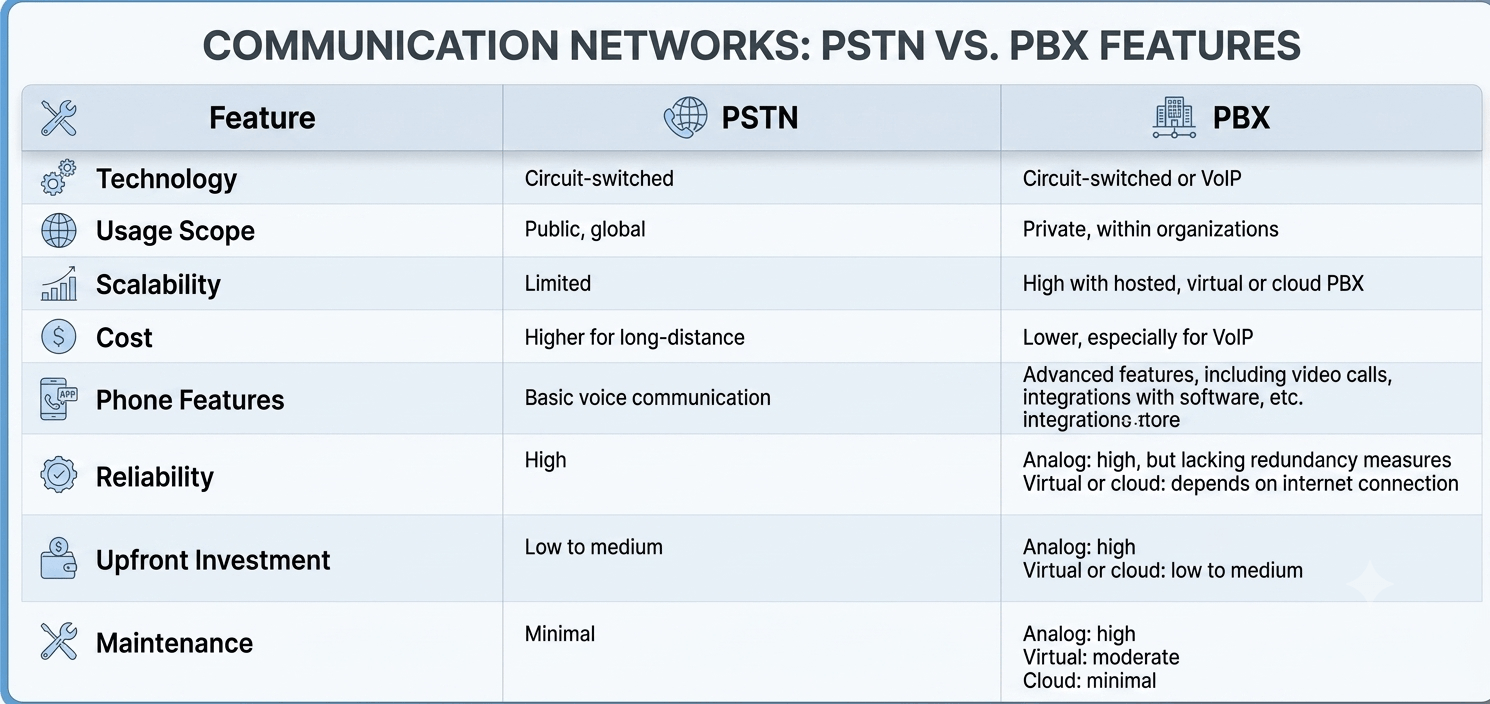
To understand the difference, one must look at where the switching happens. PSTN is the global network, while a Private Branch Exchange (PBX) is a private network used within a company. A PBX allows users to share a limited number of external pstn lines. For example, an office might have 50 employees but only 10 actual pstn phone lines. The PBX handles the internal routing between employees and connects them to the external pstn network when needed.
The main difference lies in ownership and control. The pstn provider owns the public switches, while the business owns the PBX hardware. Modern PBX systems have evolved into IP-PBX, which uses the internet instead of traditional phone lines, but the core concept of an internal switching system remains the same. The connection from the PBX to the outside world still often involves a pstn gateway.
Other PSTN Alternatives
As telecommunications technology advances, several alternatives have emerged that offer more features and lower costs than the public switched telephone network. These technologies are slowly replacing the legacy copper lines in many parts of the world, a process known as the PSTN switch-off.
PSTN v. ISDN
Integrated Services Digital Network (ISDN) was one of the first major upgrades to the traditional telephone system. It allowed for the simultaneous transmission of voice and data over the same copper wires. While it was a significant improvement over standard pstn calls, ISDN is also being phased out in favor of purely internet-based solutions. ISDN provided better digital quality but still relied on the physical infrastructure of the pstn network.
PSTN vs. VoIP
Voice over Internet Protocol (VoIP) is the most significant competitor to the public switched telephone network. VoIP sends voice data as digital packets over the internet. This eliminates the need for a dedicated circuit, allowing for much more efficient use of network resources. The debate of pstn vs voip often comes down to a trade-off between the extreme reliability of legacy systems and the advanced features and low cost of modern digital systems.
How Much Does PSTN Access Cost?
The cost of using a pstn phone line varies significantly depending on the region and the provider. Generally, users pay a monthly line rental fee regardless of how many calls they make. This fee covers the maintenance of the physical copper wire. In addition to the line rental, there are often per-minute charges for pstn calls, especially for long-distance or international destinations.
For businesses, what are the pstn setup charges connection fees? These can be substantial. Installing a new physical line involves labor costs and equipment fees. If a company needs a high-capacity connection, such as a T1 line, the installation costs can run into thousands of dollars.
According to a report by Frost & Sullivan, businesses can save up to 50% on their communication bills by moving away from traditional pstn provider contracts and adopting cloud-based solution.
Four Reasons Why VoIP Is Better Than PSTN
The transition from the public switched telephone system to VoIP is accelerating. Businesses of all sizes are finding that the benefits of digital communication far outweigh the familiarity of the old landline.
1. Enhanced Cost Efficiency
VoIP is significantly cheaper because it uses an existing internet connection rather than requiring a dedicated pstn line. Long-distance and international calls are often included in a flat monthly subscription, which is much cheaper than the per-minute rates of pstn networking. Additionally, there is no need for expensive physical hardware maintenance on the customer’s side.
2. Improved Customer Service
Modern VoIP systems offer features that a standard pstn telephone cannot match. These include interactive voice response (IVR) menus, automatic call distribution, and integration with CRM platforms. When a customer calls, the system can automatically pull up their records, allowing for a more personalized experience. This level of automation is difficult and expensive to achieve with a traditional pstn phone system.
3. Increased Productivity
With VoIP, a phone number is not tied to a physical pstn line. This means employees can take their business calls on their laptops, tablets, or smartphones from anywhere in the world. This mobility is essential for remote work and global teams. Features like voicemail-to-email and click-to-dial further streamline communication, saving time and increasing overall efficiency.
4. Greater Scalability
Scaling a digital system is nearly instantaneous. If a business expands, they can add hundreds of new lines without a single technician visiting the office. This “on-demand” nature of voip pstn services allows companies to grow at their own pace without being held back by physical infrastructure limitations. The ability to quickly scale up or down is a major advantage in fluctuating markets.
What Does the Future Hold for PSTN?
The future of the public switched telephone network pstn is a gradual sunset. Many countries have already announced dates for the complete decommissioning of their copper networks. In the UK, BT has planned to shut down the PSTN and ISDN by 2025, moving all customers to fiber-based IP networks. This trend is being mirrored across Europe, North America, and parts of Asia.
However, the legacy of what is pstn will live on in the standards and protocols that modern systems use. The PSTN will likely remain in use in niche applications and extremely remote areas for another decade or two. Eventually, the world will be fully connected via packet-switched fiber and satellite networks, making the dedicated copper circuit a piece of history. The transition to a post-pstn world promises more features, better integration, and lower costs for everyone.
As we move forward, the pstn meaning will shift from a primary communication tool to a historical foundation upon which the modern internet was built. The transition to VoIP is not just about changing the hardware; it is about embracing a more flexible and connected way of communicating. Whether you are a small business owner or a home user, understanding the shift from pstn to digital is crucial for staying connected in the modern world.
Read More: How to Secure Your VoIP Calls: The Ultimate 2026 Protection Guide
Final thought
While the PSTN has served as the backbone of global communication for over a century, its time is drawing to a close. The shift toward digital, internet-based communication is inevitable due to its superior flexibility and cost-effectiveness. Understanding the history and mechanics of the public switched telephone network allows us to appreciate how far we have come and prepare for a future where communication is more integrated and accessible than ever before.
Faqs
What is PSTN vs VoIP?
PSTN uses a physical, circuit-switched network of copper wires and switches to connect calls, while VoIP uses the internet to send voice data as digital packets. PSTN is known for its reliability and dedicated lines, whereas VoIP is more cost-effective and offers advanced digital features like video and integration with other software.
Is PSTN the same as landline?
Yes, in common terminology, a PSTN connection is often referred to as a traditional landline. It is the service that connects a home or office phone to the public network using physical wires, unlike cellular or satellite phones.
What is the PSTN in the UK?
In the UK, the PSTN refers to the legacy copper network managed primarily by Openreach (a BT Group business). The UK is currently in the process of phasing out this network, with a planned “switch-off” to move all users to digital, fiber-based services.
What is PSTN and how does it work?
The Public Switched Telephone Network is a global system of interconnected voice-oriented telephone networks. It works by establishing a dedicated physical circuit between two callers using a series of switches at local and regional exchanges.
Do PSTN phones still work with VoIP?
Traditional PSTN phones can work with VoIP systems if you use an Analog Telephone Adapter (ATA). This device converts the analog signal from the old phone into digital data that can be transmitted over the internet.
Is PSTN analog or digital?
The PSTN is a hybrid. The connection from a home to the local exchange (the local loop) is typically analog, but the core of the network that carries calls over long distances is almost entirely digital.
What kind of network is the PSTN?
The PSTN is a circuit-switched network. This means it reserves a dedicated communication path between two points for the entire duration of a call, ensuring constant bandwidth but utilizing resources less efficiently than packet-switched networks.
What is VoIP?
VoIP stands for Voice over Internet Protocol. it is a technology that allows you to make voice calls using a broadband internet connection instead of a regular (or analog) phone line.
Is VoIP worth it for small businesses?
Yes, VoIP is generally highly recommended for small businesses because it eliminates the need for expensive hardware, reduces monthly phone bills, and provides professional features like auto-attendants and mobile apps that were previously only available to large corporations.