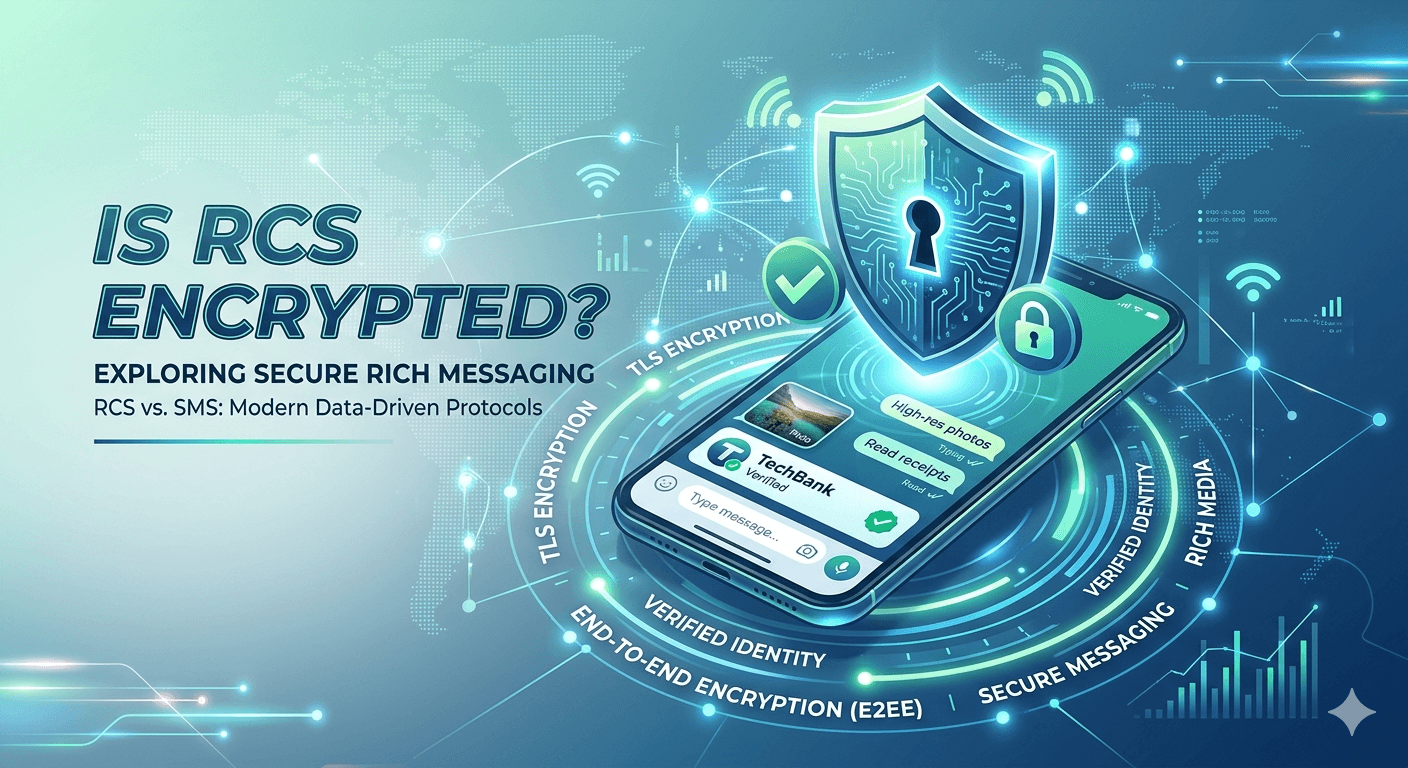
Is RCS encrypted? Rich Communication Services (RCS) is the modern successor to SMS, providing a secure and feature-rich messaging experience for both individuals and enterprises. Unlike traditional SMS, which lacks native encryption, RCS employs robust security protocols to protect data. For person-to-person conversations on Android devices, Google has integrated full end-to-end encryption, ensuring only the sender and receiver can read the content. For business-to-consumer communication, RCS utilizes Transport Layer Security to safeguard messages during transit. This dual-layered approach makes RCS a significantly safer alternative for sharing sensitive information, verified brand interactions, and high-quality media across mobile networks globally.
What is RCS Messaging?
Rich Communication Services, commonly known as RCS, is a communication protocol designed to replace the aging SMS and MMS standards. While SMS has been the backbone of mobile messaging for decades, it is limited by a 160-character cap and a total lack of security features. RCS brings the functionality of modern messaging apps like WhatsApp or iMessage directly to the native dialer or messaging app of a smartphone. It allows for high-resolution photo sharing, typing indicators, read receipts, and interactive buttons. Because it operates over data networks rather than traditional cellular signaling channels, it provides a much more flexible platform for innovation.
The shift toward RCS is driven by the global need for a unified messaging standard that works across different carriers and manufacturers. The GSMA developed the Universal Profile to ensure that RCS features are consistent regardless of the network or device being used. This standardization is crucial for businesses that want to reach a wide audience without worrying about whether the recipient has a specific app installed. By leveraging the native messaging app, RCS ensures high open rates while offering the rich features of an over-the-top application.
One of the most significant advantages of this technology is the ability to create branded experiences. Businesses are no longer restricted to plain text from a random short code. Instead, they can present a verified profile with a logo, brand colors, and interactive carousels. This transition not only improves user engagement but also addresses the core question: is rcs encrypted? The infrastructure behind RCS was built with modern security requirements in mind, providing a level of protection that SMS simply cannot match in today’s digital landscape.
How RCS compares to SMS and OTT apps
When comparing RCS to SMS, the security difference is night and day. SMS messages are sent over the air in plain text, meaning they can be intercepted by sophisticated hardware or through vulnerabilities in the signaling system. Furthermore, SMS does not support sender verification, which is why smishing attacks are so prevalent. RCS addresses these flaws by implementing encryption protocols and a strict verification process for businesses. While SMS is a legacy technology, RCS is a modern data-driven protocol that prioritizes the integrity and confidentiality of the message.
Comparing RCS to over-the-top (OTT) apps like WhatsApp or Signal reveals a different set of trade-offs. OTT apps have long championed end-to-end encryption as a standard feature. RCS has been catching up, with Google’s implementation of encryption for one-on-one and group chats. However, the primary difference lies in accessibility. OTT apps require a specific download and account creation, whereas RCS is built into the phone. This makes RCS a more powerful tool for businesses that need to reach customers who may not want to manage multiple messaging applications for every brand they interact with.
Another key differentiator is the control over data. OTT apps are often owned by private corporations that may have different data-sharing policies. RCS, being a carrier-supported standard, often falls under stricter telecommunications regulations. This provides an additional layer of oversight and accountability. For businesses looking for a balance between the reach of SMS and the rich features of WhatsApp, RCS provides the perfect middle ground, especially when considering whether is rcs messaging safe for handling customer queries and transactional notifications.
Encryption in RCS: Current state
The current state of RCS encryption is a dynamic landscape that has seen rapid improvements over the last few years. Initially, the GSMA standard for RCS did not mandate end-to-end encryption, focusing instead on the rich features and interoperability. However, as privacy became a top priority for users and regulators, major players like Google took it upon themselves to enhance the protocol. Today, if you are using Google Messages on an Android device to talk to another user on the same platform, your messages are automatically protected by end-to-end encryption, which answers the concern of are rcs messages encrypted for the majority of users.
For business-to-consumer (B2C) messaging, the encryption landscape is slightly different but equally robust in its own way. While personal chats use E2EE, business messages typically rely on Transport Layer Security (TLS). This ensures that while the message is traveling from the business server to the user’s device, it cannot be intercepted or read by unauthorized third parties. This distinction is important because businesses often need to process or store messages for compliance and customer service reasons, which would be impossible if the content was fully encrypted end-to-end between the business and the end-user.
According to research by Juniper Research, the number of RCS users is expected to reach nearly 1.2 billion by the end of 2024. This massive growth is pushing carriers and tech giants to standardize security even further.
The industry is currently moving toward a more unified approach where encryption becomes the default for all types of RCS traffic. As Apple joins the RCS ecosystem with the release of iOS 18, the conversation around encryption is expanding to include cross-platform security, ensuring that the “green bubble” and “blue bubble” divide no longer implies a compromise in safety.
Understanding the two layers of RCS encryption
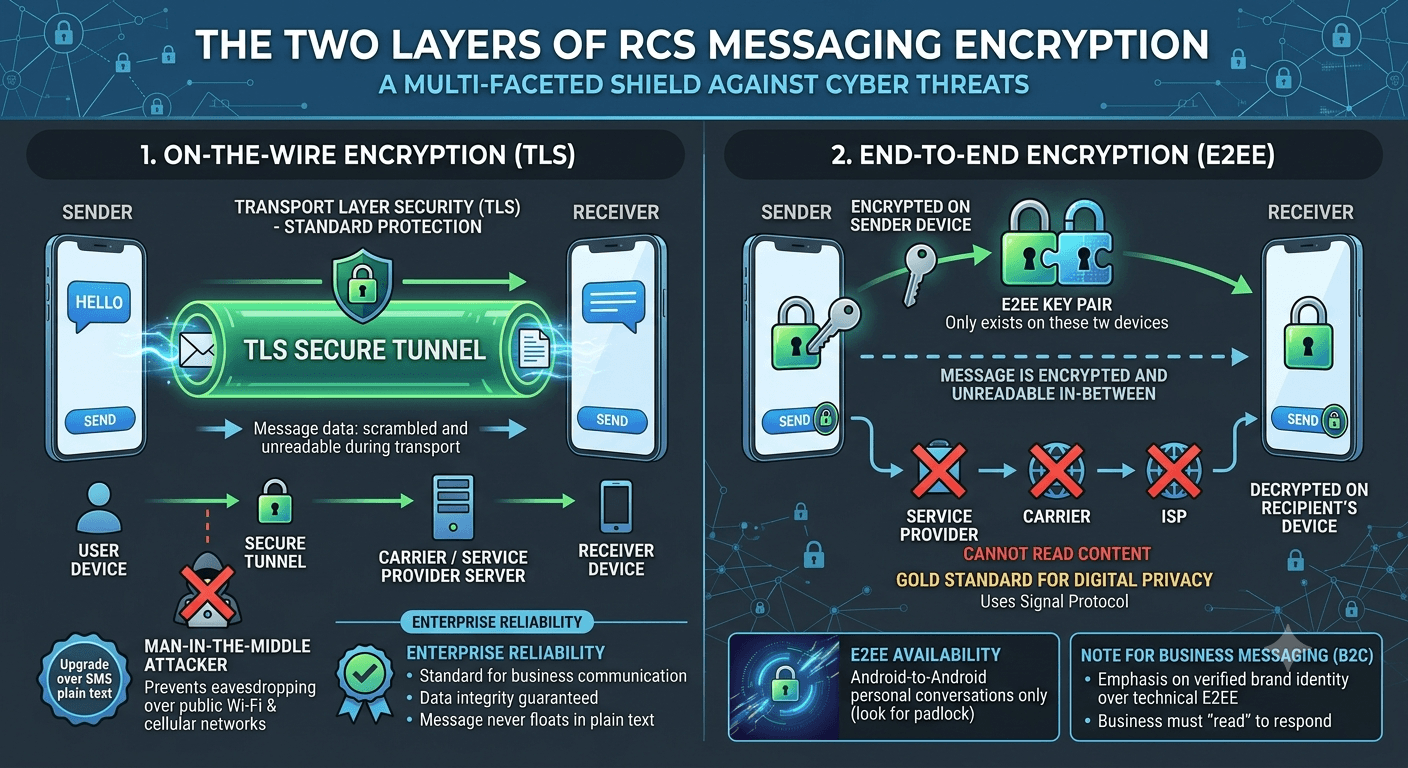
To fully grasp the security of this platform, it is necessary to look at the two primary methods of protection currently in use. Most users want to know is rcs secure, and the answer lies in how the data is handled at different points of its journey. By combining transport security with application-level protection, RCS creates a multi-faceted shield against cyber threats. These layers work together to ensure that whether you are sending a simple hello or a sensitive banking notification, the data remains confidential and unaltered.
1. On-the-wire encryption (TLS)
On-the-wire encryption, primarily using Transport Layer Security (TLS), is the standard for almost all RCS communications. This protocol creates a secure tunnel between the user’s device and the service provider’s server. When a business sends a message, TLS ensures that the packet of data is scrambled into an unreadable format as it moves through the internet and carrier networks. This prevents “man-in-the-middle” attacks where a hacker might try to eavesdrop on the data being sent over public Wi-Fi or cellular towers.
For enterprises, TLS is a critical component of rcs messaging security. It provides a guarantee that the data delivered to the carrier is the same data that reaches the customer. Because TLS is a well-established standard used in banking and web browsing, it offers a level of reliability that businesses can trust. Even if a message is not end-to-end encrypted, TLS ensures it is never floating around the web in plain text, which is a massive upgrade over the legacy SMS infrastructure.
2. End-to-end encryption (E2EE)
End-to-end encryption (E2EE) is the gold standard for digital privacy. It ensures that the message is encrypted on the sender’s device and can only be decrypted on the recipient’s device. No one in between—not the internet service provider, not the carrier, and not even the messaging platform provider—has the keys to read the content. Google implemented E2EE for RCS by using the Signal Protocol, which is widely recognized as one of the most secure encryption methods available today.
When users ask does rcs have end to end encryption, the answer is yes for personal Android-to-Android conversations. This feature is indicated by a small padlock icon on the send button. However, for business messaging, E2EE is less common because the business itself needs to be able to “read” the message to respond via an automated bot or a customer service agent. In the B2C context, the security emphasis is placed on the verified identity of the brand rather than the technical impossibility of the service provider seeing the content.
What does this mean for businesses
For a business, the security architecture of RCS means that they can finally offer a premium, secure communication channel that rivals specialized apps. Knowing is rcs messaging safe allows companies to move sensitive workflows, such as password resets, appointment reminders, and payment confirmations, onto a platform that customers already use. It reduces the risk of phishing because the sender’s identity is cryptographically verified by the carrier or a third-party aggregator.
Moreover, the combination of TLS and verified identities allows businesses to build a much deeper level of trust with their audience. When a customer receives a message with a brand’s logo and a checkmark, they are far more likely to engage than if they receive a suspicious-looking text from an unknown number. This high-trust environment is a direct result of the integrated rcs security features that protect both the brand’s reputation and the consumer’s personal data.
How GSMA standards shape secure messaging
The GSMA acts as the governing body for the mobile industry, and its Universal Profile is what makes RCS a global reality. The standards set by GSMA include specific requirements for how data should be handled, how networks should interact, and how security should be implemented. By creating a unified set of rules, the GSMA ensures that a message sent from a user in London reaches a user in New York with the same level of integrity.
These standards are constantly evolving to address new security threats. The GSMA’s role is to facilitate collaboration between carriers like Vodafone and AT&T, and tech giants like Google and Apple. By following these standards, enterprise RCS platforms can guarantee that they are utilizing the most up-to-date security protocols. This collaborative approach is what separates RCS from proprietary apps, creating an ecosystem that is both open and secure for all participants.
Privacy and data protection in RCS messaging
Privacy is a top concern for modern consumers, and RCS is designed with “privacy by design” principles. Unlike SMS, which can be stored on carrier servers for long periods in an unencrypted state, RCS providers often have much shorter retention periods and more stringent access controls. Because is rcs safe is a primary question for many, the protocol ensures that metadata—the data about the message—is also handled with care.
In many jurisdictions, the handling of RCS data is subject to strict telecommunications privacy laws. This means that carriers are legally obligated to protect the confidentiality of the communications they facilitate. For businesses, this adds a layer of legal protection, as they are working within a regulated framework that prioritizes the rights of the individual. Using RCS helps businesses align with the growing global trend toward data sovereignty and user privacy.
How RCS handles user data vs. other messaging platforms
Different messaging platforms have different business models, which often impacts how they handle user data. Many OTT apps make money by analyzing user behavior or selling data to advertisers. RCS, being tied to the telecommunications industry, typically operates on a more traditional service-based model. This often results in a cleaner data privacy profile for the user. When we look at rcs encryption, we see a focus on protecting the message content rather than harvesting it for secondary purposes.
Furthermore, RCS gives users more control over their data. Features like read receipts and typing indicators can usually be toggled off in the settings, allowing for a more private experience. Because RCS is the native messaging solution, it doesn’t require the user to upload their entire contact list to a third-party server in the same way some social media apps do. The data remains within the trusted environment of the mobile OS and the carrier network.
Building trust with verified sender identities and branded messages
One of the most powerful security features of RCS for businesses is the Verified Sender program. Before a business can send RCS messages, they must undergo a rigorous verification process. This involves proving their identity and their right to represent the brand. Once verified, their messages appear with a verified checkmark, a custom logo, and the brand’s name. This is a massive deterrent for hackers who often use SMS spoofing to trick users into clicking malicious links.
This branding does more than just look good; it acts as a visual seal of authenticity. When a user sees a verified brand, they know that the message is rcs secure and that it actually comes from the company it claims to be from. This reduces the cognitive load on the user, who no longer has to scrutinize every digit of a short code to determine if a message is legitimate. For businesses, this translates to higher conversion rates and a significant reduction in fraud-related costs.
How enterprise RCS platforms support privacy and compliance
Enterprise-grade RCS platforms, provide the infrastructure needed to manage high-volume messaging while maintaining strict privacy standards. These platforms act as a bridge between the business’s internal systems and the global RCS network. They provide advanced tools for managing opt-ins, ensuring that businesses only contact customers who have given explicit permission, which is a cornerstone of privacy regulation.
These platforms also offer sophisticated encryption at rest, meaning that any data stored on their servers is protected by high-level cryptographic keys. By using an enterprise platform, companies can ensure that their rcs messaging security meets the highest industry standards. This includes detailed logging for audit trails, secure API endpoints for data transfer, and automated tools to strip sensitive information from logs, ensuring that privacy is maintained at every step of the communication lifecycle.
Compliance and enterprise readiness with RCS messaging
For large organizations, security is only one part of the puzzle; compliance is the other. Businesses in sectors like finance, healthcare, and insurance must follow strict rules regarding how they communicate with clients. RCS is uniquely positioned for enterprise readiness because it was built to integrate with existing regulatory frameworks. When businesses ask is rcs messaging safe, they are often also asking if it will help them stay on the right side of the law.
Why compliance matters in modern messaging
In an era of massive data breaches and multi-million dollar fines, compliance is no longer optional. Regulations like GDPR in Europe, CCPA in California, and various financial regulations globally demand that businesses protect customer data. Failure to do so can lead to devastating reputational damage and legal consequences. RCS provides the tools necessary to meet these challenges by offering secure transit, verified identities, and clear opt-out mechanisms.
Using a compliant messaging channel also builds long-term loyalty. Customers are increasingly aware of their digital rights and prefer to interact with brands that respect their privacy. By choosing a platform that prioritizes rcs messaging security and regulatory compliance, a business demonstrates that it values its customers’ safety. This proactive approach to compliance can be a significant competitive advantage in a crowded marketplace.
Key regulatory frameworks supported by RCS
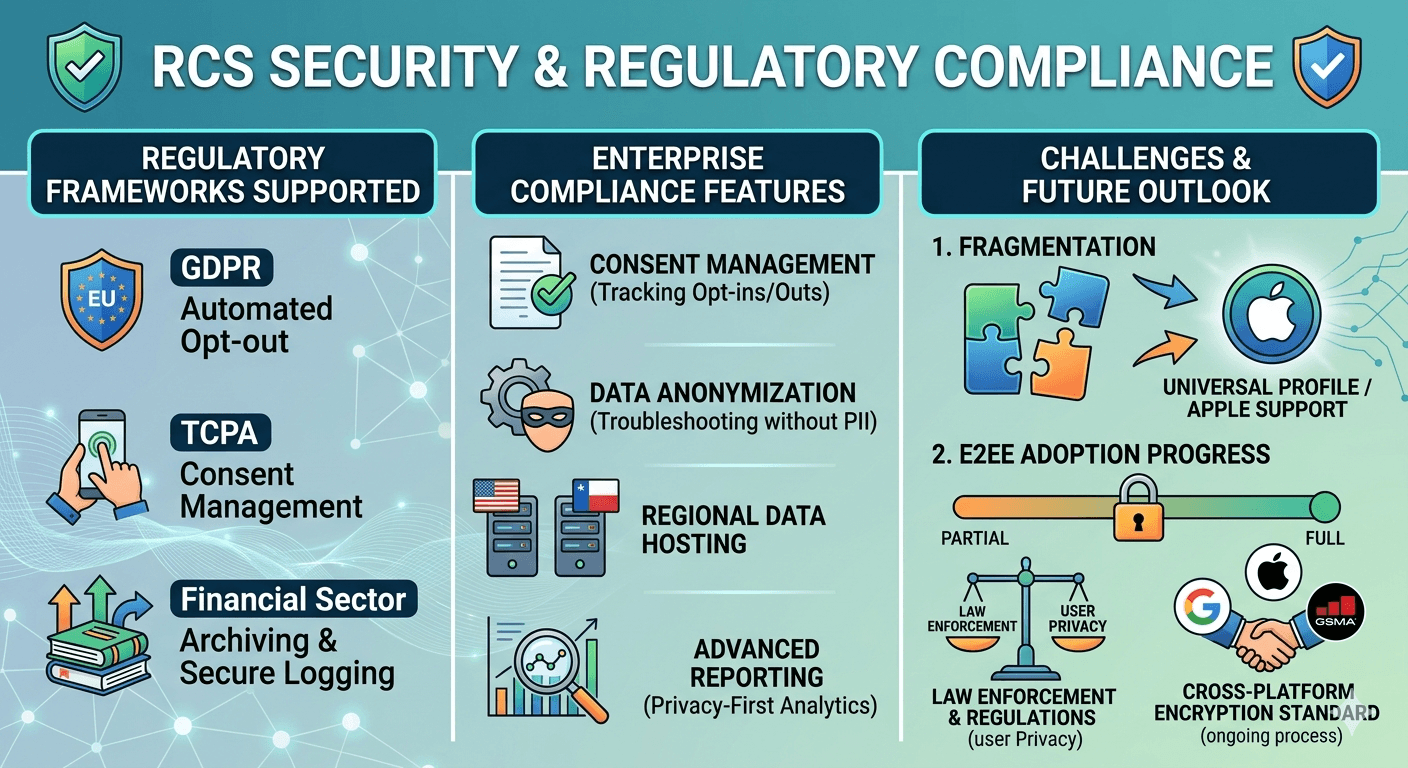
RCS is designed to be compatible with major global privacy and security frameworks. For example, under GDPR, businesses must have a lawful basis for processing personal data and must provide users with the right to be forgotten. RCS supports this by offering automated opt-out keywords and clear sender identification. In the United States, the TCPA (Telephone Consumer Protection Act) regulates how businesses can contact consumers via mobile; RCS platforms provide the tracking and consent management tools needed to adhere to these rules.
In the financial sector, regulations often require that all communications be archived and searchable for a certain period. Enterprise RCS solutions allow for the secure logging of messages in a way that satisfies these requirements without compromising the user’s privacy. By providing a clear audit trail, RCS ensures that businesses can prove their compliance to auditors and regulators whenever necessary.
Enterprise features that support compliance
Standard RCS features are augmented by enterprise-specific tools to ensure total compliance. These include:
-
Consent Management: Systems that automatically track when a user opts in or out of receiving messages, ensuring no one is contacted illegally.
-
Data Anonymization: The ability to mask personal information in logs so that support staff can troubleshoot issues without seeing sensitive customer data.
-
Regional Data Hosting: Many enterprise platforms allow businesses to choose where their data is stored, helping them comply with data residency laws.
-
Advanced Reporting: Detailed analytics that provide insight into delivery rates and user engagement while adhering to privacy-first reporting standards.
Top capabilities of RCS for businesses
The capabilities of RCS go far beyond simple security. It is a full-featured marketing and customer service tool. Businesses can use rich cards to show product images, suggest replies to guide the conversation, and even integrate payment gateways for seamless in-app purchases. This rich functionality, combined with the assurance that rcs secure protocols are in place, makes it a superior choice for any company looking to modernize its mobile strategy.
Another key capability is the use of carousels. A retail brand can send a carousel of the latest products, allowing the user to swipe through options and click a button to “Buy Now” or “Learn More.” Because these interactions happen within a verified and secure environment, the friction of moving from a text message to a browser or a separate app is removed. This leads to a much more cohesive and satisfying customer journey.
Use cases of RCS for businesses
There are countless ways businesses can leverage the security and richness of RCS. In the travel industry, an airline can send a boarding pass as a rich card with a QR code that is updated in real-time if the gate changes. Because is rich communications safe, the passenger can trust that their flight details are secure. In the banking sector, RCS can be used for fraud alerts where the user can click a “Yes” or “No” button to confirm a transaction, significantly speeding up the resolution process compared to a phone call.
Retailers can use RCS for personalized promotions and loyalty program updates. By using verified sender identities, they can ensure their coupons are not mistaken for spam. Healthcare providers can send appointment reminders with an “Add to Calendar” button and a secure link for pre-appointment check-ins. These use cases demonstrate how RCS takes the reliability of SMS and adds the security and functionality of a high-end application.
Challenges and future outlook for RCS security
While RCS is a massive step forward, it is not without its challenges. The journey toward a fully secure, global messaging standard involves navigating complex technical and political landscapes. However, the momentum behind the protocol suggests that these hurdles are being overcome. Understanding the current challenges is key to understanding the future of rcs security and how it will continue to evolve to meet new threats.
1. Fragmentation across devices, carriers, and networks
One of the primary challenges for RCS has been fragmentation. In the early days, different carriers implemented different versions of RCS, leading to interoperability issues. If a user on Carrier A sent an RCS message to a user on Carrier B, it might fall back to SMS if the two networks didn’t “speak” the same version of the protocol. This fragmentation also affected encryption, as security features were not always consistent across all implementations.
Fortunately, the industry has rallied around the GSMA Universal Profile, which has largely solved these interoperability issues. Today, the vast majority of carriers and device manufacturers are on the same page. The recent announcement that Apple will support RCS means that the final major piece of the puzzle is falling into place. This will lead to a more unified and secure messaging experience for everyone, regardless of which phone they choose to carry.
2. End-to-end encryption adoption progress
While Google has successfully implemented E2EE for a large portion of RCS users, it is not yet a universal feature for all RCS traffic. The next frontier is ensuring that E2EE works across different platforms and for all types of conversations. This requires cooperation between Google, Apple, and the GSMA to define a cross-platform encryption standard. The goal is to reach a state where is rcs encrypted is a resounding “yes” for every single interaction, whether it’s P2P or B2C.
There is also the challenge of balancing encryption with the needs of law enforcement and regulatory bodies. Different countries have different views on E2EE, and navigating these legal requirements while protecting user privacy is an ongoing process. However, the trend in the tech industry is clearly moving toward more robust, default encryption as the standard for all digital communication.
Read More: Visuwell Telehealth: How to Use Visuwell Platform?
Conclusion
The question of is rcs encrypted is central to the future of mobile communication. As we have explored, RCS provides a sophisticated, multi-layered security approach that far exceeds the capabilities of traditional SMS. With TLS protecting data in transit and E2EE securing personal conversations, RCS offers a safe and trusted environment for both consumers and businesses. The addition of verified sender identities further strengthens this trust, creating a messaging ecosystem where transparency and safety are the defaults.
For businesses, RCS represents an unparalleled opportunity to engage with customers through a rich, interactive, and secure channel. By choosing the right partner and following best practices for privacy and compliance, companies can build deeper relationships and drive better results. As the technology continues to mature and adoption becomes universal, RCS is set to become the global standard for how we connect, share, and conduct business on our mobile devices.
FAQs
-
Is RCS encrypted? Does RCS have end-to-end encryption?
RCS utilizes different types of encryption depending on the context. For personal chats between Android users using Google Messages, end-to-end encryption (E2EE) is standard, meaning only the sender and receiver can read the messages. For business-to-consumer messages, Transport Layer Security (TLS) is used to encrypt the data while it is in transit between servers and devices. This ensures that while the message is moving through the network, it cannot be intercepted by third parties, providing a high level of security for all types of interactions.
-
What do we know about end-to-end encryption of RCS between Android and iPhones, if anything?
Currently, the most common form of E2EE for RCS is through Google’s proprietary implementation in the Google Messages app. As Apple integrates RCS support into iOS, the industry is working toward a standardized cross-platform encryption method. While initial RCS support on iPhone may rely on standard TLS encryption, both Google and Apple have expressed interest in working with the GSMA to bring a unified end-to-end encryption standard to the RCS Universal Profile, which would secure messages between different operating systems.
-
Tell us about “encrypted in transit.” Can you explain encryption when it comes to a business’ RCS messages?
Encrypted in transit means that the data is protected while it is traveling from one point to another. For a business, when they send an RCS message, it is encrypted using TLS before it leaves their server or the messaging platform’s server. It remains encrypted as it travels through the internet and the carrier’s network until it reaches the user’s phone. This prevents hackers from “sniffing” the data on the network, ensuring that sensitive information like one-time passwords or personal notifications remains private during delivery.
-
How does a user opt in to receive RCS messages from a business? How do they opt out?
Users typically opt in to receive RCS messages by providing their phone number and explicit consent through a website, app, or physical form. In many cases, a user might also initiate the conversation themselves, which acts as a form of consent. To opt out, RCS provides a standardized and easy process. Users can usually reply with keywords like “STOP” or use the built-in “Block & Report Spam” features in their messaging app. This gives the user complete control over who can message them, enhancing the overall safety and quality of the channel.
-
How does RCS help with spam?
RCS helps combat spam through its strict Verified Sender program. Unlike SMS, where anyone can send a message from a random number, RCS businesses must be vetted by carriers or aggregators before they can send messages. This makes it much harder for scammers to operate. Furthermore, RCS apps have advanced spam detection algorithms that can identify and filter out suspicious messages. Because businesses are tied to a verified profile, they are less likely to engage in spammy behavior as it would lead to their verified status being revoked.
-
What is the process for a business getting verified to send RCS? Who is involved in the decision-making process?
The verification process involves several steps and multiple parties. A business typically works with an RCS provider like, which collects the brand’s details, including their legal name, logo, and website. This information is then submitted to the carriers or a central verification authority. They verify that the business is legitimate and has the right to use the brand assets. Once the background check is complete, the business is granted a verified profile, allowing them to send branded messages with the official checkmark.
-
Who assigns the “verified” status and is it trustworthy?
The verified status is typically assigned by the mobile network carriers or authorized third-party aggregators that manage the RCS ecosystem. It is highly trustworthy because it is based on a rigorous vetting process that includes legal and operational checks. This system is much more secure than the open nature of SMS, as it creates a “closed” list of authorized senders. This verification acts as a digital certificate of authenticity, giving consumers the confidence that the message they are seeing is genuine.
-
Is RCS GDPR compliant?
Yes, RCS can be fully GDPR compliant when implemented correctly. The protocol supports essential privacy features like clear sender identification, secure data transmission, and easy opt-out mechanisms. Enterprise platforms that facilitate RCS also provide the necessary data handling tools, such as data encryption at rest and logging controls, to help businesses meet their GDPR obligations. Because RCS is a regulated telecommunications service, it often adheres to even stricter privacy standards than many unregulated internet-based messaging apps.