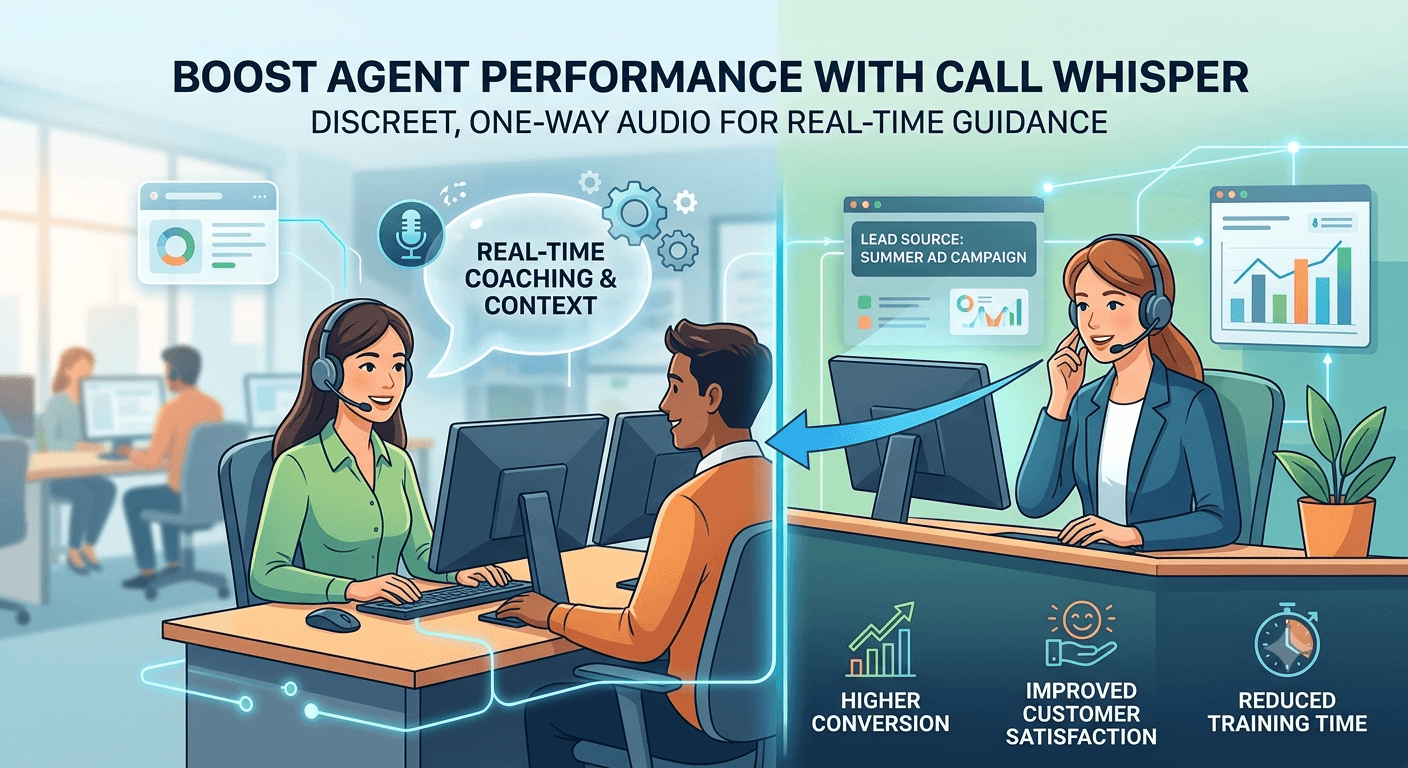
Call whisper is a sophisticated telecommunications feature that allows a supervisor or automated system to provide real-time information to a call center agent without the customer hearing the audio. This technology serves as a bridge during live interactions, offering context or coaching that enables agents to handle complex inquiries with greater precision. By using a call whisper service, businesses can ensure that their staff is always prepared, leading to higher conversion rates and improved customer satisfaction. This tool is essential for modern sales teams and support centers looking to maintain high standards of communication and professional service delivery.
What is Call Whisper?
To understand the core functionality of this technology, we must first look at the call whisper meaning within the context of modern cloud communications. At its heart, it is a feature of Voice over Internet Protocol systems that enables a one-way audio stream. While a three-way call involves all parties hearing each other, this specific tool ensures that only the agent receives the additional audio. This allows for discreet guidance, which is why many organizations refer to it as a silent coach. It functions as a specialized layer of communication that operates behind the scenes of a standard telephone interaction.
The technical infrastructure behind a call whisper service involves complex routing protocols that separate audio channels. When a call is initiated, the system identifies the source and the intended recipient. If a supervisor decides to intervene, the software intercepts the audio from the supervisor and injects it into the agent’s headset. This happens instantaneously, ensuring there is no lag that might disrupt the flow of the conversation. For the customer, the experience remains seamless, as they continue to hear only the agent’s voice. This level of sophistication is what makes modern call tracking and whisper system setups so valuable for high-stakes business environments.
In many scenarios, this feature is automated rather than manual. For instance, an agent might hear a brief recorded message before the call connects, informing them of which marketing campaign the caller is responding to. This provides immediate context, allowing the agent to tailor their greeting and sales pitch accordingly. This proactive approach eliminates the guesswork often associated with inbound lead management. By providing the agent with the right information at the exact moment they need it, the business minimizes errors and maximizes the potential for a successful outcome.
Call Whispering Use Cases
The versatility of a whisper call center setup allows it to be applied across numerous industries and business functions. One of the most common use cases is in high-volume sales environments where lead source identification is critical. When a sales representative answers a call, they might hear a brief notification indicating that the caller is interested in a specific product line. This allows the representative to skip the discovery phase and move directly into a relevant sales dialogue. This efficiency is particularly useful for agencies managing multiple clients or diverse product catalogs where context switching is frequent.
Another significant application is found in the training of new employees within a call center. Traditionally, training required a supervisor to sit next to an agent and provide feedback after the call. With call whispering, the supervisor can provide live corrections and encouragement while the call is in progress. If a new trainee forgets a specific compliance disclaimer or struggles with a rebuttal, the supervisor can provide the necessary words immediately. This real-time intervention accelerates the learning curve and ensures that the quality of service does not suffer while an employee is still gaining experience.
In the realm of customer support, especially for technical or complex troubleshooting, this tool proves invaluable. A senior technician can listen in on a call handled by a junior staff member and offer specific technical advice or diagnostic steps. This prevents the need for putting the customer on hold or transferring them to a different department, which are major pain points in the customer experience journey. By keeping the communication direct and informed, the company builds trust and demonstrates a high level of competency, even when the primary agent might be encountering a new challenge.
What is a Call Whisper Message?
A whisper message is a short, pre-recorded audio snippet that plays only for the agent right before the live conversation begins. This message is usually triggered by the specific phone number the customer dialed or the marketing channel they used. For example, if a customer clicks an ad for “Summer Discounts,” the agent might hear a voice say, “Summer Discount Campaign.” This brief second of audio provides the representative with the mental frame needed to provide a personalized experience. It acts as an internal caller ID that goes beyond just a name and number, offering intent and context.
These messages are highly customizable and can be configured to provide various data points. Some advanced systems integrate with Customer Relationship Management software to provide the agent with the caller’s name or their most recent purchase history. This means before the agent even says “hello,” they are already aware of who is calling and why. This level of preparation is a hallmark of a professional whisper call center, where every second of the interaction is optimized for efficiency. The message acts as a trigger for the agent to pull up the correct script or database entries, reducing the dead air at the start of a call.
The psychological impact of these messages on agents should not be underestimated. Knowing exactly what a caller wants before they speak reduces the anxiety associated with inbound calls. It allows the agent to feel more in control of the conversation, which translates to a more confident and persuasive tone. Instead of reacting to a customer’s inquiry, the agent can proactively guide the conversation. This shift from a reactive to a proactive stance is one of the primary reasons businesses invest in a dedicated call tracking and whisper system.
Benefits of a Call Whisper Service
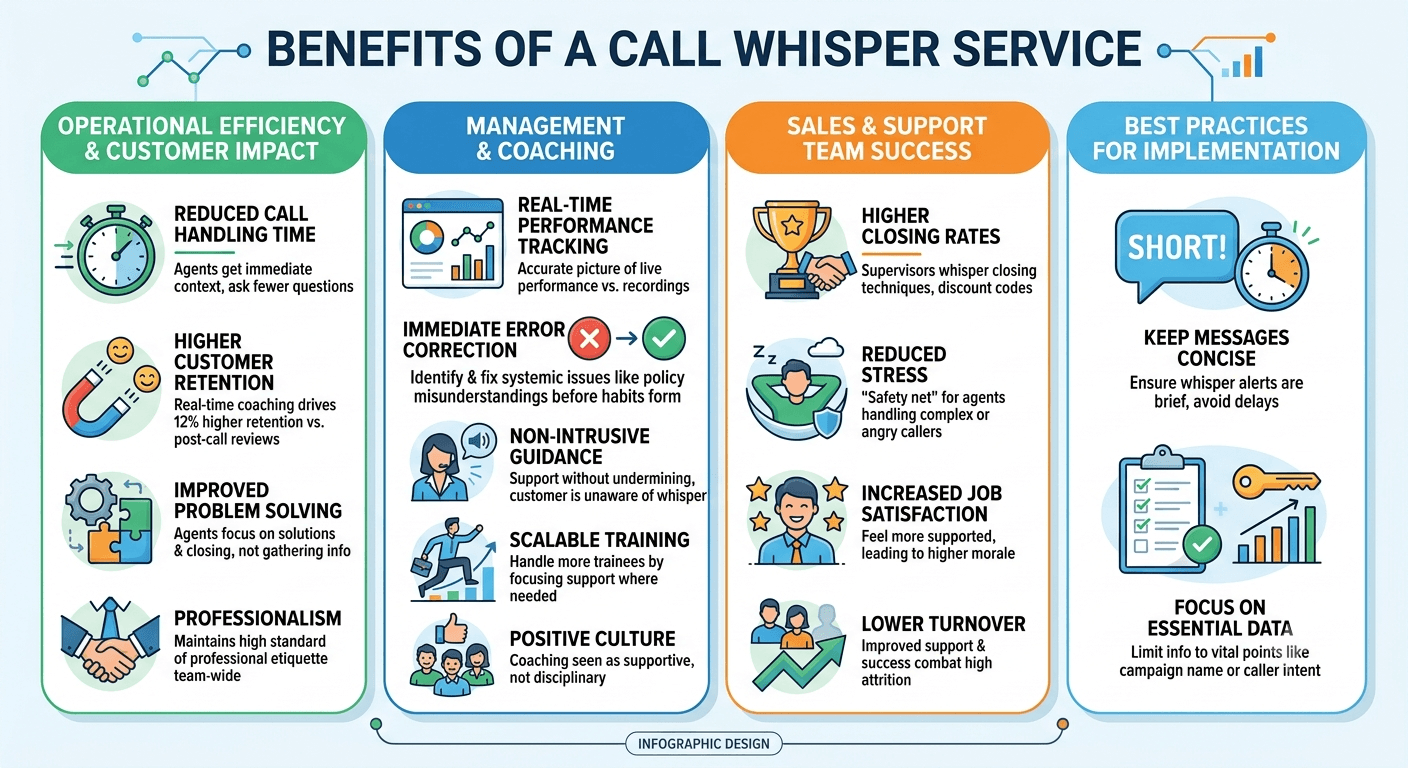
Implementing a call whisper service offers a range of advantages that impact both the operational efficiency and the overall profitability of a business. One of the most immediate benefits is the drastic reduction in call handling time. When agents have the necessary context immediately, they spend less time asking clarifying questions and more time solving the customer’s problem or closing a sale.
According to a study by the Aberdeen Group, companies that utilize real-time coaching tools like call whispering see a 12% higher customer retention rate compared to those that rely solely on post-call reviews. This demonstrates the tangible link between real-time support and long-term customer loyalty.
Furthermore, this technology promotes a culture of continuous improvement without being intrusive. Because the customer is unaware of the supervisor’s presence, the agent can receive guidance without feeling embarrassed or undermined in front of the client. This builds a stronger relationship between management and staff, as the coaching is seen as a supportive measure rather than a disciplinary one. The ability to provide subtle hints or reminders helps maintain a high standard of professional etiquette across the entire team, regardless of individual experience levels.
Following are the benefits of a call whisper service organised into key categories:
1. Operational Efficiency & Customer Impact
-
Reduced Call Handling Time: Agents get immediate context, reducing the need for clarifying questions.
-
Higher Customer Retention: Real-time coaching contributes to a 12% higher retention rate compared to post-call reviews.
-
Improved Problem Solving: Agents can focus more on solving issues or closing sales rather than gathering basic information.
-
Professionalism: Helps maintain a high standard of professional etiquette across the entire team.
2. Management & Coaching
-
Real-Time Performance Tracking: Provides a more accurate picture of agent performance than listening to recordings after the fact.
-
Immediate Error Correction: Allows managers to identify and fix systemic issues (like policy misunderstandings) before they become habits.
-
Non-Intrusive Guidance: Agents receive support without feeling embarrassed or undermined, as the customer is unaware of the supervisor’s presence.
-
Scalable Training: Managers can handle more trainees simultaneously by jumping between live calls to provide support where it is most needed.
-
Positive Culture: Shifts the perception of coaching from a disciplinary measure to a supportive one.
3. Sales & Support Team Success
-
Higher Closing Rates: Supervisors can whisper closing techniques or discount codes to help win difficult negotiations.
-
Reduced Stress: Provides a “safety net” for agents handling complex or angry callers.
-
Increased Job Satisfaction: Employees feel more supported, leading to higher morale.
-
Lower Turnover: Improved support and success rates help combat high attrition common in the call center industry.
4. Best Practices for Implementation
-
Keep Messages Concise: Ensure whisper alerts are short to avoid delaying the call or frustrating the customer.
-
Focus on Essential Data: Limit information to vital points like the campaign name or the caller’s primary intent.
How Does Call whisper Work? The 5-step process
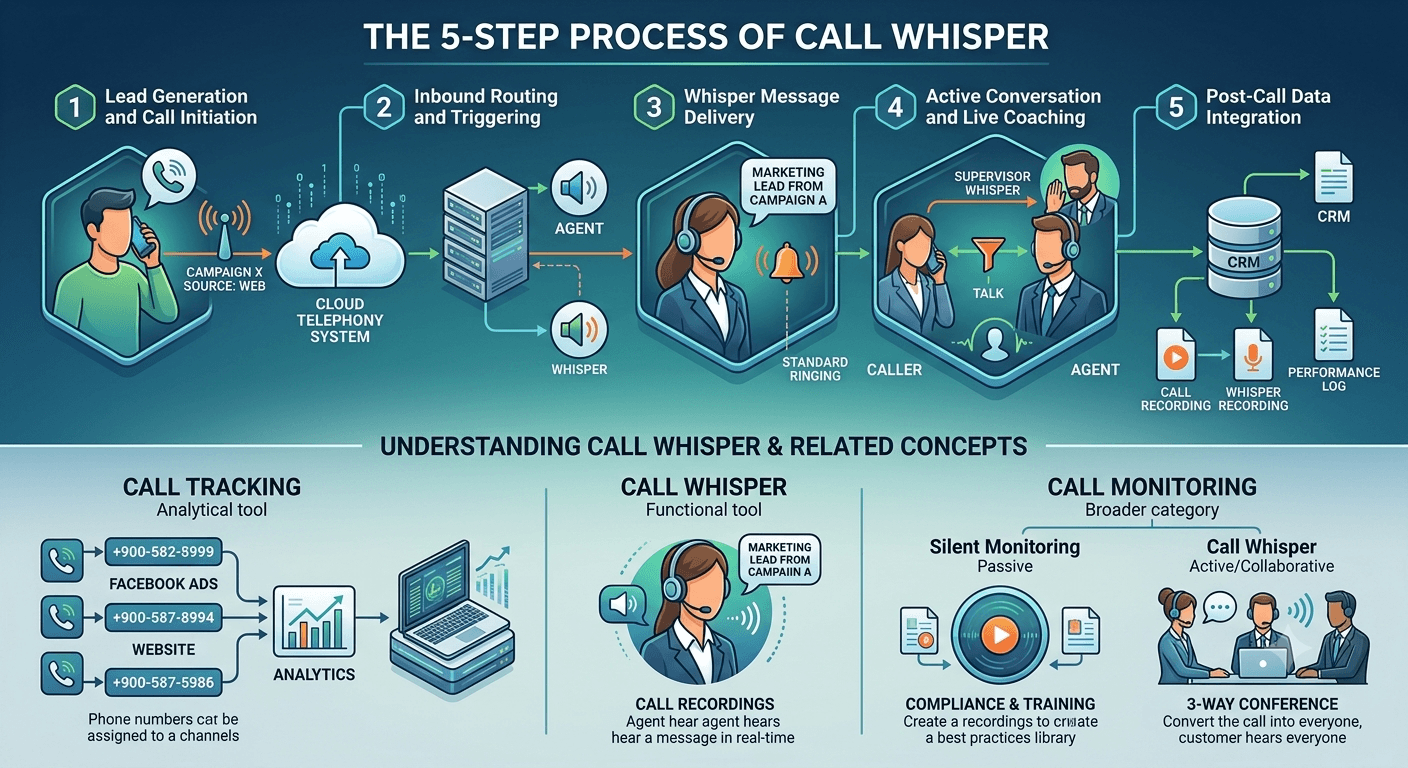
The technical operation of a call whisper system is a streamlined process that integrates seamlessly into existing telephony workflows. Understanding this process is key to maximizing its utility within your organization.
-
Lead Generation and Call Initiation: The process begins when a customer dials a specific tracking phone number associated with a marketing campaign or service department. The system recognizes the incoming call and identifies the metadata associated with that specific number.
-
Inbound Routing and Triggering: As the call is routed through the cloud-based server, the call tracking and whisper system identifies which agent or queue should receive the call. Before the audio paths are fully connected between the caller and the agent, the system prepares the “whisper” component.
-
Whisper Message Delivery: Once the agent picks up the phone, they hear the pre-configured whisper message or the supervisor’s voice. During this brief window, the caller usually hears a standard ringing tone or a brief hold music, completely unaware that the agent is receiving a briefing.
-
Active Conversation and Live Coaching: After the whisper message, the live audio path between the caller and the agent is opened. If a supervisor is monitoring the call, they can continue to provide one-way audio guidance throughout the conversation. The agent can hear the supervisor, but the supervisor’s voice is filtered out of the audio stream sent to the caller.
-
Post-Call Data Integration: Once the call concludes, the system logs the interaction. Advanced platforms will record both the main conversation and the whisper audio for later review. This data is then synced with the company’s CRM, providing a complete record of the lead source, the agent’s performance, and the guidance provided during the call.
Call whisper vs. call tracking vs. call monitoring
While these terms are often used interchangeably in casual conversation, they represent distinct features within a comprehensive communication suite. Understanding the differences is crucial for any business looking to optimize its call center operations. Each feature serves a specific purpose, and while they work best in tandem, they provide different types of value to the organization.
Call whisper vs. call tracking
The primary difference between these two lies in their objective and timing. Call tracking is an analytical tool used to identify how a caller found your business. It involves assigning unique phone numbers to different marketing channels, such as print ads, social media, or website landing pages. The goal is to gather data on which campaigns are driving the most calls. In contrast, call whispering is a functional tool used during the call to improve the interaction itself. While tracking tells you where the caller came from, whispering tells the agent that information so they can react appropriately.
Call whisper vs. call monitoring
Call monitoring is a broader category that encompasses several different modes of listening. Traditional call monitoring usually refers to a supervisor listening to a call in silence without any interaction. They are simply observers gathering data for performance reviews. Call whispering takes this a step further by allowing the supervisor to speak to the agent. While monitoring is passive, whispering is active and collaborative. Monitoring helps in identifying problems, but whispering is the tool used to fix those problems in the moment, preventing a poor customer experience before it happens.
Call recordings
Recording calls is a standard practice for compliance and training. When you combine recordings with a call whisper service, you create a powerful library of “best practices.” Managers can save recordings where a whisper intervention successfully turned a difficult situation around. These recordings can then be played back during team meetings to show other agents how to handle similar scenarios. It provides a concrete example of how real-time guidance can be implemented effectively, making the training process much more practical and less theoretical.
Call barging
Call barging is the next level of intervention beyond whispering. If a call is going poorly and the supervisor’s whispered advice isn’t enough to steer it back on track, they can “barge” into the call. This turns the interaction into a three-way conference where the customer can now hear the supervisor as well. This is usually reserved for extreme situations where a supervisor needs to take over the conversation to resolve a major complaint or a complex legal issue. Having the ability to transition from a whisper to a barge gives the management team total control over the customer experience.
Comparison Table: Call Center Features at a Glance
| Feature | Primary Objective | Timing | Who Can Hear the Supervisor? | Primary User |
| Call Tracking | Marketing Attribution | Pre-call / Start of call | No one (Data only) | Marketing / Sales |
| Call Monitoring | Performance Evaluation | During the call | No one (Silent) | QA / Supervisors |
| Call Whisper | Real-time Coaching | During the call | Agent only | Supervisors |
| Call Barging | Conflict Resolution | During the call | Agent and Customer | Management |
| Call Recording | Compliance & Training | Post-call (Review) | N/A (Playback) | Training Teams |
How They Work Together
In a modern communication suite, these tools create a seamless workflow:
-
Call Tracking identifies the caller’s intent before the agent picks up.
-
The Whisper feature tells the agent that intent (e.g., “This caller is from the Summer Sale ad”).
-
A supervisor uses Monitoring to ensure the call is going well.
-
If the agent falters, the supervisor uses Whisper to guide them.
-
If the call fails, the supervisor uses Barge to save the customer relationship.
-
The entire interaction is saved via Recording to train future agents on how to handle similar situations.
Does your business need call whisper?
Determining whether your organization requires these tools depends on several factors, including the complexity of your sales cycle and the experience level of your staff. Data from Gartner suggests that by 2025, 80% of customer service organizations will be leveraging some form of real-time AI or supervisor intervention tools to improve agent proficiency and reduce churn. If your business handles a high volume of leads from multiple sources, a call tracking and whisper system is almost a necessity. It ensures that no lead is mishandled due to a lack of context, which directly protects your marketing investment.
Businesses that deal with highly regulated industries, such as finance or healthcare, also stand to benefit significantly. In these fields, a single mistake in wording or a missed disclosure can lead to significant legal repercussions. Having a supervisor available to whisper reminders about compliance during a live call acts as a vital insurance policy. It reduces the risk of human error and ensures that every interaction remains within the bounds of the law. For these companies, the cost of the software is far outweighed by the risk mitigation it provides.
Finally, if you are a growing company looking to scale your team quickly, call whispering is an essential training tool. It allows you to get new hires onto the phones faster, as they have a “voice in their ear” to guide them through their initial calls. This reduces the time-to-competency for new agents and allows your more experienced staff to manage larger teams effectively. Ultimately, if your goals involve improving customer satisfaction, increasing sales efficiency, and fostering a supportive work environment, then implementing a whisper call center strategy is a logical and highly effective step.
Read More: How to Dial a Phone Number with Letters Effortlessly?
Final Thought
Integrating a call whisper service into your business communication strategy is more than just a technical upgrade; it is a commitment to excellence in customer engagement. By providing agents with the real-time support they need, you empower them to deliver superior service that distinguishes your brand from the competition. Whether it is through automated messages that provide marketing context or live coaching from a seasoned supervisor, this technology ensures that every call is handled with the highest level of professionalism. As the business landscape becomes increasingly competitive, tools that facilitate better communication and faster problem-solving will remain at the forefront of successful organizational growth.
FAQs
-
What is a call whisper?
Call whisper is a telecommunications feature that allows a third party, such as a supervisor or an automated system, to speak to an agent during a live call without the customer hearing. This is primarily used for providing real-time coaching or giving the agent context about the caller’s needs before the conversation begins.
-
What is a whisper message?
A whisper message is a brief, pre-recorded audio notification played for the agent just before a call is connected. It typically identifies the source of the call, such as a specific marketing campaign or a product line, allowing the agent to prepare their response and personalize the greeting for the customer.
-
How to whisper on text?
Whispering on text usually refers to “internal notes” or “private comments” within a shared inbox or CRM system. While the customer sees the main chat thread, agents and supervisors can send messages to each other in a separate, hidden panel to collaborate on the response without the customer’s knowledge.
-
What is the whisper tool calling?
The whisper tool is often referred to as call whispering, agent coaching, or a whisper-and-barge system. In technical terms, it is a feature of VoIP and PBX systems that enables one-way audio injection into a specific participant’s stream while maintaining privacy from other participants.
-
Can the customer hear the supervisor during a call whisper session?
No, the fundamental design of this technology ensures that the customer cannot hear the supervisor. The audio stream from the supervisor is only routed to the agent’s headset. This allows the agent to receive guidance discreetly while maintaining a professional and uninterrupted conversation with the client.
-
When should call whisper be used?
It should be used during the onboarding of new agents, when handling high-value sales leads, or during complex support calls that require technical expertise. It is also highly effective for identifying marketing sources when an agency is managing multiple diverse advertising campaigns simultaneously.
-
Does call whisper affect call quality?
When implemented through a high-quality cloud provider, it does not affect the audio quality for the customer. Modern VoIP systems are designed to handle multiple audio streams efficiently, ensuring that the primary conversation remains clear and free of lag or interference while the whisper is active.
-
Can call whisper be recorded?
Yes, most professional call center platforms allow for the recording of both the agent-customer conversation and the internal whisper audio. Recording these interactions is highly beneficial for later review, quality assurance, and creating training materials for future employees.