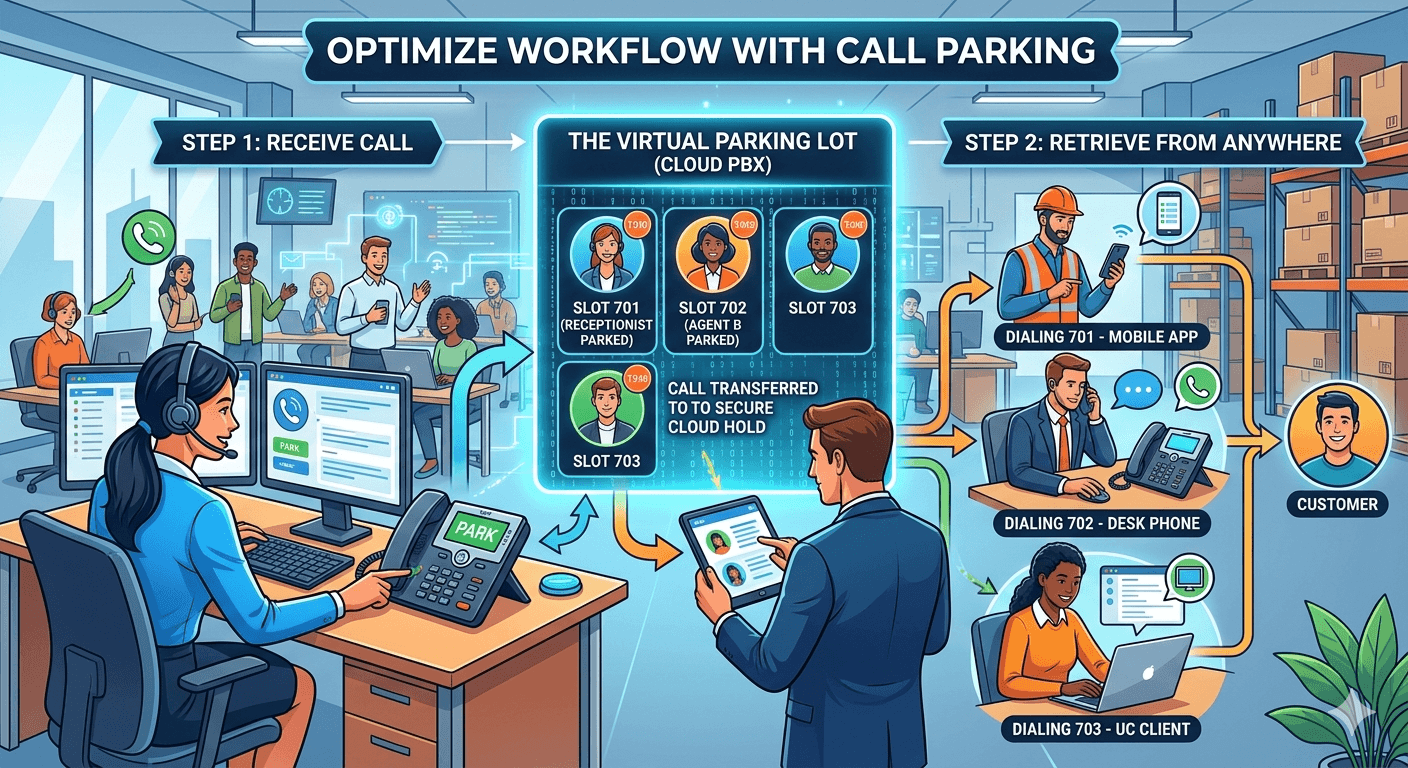
Call parking is a sophisticated telecommunication feature, commonly found in modern Voice over IP systems, that allows a user to place an active call into a virtual holding area known as a parking lot. Unlike a standard hold, which keeps a caller tethered to a specific physical device, a parked call is assigned a temporary extension or slot number. This enables any authorized team member across the entire network to retrieve the call from any desk phone or mobile application by simply dialing the assigned code. It streamlines communication in busy environments by facilitating easy collaboration and team mobility.
What Is Call Parking?
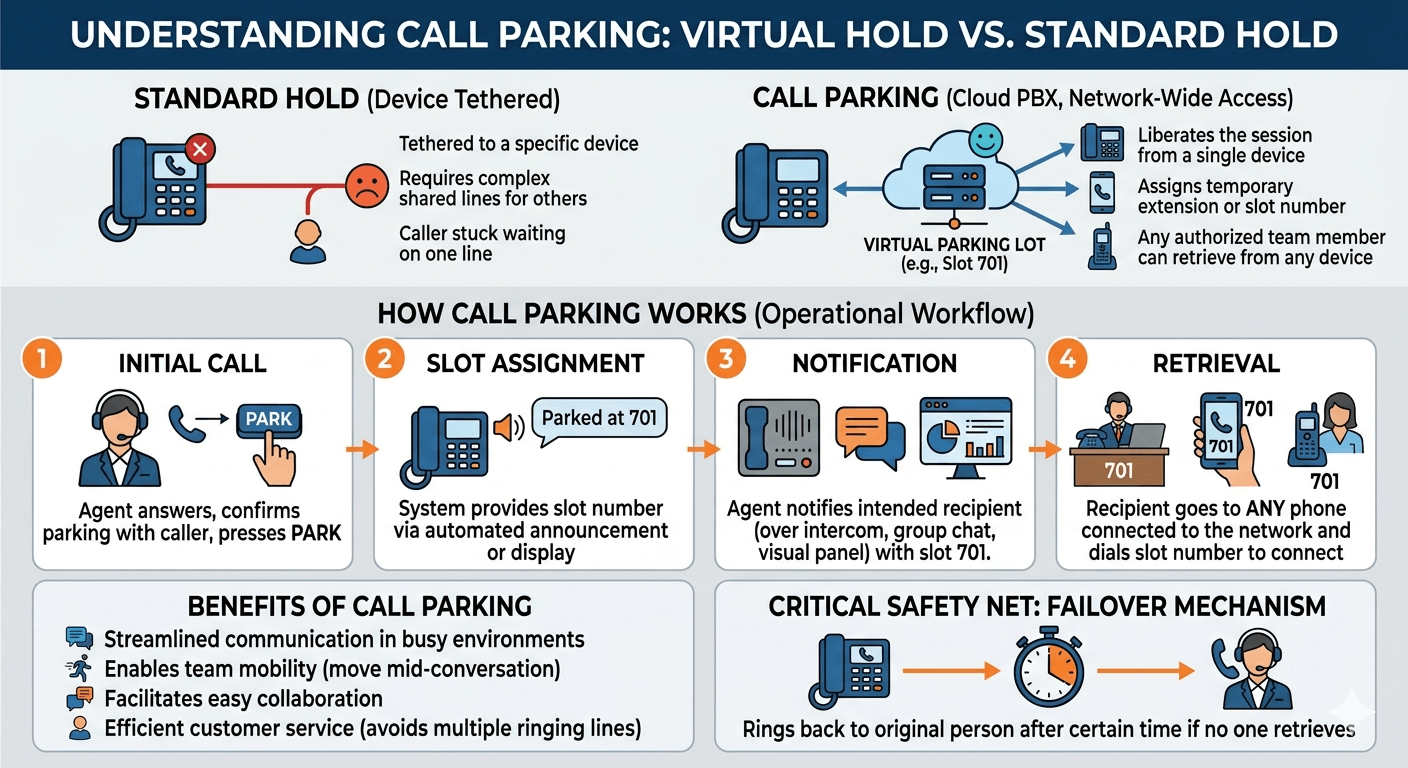
To grasp the full utility of this technology, it is important to clarify what is call parking in a practical, day-to-day sense. At its core, this feature is a way to place a caller on a universal hold. While a standard hold keeps the caller stuck on the specific line they dialed into, parking a call puts them into a parking lot or a virtual slot. Once the call is in this slot, the person who originally answered can hang up their phone and move to a different task, while the caller remains safely connected to the system.
The functionality of a parked call is often described through the lens of a cloud-based PBX system. In these environments, the call is assigned a short code, such as 701 or 802, which serves as its location. This code is then shared with the rest of the team, often through an intercom system, a shared chat application, or a visual indicator on their desk phones. Because the caller is held in the cloud rather than on a physical line, the system can manage multiple parked sessions simultaneously without any loss in audio quality or connection stability.
Understanding what is a parked call also involves knowing what happens if no one retrieves it. Most business systems include a failover mechanism where the session will ring back to the original person who parked it after a certain amount of time. This ensures that customers are not forgotten in the virtual parking lot. This safety net is a critical component of professional communication, as it prevents the negative experience of a caller being left in limbo for an extended period.
Exploring What Does Park Mean on a Phone and How it Differs from Hold
Many users often wonder what does park mean on a phone when they first encounter the button on their new hardware. While the terms hold and park are sometimes used interchangeably in casual conversation, they represent two very different technical processes. When you place a caller on hold, they are tied to your specific device. If you were to walk away or try to answer another line, the caller would still be waiting specifically for you to return to that phone. No one else in the office can grab that call unless you have a complex shared line appearance set up.
In contrast, what does parking a call mean involves liberating the session from a single device. It essentially detaches the incoming data stream from your phone and anchors it to the server. This allows for a much higher degree of flexibility. For example, a warehouse manager who answers a call on a desk phone can park it, walk across the facility to verify inventory, and then pick the call back up using a cordless phone or a mobile app. The ability to switch devices mid-conversation without dropping the call is one of the primary reasons businesses choose this tool.
When analyzing what does it mean to park a call, one should consider the collaborative aspect. In a busy medical clinic, a receptionist might answer a call for a specific doctor. Instead of trying to find which room the doctor is currently in and transferring the call there, the receptionist can simply park the call and announce it over the internal paging system. The doctor can then pick up the nearest phone, dial the park code, and immediately speak with the patient. This eliminates the need for the receptionist to track the doctor’s exact location.
The Operational Workflow and How to Park a Call
The process of managing these sessions is designed to be intuitive so that employees can handle high volumes of traffic without making mistakes. While specific buttons may vary between software providers, the general logic of how to park a call remains consistent across the industry. It starts with the initial engagement where the agent identifies the needs of the caller and determines that the call needs to be moved to a different location or person.
-
The first step involves answering the incoming call and confirming that the caller is comfortable being placed in a parking spot for a brief moment. Once confirmed, the agent presses the dedicated park button or enters a specific feature code on their keypad.
-
After the command is initiated, the system will provide a parking slot number. This could be an automated voice announcement heard only by the agent or a visual notification on the screen of the device. This number is the key to retrieving the caller later.
-
The next phase is the notification of the intended recipient. The agent might use an overhead page, a private message, or a group notification to let the team know that there is a caller waiting on a specific extension.
-
Finally, the recipient goes to any phone connected to the system and dials the park slot number. The system immediately connects the two parties, and the parking slot becomes empty and available for the next call.
This streamlined approach ensures that everyone on the team is aware of waiting callers without the chaos of multiple ringing lines. In modern VoIP setups, parked calls are often visible on a dashboard or a side panel on a computer screen. This visual representation allows managers to monitor how many callers are currently waiting and how long they have been in the parking lot. This data is invaluable for maintaining high levels of customer service and ensuring that staffing levels are appropriate for the call volume.
Comparing Call Park vs Hold in Professional Environments
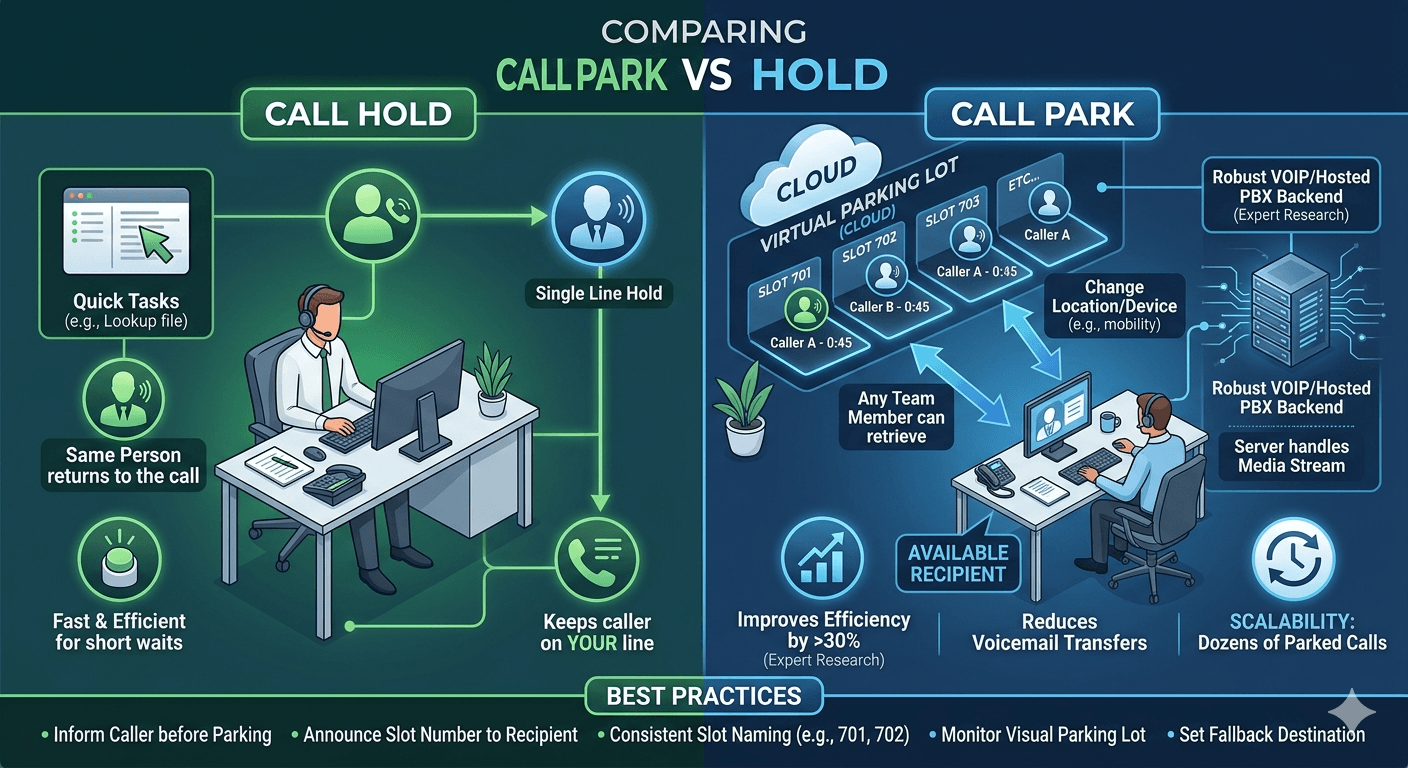
Choosing between call park vs hold depends entirely on the situation and the desired outcome of the interaction. A hold is best suited for quick tasks where the person who answered the call will be the one to finish it. For example, if you need to look up a file or verify a quick piece of information, a standard hold is the fastest and most efficient choice. It keeps the caller on your line and allows you to return to the conversation with a single button press.
However, when the call needs to be handled by someone else or when you need to change your physical location, parking a call is the superior option. It provides a level of mobility that a standard hold cannot match. In large organizations, the ability to park calls reduces the complexity of transfers. Transferring a call directly to someone’s extension can sometimes lead to the caller being sent straight to voicemail if the person is busy. By parking the call instead, the recipient can finish their current task and pick up the caller whenever they are ready.
From the caller’s perspective, the experience is generally the same. They will typically hear hold music or a pre-recorded message while they are in the parking lot. However, the efficiency of the internal team is much higher when using parking. Research by communication experts suggests that efficient call handling can improve customer satisfaction rates by over 30 percent. By using the right tool for the right situation, businesses can ensure that their communication is both professional and timely, which directly impacts the bottom line and brand reputation.
The Technical Infrastructure Supporting Parked Calls
The ability to successfully manage parked calls relies on a robust backend infrastructure, usually provided by a VoIP or Hosted PBX provider. When a command is sent to park a call, the server takes over the media stream. It handles the signaling required to keep the caller connected while freeing up the bandwidth and the line on the original device. This is why phone park features are so much more powerful in the digital age than they were in the days of analog lines.
In a traditional setup, you were limited by the number of physical lines coming into the building. If you had four lines, you could only have four active calls regardless of whether they were parked or active. With modern VoIP, you can have dozens of parked calls at once, limited only by your service agreement and internet bandwidth. This scalability is essential for growing businesses that might experience sudden spikes in call volume. The system handles the queueing and slot assignment automatically, reducing the technical burden on the office staff.
Supporting material from industry studies, such as those conducted by Grand View Research, indicates that the global VoIP market is expanding at a compound annual growth rate of over 10 percent. This growth is driven by the demand for advanced features like call parking that facilitate remote work and mobile collaboration. As more businesses move away from on-premise hardware, the reliance on cloud-based parking features will only increase. These systems are designed to be redundant, meaning that even if one server has an issue, your parked calls can often be moved to another node without the caller ever knowing there was a problem.
Best Practices for Managing One Call Parking and Beyond
To make the most of your communication system, it is vital to establish clear protocols for how your team interacts with the parking feature. Without a plan, callers can easily get lost or wait too long, leading to frustration. One of the best practices is to use a consistent naming convention for parking slots. If your team always knows that 701 is the primary slot and 702 is the secondary, they will be much faster at retrieving callers. Consistency reduces the cognitive load on your employees and allows them to focus on the conversation.
Another important factor is the use of the ringback or failover feature. You should configure your system so that a parked call returns to the original agent if it hasn’t been picked up within 60 to 120 seconds. This prevents customers from feeling abandoned. When a call rings back, the agent can apologize for the wait, offer to take a message, or try to locate the recipient again. This active management of the parking lot is what separates a professional operation from a disorganized one.
-
Always inform the caller before you park them so they understand there will be a brief moment of hold music.
-
Clearly announce the parking slot number to the intended recipient to avoid confusion or the wrong call being picked up.
-
Monitor the visual parking lot on your computer or desk phone to keep track of how long people have been waiting.
-
Set up a fallback destination, such as a general reception desk, for any calls that are not retrieved within the time limit.
-
Train all new staff on the difference between hold and park during their first week of onboarding to ensure system-wide competence.
By following these guidelines, you can ensure that your use of park calls enhances your business reputation rather than detracting from it. Communication is not just about the technology you use; it is about the way you use it to serve your clients. A well-executed parking strategy shows that your team is coordinated, professional, and respectful of the caller’s time. This level of service is a competitive advantage in any industry.
Why Your Business Needs Advanced Phone Park Capabilities
In the modern business landscape, the ability to work from anywhere is no longer a luxury but a requirement. Advanced phone park capabilities allow this flexibility by bridging the gap between different devices and locations. Whether your employees are working in a traditional office, from a home office, or while traveling, they can interact with the same virtual parking lot. This unity ensures that the customer experience remains consistent regardless of where your team is physically located.
Furthermore, the data generated by these systems can help you optimize your operations. Many VoIP providers offer analytics that show you how many calls were parked, the average wait time in a parking slot, and how many calls were eventually retrieved versus those that went to voicemail. Analyzing this information allows you to identify bottlenecks in your workflow. For instance, if you notice that callers are frequently waiting more than two minutes in a parking lot, it may be time to hire more staff or reorganize how calls are routed during peak hours.
Facts from communication audits often show that businesses lose a significant amount of potential revenue due to mishandled calls. A study by American Express found that a large percentage of consumers will hang up and call a competitor if they are placed on a long, unmanaged hold. Call parking directly addresses this risk by providing a more dynamic and transparent way to manage waiting callers. It allows your team to handle interactions with more precision and ensures that every lead or customer inquiry is treated with the importance it deserves.
Read More: How to Perfect Your Business Voicemail Greeting for Success?
Final Thought
Call parking is more than just a technical feature of a phone system; it is a vital tool for organizational efficiency and customer satisfaction. By moving beyond the limitations of a standard hold and embracing the flexibility of a virtual parking lot, businesses can ensure that their communication is fluid and professional. Whether you are managing a small retail shop or a large corporate call center, the ability to park, track, and retrieve calls from any device provides a level of agility that is essential in today’s fast-paced world. Investing in the right training and technology to support these features will pay dividends in the form of happier customers and a more collaborative workforce.
Frequently Asked Questions
-
How Does Call Parking Work?
The process begins when an agent answers an incoming call and identifies the need to park it. The agent uses a feature code or a dedicated button to move the call into a virtual parking slot. After it, the system assigns a unique number to that slot and notifies the agent, who then shares this number with the team. Any other user on the system can then dial that specific slot number from their own device to retrieve the caller. If the call is not picked up within a set timeframe, it automatically rings back to the original agent to prevent the caller from being forgotten.
-
What is the main difference between call park and call hold?
A call hold is local to a specific phone and can only be resumed from that same device. Call parking is a system-wide hold that allows the call to be retrieved from any phone or application within the organization’s network.
-
Can I park multiple calls at the same time?
Yes, most modern VoIP systems allow for multiple parking slots. These are often numbered sequentially, such as 701, 702, and 703, allowing different team members to park and retrieve multiple callers simultaneously without interference.
-
What happens if a parked call is never picked up?
If a call remains in a parking slot past the preconfigured time limit, the system will typically initiate a ringback. This sends the call back to the person who originally parked it or to a designated backup like a receptionist or a call queue.
-
Is call parking available on mobile apps?
Most leading VoIP and Unified Communications providers include the call park feature in their mobile applications. This allows remote workers or employees on the move to park or retrieve calls just as they would if they were sitting at a traditional desk phone.