
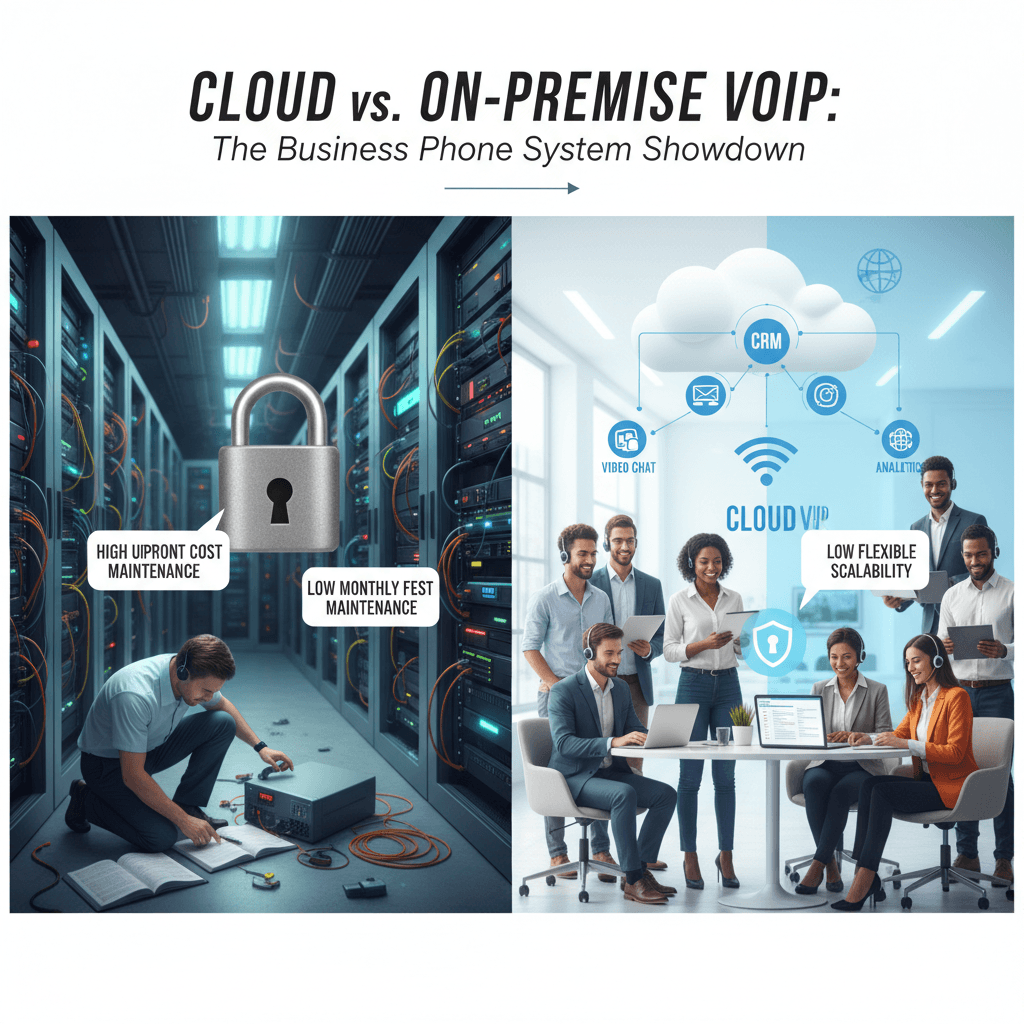
On-premise VoIP is hosted on local servers, giving businesses full control, customization, and security—but it requires higher upfront costs and maintenance. Cloud VoIP is hosted by a provider, offering scalability, remote access, and lower initial investment with minimal IT management. The choice depends on budget, control needs, and flexibility requirements.
In today’s fast-paced business world, effective communication is the backbone of success. As businesses scale, their communication infrastructure must evolve to meet increasing demands, support remote workforces, and integrate seamlessly with other critical systems. The choice between an on-premise and a cloud VoIP phone system is one of the most pivotal decisions a growing company will face.
Voice over Internet Protocol (VoIP) has revolutionized business communication, offering advanced features and significant cost savings compared to traditional landlines. However, the fundamental decision remains: should your VoIP solution be housed within your physical office (on-premise) or managed entirely by a third-party provider over the internet (cloud-based)?
This comprehensive guide will delve into a critical comparison of on-premise vs. cloud VoIP, exploring their intricacies, advantages, disadvantages, and ultimately helping scaling businesses make an informed decision that aligns with their strategic objectives.
Understanding the Fundamentals: On-Premise vs. Cloud VoIP
Before we dive into the comparison, let’s establish a clear understanding of each type of VoIP system.
1.What is On-Premise VoIP?
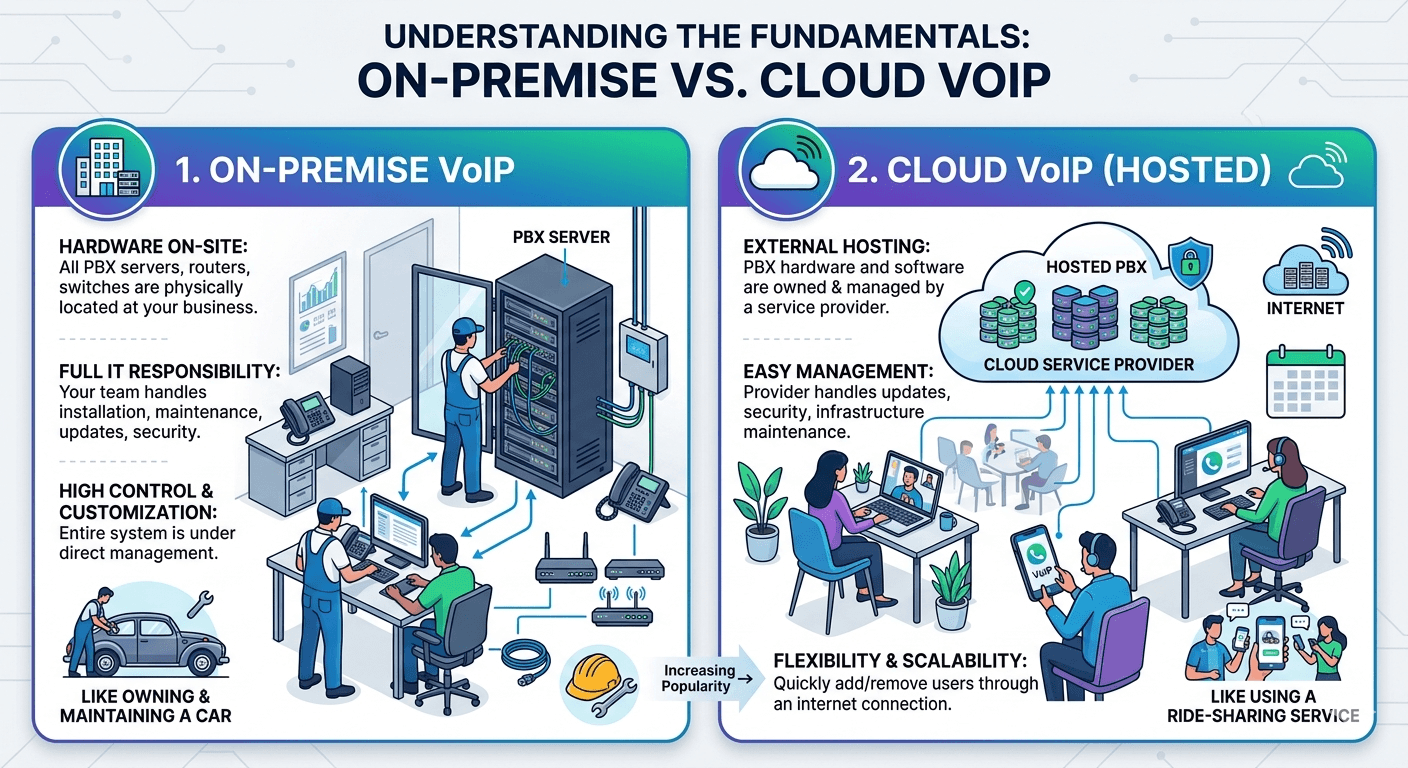
An on-premise VoIP system means that all the necessary hardware and software – primarily the Private Branch Exchange (PBX) – are physically located and maintained within your business’s premises. This includes servers, routers, switches, and the actual PBX appliance. Your IT team is responsible for installation, configuration, maintenance, upgrades, and troubleshooting.
This model provides a high degree of control and customization, as the entire system is under your direct management. It’s akin to owning and maintaining your own car rather than using a ride-sharing service.
2. What is Cloud VoIP (Hosted VoIP)?
Cloud VoIP, also known as hosted VoIP, a phone system in the cloud, or cloud-based telephony, operates entirely over the internet. The PBX hardware and software are owned, managed, and maintained by a third-party service provider in their data centers. Your business accesses the phone system’s features and functionalities through an internet connection, paying a recurring subscription fee (often per user, per month).
This model is like using a ride-sharing service – you pay for the service, and all the maintenance, infrastructure, and updates are handled by the provider. It’s increasingly popular for its flexibility and ease of management, representing a significant shift towards VoIP as a Service.
Key Comparison Categories: On-Premise vs. Cloud VoIP
When evaluating cloud based phone system vs on premise, several critical factors come into play for scaling businesses.
1. Cost Considerations: Initial vs. Long-Term Investment
The financial aspect is often a primary driver in this decision.
On-Premise VoIP Costs:
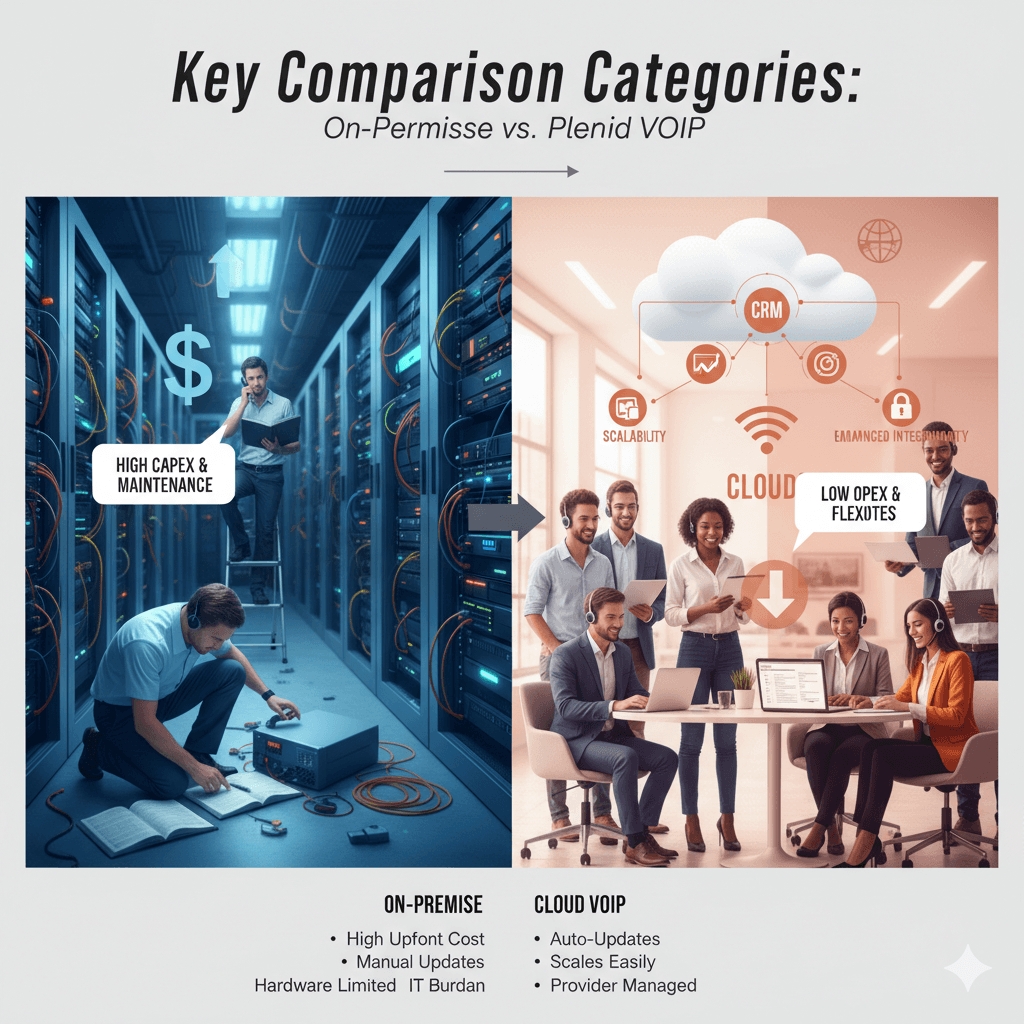
- High Upfront Investment: Requires significant capital expenditure (CapEx) for purchasing all hardware (PBX, servers, phones, wiring) and software licenses.
- Ongoing Maintenance: Your business is responsible for all maintenance, repairs, and potential replacement of hardware. This includes IT staff salaries, training, and utility costs.
- Upgrade Expenses: Major software updates or hardware upgrades often require additional investment.
- Lower Monthly Fees: Once established, monthly operating costs can be lower, primarily consisting of internet service and potentially phone lines if integrated with PSTN.
Cloud VoIP Costs:
- Low Upfront Investment: Minimal CapEx, as you don’t purchase the core infrastructure. You might only need to buy VoIP-compatible phones or use softphones.
- Predictable Monthly Fees: Operates on an Operating Expenditure (OpEx) model with recurring per-user, per-month subscription fees. This makes budgeting simpler.
- Included Maintenance & Upgrades: The provider handles all maintenance, software updates, and hardware refreshes, reducing your IT burden and hidden costs.
- Scalability Costs: Fees increase incrementally as you add more users, but you only pay for what you use.
For a scaling business, the low upfront cost and predictable OpEx of a cloud VoIP phone system can be particularly attractive, freeing up capital for other growth initiatives.
2. Scalability and Flexibility: Adapting to Business Growth
Scaling businesses need a phone system that can grow with them, without demanding costly or time-consuming overhauls.
On-Premise VoIP Scalability:
- Limited by Hardware: Scaling often involves purchasing and installing additional hardware, which can be expensive and time-consuming.
- Capacity Planning: Requires careful forecasting of future needs, as over-provisioning is wasteful, and under-provisioning leads to limitations.
- Less Flexible for Growth Spikes: Adapting to rapid hiring or seasonal demands can be challenging due to physical hardware constraints.
Cloud VoIP Scalability:
- Highly Flexible: Easily scales up or down based on your business needs. You can add or remove users, lines, and features with a few clicks through a web portal.
- Instant Provisioning: New users can be set up almost instantly, making it ideal for rapid expansion or contraction.
- Supports Remote Work: Seamlessly integrates remote employees and multiple office locations under a single system, a key cloud telephony advantage.
For businesses experiencing rapid growth or fluctuating workforce needs, the unparalleled flexibility of a cloud based telephone system is a significant advantage.
3. Features and Functionality: Enhancing Communication Capabilities
Both types of systems offer a rich set of features, but the delivery and integration differ.
On-Premise VoIP Features:
- Full Control: Offers complete control over features and customization. Businesses can integrate with specific legacy systems if needed.
- Feature-Rich: Modern on-premise PBX systems can support advanced features like IVR, call queues, conferencing, voicemail-to-email, etc.
- Integration Challenges: Integrating with newer cloud-based CRM or business intelligence tools might require custom development.
Cloud VoIP Features:
- Always Up-to-Date: Providers constantly update their platforms, ensuring access to the latest features and security patches without manual intervention.
- Rich Feature Set: Offers a comprehensive suite of business communication features, including advanced call routing, auto-attendants, call recording, video conferencing, team messaging, and CRM integrations.
- Unified Communications as a Service (UCaaS): Many cloud business phone system providers offer UCaaS bundles, combining voice, video, chat, and collaboration tools into a single platform.
- Remote Work Capabilities: Features like softphones, mobile apps, and presence management are built-in, making business cloud phone systems perfect for distributed teams.
A phone cloud system often provides a more robust and continuously updated feature set, particularly for modern collaboration and integration needs.
4. Maintenance and Management: IT Burden and Expertise
The operational burden on your IT team is a critical factor.
On-Premise VoIP Maintenance:
- High IT Involvement: Requires dedicated IT staff with expertise in VoIP systems for installation, configuration, troubleshooting, security, and ongoing maintenance.
- Downtime Responsibility: Your business is solely responsible for resolving issues and managing any downtime.
- Physical Security: Requires secure physical housing for the hardware.
Cloud VoIP Maintenance:
- Minimal IT Involvement: The provider handles all maintenance, upgrades, security, and hardware management. Your IT team can focus on core business initiatives.
- 24/7 Support: Providers typically offer round-the-clock support and monitoring.
- Redundancy: Providers often have robust data centers with built-in redundancy and disaster recovery protocols.
For businesses looking to reduce their IT overhead and focus on strategic initiatives, a hosted phone system significantly lightens the management load.
5. Reliability and Security: Protecting Your Communications
Both systems can be reliable and secure, but the approaches differ.
On-Premise VoIP Reliability & Security:
- Local Control: Security is entirely within your control. You dictate firewalls, encryption, and access policies.
- Vulnerable to Local Outages: Susceptible to local power outages, internet failures, or physical damage to your premises.
- Backup & Recovery: Your business is responsible for implementing and managing disaster recovery and backup solutions.
Cloud VoIP Reliability & Security:
- Provider’s Expertise: Relies on the provider’s robust security measures, including encryption, redundant data centers, and advanced threat detection.
- Geographic Redundancy: Less susceptible to local outages, as calls can be rerouted through other data centers.
- High Uptime SLAs: Reputable providers offer Service Level Agreements (SLAs) guaranteeing high uptime.
- Data Privacy: Ensure the provider complies with relevant data privacy regulations (e.g., GDPR, HIPAA).
While on-premise offers complete control, a good cloud calling system provider often has more extensive resources and expertise to ensure higher levels of redundancy and security against a broader range of threats.
Real-World Scenarios: Who Benefits from Each?
Let’s consider which type of system suits different business contexts.
1. When On-Premise VoIP Might Be Preferred:
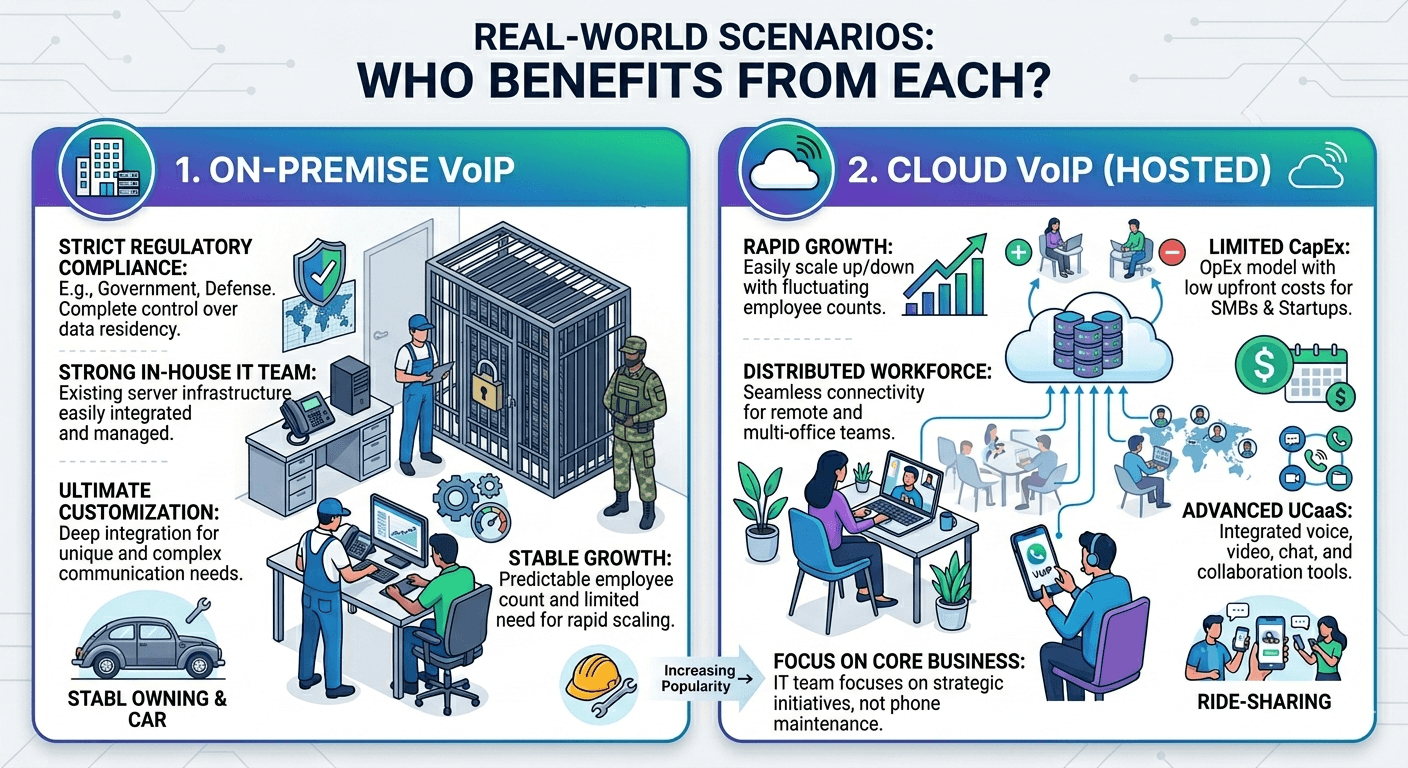
- Strict Regulatory Requirements: Businesses in highly regulated industries (e.g., government, defense) with specific data residency or security mandates that necessitate complete control over their infrastructure.
- Existing IT Infrastructure: Companies with a strong, established in-house IT team and existing server infrastructure that can easily integrate and manage the system.
- Desire for Ultimate Customization: Businesses with very unique and complex communication needs that require deep customization that a cloud provider might not offer.
- Stable Growth & Predictable Needs: Organizations with a very stable number of employees and limited need for rapid scaling.
On premise phone system vs cloud for these businesses often boils down to an imperative for complete control.
2. When Cloud VoIP is the Ideal Choice for Scaling Businesses:
- Rapid Growth: Businesses expecting significant growth or fluctuating employee counts benefit immensely from the scalability of a cloud-based phone system.
- Distributed or Remote Workforce: Companies with remote employees, multiple offices, or international operations find enterprise cloud phone system solutions perfect for unified communication.
- Budget-Conscious with Limited CapEx: Startups and small to medium-sized businesses (SMBs) prefer the OpEx model and low upfront costs of a small business cloud phone system.
- Limited IT Resources: Businesses that want to offload the burden of managing a complex phone system to an expert provider.
- Need for Advanced Features & UCaaS: Organizations looking for integrated communication tools (voice, video, chat, collaboration) without maintaining multiple systems.
- Focus on Core Business: Companies that want their IT team to focus on strategic initiatives rather than phone system maintenance.
Most scaling businesses will find the agility, cost-effectiveness, and feature richness of a business cloud phone systems to be a more strategic fit.
The Cloud Advantage: Why Modern Businesses are Shifting
The trend is clear: the vast majority of new VoIP adoptions are cloud-based. Here’s why the cloud call system is gaining overwhelming popularity:
- Agility and Speed: Businesses can deploy new features or expand services rapidly, reacting quickly to market changes.
- Disaster Recovery: Built-in redundancy and robust disaster recovery plans from providers ensure business continuity even in the face of local disruptions.
- Future-Proofing: Continuous updates and innovations from cloud providers mean your system never becomes obsolete.
- Reduced Overhead: Significant savings in hardware, maintenance, and IT staff time.
- Enhanced Collaboration: Integrates seamlessly with other cloud-based productivity tools like CRM, ERP, and collaboration platforms.
- Work-from-Anywhere: Empowers employees to communicate effectively from any location with an internet connection, a non-negotiable in today’s hybrid work environment.
Companies like Intermedia Phone Systems are examples of providers leading this charge, offering comprehensive hosted phone systems that cater to the evolving needs of businesses.
Cloud vs. Premise-Based Contact Center: A Specialized Comparison
The choice between cloud vs premise based contact center is an extension of the broader VoIP decision, but with even greater emphasis on specific functionalities.
On-Premise Contact Center:
- High Control & Customization: Absolute control over every aspect, often preferred by large enterprises with unique, deeply integrated legacy systems.
- Data Security Concerns: Some businesses with extremely sensitive customer data prefer on-premise to maintain absolute control over data location.
- Scalability Challenges: Adding agents or expanding features can be a complex and costly endeavor.
- High Initial Investment: Significant capital outlay for hardware, software, and skilled IT staff.
Cloud Contact Center:
- Rapid Deployment & Scalability: Quickly add or remove agents, perfect for seasonal peaks or rapid business expansion.
- Omnichannel Capabilities: Often provides seamless integration of voice, email, chat, social media, and more into a single agent interface.
- Advanced Analytics & AI: Cloud solutions frequently offer more sophisticated reporting, analytics, and AI-driven features (e.g., sentiment analysis, chatbots) as part of their service.
- Disaster Recovery: Built-in resilience and redundancy ensure agents can work from anywhere, even during outages.
- Lower TCO (Total Cost of Ownership): OpEx model, reduced IT burden, and continuous updates often lead to lower long-term costs.
For most scaling businesses, especially those prioritizing customer experience and operational agility, the on premise vs cloud contact center decision heavily favors the cloud.
Read more: Wireless Caller Meaning: What It Is, How It Works & Is It Spam?
Conclusion: Making the Right Choice for Your Scaling Business
The debate between on-premise vs. cloud VoIP is not about one being inherently “better,” but rather which solution is a better fit for your specific business needs, growth trajectory, and operational philosophy. For the vast majority of scaling businesses today, the agility, cost-effectiveness, advanced features, and reduced IT burden of a cloud based enterprise phone systems make it the more strategic and future-proof choice.
It empowers your teams with flexible communication tools, ensures business continuity, and allows your valuable IT resources to focus on innovation rather than infrastructure maintenance. As you plot your business’s future, consider how a modern communication system can serve as a catalyst for growth and efficiency.
FAQs
-
What are the main differences between a cloud-based phone system and an on-premise one?
The main differences lie in where the system’s hardware and software are hosted and managed. An on-premise system is physically located and managed within your business, requiring significant upfront investment and in-house IT expertise. A cloud-based system (or hosted phone system) is managed by a third-party provider over the internet, offering lower upfront costs, predictable monthly fees, and managed maintenance and updates.
-
Which is more scalable for a growing business?
A cloud-based phone system is significantly more scalable. You can easily add or remove users, lines, and features as your business grows or contracts, typically through a simple web portal. On-premise systems require purchasing and installing additional hardware, which can be costly and time-consuming.
-
Is a cloud phone system more secure than on-premise?
Security depends on the specific implementation for both. While an on-premise system gives you full control, you are solely responsible for its security. Reputable cloud providers invest heavily in advanced security measures, redundancy, and continuous monitoring across multiple data centers, often offering a more robust and resilient security posture than many individual businesses can achieve on their own.
-
What are the primary cost advantages of cloud telephony?
The primary cost advantages of cloud telephony are lower upfront capital expenditure (CapEx), predictable monthly operating expenses (OpEx), and the inclusion of maintenance, updates, and hardware refreshes in the subscription fee. This helps avoid unexpected costs and allows for easier budgeting compared to the often higher TCO of on-premise systems.
-
Can I integrate a cloud phone system with my existing business software?
Yes, most modern cloud business phone systems offer extensive integration capabilities with popular CRM (Customer Relationship Management) platforms, ERP (Enterprise Resource Planning) systems, and other business applications. These integrations can enhance productivity, streamline workflows, and provide a unified view of customer interactions.