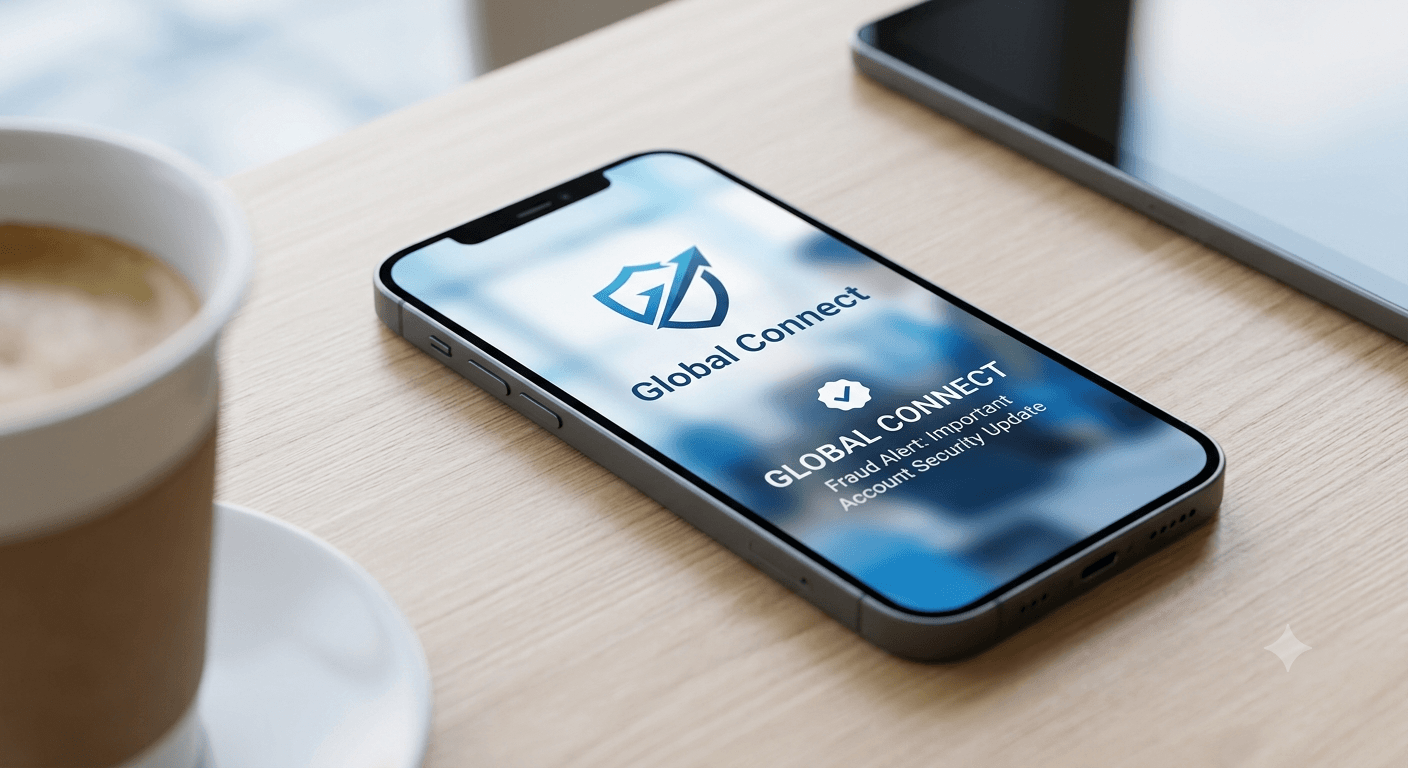
Branded calling is a highly complex communication technology that allows organizations to display their company name, logo, and reason for the call on a recipient’s mobile phone screen. Unlike traditional caller ID, which often shows only a phone number or a generic location, this solution provides a verified identity to the person receiving the call. By utilizing enterprise branded calling, businesses can transform a standard outbound dial into a powerful brand touchpoint. This digital handshake verifies the caller’s legitimacy through carrier-level authentication, helping to overcome the massive decline in answer rates caused by the rise of anonymous spam calls and phone-based fraud.
What is branded calling?
Branded calling is a mobile identity solution that replaces the standard numeric string on a recipient’s screen with a rich, recognizable interface. It allows a business to present its official caller logo and brand name directly on the mobile device during an incoming call. This technology is designed to restore trust in the voice channel, ensuring that when a customer sees a call from your organization, they know exactly who is calling and why.
The rise of robocalls has made consumers wary of answering numbers they do not recognize. According to industry data, nearly 70 percent of unidentified calls go straight to voicemail. Branding calls helps solve this by providing a professional, verified identity. It is not just about the name; it is about providing a calling brands experience that aligns with the rest of your company’s digital presence.
How branded calling works?
The process begins when a business initiates an outbound call through a branded calling service. The call data is sent through the telecommunications network, where it is cross-referenced with a database of verified business identities. Using protocols like STIR/SHAKEN, the carrier authenticates that the caller is indeed who they claim to be.
Once authenticated, the network delivers the branded call display information to the recipient’s smartphone. This information can include the company name, a high-resolution logo, and even a custom message explaining the intent of the call. This seamless delivery happens in milliseconds, ensuring that the visual branding appears the moment the phone starts ringing.
Who uses branded calling?
A wide variety of sectors utilize these solutions to improve their outreach efficiency. Financial institutions use it for fraud alerts, while healthcare providers use it for appointment reminders. Retailers find it useful for delivery updates, and utility companies use it to communicate during service outages or maintenance windows.
Technical services and logistics firms also rely heavily on caller id branding. For these industries, reaching the customer on the first try is essential for operational efficiency. By using a branded calling id, they can ensure their technicians or delivery drivers are not ignored, which significantly reduces the cost-per-call and improves service delivery timelines.
How branded caller ID works?
The technical architecture behind a branded caller id involves a partnership between the enterprise, the service provider, and the mobile carriers. When a call is placed, the system checks the phone number against a registry of verified brands. This registry ensures that only authorized entities can display specific names and logos, preventing unauthorized use of a brand’s identity.
Once the identity is confirmed, the rich data—including the caller logo—is pushed to the mobile device via the data channel. This happens simultaneously with the voice signal. The mobile operating system then renders this data on the screen, providing a visual experience that is far more engaging than a simple text-based display.
How is a branded caller ID name determined?
The name displayed on the screen is usually determined during the registration process with a branded calling provider. Businesses must provide legal documentation to prove their ownership of the brand and the phone numbers associated with it. This rigorous verification process is what makes branded calls trustworthy.
Organizations can often choose different display names for different departments. For example, a hospital might use a specific name for its pharmacy department and another for its billing department. This level of customization allows for more precise communication and helps the recipient understand the context of the call immediately.
Branded calling vs. traditional caller ID
Traditional caller ID, often referred to as CNAM (Calling Name), is a legacy system that relies on text-based databases. It is often limited to 15 characters and frequently fails to display correctly across different carriers or devices. It does not support logos or custom call reasons, making it a very basic and sometimes unreliable tool for modern businesses.
In contrast, branded calling provides a rich media experience. It supports full-color logos and extended text, and it is designed specifically for the modern smartphone era. While traditional caller ID is easily spoofed by scammers, branded caller id solutions use advanced encryption and authentication methods to ensure the information displayed is authentic and secure.
Why branded calling is important
The modern telecommunications landscape is cluttered with spam and fraudulent activity. This has led to a “crisis of trust” where consumers simply stop answering their phones. For businesses that rely on phone communication to drive revenue or provide support, this is a major obstacle. Branded calling is important because it serves as a digital badge of authenticity.
Recent studies have shown that 87 percent of consumers say they often do not answer calls from unknown numbers. This reluctance can cripple a business’s ability to communicate effectively. By implementing caller id branding, companies can bypass this skepticism. It allows them to stand out in a crowded call log and proves to the customer that the call is worth their attention.
Benefits of branding calling
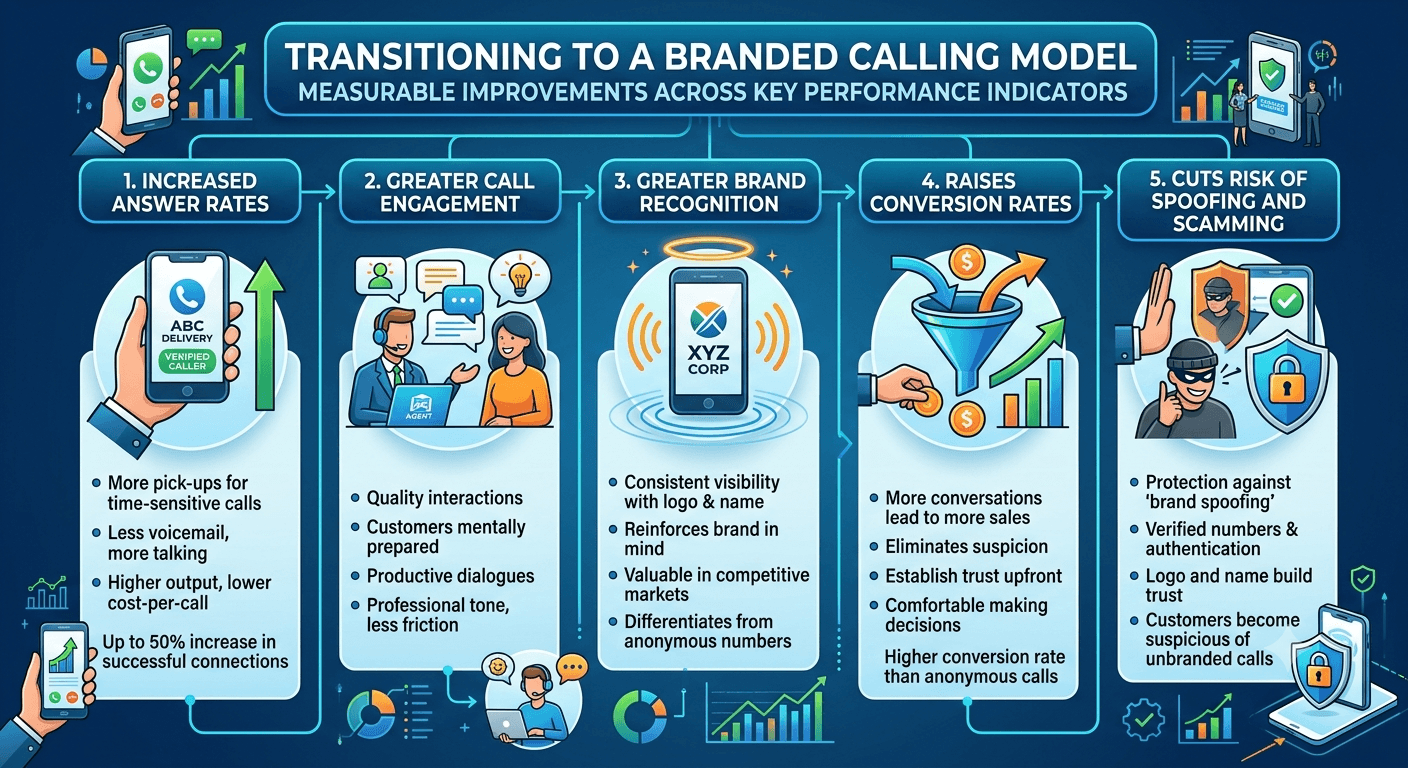
The transition to a branded model offers measurable improvements across several key performance indicators. It is not merely a cosmetic change; it is a strategic upgrade to the company’s communication infrastructure. By prioritizing brand call solutions, enterprises can see a direct impact on their bottom line through improved operational efficiency.
One of the most significant impacts is seen in the reduction of “ghosting,” where customers ignore calls despite having an existing relationship with the brand. When the brand identity is clear, the customer feels more respected and is more likely to engage in a meaningful conversation.
1. Increased answer rates
The most immediate benefit is a surge in answer rates. When people see a verified company name and logo, they are significantly more likely to pick up the phone. This is especially true for time-sensitive calls like delivery notifications or security alerts.
Higher answer rates mean that your team spends less time leaving voicemails and more time talking to actual customers. This efficiency boost can lead to a lower cost-per-call and a higher overall output for your outbound departments. In some cases, businesses have reported up to a 50 percent increase in successful connections after implementing these services.
2. Greater call engagement
Engagement goes beyond just answering the phone; it involves the quality of the interaction. When a customer knows who is calling before they answer, they are mentally prepared for the conversation. This leads to more productive dialogues and a higher likelihood of achieving the call’s objective.
A branded call display sets the tone for a professional interaction. It reduces the initial friction often felt when a stranger calls, allowing the agent to get straight to the point. This professional start to the call improves the customer’s perception of the brand and makes them more receptive to the information being shared.
3. Greater brand recognition
Every time a phone rings with your company’s logo, it serves as a brand impression. Even if the customer does not answer, they have seen your logo and name on their screen. This consistent visibility helps reinforce brand recognition in the mind of the consumer.
This is particularly valuable in competitive markets. By being one of the few calling brands that provides a rich visual identity, you differentiate yourself from competitors who appear as anonymous numbers. Over time, this constant reinforcement builds a sense of familiarity and trust that is difficult to achieve through other channels.
4. Raises conversion rates
For sales-driven organizations, the ultimate goal is conversion. Branded calls lead to more conversations, and more conversations lead to more sales. By identifying yourself upfront, you eliminate the suspicion that often derails sales calls before they even begin.
Statistics indicate that calls with a verified brand identity have a much higher conversion rate than anonymous calls. This is because the trust established at the beginning of the call carries through to the end of the transaction. Customers are more comfortable sharing information and making purchasing decisions when they are certain of the caller’s identity.
5. Cuts the risk of spoofing and scamming
One of the biggest threats to a company’s reputation is “brand spoofing,” where scammers pretend to be a well-known company to steal information. Branded calling id solutions provide a layer of protection against this. Because the branding is tied to verified numbers and carrier-level authentication, it is much harder for scammers to replicate.
When a company consistently uses branded call display, customers become accustomed to seeing the logo and verified name. If they receive a call from a number claiming to be the same company but without the branding, they are more likely to be suspicious. This helps protect both the customer and the brand’s reputation from the damaging effects of fraud.
Is enterprise branded calling trustworthy?
Yes, enterprise branded calling is highly trustworthy because it is built on a foundation of rigorous verification. Providers like Numeracle branded calling and TNS branded calling work directly with carriers to ensure that only legitimate businesses can access these features. The system is designed to be a “closed loop,” where identity is confirmed at multiple points.
The use of STIR/SHAKEN technology further enhances this trust. This framework allows carriers to digitally sign calls, providing a “certificate of authenticity” that travels with the call. When a mobile device receives a branded call, it knows that the identity has been vetted by the network, making it a highly secure method of communication.
Challenges and limitations of branded calling
While the technology is powerful, there are some challenges to consider. One primary limitation is carrier fragmentation. Not all mobile carriers support rich branded displays in the same way. This means that a call might look different on an AT&T phone compared to a Verizon or T-Mobile device.
Additionally, older mobile devices may not have the hardware or software capabilities to display logos and rich text. While this is becoming less of an issue as consumers upgrade to newer smartphones, it is still a factor in reaching 100 percent of your audience. Cost is another consideration, as branded caller id pricing can vary depending on the volume of calls and the level of features required.
How businesses can use branded calling to boost trust and results?
Different industries can leverage this technology in unique ways to solve specific communication problems. By tailoring the display to the context of the industry, companies can maximize the effectiveness of their outbound strategy. The following examples illustrate how various sectors utilize these tools to improve outcomes.
Healthcare: Reducing missed appointments with branded reminders
In the healthcare sector, missed appointments cost providers billions of dollars each year. Many patients ignore reminder calls because they do not recognize the hospital’s main office number. By using a branded calling id, healthcare facilities can display their name and the word “Appointment” on the screen.
This simple change ensures that patients know the call is important and not a telemarketing attempt. When patients answer these calls, they can confirm or reschedule their appointments, leading to a significant reduction in “no-shows” and better resource management for the clinic.
Retail: Improving order pickup and customer satisfaction
Retailers often need to call customers regarding order status, delivery windows, or product availability. In an age of package theft and delivery scams, customers are hesitant to answer calls from unknown numbers. A branded call with a retailer’s logo provides immediate reassurance.
When a customer sees the official brand logo, they are more likely to answer to coordinate their delivery. This leads to higher customer satisfaction scores and fewer failed delivery attempts, which saves the retailer money on logistics and improves the overall shopping experience.
Banking: Enhancing security with branded fraud alerts
Banks frequently need to contact customers urgently to verify suspicious transactions. However, these calls are often mistaken for the very scams they are trying to prevent. By using enterprise branded calling, banks can clearly identify themselves during these critical moments.
A call labeled “Fraud Alert” with the bank’s official logo carries a level of authority that a plain number does not. This allows the bank to reach the customer quickly, secure the account, and prevent financial loss. This proactive approach not only protects the customer but also strengthens their trust in the bank’s security measures.
Utilities: Managing outages and service updates
Utility companies often need to reach large groups of people during emergencies or maintenance. Whether it is a power outage update or a scheduled water line repair, getting the information to the resident is vital for safety and convenience.
Branded calling allows these companies to broadcast their identity clearly. Residents are much more likely to answer a call from their local power company than a random number. This ensures that safety instructions and service updates are received and acted upon promptly, improving public relations and community safety.
How to implement branded calling?
Implementing a branded strategy requires a coordinated effort between your IT department, your communication provider, and the branded calling vendor. It is not a “set it and forget it” process; it requires ongoing management to ensure that the branding remains consistent and effective across all platforms.
The first step is identifying the right partners. Look for vendors who have direct relationships with major carriers and a proven track record in identity management. You will also need to decide which phone numbers in your organization require branding and what specific information you want to display to your customers.
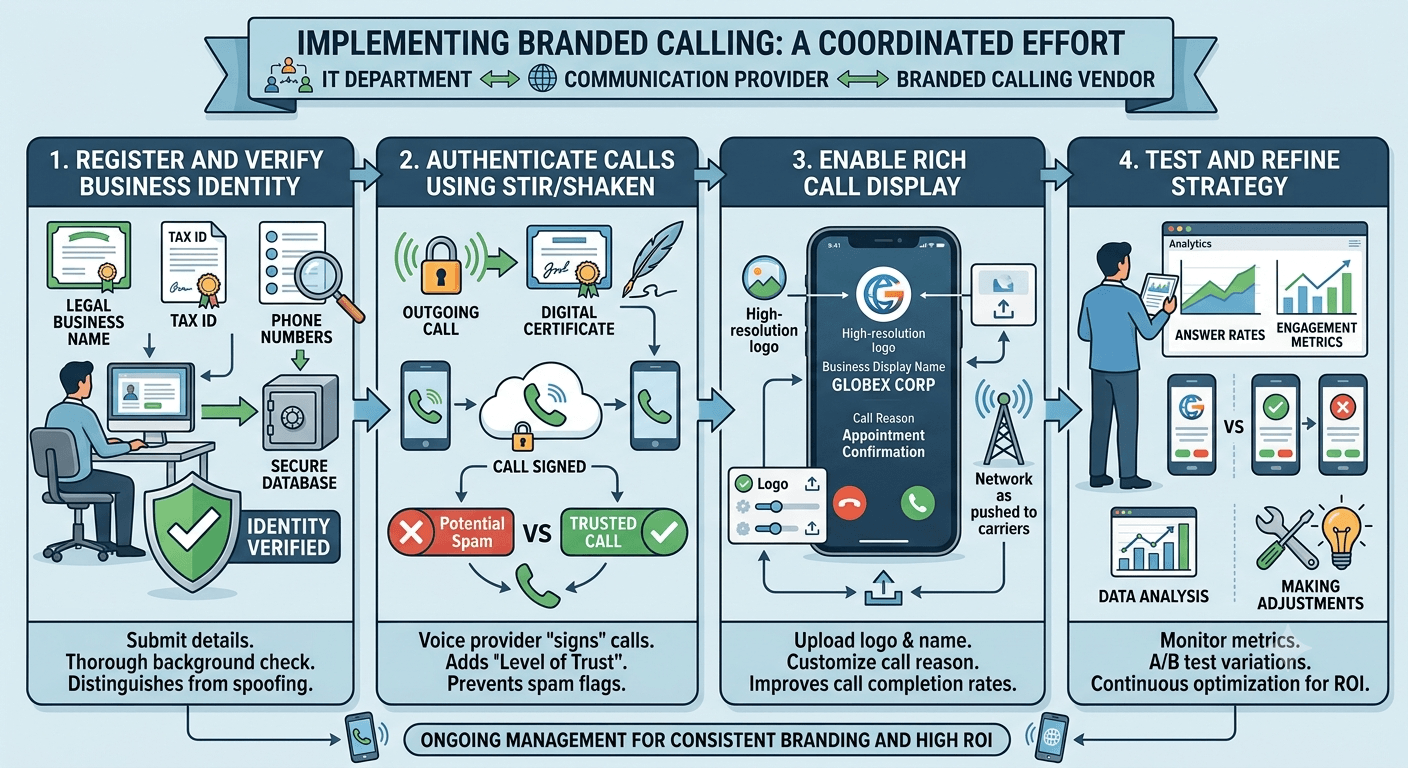
1. Register and verify your business identity
The most critical step is the registration phase. You must provide your legal business name, tax ID, and a list of all phone numbers you intend to brand. The provider will then conduct a thorough background check to verify that your business is legitimate and that you have the right to use the brand name and logo.
This step is what separates professional branded calling from simple caller ID spoofing. Once your identity is verified, it is stored in a secure database that carriers can access to authenticate your calls. This verification must be kept up to date, especially if your business changes names or acquires new number blocks.
2. Authenticate your outbound calls using STIR/SHAKEN
To ensure your calls are not flagged as spam, you must implement the STIR/SHAKEN framework. This technical standard allows your voice provider to “sign” your calls with a digital certificate. This certificate tells the receiving carrier that the call has been authenticated and has not been tampered with.
Without this authentication, your branded call might still be blocked or labeled as “Potential Spam” by the recipient’s carrier. Working with a provider that fully supports these protocols is essential for the success of your brand calling initiative. It ensures your calls have the highest possible “level of trust” as they traverse the network.
3. Enable rich call display through carrier networks
Once your identity is verified and your calls are authenticated, you can enable the rich call display features. This involves uploading your high-resolution logo and setting your display name. Some providers also allow you to include a “call reason,” which can be customized based on the department or the specific campaign. This information is then pushed to the carriers, who handle the delivery to the end-user’s device.
According to a report by TransNexus, businesses that use authenticated and branded displays see a marked improvement in call completion rates.
This carrier-level integration is what allows the rich media to appear seamlessly during the ringing phase of the call.
4. Test and refine your branded call strategy
After the system is live, it is important to test how the branding appears on various devices and carriers. You should monitor your answer rates and engagement metrics to see which logos or display names perform best. A/B testing different call reasons can also provide valuable insights into customer behavior.
Refining your strategy involves looking at the data and making adjustments. For example, if you find that a certain logo doesn’t display well on smaller screens, you might need to simplify the design. Continuous monitoring ensures that your branded caller id news remains positive and that your communications continue to deliver a high ROI.
Why branded calling matters for the future?
As we move toward a more digital and automated world, the value of a verified voice connection will only increase. The telephone remains one of the most personal and effective ways to resolve complex issues or close important deals. However, for the voice channel to survive, it must be protected from the noise of spam and fraud.
Branded calling is the future of business communication because it prioritizes the user experience and security. It aligns with the way consumers use their smartphones—as visual, data-driven devices. In the coming years, we can expect even more interactive features, such as the ability for customers to take actions directly from the call screen, making the branded call an even more integral part of the customer journey.
How to know if branded calling solutions are right for your business?
Deciding whether to invest in this technology depends on your current communication challenges and goals. If your outbound teams are struggling to reach people or if your brand is frequently victimized by spoofing, the answer is likely yes. It is a strategic investment in your brand’s reputation and operational efficiency.
A branded calling solution is right for your business if you want to:
Build trust with your customers by showing a verified identity.
Increase your call pickup rate and reduce wasted time on voicemails.
Rely on outbound calling as a primary channel for sales or support.
Have more control over your business information display across different carriers.
Make it harder for scammers and vishers to imitate your brand and harm your reputation.
Boost your outbound conversion rate by starting every call on a professional note.
Increase your outbound ROI by making every dial count toward a successful connection.
Read More: Loa Meaning in Business: Crucial Insights for Successful Management
Final words
Branded calling is no longer just a “nice-to-have” feature; it is becoming a necessity for any business that wants to maintain a professional and effective voice presence. By replacing anonymous numbers with a clear, verified identity, companies can break through the noise of spam and rebuild trust with their audience. Whether it is through an at&t branded call display or other carrier-specific solutions, the goal remains the same: to ensure that when you call, your customers answer with confidence. As technology continues to evolve, those who embrace these branded solutions will find themselves at a significant advantage, enjoying higher engagement, better security, and a stronger connection with their customers.
Faqs
What do branded calls mean?
A branded call is a telephone call that displays the calling company’s specific name, logo, and sometimes the reason for the call on the recipient’s smartphone screen. This technology replaces the standard phone number or generic location text with a verified business identity, helping to improve trust and increase the likelihood that the recipient will answer the call.
What is a branding call?
A branding call refers to the process of using a branded calling service to identify your business to the recipient during an outbound dial. It involves the delivery of rich media—such as a company logo and verified name—directly to the mobile device’s call screen, ensuring the customer knows exactly who is contacting them before they pick up.
What is the difference between CNAM and branded calling?
CNAM (Calling Name) is an older, text-only technology that is limited to 15 characters and often displays incorrectly across different networks. Branded calling is a modern solution that supports full-color logos, extended text, and call reasons, and it uses advanced carrier-level authentication like STIR/SHAKEN to verify the caller’s identity securely.
What are the four types of calls?
In a business context, the four types of calls usually refer to inbound calls (received from customers), outbound calls (initiated by the business), internal calls (between employees), and automated calls (reminders or alerts sent by a system). Branded calling is primarily used to enhance outbound calls to customers and prospects.
Is branded calling expensive?
The cost of these services varies depending on the provider and the volume of calls placed. Most vendors offer tiered pricing based on the number of branded minutes or the number of devices reached. While there is an upfront cost, many businesses find that the increase in answer rates and conversion more than covers the investment.
Does branded calling work on all phones?
It works on most modern smartphones that have a data connection. While the display might vary slightly between iPhone and Android or between different carriers, the core identity information is designed to be as consistent as possible. Older “flip phones” or landlines may only see the text version of the brand name.
How do I get my logo on the call screen?
To display your logo, you must partner with a branded calling provider who will verify your business identity and register your numbers with the major carriers. You will then provide them with a high-resolution version of your logo, which they will push to the mobile networks for display during your outbound calls.
Can branded calling help with spam labeling?
Yes, one of the primary functions of these solutions is to prevent your legitimate business calls from being incorrectly labeled as “Scam” or “Spam.” By authenticating your numbers and providing a clear brand identity, you signal to the carriers and the recipients that your call is legitimate and desired.
What is the impact on customer trust?
The impact is significantly positive. When customers see a verified brand they recognize, they feel more secure and respected. This transparency reduces the anxiety associated with unknown calls and fosters a better long-term relationship between the consumer and the business.