
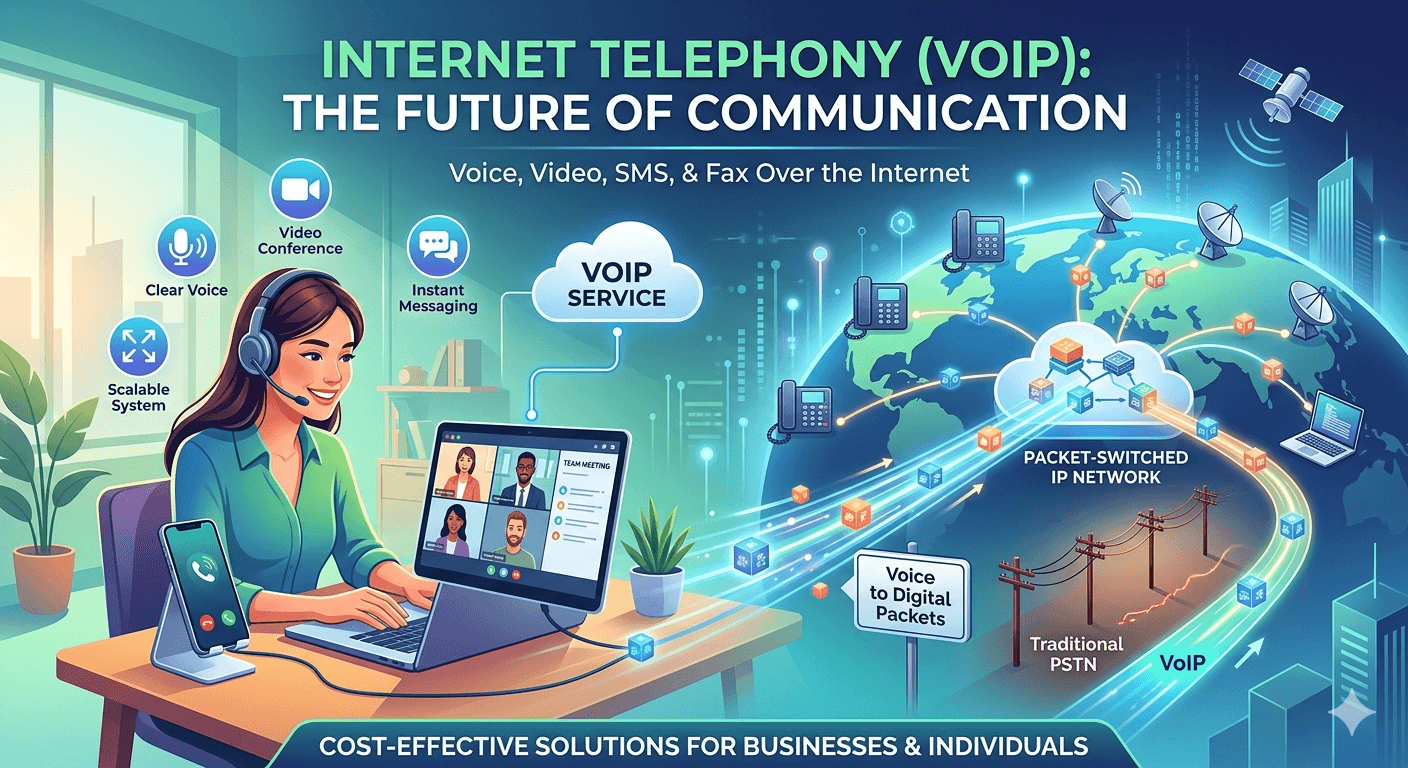
Internet telephony, also known as IP telephony or VoIP telephony, revolutionizes how we communicate by transmitting voice calls, SMS, and faxes over the internet instead of traditional phone lines. Discover why businesses and individuals are switching to this cost-effective telephony solution.
What is Internet Telephony?
Internet telephony refers to the technology that enables voice calls, video conferencing, SMS, and fax services by converting audio into digital data packets sent over the internet using Internet Protocol (IP). Unlike traditional telephony systems that rely on circuit-switched public switched telephone networks (PSTN), internet telephony leverages packet-switched networks for efficient data transmission.
This telephony service, often interchangeable with terms like IP telephony and internet telephone, allows users to make crystal-clear internet calls from anywhere with a stable broadband connection. Imagine ditching clunky desk phones for apps on your laptop or smartphone— that’s the magic of internet telephony in action.
VoIP Telephony Explained: What is VoIP and How Does It Work?
VoIP stands for Voice over Internet Protocol, the core technology powering most internet telephony systems. For businesses seeking telephony solutions, internet telephony offers scalability without the hefty infrastructure costs of legacy telephony systems.
VoIP telephony is a subset of internet telephony where voice data is digitized, compressed, and packaged into IP packets for transmission over the internet. What is VoIP and how does it work? It starts with an analog-to-digital converter (ADC) that samples your voice at high speeds, encodes it, and sends it via protocols like Session Initiation Protocol (SIP) for call setup and Real-time Transport Protocol (RTP) for media streaming.
In a typical internet telephony system, your device (phone, computer, or app) connects to a VoIP provider’s server. The server routes packets to the recipient, who reassembles them into audible sound using a digital-to-analog converter (DAC). This process ensures low-latency internet phone systems, even for international calls.
Comparison Table: VoIP Telephony vs. Traditional Telephony
This table highlights why telephony as a service (TaaS) like VoIP is overtaking outdated telephony systems.
| Feature | VoIP Telephony (Internet Telephony) | Traditional Telephony (PSTN) |
| Transmission Method | Packet-switched IP networks | Circuit-switched copper lines |
| Cost for Long-Distance | Low or free with data plans | High per-minute charges |
| Hardware Needs | Softphones, IP phones, ATA | Analog phones, landlines |
| Scalability | Unlimited extensions, cloud-based | Fixed lines, hardware expansions |
| Features | Video, SMS, CRM integration | Basic voice only |
What Are the Key Differences Between Internet Telephony and Traditional Phone Calls?
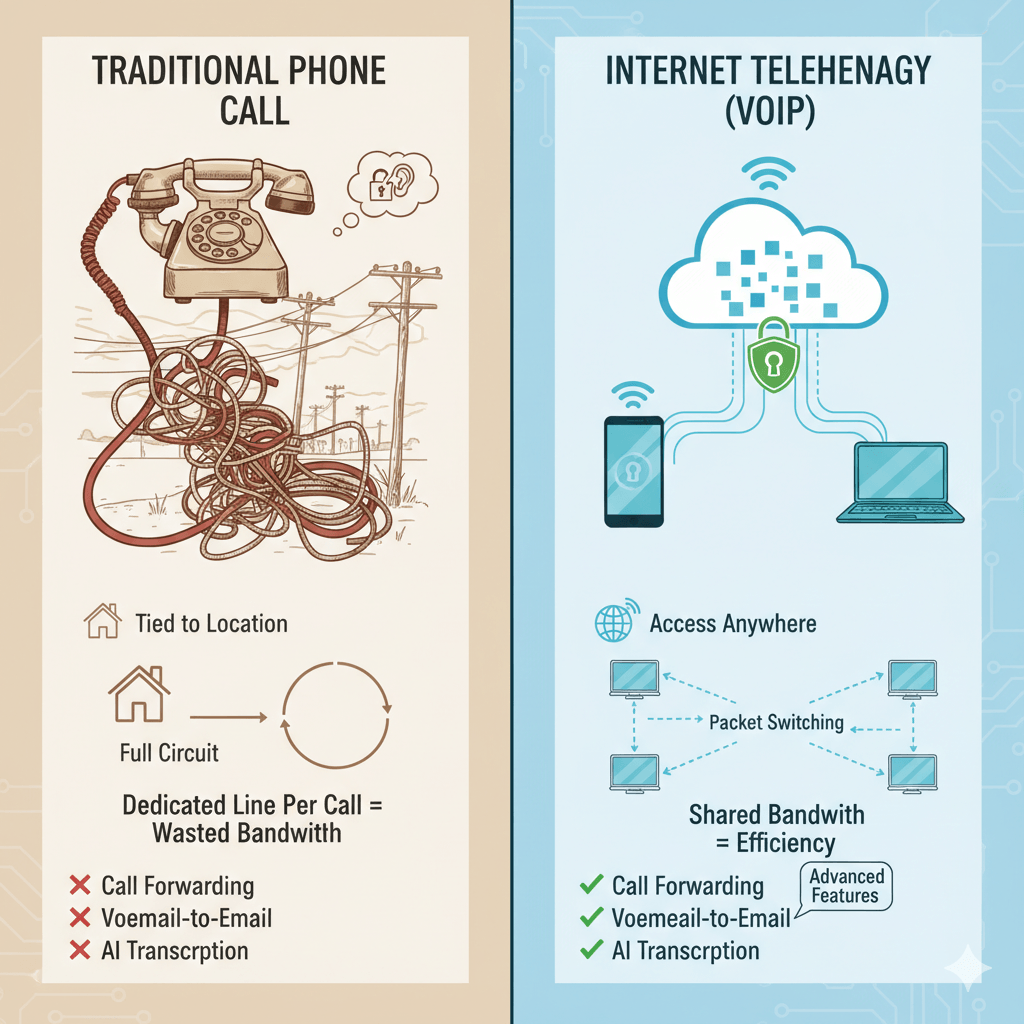
The key difference between internet-based and traditional phone calls lies in infrastructure. Traditional telephony systems dedicate a full circuit per call, wasting bandwidth during silence, while internet telephony shares bandwidth dynamically via packet switching.
Internet calls shine in flexibility—port your number anywhere with internet access—versus landlines tied to physical locations. Security in internet telephony handles data via encryption, contrasting PSTN’s vulnerability to eavesdropping on open lines. For telephony solutions, internet telephony wins with features like call forwarding, voicemail-to-email, and AI transcription absent in basic telephony services.
How Does an Internet Phone System Work?
An internet phone system transforms your voice into digital magic, sending it across the internet as data packets rather than through old-school phone lines. It all starts smoothly when hardware like a microphone or headset captures your analog voice signals, converting them into electrical waves. These waves hit an analog-to-digital converter (ADC), which samples the sound at around 8kHz—chopping it into tiny digital snapshots—and quantizes them into binary code for easy handling. Next, clever software codecs like G.711 or Opus step in to compress this data efficiently, shrinking file sizes without losing quality so it zips over the internet faster.
From there, the digitized audio gets packetized using protocols like Real-time Transport Protocol (RTP), which wraps it into neat IP packets complete with headers for routing, timestamps, and sequence numbers to keep everything in order. These packets then ride UDP/IP across your broadband connection, with smart jitter buffers on both ends smoothing out any network hiccups like delays or out-of-order arrivals. If you’re calling a regular phone, gateways bridge the gap by translating VoIP packets into traditional PSTN signals.
Finally, at the recipient’s end, a digital-to-analog converter (DAC) reassembles the packets in real-time, turning binary back into audible sound through their speaker. This entire telephony system ensures high-quality internet telephony VoIP even on mobile data, making it perfect for remote teams who need reliable internet calls without interruptions. No wonder businesses love how this IP telephony flow scales effortlessly for global communication.
What are the types of Telephony Systems?
Telephony comes in various forms, from legacy to cutting-edge:
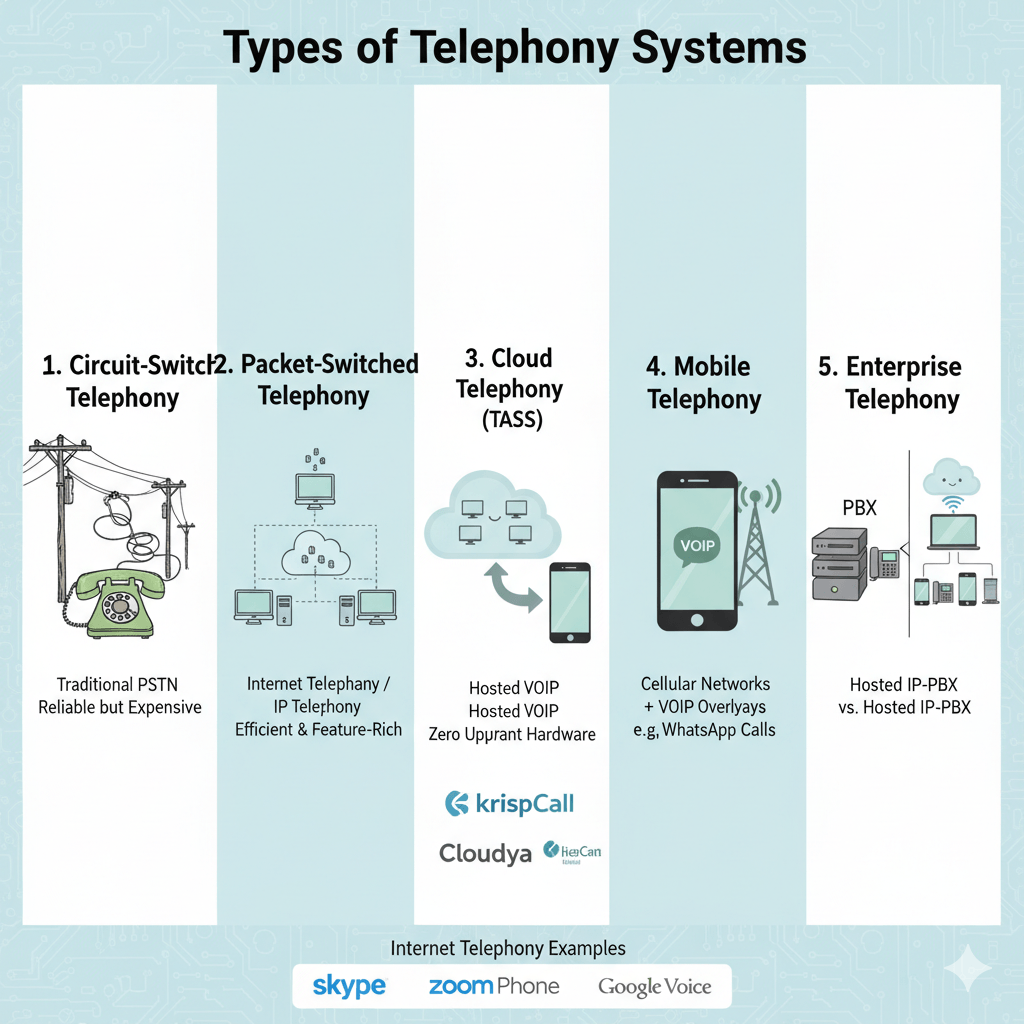
- Circuit-Switched Telephony: Traditional PSTN—reliable but expensive.
- Packet-Switched Telephony: Internet telephony and IP telephony—efficient and feature-rich.
- Cloud Telephony (Telephony as a Service): Hosted VoIP like Cloudya or KrispCall—zero upfront hardware.
- Mobile Telephony: Cellular networks with VoIP overlays (e.g., WhatsApp calls).
- Enterprise Telephony Solutions: PBX (Private Branch Exchange) vs. hosted IP-PBX.
Internet telephony examples include Skype, Zoom Phone, and Google Voice, showcasing diverse telephony solutions.
What Hardware Do You Need for Internet Telephony?
Minimal hardware unlocks full internet telephony potential. Essentials include:
- IP Phones: Desk devices with built-in VoIP support (e.g., Yealink models).
- Analog Telephone Adapter (ATA): Converts conventional phones to VoIP—plug in your old phone!
- Softphones: Apps like Zoiper or Linphone on PCs/smartphones.
- Headsets: USB or Bluetooth for clear audio.
- Routers/Gateways: QoS-enabled for prioritizing voice packets.
For businesses, SIP trunks connect your telephony system to providers without physical lines. The examples of some hardwares are mentioned in the following table.
| Device Type | Use Case | Cost Range | VoIP Compatibility |
| IP Phone | Office desks | $50-200 | Native SIP/RTP |
| ATA Adapter | Legacy phone conversion | $20-50 | Converts FXS ports |
| Softphone App | Mobile/Remote work | Free | Multi-platform |
| Headset | Calls & conferences | $30-150 | Noise-canceling essential |
How Internet Phone Data is Handled Securely?
Secure internet telephony uses protocols like SRTP (Secure RTP) for encrypted media and TLS for signaling. Providers implement firewalls, DDoS protection, and VPNs to safeguard VoIP telephony traffic. End-to-end encryption (E2EE) in apps like Signal prevents interception, vital as cyber threats rise.
Best practices: Enable two-factor authentication, use strong passwords, and monitor for anomalies. Unlike PSTN’s physical taps, IP telephony vulnerabilities like SIP hacking are mitigated via regular firmware updates.
Can You Call External Numbers with VoIP—and How Does It Work?
Can you call external numbers or regular phones with VoIP? Absolutely! VoIP gateways or SIP trunks terminate calls to PSTN networks. Your internet telephony provider handles the conversion, charging minimal DID (Direct Inward Dial) rates.
How does this work? Packets route to a carrier’s media gateway, which translates to analog signals for landlines. Services like Twilio or Vonage excel here, blending internet calls with global reach.
What VoIP Options Exist and How Do You Convert Conventional Phones to VoIP?
VoIP opens a treasure chest of deployment flavors, from hands-off cloud services to DIY control, letting you pick the perfect fit for solo hustlers or sprawling enterprises—while simple adapters breathe new life into dusty analog phones without tossing your trusted handsets.
VoIP Options abound across hosted ease, self-hosted power, and mobile freedom, each unlocking internet telephony superpowers like unlimited calling and CRM syncs. Following are the details of VoIP Options:
- Hosted VoIP (Provider-Managed): Services like RingCentral or Nextiva host your PBX in the cloud—no servers, instant scalability, and 24/7 support; ideal for SMBs adding lines on-demand with auto-attendants and analytics dashboards [ prior context].
- Self-Hosted PBX (On-Premise): Open-source like Asterisk or 3CX on your hardware; full customization for privacy-focused teams, but demands IT savvy for maintenance and SIP trunk setup.
- Mobile Apps (Free/Consumer Tiers): WhatsApp Business, Signal, or FaceTime for casual internet calls; pro versions like Zoom Phone add SIP trunking for business-grade encryption and call recording.
- Hybrid PBX-VoIP: Blend legacy PBX with SIP trunks (e.g., via gateways) for gradual migration—keep internal analog calls while routing externals over IP.
- SIP Trunking Only: Bolt VoIP lines onto existing PBX phone systems; cost-effective for enterprises with hefty hardware investments.
Convert a conventional phone to VoIP with an ATA: Connect your analog phone to the ATA’s FXS port, link ATA to your router via Ethernet, configure SIP credentials from your provider. Instant upgrade!
What Are the Top Business Use Cases for Internet Phone Systems?
Internet phone systems supercharge operations across industries, turning VoIP telephony into a Swiss Army knife for communication—whether rallying global teams or wowing customers with smart routing that feels downright futuristic. By 2030, 80% of businesses will embrace cloud telephony systems, ditching hardware for always-on, auto-scaling platforms.
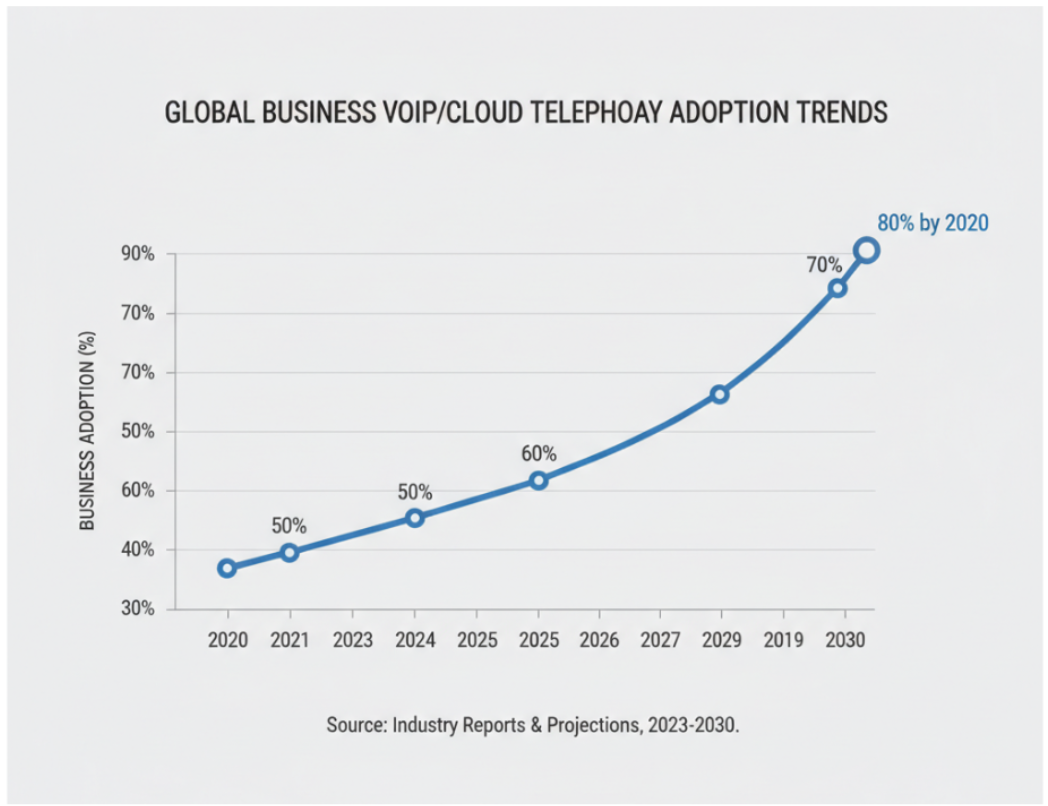
Graph Placeholder: Telephony Adoption Trends
Typical business use cases of an internet phone system unlock efficiency like never before, blending cost savings with powerhouse features.
- Remote Work: Global teams connect via softphones on laptops or mobiles, with presence indicators showing “available” from Bali beaches—eliminating “you’re on mute” chaos in hybrid setups.
- Customer Support: IVR greets callers (“Press 1 for sales”), smart queues prioritize VIPs, and call recording ensures compliance while training reps with real playback.
- Sales Teams: Click-to-call from CRMs like Salesforce pops client histories mid-dial, boosting close rates by 30% with seamless internet calling.
- Multinational Ops: Virtual numbers from 100+ countries create local presence (e.g., +44 UK for EU clients), dodging hefty roaming fees for borderless expansion.
- Healthcare Telemedicine: HIPAA-compliant VoIP PBX links doctors to patients via video consults, with queues managing appointments and transcriptions feeding EHRs.
- Retail & E-commerce: Post-purchase SMS via SIP trunks confirms orders, while abandoned cart calls recover sales—spiking conversions effortlessly.
Telephony systems like these cut costs by 50-70% for SMBs.
What Are the Key Advantages of Internet Phone Systems for Businesses?
Internet phone systems deliver game-changing advantages that obliterate legacy telephony limitations, handing businesses a cost-crushing, feature-packed communication arsenal that scales with ambition and syncs seamlessly into daily workflows.
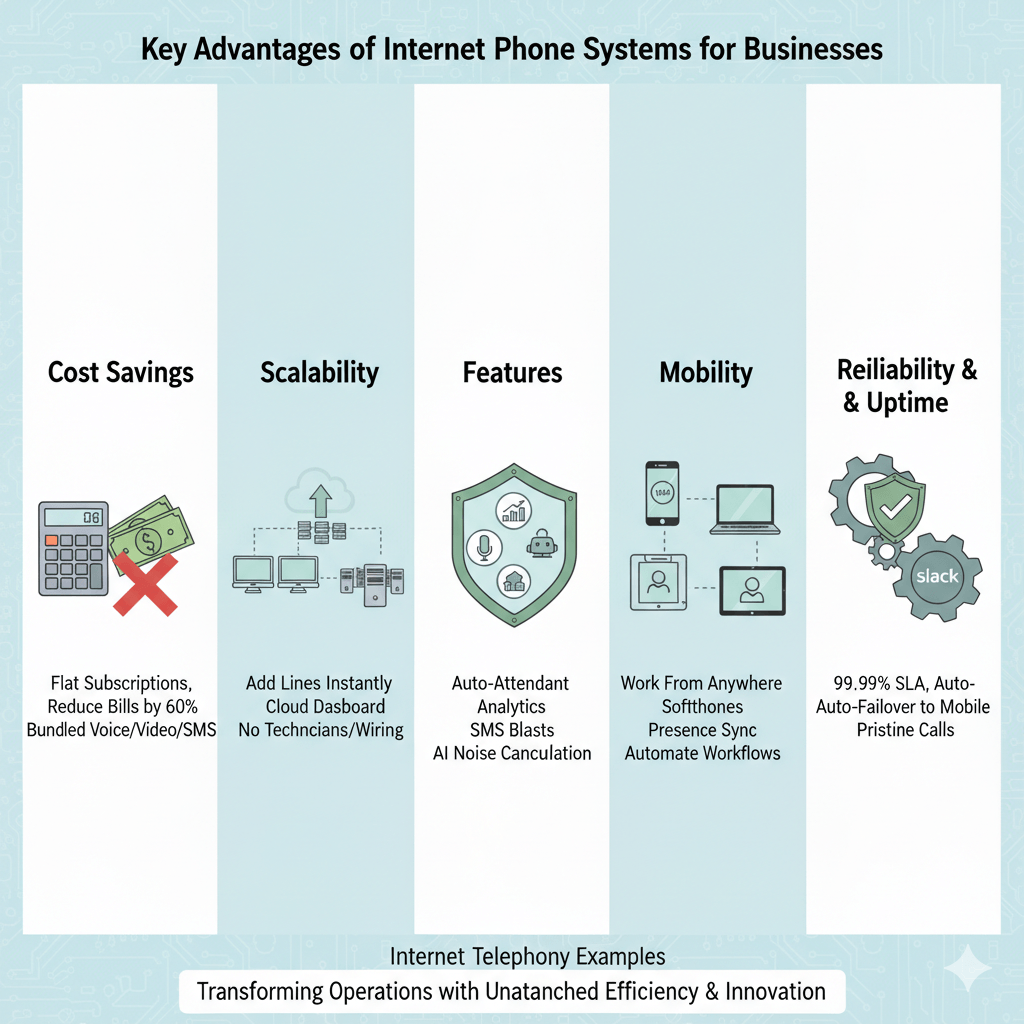
It will offer the following advantages, transforming operations with unmatched efficiency and innovation.
- Cost Savings: No per-minute fees; flat subscriptions slash bills by 60%, freeing budgets from long-distance gouging while bundling voice, video, and SMS.
- Scalability: Add lines instantly via cloud dashboards—no technicians or wiring—perfect for seasonal surges or hiring sprees without capital outlay.
- Features: Auto-attendants greet callers 24/7, analytics track peak hours and agent performance, SMS blasts nurture leads—all in one VoIP PBX powerhouse.
- Mobility: Work from anywhere with softphones on mobiles; presence syncs across devices, ensuring “Do Not Disturb” respects home-office boundaries.
- Integration: Sync with HubSpot, Salesforce, or Slack for screen pops with customer histories, automating workflows and skyrocketing productivity.
- Reliability & Uptime: 99.99% SLA with auto-failover to mobile during outages, plus AI noise cancellation for pristine calls from bustling cafes.
How Do You Migrate from Traditional Phone Systems to VoIP?
Migrating from traditional phone systems to VoIP unleashes cost savings and modern features without the chaos of rip-and-replace, following a proven roadmap that minimizes downtime and maximizes ROI for seamless internet telephony adoption.
The migration involves the following steps, each battle-tested for businesses ditching copper lines.
- Assess Needs: Count extensions, features like IVR or CRM integration; audit call volumes and forecast growth to right-size your VoIP PBX plan.
- Choose Provider: Evaluate telephony solutions like RingCentral or Nextiva for pricing, uptime SLAs, and global reach; request demos to test SIP trunking.
- Port Numbers: Transfer existing DIDs with E911 compliance for emergencies; providers handle paperwork, typically 3-7 days with minimal service gaps.
- Test Parallel Run: Run dual systems for 2 weeks—route select calls via VoIP while keeping landlines live; monitor quality and gather team feedback.
- Train Staff: Demo softphone setup on mobiles/desktops, covering speed dials and presence; hands-on sessions boost adoption by 80%.
- Go Live: Cut landlines post-testing, activate full VoIP failover; celebrate with analytics dashboards tracking your first month’s savings.
Its downtime is near-zero with cloud telephony as a service.
What is the Future of Telephony?
The future of telephony hurtles toward an AI-powered revolution, where internet telephony evolves into intelligent, seamless communication that anticipates your needs, spans languages effortlessly, and thrives on next-gen networks—leaving clunky landlines as museum relics.
Predictive dialing auto-connects sales reps to hot leads milliseconds after hangups, while real-time translation breaks language barriers during global VoIP calls (imagine pitching in Mandarin to a Tokyo client, heard in perfect English). WebRTC enables browser-based video without downloads, powering instant collaboration in Chrome or Safari.5G/6G supercharges IP telephony with sub-1ms latency for lag-free holograms and AR meetings, while blockchain fortifies decentralized VoIP PBX against hacks via tamper-proof ledgers.
Quantum-secure encryption will render eavesdropping obsolete, and ambient computing—think earbuds auto-joining calls via voice commands—blurs phones into invisibility. SIP phones morph into neural interfaces, with edge AI filtering spam mid-sentence. Ultimately, telephony becomes ubiquitous intelligence: proactive, borderless, and woven into daily life, slashing costs 70% further while boosting human connection in a hyper-connected world.
Read More: How To Call China From UK
FAQs
What is meant by internet telephony?
Internet telephony is voice communication over the internet using IP protocols, enabling cheap calls via VoIP telephony. It bypasses traditional copper wire networks by converting sound into digital data packets that travel across the web. This technology supports not just voice, but also integrated video and messaging, creating a unified digital communication environment.
Which is better, PBX or VoIP?
VoIP (cloud-based) is better for scalability and cost; traditional PBX suits on-premise control but lacks flexibility. While traditional PBX offers total physical ownership of the hardware, it requires significant space and a dedicated IT staff for any manual updates. VoIP is generally the winner for modern businesses because it enables remote work and includes advanced features like AI-analytics without additional hardware investments.
What is an example of internet telephony?
Skype or Zoom Phone exemplify internet telephony, allowing internet calls to regular phones. These platforms use a cloud infrastructure to bridge the gap between computers, mobile apps, and the global public switched telephone network. Other common examples include WhatsApp Calling and enterprise-grade systems like Ring Central or Microsoft Teams, which provide a complete business phone setup without physical lines.
What is the difference between VoIP and telephony?
Telephony is broad communication tech; VoIP is internet-based telephony using packet-switched networks. Traditional telephony relies on the “circuit-switching” of the PSTN (Public Switched Telephone Network) to maintain a dedicated connection for the duration of a call. In contrast, VoIP is a specific subset of telephony that treats voice like any other data—such as email or web traffic—making it far more efficient and versatile.